tarted off the day ust packing up for the next leg . I must confess, by he end of the first day of hiking I was grateful for a cozy bed, a dark room, and ibuprofen . Our lodging for the night did not include breakfast so we moseyed on down the road to a local pub, where some of the other customers drove up on tractors.
This was a much shorter day, eased also by the wonderful five-toed hiking sox that had been given to me by DM, and were highly recommended by some pilgrims on Day 2 who sympathized with our developing blisters. The 5-toed sox keep the toes from rubbing against each other, and the toenails you forgot to clip from slicing the neighboring toe, so all you have to deal with is the friction between your foot and your boots. We were heartened also by the many encouraging signs and markers we encountered on the way, including this stalwart pilgrim.
Ponte Lima was one of several towns along the way where we agreed we should have allowed more time. Our first view of the medieval bridge, still used for pedestrians to walk across the bridge, was only a hint of the interesting streets, shops, and historical markers waiting for us to explore.
In addition to the attractions of the town, M and B have two friends who have established residence in Ponte de Lima, and of course we shared dinner with them. M had hoped they would invite us to their home, a stone cottage which they had been renovating for awhile, but apparently the home is located an impractical distance from the town center and construction was ongoing so instead we met in a local bar on the other side of the medieval bridge from our hotel. On the way home, we were entranced by the lights outlining many of the features of the town, its church, and its bridge.
We woke up for our first day of walking to meet a drizzly morning. We were undaunted – each of us was equipped one way or another with rain gear – DM had a voluminous poncho which was parr of the swag from one of her cruises, I had my lightweight hooded gown courtesy of a Maid of the Mist tour at Niagara Falls, M and B had more elegant fitted jackets and backpack covers. D even unfurled her umbrella, but the rest of us decided to keep our hands free.
One of the few miscalculations M made in her planning was to have us start off with one of the longest hikes, Barcelos to Vitorino dos Paies. We started off through the center of Barcelos, which we had explored the evening before, spent some time in the suburbs, and finally reached open country. (M agreed later that we could easily have hopped a taxi and skipped the suburbs, though if you want to learn a country the suburbs count too.)
Along the way there were plenty of accomodations for pilgrims. We learned to be alert for the scallop shells in the pavement or bright blue and gold signs, whether to announce a meal opportunity or sanitary facilities.
After seven miles, (broken by lunch and snack breaks) we limped into Postela ready to sit and soak our feet. Despite two layers of socks I still had a blister forming on my left big toe and the toenails on both my little toes were turning blue.
At Porto, the Caminho starts in front of the cathedral, looking out over the city. Here is where you pick up your empty Camino passport – filled with stamps from businesses along the way it might earn you a certification as a true peregrina. The symbol on the pylon is the official stylized scallop shell logo of the Pilgrimage. The arrow, of course, points the route, and within the small oval is the number of kilometers you have between you and your goal in Santiago. From one of many vendors about the place, you can purchase an actual scallop shell to hang on your backpack to let everyone know you are on the Way.
Following the advice of a Caminho Whisperer whom Michele consulted, we are taking the train through the industrial outskirts of Porto, and beginning our walk in Barcelos, a charming town about fifty kilometers along the way.
We are staying just across the river from the medieval walls and chapel of Barcelos, at the Top ‘Otel. This is a modern, sleek, brightly colored inn, whose only defect is a lack of elevators to carry us to our rooms on the top floor.
Barcelos is famous for its roosters, based on a legendary appearance of Saint James in support of a pilgrim falsely accused of theft and sentenced to hang. A medieval cross within the castle grounds illustrates the miracle.
The condemned man cries out to his judge who is eating a dinner of roasted chicken “As sure as I am innocent, that cock will rise and crow if I am hanged!” To everyone’s shock, the roasted cockerel did rise and crow, the judge rushed to the gallows and found that the pilgrim, though hanging, was not strangled: Saint James had appeared and supported his feet.
The man was cut down, the judge apologized, and the rooster became the symbol not only of Barcelos, but also of Portugal.
When my long-time travel companion DM (see “Nepal” and “France” tagged entries) suggested we should do another walking trip together, I hit on doing at least part of the Portuguese Way of the pilgrimage to San Juan Compostelo’s cathedral in Santiago, Spain. My sister M and her husband B are permanent residents of Porto, Portugal, a popular starting point for the Portuguese Way, and they immediately signed on with enthusiasm.
The average age of the foursome is over 75, and all agreed that they felt no need to earn a Compostela – a certificate affirming that the pilgrim has walked at least one hundred kilometers along the Camino. We were inspired only by the desire to travel together in a way that would enable us to enjoy the countryside of Portugal and Spain on a path largely inaccessible to tour buses. We did enjoy getting validation stamps on our pilgrim’s credentiales, as the restaurants and auberges along the way vied to offer the most interesting stamps. But instead of tracking miles and steps, Michele consulted with experienced Camino walkers to identify the most interesting and most scenic stretches along the Portuguese Way, including one stretch on a boat up the Rio Ulla to Padron. The quartet began in Porto on May 18, and used trains, buses, and taxis as needed to finish their Camino in Santiago on May 30.
Rather than work with a tour group, M booked accommodation each night through Bookings.com. Accomodation varied from elegant hotels in Barcelos and Valenca to four twin beds in a single room in a tiny town between Padron and Santiago. M also arranged luggage transport from each accommodation, so the walkers had only to carry daily essentials (food, raingear, extra layers of warmth, and first aid materials) in our backpacks.
All four of us were fit, fairly experienced hikers, and well -equipped with hiking boots, walking sticks, comfortable backpacks, and broad-brimmed hats to fend off the Iberian sun. How well did that all work? Stay tuned for a day-by-day account!
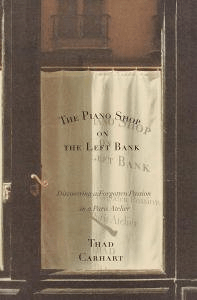
The Piano Shop on the Left Bank If a book cover has the words “Bookshop” or “Paris” or anything evoking those memes, I’m liable to pick it up. If it has “Piano”, that’s almost as magnetic. This memoir of living in Paris and finding access to the neighborhood hidden behind the courtyard doors is charming, full of information about French life and culture, and about the history, development, mechanisms, and lore surrounding the pianoforte.
A perfect bedside book, as it alternates between personal experience and historical reflection in alternating chapters.
I loved the freedom of riding a bicycle ever since I first learned to balance my balloon-tired Schwinn on the tar roads I grew up with. As a child I could ride as far as the neighborhoods that had pavement and sidewalks and could admire the columned porches and vast green lawns behind the fences. When I was 12, I won a three-speed lightweight bike in a contest. I was over the moon. That bike took me through college, getting me to class on time as I swooped past plodding pedestrians, until in my senior year I left it unlocked for just a few minutes and it was gone.
After I was married my husband and I treated each other to Raleigh three-speeds, as we had only one car. I would pedal across town to the home of a co-worker and we would carpool together; I drove the carpool on alternate weeks, while my husband would either bike or bus to his job.
Our children started them out with bike seats on the back of our bikes, then encouraged them to learn to ride themselves. Once they had mastered their bikes, we took them and the bikes to Yosemite, to San Francisco, to Monterey, and on every bike trail within thirty miles.
Years later. My husband had a fall a few years ago and his knees are going out, but I continued to ride my bicycle, against his advice, on local errands: to the library, to my hairdresser, to the blood bank. “What if you have a crash?” he would ask me. “People are going to read about it in the paper and say “What the heck is a woman that age doing on a bicycle anyway?”
“I’m careful, “ I said. “I’m not going to crash.” And I didn’t, exactly.
I hopped on my bike on a Saturday morning to pick up some bagels from the House of Bagels, about a fifteen-minute ride from my house. A lovely morning – just enough high clouds to keep cool, no traffic. I sailed along the main street on the way to the bagel shop, taking a few detours on loop streets to admire the jacaranda trees in bloom, check out the progress of the construction projects, see if there were any windfall fruits to be picked up. I zoomed into the parking lot by the bagel shop… and my brain froze.
I couldn’t remember how to dismount from the bike.
I had had a little trouble dismounting the last couple of times I had ridden; the most recent time I managed somehow to give my shin a good whack and had raised a faint blue bruise. But I had gotten off this bicycle hundreds of times. The act should have been deep in my muscle memory, something I did without thinking. Now I had to think. To dismount, I only had to do in reverse what I had so easily done getting on: lean on the left pedal, swing my leg up and over the seat and rear wheel, apply the brakes. I circled around the parking lot and tried again. No way. Nothing but icy fear of losing my balance, of falling.
There was a high curb with a railing not far from the bagel shop. I pulled up to that, stopped, and then managed to step up onto the curb, hold onto the railing and haul my leg over the cross bar. Shaken, I walked the bike across the lot to my usual lockup spot next to the bagel shop. “That was weird,” I thought. “That was really weird.”
I bought two bagels, swung onto my bike with no problem, rode home, rode up my driveway… and my brain froze again. I couldn’t do it. I could not swing myself off. My muscle memory had gone dead.
I braked and with some difficulty managed to get my leg over the crossbar without falling over. I trundled my bike into the garage and parked it next to my husband’s bike. which was covered in cobwebs. His tires were so flat the wheel rims touched the ground. I stood looking at it for a few moments.
Then I locked my bike up as usual, went into the house, and emailed the local Bicycle Exchange. I have two bikes to donate. Within two days the bicycles and all associated accessories were gone.
I know this was a good decision. I have several friends who have been injured severely when their bikes slipped out from under them. But I miss the freedom of riding my bike. I miss being able to stop and inspect changes in my neighbor’s gardens, to take short cuts through suburban bikeways, to not worry about parking. I’m envious of the people who are trying out the newly painted bike lanes on El Camino and El Monte. It’s no fun driving to my hairdresser. On Saturday morning my husband goes for the bagels now.
There’s an empty space in our garage. I expect it will gradually fill up with the things that go into garages. I hope the empty spaces in my mind will fill up too.
Outdoors in South Carolina is a lot different from outdoors in Northern California, where I spend most of my time. SC is green, the air is moist, there is water, and there is history. Columbia’s Riverbank Walkway is a wonderful illustration of the difference, with its effortlessly un-irrigated green spaces, its leisurely meanderings along the Columbia Canal, and its unexpected evocation of the workers who built the canal.
We parked at the Laurel Street entrance, just late enough to avoid a major fun run which had been organized for the morning – volunteers were folding tables and taking down canopies, but they cheerfully directed us down the pathway to the canal.
On the way we pass a steep stairway leading upward. Signs let us know that there is a restaurant above, probably with a fine view of the canal and the river beyond. We resist the temptation.
Further down we spot a building off to the side, which turns out to be the former operating station for the canal. Facing the building is a monument to the Irish worker who helped build the canal. I remember that at the time of the canal’s building there were probably signs in downtown Columbia reading “Help Wanted: No Irish Need Apply”, and felt pleased that this maligned immigrant group was receiving recognition.
At the bottom of the trail is a playground for children who have not worked off enough steam on the walk down. No, wait; it’s not for children, it’s a workout center for adults who have not worked off enough steam after jogging the four-mile river trail. Whichever – it’s a beautiful location.
As we turned to go back up the slope to the parking lot (not feeling up to a four-mile jog on this particular day) we spotted this whimsical artwork just up from the workout center/playground. It’s a testament to a light-hearted spirit that we felt throughout our visit to Columbia.
There’s a lot more to Columbia than the stretch from the Capitol down Main Street to the museum and library. For one thing, it is the home of the University of South Carolina, whose lovely campus is located on the other side of the Capitol from those attractions. The presence of a university almost guarantees a range of good cheap restaurants for feeding starving students escaping dorm food. We tried a couple:
Camon Japanese Restaurant and Sushi Bar on Assembly Street near the campus has Japanese sliding screens, woodcut prints, and unexpectedly excellent sushi. It was empty when we entered at 6PM, and when we ordered an Asahi beer and were told there was no liquor license, we thought we knew why. But by the time we left, well satisfied with our edamame, unagi roll and pork tonkatsu, the place was nearly full of local adults as well as students who were probably underage anyway.
Another night we went further down Main to the Green Olive, its inauspiciously plain exterior surrounded by cracked parking lots and state office buildings. But the interior was much more promising, with a number of comfortable booths and tables testifying to a significant number of expected customers. The server looked exotic enough to be Turkish, but when I asked she giggled and said “No, I’m half Chinese and half Peruvian.”
The presentation of the food made no attempt at artistic plating or frou-frou snips of parsely or fennel. The flavor though was delicious and the amount generous. Again, as we ate the booths began to fill with a diverse population of older adults as well as flannel-shirted twenty-somethings.
Our most successful lunch was at a deli near our hotel downtown. I didn’t expect much from the East Bay Deli, one of five locations in Columbia for a chain that originated up in Charlotte. We went there because it was close to our hotel, we were hungry, and we were with my in-laws and needed a place with a diverse enough menu to satisfy each of our tastes. And it was good. Just plain good. Good bread. Good meat. Real lettuce, not ribby romaine. Crispy fries. Enough food that my in-laws split a sandwich between them.
You won’t starve for lack of good food in Columbia
Columbia, South Carolina is a walkable state capital, and the area around the Capitol building has plenty of agreeable spots to walk to. The Capitol building itself is a peculiar architectural folly – a classic Greek/Roman base complete with grandiose steps and towering pillars, but topped incongruously with a weathered bronze cupola and dome which seem to have wandered over from some eccentric Victorian’s mansion. The Capitol grounds have the requisite number of monuments to the fallen heroes of various wars, interspersed with (in March at least) truly splendid beds of blooming azaleas, dogwood, and other gifts of nature.
The main street of Columbia starts at the Capitol. Called, appropriately, Main Street, it is the core of activity every Saturday, when a craft/produce/food truck fair takes place from 9-2 year round. Folks line up for barbecue, for chicken with grits, and even just for coffee. If you are a fan of vintage clothing, kitchy art, and herbal cosmetics, you’ll have fun here. If not, you’ll still have fun watching the parade of people and pets that wander the street in search of that perfect vintage leather jacket, or the ideal potpourri.
And there’s the food…
And the street musicians…
And if you get tired of the crowd, you can always go to the art museum, only a block off Main Street…
Or to the Richmond Library, a truly amazing collection of books and nooks to read them in. only a couple of blocks in the other direction…
If you must be on a freeway, make it forested. Stretching out on either side of Interstate 77, the road between Charlotte, South Carolina and the state capital at Columbia, is a piney woods. Almost no bill-boards, almost no signs of habitation for miles. Just green and rustling trees on either side, two strips of well-maintained gray asphalt, and a green lawn median.
If you must be on a freeway, make it flowery. I-77 is lined in spring with flowers. Gnarled wisteria vines twine through the long-leaf pines that line the road, bursting into garlands of purple blooms. In the understory are drifts of white dogwood. Every so often comes an accent of bright yellow – is it Scotch broom, or a Carolina native? At 70 mph I can’t quite make it out.
If you must be on a freeway, make it fast. I-77 heads almost due south from Charlotte to Columba, and once you clear the clutter surrounding Charlotte and its abysmal airport, it’s a very straight shot, with excellent signage directing us to our desired exit near the Capitol.