Allyson Johnson

Pieces of my Mind

Archive for the category “publishing”

The Publishing Journey – Step 6: Build your Literary Community

What the heck is a “Literary Community”? Why do I need it?

Well, back in the day, an author could count on their publisher to provide visibility for a new release, with a book launch event, book tours, interviews, trade reviews, and so on. But per Jim Millot in Publishers Weekly “The total number of books published in the U.S. in 2025 with ISBN numbers jumped 32.5% over 2024, to more than four million books, according to statistics compiled by Bowker.”

The five major publishers with all their subsidiary imprints published over a million of these titles, with small presses, hybrid presses, and self-publishers providing the balance. But at the same time that the number of new releases is ballooning, the universe of hard-copy book buyers is stable or shrinking.

So how does one find buyers for a new novel? Social media, that dreaded sinkhole of targeted advertisements and cute cat memes, has become a main channel for publicizing a new release. One goal is to find a community of contributors focused on a topic or genre that relates to one’s book, and become a member of that community. Post often, post constructively, and put your name on every post. When the book is released, the power of name recognition will kick in. Other contributors, seeing a familiar name, will be more tempted to click on that “BUY NOW” button.

Sounds like a long-shot bet, doesn’t it? But with the average published book selling less than one thousand copies across all formats and all markets (per Steve Piersanti – Barrett-Koehler Publishers) the author must resort to any possible stratagem.

So what are the communities I might try to join? There are several Facebook groups which focus on historical fiction, both readers of and writers of. That’s a start – though most FB groups do not allow direct publicizing of one’s own work. So I have joined:

  • the Historical Fiction Book Lovers.
  • the Historical Fiction Book Club
  • the Historical Fiction Lover’s Book Club
  • the Historical Fiction Authors

Unfortunately for my literary community building, I don’t always have that much to say, and what I do say, I usually say on my blog. Being an active contributor to even these four FB groups is going to take time I usually spend (on a good day) writing my next novel.

(Some of my younger relatives point out that FaceBook is mostly used these days by parents and grandparents doting on their children. The real jazzy stuff goes on TikTok and Instagram. The more I thought about this, the better I felt about FB – it’s those same parents and grandparents who are still buying hardback books, bless their hearts!)

Image – Pete Sutton

The Publishing Journey – Step 5: the Website

Image courtesy of Tortoise and Hare Software

When I quit my day job, I decided to create a blog. With a little help from friends, I was able to get going on WordPress.com and have published quite a few posts, as you can see by the lengthy string of tags and archives to the right.

Now I’m publishing a novel – do I need a special Author Website? Or could I modify what I had to bring it up to date?

A friend, Carol Efron, who is also publishing a novel through She Writes Press, invited me to take a look at the website which she had created. Wow! A bunch of ideas: a home page! links to buy my book or read my first effort online! A picture of myself on the About page (which had not been updated for far too many months)!

If you are reading this post through a link or subscription, maybe you haven’t noticed any of the new look. But click on the About, Books, Travel, and Home tabs at the top and explore a bit. Then click on the Comment button to the left and tell me what you think!

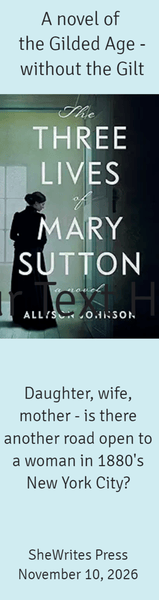
BONUS: If you explore, you’ll find the FINAL COVER of my novel “The Three Lives of Mary Sutton” which I teased you about in Step 3 two weeks ago.

The Publishing Journey – Step 4 – Copy editing

SheWrites Press has green-lighted my submission, meaning that they believe if the total manuscript measures up to the sample I sent, they will not require additional developmental editing or content revision. I owe having cleared this hurdlenot to my own care or competence but to the well-considered line-editing and content feedback I have received throughout the development of the manuscript by my Writing Group.

So thanks and kudos to

Rosemary Hayward, author of Strait Lace, a novel of a woman involved in the struggle for women’s suffrage in Britain in the 1800’s. Check out Rosemary’s book recommendations and other writings at rosemaryhayward.com

Claire Noonan, author of The House on Harriman’s Hill, a memoir of the resilience of an indomitable woman, Mary Edwards, in the wake of a trouble-filled childhood. Based on true events in the lives of the Edwards family, set in the Sierra Nevada in the early 20th century

Monica McHenney – writer of prize-winning short stories and flash fiction. Here’s a link to one of her stories: https://www.paloaltoonline.com/short_story/short_story_36/adult9.php and here’s a link to her flash-fiction website: https://monicaflash.com/

Richard Probst tireless memoirist and enthusiastic supporter. Look for his inside story of the development of the Jeep to appear soon.

Steve Noble – fabulist and raconteur, carrying on the traditions of Robert Heinlein and Flash Gordon in his short stories and maybe a sci fi novel soon. Get a flavor of his writing at his website: Noble Speculations – Steve Noble writes you are invited to Read

The Publishing Journey: Step 3 – Design a Cover

I had a title for my novel.  “Her Own Way”. I thought this indicated clearly that the book is about a woman, one who carves her own path rather than meeting the expectations of others. Would you want to read that book? 

My publisher’s crew did not like that title. “Too generic” they said.  They gave me some other choices: 

The Liberation of Nellie Young

The Many Lives of Nellie Young

The Three Lives of Mary Sutton

The Sutton Sisters

I had jokingly suggested that “I led Three Lives” would have been  a good title for the book if that title had not been claimed already by a long-running TV series (though few of my prospective readers would ever have head of it.)  So I went with Option 3. 

I had suggested that I wanted a picture of the great-grandmother who inspired my novel on the cover.  the publishing crew seemed amenable, and Isent two different photos.  Sorry, these are not in the required high-definition format and would look pixilated on the cover – ok if this were a Sci-fi novel but not for a historical.  

Fortunately, I have a friend who worked for Adobe and knows all about creating a 300 dpi photo file fro a 150 dpi scanned image. I scanned the photos on my home multi-function printer and Jim transformed the scanner’s output into the required format.  Hurdle overcome. Enhanced versions sent. 

Sorry.  After several tries, the publisher’s crew of artists communicated that it would not be possible to make a cover that was properly eye-catching using the historic photos.  The one I liked had too much old-=fashioned detail (a chair, a fern) and could not be cropped.  The other one was possible, but they could not figure out how to make her static figure look dynamic against a historic street scene. And the whole effect was too busy. 

In several exchanges of letters, I was educated in the new requirements of cover design.  

Most importantly, the cover needs to convey its message when shrunk to a dimension about the size of a large postage stamp.  

*This is the size which will be displayed in print inserts to local newspapers from local bookstores. 

* This is the size which will appear in print advertising in magazines such as my University’s alumni magazine or in “Wirter’s Digest” or in the New York Review of books.  And above all 

*This is the size which will appear on a potential reader’s phone or tablet when he/she clicks through Amazon looking for something of interest. 

The artists sent four suggestions: 

One simply showed a woman’s expressionless face. What does that tell you?  Not that one. 

One showed a woman from the back, wearing a long black dress, arms pressed close to her sides, her hair in a severe bun.  She looked like Morticia. Why would you want to read about her?  Not that one.

One showed a rather plain young girl dressed again in a long black dress, looking sadly out of a window. No fun.

The fourth was ok.  I sent a note indicating that I thought this was the best of the four.  To my dismay, the team took this to be a full approval . I had expended energy already over my photo failure, and did not demur, as I had no alternative suggestion prepared.   

Of course, a week or so later I had all sorts of better ideas for the cover, but that ship had sailed.  Maybe when the book goes to its second printing? (Ha!  In your dreams – but why not dream?) 

No, I’m not showing you the actual cover.  Apparently the “cover reveal” is a big deal later in the process.  Stand by. 

Post Navigation