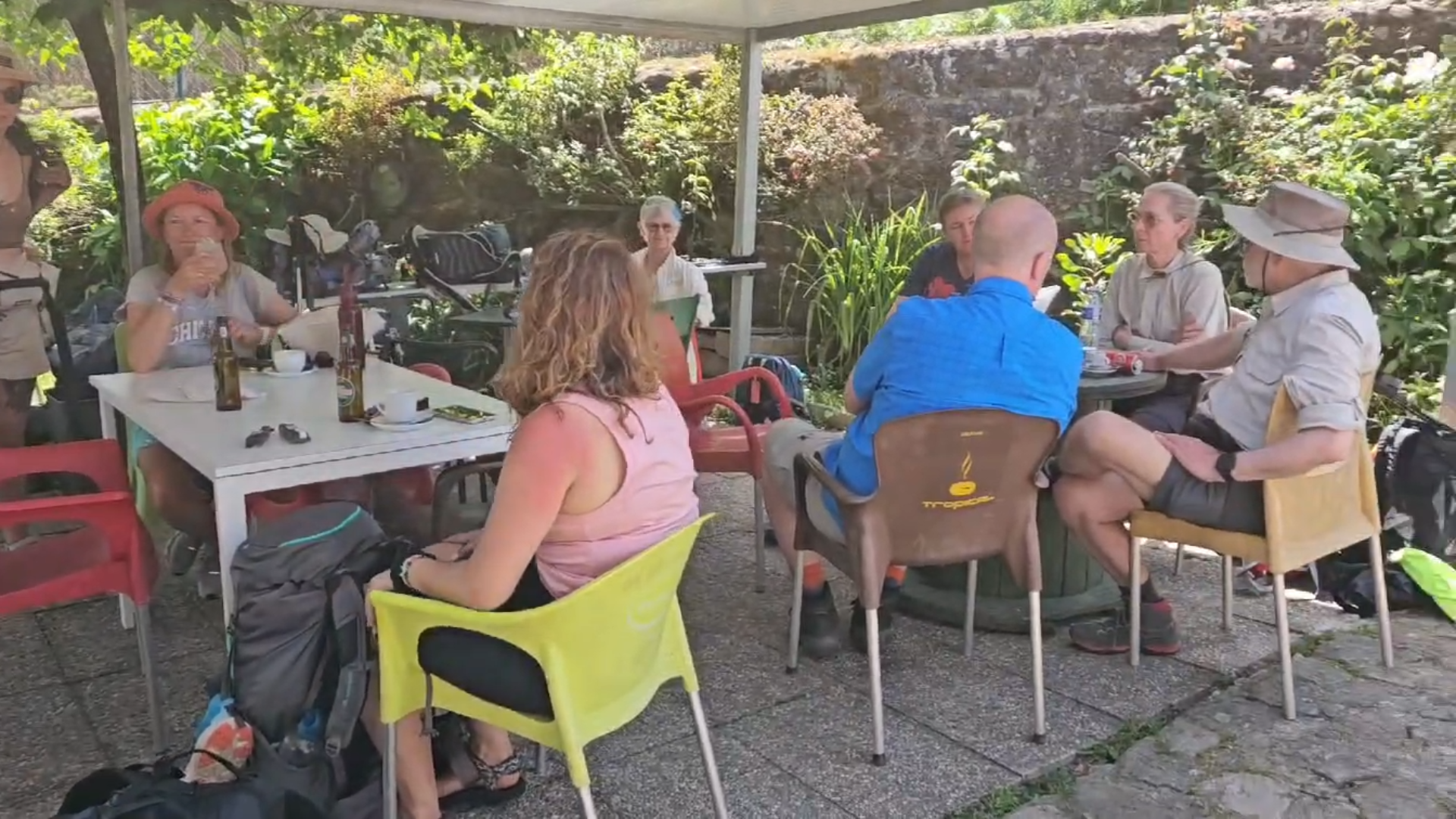
Last segment in Portugal and just as lovely as the rest. Walking through rural villages, peering over walls to inspect blooming gardens, and the city of Valenca approaching.
After M had been saying “Only 30 minutes to go ” for an hour and a half, we decided to take a taxi to our hotel from the Cafe where we were stopped for an ice cream break. It was all the way across the city threading through the medieval gates in the city wall and would certainly have taken us at least an hour.
We stayed at one of the two hotels called Alojamento da Vila, this one with Golden added (Alogamento da Vila Golden). It was the only time our luggage went astray (we used Top Santiago (www.topsantiago.com) because we didn’t include the last word on the label; but as they are two medieval blocks away from each other, not a big problem!
This is a very nice hotel, excellent lounge area with free wine and snacks available as well as a good breakfast. I would stay here again even if not on a walking holiday. The city of Valenca is charming, worth a visit on its own. There is a cute dress shop just around the corner, several interesting craft stores, and a big public plaza with outdoor eateries.
Since our luggage is not here yet, I can’t take a shower (no clean clothes) or go for a walk (I have a small blister that needs treatment and I don’t want to put my boots back on). D has gone to see the city in her hiking gear while M and B go to retrieve our luggage.
Yes, we have been walking through vineyards and under shady grape trellises the past 2 days.
Beautiful views out over the vineyards of Galicia
This cross reassures us that we are on the Way. The path zig-zags down to the picturesque little church halfway down the hillside. At this point my toes are quite tired of being shoved into the front end of my hiking boots, so I delay to take a picture every chance I get. My super 5-toed sox did not get dry from last night’s washing and I had to wear my silk sock liners with wool sox dating back to my trek in Nepal fifteen years ago- so dated! D is heading down the path ahead.
Tomorrow I am going to lighten my pack by two punds by leaving my dop kit in my suitcase – M infected me with paranoia that the suitcases might get lost, but on today’s hike I begrudged every ounce. This was the steepest elevation over a boulder-strewn path – I was glad for my sticks but at some points I had to hand them to B and hug a tree to get around to the next portion. (The maintainers of the Way certainly do their best to maintain the authenticity of the experience!) At another point I tried to force myself up an unusually high step and with the pack on my back I almost overbalanced and fell backward. I was VERY careful after that, leaving me trailing behind the other three with younger bones or less fear of falling.
Below – our first view of Valenca in the distance – we have a lot of valley to traverse before we get there~
We had made sandwiches from the breakfast offerings, plus fruit, so even though we were only “30 minutes ” from where Michele wanted to stop for lunch we took advantage of a bench and some rocks and picnicked.
Further on we were delighted to find a little bit of California in Portugal – a drift of sunny California poppies!
Finally – arrival in Rubaies! Nice view out the window, two double beds with matelasse/embroidered coverlets, a shower with a tub so I can soak my weary feet (the blue nail is no worse)
We are to go down to meet B and M and share a glass of wine while we exchange photos – but since they have iPhones and D and I are of the Android persuasion I don’t expect much success.
We are to be picked up and transported to the best restaurant in town (probably the only restaurant in town) at 6:30 so I’ll have more to tell you when we return about 930 our time, 12:30 your time.
I slept wonderfully last night in Ponte de Lima – one melatonin + one ibuprofen for the aching quads and dorsal muscles did the trick.
Leaving Ponte de Lima was hard. We took our time in the morning, and I had a chance to wander a bit along the river and discover some additional history. It seems that a Roman Army was in pursuit of some fractious Iberians who fled across the river. “After them!” thundered the General, but the soldiers refused. They believed that the obstacle was the river Lethe, and that if the waters touched them, they would lose all their memories.
The General swam his horse to the other side and from there called to each soldier by name, proving his memory was intact. The episode is commemorated by some steel monuments somewhat reminiscent of the card-soldiers in “Alice Through the Looking Glass.” The platoon is on one side of the river, the General harangues them from the other side.
It seemed Ponte de Lima was sorry to see us go also. There were lots of signs to attract the attention of pilgrims as we crossed the Ponte de Lima for the last time.
tarted off the day ust packing up for the next leg . I must confess, by he end of the first day of hiking I was grateful for a cozy bed, a dark room, and ibuprofen . Our lodging for the night did not include breakfast so we moseyed on down the road to a local pub, where some of the other customers drove up on tractors.
This was a much shorter day, eased also by the wonderful five-toed hiking sox that had been given to me by DM, and were highly recommended by some pilgrims on Day 2 who sympathized with our developing blisters. The 5-toed sox keep the toes from rubbing against each other, and the toenails you forgot to clip from slicing the neighboring toe, so all you have to deal with is the friction between your foot and your boots. We were heartened also by the many encouraging signs and markers we encountered on the way, including this stalwart pilgrim.
Ponte Lima was one of several towns along the way where we agreed we should have allowed more time. Our first view of the medieval bridge, still used for pedestrians to walk across the bridge, was only a hint of the interesting streets, shops, and historical markers waiting for us to explore.
In addition to the attractions of the town, M and B have two friends who have established residence in Ponte de Lima, and of course we shared dinner with them. M had hoped they would invite us to their home, a stone cottage which they had been renovating for awhile, but apparently the home is located an impractical distance from the town center and construction was ongoing so instead we met in a local bar on the other side of the medieval bridge from our hotel. On the way home, we were entranced by the lights outlining many of the features of the town, its church, and its bridge.
We woke up for our first day of walking to meet a drizzly morning. We were undaunted – each of us was equipped one way or another with rain gear – DM had a voluminous poncho which was parr of the swag from one of her cruises, I had my lightweight hooded gown courtesy of a Maid of the Mist tour at Niagara Falls, M and B had more elegant fitted jackets and backpack covers. D even unfurled her umbrella, but the rest of us decided to keep our hands free.
One of the few miscalculations M made in her planning was to have us start off with one of the longest hikes, Barcelos to Vitorino dos Paies. We started off through the center of Barcelos, which we had explored the evening before, spent some time in the suburbs, and finally reached open country. (M agreed later that we could easily have hopped a taxi and skipped the suburbs, though if you want to learn a country the suburbs count too.)
Along the way there were plenty of accomodations for pilgrims. We learned to be alert for the scallop shells in the pavement or bright blue and gold signs, whether to announce a meal opportunity or sanitary facilities.
After seven miles, (broken by lunch and snack breaks) we limped into Postela ready to sit and soak our feet. Despite two layers of socks I still had a blister forming on my left big toe and the toenails on both my little toes were turning blue.
At Porto, the Caminho starts in front of the cathedral, looking out over the city. Here is where you pick up your empty Camino passport – filled with stamps from businesses along the way it might earn you a certification as a true peregrina. The symbol on the pylon is the official stylized scallop shell logo of the Pilgrimage. The arrow, of course, points the route, and within the small oval is the number of kilometers you have between you and your goal in Santiago. From one of many vendors about the place, you can purchase an actual scallop shell to hang on your backpack to let everyone know you are on the Way.
Following the advice of a Caminho Whisperer whom Michele consulted, we are taking the train through the industrial outskirts of Porto, and beginning our walk in Barcelos, a charming town about fifty kilometers along the way.
We are staying just across the river from the medieval walls and chapel of Barcelos, at the Top ‘Otel. This is a modern, sleek, brightly colored inn, whose only defect is a lack of elevators to carry us to our rooms on the top floor.
Barcelos is famous for its roosters, based on a legendary appearance of Saint James in support of a pilgrim falsely accused of theft and sentenced to hang. A medieval cross within the castle grounds illustrates the miracle.
The condemned man cries out to his judge who is eating a dinner of roasted chicken “As sure as I am innocent, that cock will rise and crow if I am hanged!” To everyone’s shock, the roasted cockerel did rise and crow, the judge rushed to the gallows and found that the pilgrim, though hanging, was not strangled: Saint James had appeared and supported his feet.
The man was cut down, the judge apologized, and the rooster became the symbol not only of Barcelos, but also of Portugal.
When my long-time travel companion DM (see “Nepal” and “France” tagged entries) suggested we should do another walking trip together, I hit on doing at least part of the Portuguese Way of the pilgrimage to San Juan Compostelo’s cathedral in Santiago, Spain. My sister M and her husband B are permanent residents of Porto, Portugal, a popular starting point for the Portuguese Way, and they immediately signed on with enthusiasm.
The average age of the foursome is over 75, and all agreed that they felt no need to earn a Compostela – a certificate affirming that the pilgrim has walked at least one hundred kilometers along the Camino. We were inspired only by the desire to travel together in a way that would enable us to enjoy the countryside of Portugal and Spain on a path largely inaccessible to tour buses. We did enjoy getting validation stamps on our pilgrim’s credentiales, as the restaurants and auberges along the way vied to offer the most interesting stamps. But instead of tracking miles and steps, Michele consulted with experienced Camino walkers to identify the most interesting and most scenic stretches along the Portuguese Way, including one stretch on a boat up the Rio Ulla to Padron. The quartet began in Porto on May 18, and used trains, buses, and taxis as needed to finish their Camino in Santiago on May 30.
Rather than work with a tour group, M booked accommodation each night through Bookings.com. Accomodation varied from elegant hotels in Barcelos and Valenca to four twin beds in a single room in a tiny town between Padron and Santiago. M also arranged luggage transport from each accommodation, so the walkers had only to carry daily essentials (food, raingear, extra layers of warmth, and first aid materials) in our backpacks.
All four of us were fit, fairly experienced hikers, and well -equipped with hiking boots, walking sticks, comfortable backpacks, and broad-brimmed hats to fend off the Iberian sun. How well did that all work? Stay tuned for a day-by-day account!
I loved the freedom of riding a bicycle ever since I first learned to balance my balloon-tired Schwinn on the tar roads I grew up with. As a child I could ride as far as the neighborhoods that had pavement and sidewalks and could admire the columned porches and vast green lawns behind the fences. When I was 12, I won a three-speed lightweight bike in a contest. I was over the moon. That bike took me through college, getting me to class on time as I swooped past plodding pedestrians, until in my senior year I left it unlocked for just a few minutes and it was gone.
After I was married my husband and I treated each other to Raleigh three-speeds, as we had only one car. I would pedal across town to the home of a co-worker and we would carpool together; I drove the carpool on alternate weeks, while my husband would either bike or bus to his job.
Our children started them out with bike seats on the back of our bikes, then encouraged them to learn to ride themselves. Once they had mastered their bikes, we took them and the bikes to Yosemite, to San Francisco, to Monterey, and on every bike trail within thirty miles.
Years later. My husband had a fall a few years ago and his knees are going out, but I continued to ride my bicycle, against his advice, on local errands: to the library, to my hairdresser, to the blood bank. “What if you have a crash?” he would ask me. “People are going to read about it in the paper and say “What the heck is a woman that age doing on a bicycle anyway?”
“I’m careful, “ I said. “I’m not going to crash.” And I didn’t, exactly.
I hopped on my bike on a Saturday morning to pick up some bagels from the House of Bagels, about a fifteen-minute ride from my house. A lovely morning – just enough high clouds to keep cool, no traffic. I sailed along the main street on the way to the bagel shop, taking a few detours on loop streets to admire the jacaranda trees in bloom, check out the progress of the construction projects, see if there were any windfall fruits to be picked up. I zoomed into the parking lot by the bagel shop… and my brain froze.
I couldn’t remember how to dismount from the bike.
I had had a little trouble dismounting the last couple of times I had ridden; the most recent time I managed somehow to give my shin a good whack and had raised a faint blue bruise. But I had gotten off this bicycle hundreds of times. The act should have been deep in my muscle memory, something I did without thinking. Now I had to think. To dismount, I only had to do in reverse what I had so easily done getting on: lean on the left pedal, swing my leg up and over the seat and rear wheel, apply the brakes. I circled around the parking lot and tried again. No way. Nothing but icy fear of losing my balance, of falling.
There was a high curb with a railing not far from the bagel shop. I pulled up to that, stopped, and then managed to step up onto the curb, hold onto the railing and haul my leg over the cross bar. Shaken, I walked the bike across the lot to my usual lockup spot next to the bagel shop. “That was weird,” I thought. “That was really weird.”
I bought two bagels, swung onto my bike with no problem, rode home, rode up my driveway… and my brain froze again. I couldn’t do it. I could not swing myself off. My muscle memory had gone dead.
I braked and with some difficulty managed to get my leg over the crossbar without falling over. I trundled my bike into the garage and parked it next to my husband’s bike. which was covered in cobwebs. His tires were so flat the wheel rims touched the ground. I stood looking at it for a few moments.
Then I locked my bike up as usual, went into the house, and emailed the local Bicycle Exchange. I have two bikes to donate. Within two days the bicycles and all associated accessories were gone.
I know this was a good decision. I have several friends who have been injured severely when their bikes slipped out from under them. But I miss the freedom of riding my bike. I miss being able to stop and inspect changes in my neighbor’s gardens, to take short cuts through suburban bikeways, to not worry about parking. I’m envious of the people who are trying out the newly painted bike lanes on El Camino and El Monte. It’s no fun driving to my hairdresser. On Saturday morning my husband goes for the bagels now.
There’s an empty space in our garage. I expect it will gradually fill up with the things that go into garages. I hope the empty spaces in my mind will fill up too.
Outdoors in South Carolina is a lot different from outdoors in Northern California, where I spend most of my time. SC is green, the air is moist, there is water, and there is history. Columbia’s Riverbank Walkway is a wonderful illustration of the difference, with its effortlessly un-irrigated green spaces, its leisurely meanderings along the Columbia Canal, and its unexpected evocation of the workers who built the canal.
We parked at the Laurel Street entrance, just late enough to avoid a major fun run which had been organized for the morning – volunteers were folding tables and taking down canopies, but they cheerfully directed us down the pathway to the canal.
On the way we pass a steep stairway leading upward. Signs let us know that there is a restaurant above, probably with a fine view of the canal and the river beyond. We resist the temptation.
Further down we spot a building off to the side, which turns out to be the former operating station for the canal. Facing the building is a monument to the Irish worker who helped build the canal. I remember that at the time of the canal’s building there were probably signs in downtown Columbia reading “Help Wanted: No Irish Need Apply”, and felt pleased that this maligned immigrant group was receiving recognition.
At the bottom of the trail is a playground for children who have not worked off enough steam on the walk down. No, wait; it’s not for children, it’s a workout center for adults who have not worked off enough steam after jogging the four-mile river trail. Whichever – it’s a beautiful location.
As we turned to go back up the slope to the parking lot (not feeling up to a four-mile jog on this particular day) we spotted this whimsical artwork just up from the workout center/playground. It’s a testament to a light-hearted spirit that we felt throughout our visit to Columbia.
Past Petaluma and on through rolling hills and farmland, we roll through a few scattered small villages (Two Rocks, Valley Ford, Bodega) and then up a narrow two lane version of highway 1 to Bodega Bay. On the left the road bristles with boat masts, fishing shops, a fish market, and small restaurants all boasting “the best Clam Chowder in Bodega Bay”. On the right, small bungalows perch on the hillside, with pink naked ladies (more politely known as amaryllis lilies) thrusting up out of the bare ground, and brilliant geraniums overflowing from containers. A hairpin turn past The Birds restaurant (bodega bay was a filming site for Hitchcock’s classic) and the Candy and Kites store, a sharp right on Bodega Road, and we are at the Bodega Harbor Inn, our refuge for the next few days.
The Bodega Harbor Inn exceeds my expectations. For about $270 a night we have an attached cottage, including a spacious living room with a 180 degree view of the harbor, a tiny kitchenette with a mini fridge and freezer (real ice cubes!), a microwave, a coffee maker, an electric tea kettle, and plenty of mugs and plastic utensils. The two bedrooms offer a queen or king size bed. The smaller bed shares the space with an ample wardrobe and has the harbor view again, the larger one has no closet but is completely sheltered from road noise and street light. Outside, a pair of Adirondack chairs invites laid-back appreciation of the scenery and the passing parade of cars and families on the way to the Candy and Kites store.
The afternoon is warm and sunny, and we spend it driving north along the Sonoma Coast Beaches: Salmon Creek, Shell, Carnet, Schoolhouse, and a half-dozen others all tempting a turnout. We have our sights on Goat Rock at the end of the string of beaches. There we find a wonderful view of sea and surf up and down the coast, with Arch Rock perfectly positioned for photos to the south, Goat Rock looming due west, and a sandy beach with easy access to the north. We take the photos, descend to the beach, get our feet sandy and our toes wet, and head south again. Southward we are on the scenic side of the road, and we enjoy the panorama of rocky coast and soaring spray all the way back to our refuge.