Allyson Johnson

Pieces of my Mind

Archive for the category “Memoir”

The Publishing Journey – Step 7: Build Your Network

It’s not what you know, it’s who you know. Turns out that old adage applies to publishing a book, also. I want all my connections to know about my book, to buy it if only to demonstrate their respect for my efforts, better yet to read it, review it on Amazon and Goodreads, and recommend it to their book clubs!

OK, World of Allyson, I’m going to have to call in my chips. Let’s see… who do I know? Who am I connected with, however loosely?

The Johnson family – including ten households. Maybe twelve if I include some cousins who we still send Christmas cards to, though we haven’t seen each other in years.

The Young family – ten more households

The Sutton family – we had a reunion last year and I met some new cousins – seven more households.

Attendees at the Women’s Fitness Camp I help organize – maybe fifty over the last several years

Members of my Overseas Campus group – sixty survivors

Subscribers to the Morning Forum lecture series – I’m on the board – about four hundred and fifty, if I could use the mailing list – uncertain

Followers on my blog – about 300

Members of my high school graduating class – we have an active website – about two hundred and fifty

Members of the local Garden Club – I’m on the board – about one hundred and fifty

Members of my college graduating class – about five hundred, but getting in touch might not be easy.

Subscribers to the Los Altos Town Crier – I have written op-eds and other columns for fifteen years – if only one in one hundred of the 16,000 subscribers buys my book, how wonderful would that be?

It doesn’t add up to a best-seller, but it’s not bad. World of Allyson, prepare to hear from me!

The Publishing Journey – Step 6: Build your Literary Community

What the heck is a “Literary Community”? Why do I need it?

Well, back in the day, an author could count on their publisher to provide visibility for a new release, with a book launch event, book tours, interviews, trade reviews, and so on. But per Jim Millot in Publishers Weekly “The total number of books published in the U.S. in 2025 with ISBN numbers jumped 32.5% over 2024, to more than four million books, according to statistics compiled by Bowker.”

The five major publishers with all their subsidiary imprints published over a million of these titles, with small presses, hybrid presses, and self-publishers providing the balance. But at the same time that the number of new releases is ballooning, the universe of hard-copy book buyers is stable or shrinking.

So how does one find buyers for a new novel? Social media, that dreaded sinkhole of targeted advertisements and cute cat memes, has become a main channel for publicizing a new release. One goal is to find a community of contributors focused on a topic or genre that relates to one’s book, and become a member of that community. Post often, post constructively, and put your name on every post. When the book is released, the power of name recognition will kick in. Other contributors, seeing a familiar name, will be more tempted to click on that “BUY NOW” button.

Sounds like a long-shot bet, doesn’t it? But with the average published book selling less than one thousand copies across all formats and all markets (per Steve Piersanti – Barrett-Koehler Publishers) the author must resort to any possible stratagem.

So what are the communities I might try to join? There are several Facebook groups which focus on historical fiction, both readers of and writers of. That’s a start – though most FB groups do not allow direct publicizing of one’s own work. So I have joined:

  • the Historical Fiction Book Lovers.
  • the Historical Fiction Book Club
  • the Historical Fiction Lover’s Book Club
  • the Historical Fiction Authors

Unfortunately for my literary community building, I don’t always have that much to say, and what I do say, I usually say on my blog. Being an active contributor to even these four FB groups is going to take time I usually spend (on a good day) writing my next novel.

(Some of my younger relatives point out that FaceBook is mostly used these days by parents and grandparents doting on their children. The real jazzy stuff goes on TikTok and Instagram. The more I thought about this, the better I felt about FB – it’s those same parents and grandparents who are still buying hardback books, bless their hearts!)

Image – Pete Sutton

The Publishing Journey – Step 5: the Website

Image courtesy of Tortoise and Hare Software

When I quit my day job, I decided to create a blog. With a little help from friends, I was able to get going on WordPress.com and have published quite a few posts, as you can see by the lengthy string of tags and archives to the right.

Now I’m publishing a novel – do I need a special Author Website? Or could I modify what I had to bring it up to date?

A friend, Carol Efron, who is also publishing a novel through She Writes Press, invited me to take a look at the website which she had created. Wow! A bunch of ideas: a home page! links to buy my book or read my first effort online! A picture of myself on the About page (which had not been updated for far too many months)!

If you are reading this post through a link or subscription, maybe you haven’t noticed any of the new look. But click on the About, Books, Travel, and Home tabs at the top and explore a bit. Then click on the Comment button to the left and tell me what you think!

BONUS: If you explore, you’ll find the FINAL COVER of my novel “The Three Lives of Mary Sutton” which I teased you about in Step 3 two weeks ago.

The Publishing Journey: Step 3 – Design a Cover

I had a title for my novel.  “Her Own Way”. I thought this indicated clearly that the book is about a woman, one who carves her own path rather than meeting the expectations of others. Would you want to read that book? 

My publisher’s crew did not like that title. “Too generic” they said.  They gave me some other choices: 

The Liberation of Nellie Young

The Many Lives of Nellie Young

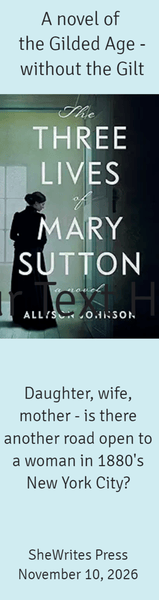
The Three Lives of Mary Sutton

The Sutton Sisters

I had jokingly suggested that “I led Three Lives” would have been  a good title for the book if that title had not been claimed already by a long-running TV series (though few of my prospective readers would ever have head of it.)  So I went with Option 3. 

I had suggested that I wanted a picture of the great-grandmother who inspired my novel on the cover.  the publishing crew seemed amenable, and Isent two different photos.  Sorry, these are not in the required high-definition format and would look pixilated on the cover – ok if this were a Sci-fi novel but not for a historical.  

Fortunately, I have a friend who worked for Adobe and knows all about creating a 300 dpi photo file fro a 150 dpi scanned image. I scanned the photos on my home multi-function printer and Jim transformed the scanner’s output into the required format.  Hurdle overcome. Enhanced versions sent. 

Sorry.  After several tries, the publisher’s crew of artists communicated that it would not be possible to make a cover that was properly eye-catching using the historic photos.  The one I liked had too much old-=fashioned detail (a chair, a fern) and could not be cropped.  The other one was possible, but they could not figure out how to make her static figure look dynamic against a historic street scene. And the whole effect was too busy. 

In several exchanges of letters, I was educated in the new requirements of cover design.  

Most importantly, the cover needs to convey its message when shrunk to a dimension about the size of a large postage stamp.  

*This is the size which will be displayed in print inserts to local newspapers from local bookstores. 

* This is the size which will appear in print advertising in magazines such as my University’s alumni magazine or in “Wirter’s Digest” or in the New York Review of books.  And above all 

*This is the size which will appear on a potential reader’s phone or tablet when he/she clicks through Amazon looking for something of interest. 

The artists sent four suggestions: 

One simply showed a woman’s expressionless face. What does that tell you?  Not that one. 

One showed a woman from the back, wearing a long black dress, arms pressed close to her sides, her hair in a severe bun.  She looked like Morticia. Why would you want to read about her?  Not that one.

One showed a rather plain young girl dressed again in a long black dress, looking sadly out of a window. No fun.

The fourth was ok.  I sent a note indicating that I thought this was the best of the four.  To my dismay, the team took this to be a full approval . I had expended energy already over my photo failure, and did not demur, as I had no alternative suggestion prepared.   

Of course, a week or so later I had all sorts of better ideas for the cover, but that ship had sailed.  Maybe when the book goes to its second printing? (Ha!  In your dreams – but why not dream?) 

No, I’m not showing you the actual cover.  Apparently the “cover reveal” is a big deal later in the process.  Stand by. 

The Publishing Journey: Step 1 – Write a book

The first novel I wrote took me ten years to finish. I had expected once I retired that I would whip it into shape in six months from the fragments I had generated during my off hours at work. Vain dream. I had hoped that once it was finished I would find an agent, who would find a publisher, who would find an audience. More vain dreams. I ended up publishing that first effort online (see ajmccready.com) where instead of going viral it sank like a dime into jello, without a ripple.

Undaunted, I’ve written another book. This one took me only about two years, as I had a historical framework to start from – the fragmentary story of my paternal great-grandmother. And I got a lucky break: a previously unknown relative contacted me, hoping to complete a genealogical record she had been researching, and she ended up being my personal research savior, digging up details of my great-grandmother’s story from census reports, cemetery documents, ship’s passenger lists, and poorhouse records.

There were still enough gaps in the history to allow my imagination free rein. My great-grandmother lived in New York City during the Gilded Age, so there was a wealth of historical possibility I could insert into her story. E.L. Doctorow had inserted Teddy Roosevelt and other historical personages into his classic “Ragtime”; I could do the same. I had fun. I put together almost three hundred pages. I imagined the book being published, with a cover featuring a photo I had recovered of my great-grandmother looking resolute and intrepid.

Onward!

[Graphic on imagined cover of “Fox Spirit” is copyrighted by artist Meredith Dilllman]

What I’ve Been Reading: Triple Trouble/ The Hate U Give

Triple Trouble/The Hate U Give

My eyes lit on a battered discarded library book in one of the neighborhood Little Free Libraries.  “Triple Trouble – Lambert” in black capitals on the spine. Could it be?  Yes it was – written by Janet Lambert, the queen of Young Adult fiction in the 50’s, and part of a series that somehow I had never read. (Ah, the publication date was 1965 – I had grown out of the Teenage section of the library by then.) I took the book home, and settled down into a time warp.

Cinda Hollister, the seventeen year old protagonist of “Triple Trouble” lives in a house with a library and a Persian rug and hardwood floors and columns on the front porch and a balcony and a broad slope of lawn and a basement with a rec room.  Her oldest brother is at Princeton, the second is into sports at a the University of Michigan and coaches Little League, and she also has a fourteen-year-old “terror” of a little brother and a quiet little sister. The house isn’t air-conditioned, but they can cool off at the club pool.  They have a cottage at the shore but rent it out for part of the summer.

So what is the Triple Trouble?  Will the oldest brother drop out of Princeton to marry his girlfriend?  Will the second brother drop out of college to accept a contract with a pro baseball team? Will Cinda be taken in by the artsy poet who fascinates her or will she stick with her white-bread suburban high school boyfriend?  At the end, Cinda says ““You know, [Mom], this has been quite a summer…. But you weathered it in fine style.  And because you stood by and kept your good sense of values, we all did.”

By chance, at home I had just begun to read a different Young Adult book, “The Hate U Give” by Angie Thomas, published in 2017.  Starr Carter, the 16-year-old protagonist, lives in a black neighborhood of Los Angeles with her father, an ex-con who runs a grocery store, her mother, a nurse,  and off-and-on her half-brother, who stays with his father when the man his mother lives with gets violent. The language is graphic, and the action is violent.

Starr has already seen her childhood friend Natasha killed in a drive-by shooting, and early on in “The Hate U Give” she is the passenger in a car which is pulled over by a white policeman who with little provocation shoots the driver, Starr’s close friend) in the back. The rest of the book deals with Starr’s wrestling with her nightmares, the media, the legal system, and the different demands of her friends and family.

Lambert writes of a world that could pass as a MAGA fantasy, while Thomas writes of a reality nearly as dystopian as “the Hunger Games.” Oddly, though, they both end in the same place – the importance of family, community, and values. 

I grew up in a suburban bubble not very different from the one in “Triple Trouble” and felt very much at home in Janet Lambert’s world. I’m sorry that today’s Young Adult readers face a much grittier reality than I had to, but glad that the fundamentals underlying what they are reading about seem to endure.

A Piece of my Mind: Wasted Day?

My fingertip went to sleep.

“That’s odd,” I thought. “I must have leaned on that hand while I was doing my morning crossword.” But it was my writing hand; I had been using it to fill in the crossword, not leaning on it.

I got up from my chair and went to the kitchen table which serves as my desk.  I massaged my fingertip while I checked my email.  The fingertip was still numb and tingling. When I looked at my finger, the first joint was swollen and blue above my wedding ring.  But the ring was not tight; I could bend the finger;  there was no pain.

Then a wave of strangeness came over me.  I felt as though I didn’t quite fit in my body, not confident that it would do what I asked.  I got up and groped my way to the living room, holding onto chairs and walls.  My husband was there.  “I feel strange,” I said, sitting down carefully in my armchair. My hands began to tremble.

He saw my shaking hands and maybe heard a tremor in my voice. “I’m calling 911.”

I didn’t move as we waited.  I breathed deeply, trying to clear the strangeness.  The ambulance arrived within five minutes, beating out the firemen from the local station. The two EMTs were crewcut, calm, and patient.  “Are you in pain?”

“No.”

“Feel dizzy?  Nauseated? Light-headed?

“That’s the word I was looking for.  Light-headed.” 

They loaded me onto a gurney and cranked me into the ambulance.  No siren, no flashing lights to alarm the neighbors. 

Brian was the EMT who stayed with me in the ambulance, while Braden drove.  Brian asked me my age.  I told him.  He asked what year it is. I told him.  Then he placed a half-dozen sticky pads on various parts of my torso and revved up the EKG machine.  After a few minutes it spat out a long white tape. “You have a beautiful heart,” Brian said. “You have the heart of a 20-year-old.”

No fever. Pulse normal.  But blood pressure was sky-high – over 180.  “You have high blood pressure usually?”

“Not usually – it was about 130 last spring.  But when I donated blood a week ago it was high – 180.  They barely let me donate.  I put it down to the four weeks of plumbing repairs we just finished going through.”

“That could do it.  Or right now it could be nervousness from riding in an ambulance. Let’s put an IV in you, just in case they need it at the hospital.” Brian jabbed me with a needle, attached an IV stent.  and went on talking calmly until we arrived at the hospital’s emergency entrance.  Down came the gurney, and I was rolled into PIT 4.  Patient in Transit?  I was to wait there for a doctor.

A nurse plugged me into a magic box which would monitor my temperature, pulse, and blood pressure every five minutes.  Brian’s stent failed to deliver enough blood for the testing Nurse Nina wanted, so she repositioned the needle. “You’re going to have some bruising. Now what started this?”

I told her about my tingling finger, the blue finger joint, and the wave of strangeness. By this time, of course, the tingling had stopped, the finger joint was a normal color, and the light-headed feeling had passed.  But the machine was still flashing yellow every five minutes to warn of the high blood pressure.

“Let’s take off that ring.  You don’t want to have that finger get swollen and have to cut the ring off.”  I tried, but the ring had been on my finger for decades; it was not about to come off easily.

“I’ll go get some lubricant.” And that was the last I saw of Nurse Nina.

My husband arrived and was allowed into PIT 4.  He was armed with a sheaf of crossword puzzles in case there was a delay in processing me through the ER.  It was about 11AM, and a busy day in the Emergency Ward.  I had to wait my turn behind the folks who were bleeding, in obvious pain, having seizures, or in other ways much more seriously troubled than I was. Lunchtime came and went.

“You should go get something to eat,” I told my husband. “I’ll be right here.”

“No, as soon as I do that you’ll be seen and transferred somewhere.  I’ll wait.”

I was allowed my phone.  I cleaned out my inbox.  I discovered a couple of Solitaire games and played many rounds.  My husband finished half of the crossword puzzles.

At about 2PM a young woman in a white coat with a badge certifying her MD status arrived.  I went through my history again.

“Can’t explain the strange feeling.  But I want to be careful about that finger. You should take off that ring.  I’ll schedule you for an X-ray.” And that was the last I saw of the doctor.

We waited again.  I found another game on my phone involving coloring in complex mandala patterns.  I completed two mandalas. My blood pressure monitor was no longer flashing yellow.

My husband was about out of crossword puzzles.  He went to the nurse’s station: “What about that X-ray?  Have you forgotten my wife?”

“Sorry.  We’re really backed up.  She should be up soon.”

At 4:30 I was wheeled into the X-ray area.  My finger was taped down to the surface and the machine whirred.

“That’s it, you’re done,” the orderly said as he escorted me into another room.

“Can I go?”

“As soon as the discharge paperwork is done.  And the doctor wrote a prescription for an antibiotic and some baby aspirin.”

My husband went down to the pharmacy to pick up the prescription.  I started work on another mandala.  My phone was down to 16% charge.

At 6:30 the discharge paperwork was completed, I had my pills and instructions in hand, and we headed for home. “So much for that day,” I grumbled/ “Eight hours in ER and nothing but baby aspirin to show for it.”

Was it a wasted day?  I now have confidence that, in case of a more severe emergency,  my local care would be prompt and thorough. I know that all my systems are working as they should.  The blood tests came back normal.  Normal feels good.  And going forward, I have the heart of a 20-year-old.    

Maybe not completely wasted.

What I’ve Been Reading: The Piano Shop on the Left Bank

The Piano Shop on the Left Bank: Discovering a Forgotten Passion in a Paris Atelier by Thad Carhart

My rating: 5 of 5 stars


The Piano Shop on the Left Bank
If a book cover has the words “Bookshop” or “Paris” or anything evoking those memes, I’m liable to pick it up. If it has “Piano”, that’s almost as magnetic. This memoir of living in Paris and finding access to the neighborhood hidden behind the courtyard doors is charming, full of information about French life and culture, and about the history, development, mechanisms, and lore surrounding the pianoforte.

A perfect bedside book, as it alternates between personal experience and historical reflection in alternating chapters.


View all my reviews

A Piece of My Mind: The Last Ride

I loved the freedom of riding a bicycle ever since I first learned to balance my balloon-tired Schwinn on the tar roads I grew up with.  As a child I could ride as far as the neighborhoods that had pavement and sidewalks and could admire the columned porches and vast green lawns behind the fences. When I was 12, I won a three-speed lightweight bike in a contest.  I was over the moon. That bike took me through college, getting me to class on time as I swooped past plodding pedestrians, until in my senior year I left it unlocked for just a few minutes and it was gone. 

After I was married my husband and I treated each other to Raleigh three-speeds, as we had only one car.  I would pedal across town to the home of a co-worker and we would carpool together;  I drove the carpool on alternate weeks, while my husband would either bike or bus to his job.  

Our children started them out with bike seats on the back of our bikes, then encouraged them to learn to ride themselves.  Once they had mastered their bikes, we took them and the bikes to Yosemite, to San Francisco, to Monterey, and on every bike trail within thirty miles.   

Years later.  My husband had a fall a few years ago and his knees are going out,  but I continued to ride my bicycle, against his advice, on local errands: to the library, to my hairdresser, to the blood bank. “What if you have a crash?” he would ask me.  “People are going to read about it in the paper and say “What the heck is a woman that age doing on a bicycle anyway?” 

“I’m careful, “ I said.  “I’m not going to crash.”  And I didn’t, exactly.

I hopped on my bike on a Saturday morning to pick up some bagels from the House of Bagels, about a fifteen-minute ride from my house. A lovely morning – just enough high clouds to keep cool, no traffic.  I sailed along the main street on the way to the bagel shop, taking a few detours on loop streets to admire the jacaranda trees in bloom, check out the progress of the construction projects, see if there were any windfall fruits to be picked up.  I zoomed into the parking lot by the bagel shop… and my brain froze.

I couldn’t remember how to dismount from the bike.

I had had a little trouble dismounting the last couple of times I had ridden;  the most recent time I managed somehow to give my shin a good whack and had raised a faint blue bruise.  But I had gotten off this bicycle hundreds of times. The act should have been deep in my muscle memory, something I did without thinking.  Now I had to think. To dismount, I only had to do in reverse what I had so easily done getting on: lean on the left pedal, swing my leg up and over the seat and rear wheel, apply the brakes.  I circled around the parking lot and tried again. No way. Nothing but icy fear of losing my balance, of falling.

There was a high curb with a railing not far from the bagel shop.  I pulled up to that, stopped, and then managed to step up onto the curb, hold onto the railing and haul my leg over the cross bar.  Shaken, I walked the bike across the lot to my usual lockup spot next to the bagel shop. “That was weird,” I thought.  “That was really weird.” 

I bought two bagels, swung onto my bike with no problem, rode home, rode up my driveway… and my brain froze again. I couldn’t do it. I could not swing myself off.  My muscle memory had gone dead.

I braked and with some difficulty managed to get my leg over the crossbar without falling over.  I trundled my bike into the garage and parked it next to my husband’s bike. which was covered in cobwebs. His tires were so flat the wheel rims touched the ground. I stood looking at it for a few moments.

Then I locked my bike up as usual, went into the house, and emailed the local Bicycle Exchange.  I have two bikes to donate.  Within two days the bicycles and all associated accessories were gone.

 I know this was a good decision.  I have several friends who have been injured severely when their bikes slipped out from under them.  But I miss the freedom of riding my bike.  I miss being able to stop and inspect changes in my neighbor’s gardens, to take short cuts through suburban bikeways, to not worry about parking. I’m envious of the people who are trying out the newly painted bike lanes on El Camino and El Monte.  It’s no fun driving to my hairdresser.  On Saturday morning my husband goes for the bagels now.

There’s an empty space in our garage.  I expect it will gradually fill up with the things that go into garages. I hope the empty spaces in my mind will fill up too.

Freeway Free in Columbia SC: Outdoors in SC

Outdoors in South Carolina is a lot different from outdoors in Northern California, where I spend most of my time. SC is green, the air is moist, there is water, and there is history. Columbia’s Riverbank Walkway is a wonderful illustration of the difference, with its effortlessly un-irrigated green spaces, its leisurely meanderings along the Columbia Canal, and its unexpected evocation of the workers who built the canal.

We parked at the Laurel Street entrance, just late enough to avoid a major fun run which had been organized for the morning – volunteers were folding tables and taking down canopies, but they cheerfully directed us down the pathway to the canal.

On the way we pass a steep stairway leading upward. Signs let us know that there is a restaurant above, probably with a fine view of the canal and the river beyond. We resist the temptation.

Further down we spot a building off to the side, which turns out to be the former operating station for the canal. Facing the building is a monument to the Irish worker who helped build the canal. I remember that at the time of the canal’s building there were probably signs in downtown Columbia reading “Help Wanted: No Irish Need Apply”, and felt pleased that this maligned immigrant group was receiving recognition.

At the bottom of the trail is a playground for children who have not worked off enough steam on the walk down. No, wait; it’s not for children, it’s a workout center for adults who have not worked off enough steam after jogging the four-mile river trail. Whichever – it’s a beautiful location.

As we turned to go back up the slope to the parking lot (not feeling up to a four-mile jog on this particular day) we spotted this whimsical artwork just up from the workout center/playground. It’s a testament to a light-hearted spirit that we felt throughout our visit to Columbia.

Post Navigation