Allyson Johnson

Pieces of my Mind

Archive for the category “Travel”

Travels with a Tiny Trailer – Day 2 (cont. again)
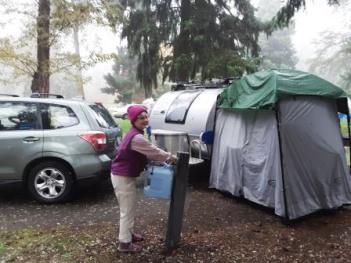
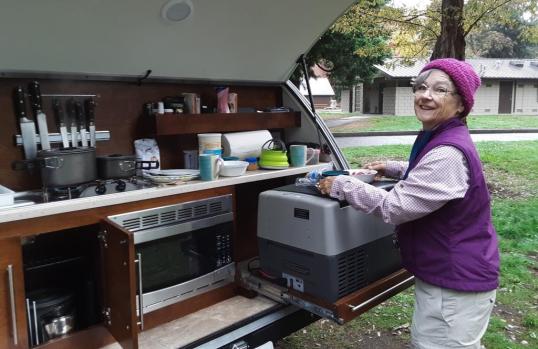
20191017_084028webWe get dressed in the confines of the tiny trailer. It’s not easy to pull on trousers without being able to stand up , but we manage it. Our water-resistant jackets are about dry after a night of hanging inside, and our moods improve as we plan on quickly making a hot breakfast on the two-burner stove in the pop-up kitchen in the back of the trailer. Sis fills the water carrier. All we need to do is boil water, and we’ll have coffee and instant oatmeal with fruit and brown sugar mixed in. So much easier than camping with a propane stove – nothing to set up, nothing to connect, just a quick flick of the lighter and….

Uh oh. The list of equipment provided with the trailer clearly lists a butane igniter, with back-up matches. The trailer is a honey-comb of clever contrived storage spaces, and it is quite likely that an igniter and/or matches is hiding in one of them. But we can’t find them. We take apart the under-sink storage, and the over-sink storage, and the behind-the-sink storage. Nope. No sign.

Here, for the first time, I’m really afraid Sis is going to lose it. No coffee? Her face twists in agony. Fortunately, I look beyond our campsite and spot a familiar item on the table in the neighboring camp – a Coleman stove. Where there is a Coleman stove, there will be a lighter or matches. Sure enough, the young man presiding over the stove has a Bic lighter in his pocket, and smilingly lights our burners for us. The day is saved! The coffee is hot and strong, and the oatmeal tastes wonderful!20191017_091418doc
We linger over our coffee, even though we are sitting on the edges of the still-wet camp chairs. We are not looking forward to dumping the water out of our leaky  tent, or loading the mass of wet canvas into the car. What will all that moisture do to the bikes? But we can’t put it into the trailer – the bedding would never dry out.

Somehow we make it happen. We put the dry side of the rainfly over the bikes, pile the tent and chairs on top, close up the kitchen, and break camp.

Will the chairs ever dry out?  Guess what will be our next stop? Stay tuned – And Happy New Year!
Travels in a Tiny Tear-drop Trailer – Day 2

20191017_084100web

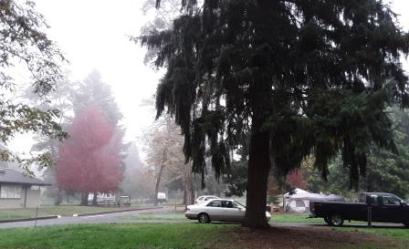
I have slept beautifully in the cozy confines of the teardrop, lulled by the sound of rain pattering on the roof. It is morning. I prop myself up on one elbow and open the privacy shade on my window. Outside I can see only as far as two campsites over. The fog is low, but fog is drier than rain. Things are looking up.

I sit up and begin to think about finding my clothes. Sis stretches and yawns next to me, so I wish her a good morning.

“I’m sorry if I disturbed you when I got up in the night,” she says.

“I didn’t hear a thing. You must have been real quiet.”

“No, actually, I was afraid you would have heard me swearing.” She props herself up, opens the door into our attached tent shelter, and gestures for me to look over her shoulder.

If we had practiced setting the tent shelter up in advance, or even if we had been able to set it up in daylight, we would surely have noticed that the shelter is not square, nor is the rainfly which is designed to cover it. Unfortunately, if a rectangular rainfly is set on a rectangular tent at a 90-degree angle from the way it is supposed to fit, the two ends of the tent will protrude from under the rainfly.

In the dark, in the rain, we had a 50-50 chance of doing it right. Unfortunately, we lost the toss.

20191017_084044webIn the morning, in daylight, we can see that the un-protected section of the tent roof is quite obviously not rain-proof. However, the bottom of the tent is water-proof, and Sis’s shoes are sitting soggily in a considerable puddle that has collected inside the tent.

“It was a pretty squishy walk to the bathroom,” Sis says.

“Oh, well, you have your hiking shoes to wear while those dry out, right?”

Sis suddenly looks stricken. “I meant to put them in the car. And then we had the fuss with the bikes. I’m not sure…. “

Will Sis find her hiking boots? Will we get the water out of the tent? Will we ever get a hot meal? Stay tuned.

And meanwhile –  MERRY CHRISTMAS!

Travels in a Tiny Tear-drop Trailer – Day 1 (cont.)


(The picture on the left above shows what the inside of the trailer looks like in the website photo.  The one on the right shows the inside of the trailer in actual use.)

An hour after arrival at Valley of the Rogue State Park, we finally have the trailer reasonably stationed in its space, with the electricity hooked up. My water-repellent wind-breaker is soaked through, and as it is after 9PM, we decide to forego cooking a hot meal and simply make a meal of cheese, fruit, and crackers, with some good red wine, and chocolate for dessert. No worries about the rain, Sis declares, as she has also rented a little tent which can be attached to the trailer door, giving us a dry place to sit while we eat.

The comprehensive directions that come with the trailer  suggest that one should practice setting up the tent attachment in advance so you know how it all fits together. We have not done that. Fortunately we both have head lamps, so we take the chairs out of the trailer and set them aside, take the tent out, and begin to assemble it in the dark and rain, with me reading the directions , and the two of us fitting poles into holes as seems most reasonable. A half-hour or so later, the tent is up, attached to the trailer, and we have secured the rain fly. It’s then  we discover that the chair bags are not water-proof, and after a half-hour of sitting out in driving rain, the chairs inside their bags are sopping wet.

Well, so are we by that time, so we set our chairs and little table up inside the tent, arrange some plastic trash bags on the sodden chairs, and drown our soggy sorrows in wine. I even manage to forgive Sis for having forgotten to bring the chocolate. We hang our wet clothes on every possible protuberance inside the trailer, and prepare for bed.  We find the mis-placed purse! Sis worries about having to get up in the night to get to the rest room, so she carefully sets her shoes just outside the trailer door inside the tent so that she can slip them on if needed.

And so to bed.

Will the rain ever stop?  Will Sis be able to find her shoes in the dark? Will we get a hot breakfast?  Stay tuned!


Travels in a Tiny Teardrop Trailer – Day 1


My sister fell in love at first sight when she saw a tiny teardrop trailer on the cover of Sunset magazine. Was this the solution to all the packing and preparation needed for a simple weekend camping trip? Could a trailer provide grab-and-go adventure?

She had done a trial weekend, renting a teardrop with a close friend, whose full-size SUV had no trouble pulling a tiny trailer while carrying a couple of bicycles and duffels in its rear. But would Sis’s little Subaru hatchback be able to tow and stow? She decided to try it out on a trip to the Pacific Northwest, to visit our brother and his wife in their new house. Bro had a trailer already, so we could trailer camp together over the weekend. And so she invited me on a road trip with the object of her passion.

Camping without bicycles, to Sis and her husband, would be like going to Hawaii without swimsuits. They routinely bike 30 miles on Sunday morning for a cup of coffee. Bro assured us that the campsite he had in mind had miles of beautiful bike trails, so Sis rented a trailer equipped with a bike rack on top, and I brought my bike to keep her company.

The trailer rental guy at Sierra Teardrops had shown Sis how to set up the bikes on top of the trailer, but she had not actually tried to do it. It was apparent almost immediately that there was no way she, at barely 5 feet tall, and I, at 5’3”, were going to be able to hoist even her lightweight bike to the top of the trailer, much less get it properly affixed in the rack. But abandoning the bikes was not an option. We pulled all our gear that had been stowed in the Subaru and piled it into the trailer, and then wrestled the two bikes into the back of the Subaru. Not easy. We were both sweating by the time we had managed to make them fit, and we were now an hour past our hoped-for departure time.

Off we go. Just short of Mt. Shasta we stop for gas. Sis can’t find her purse. Is it buried under the hastily stowed stuff in the trailer, or did she set it down in the house while picking up some last-minute items from the fridge? She phones home. Husband is home from work, looks all over, can’t find the purse in any of the places she usually sets it down. We cross fingers that the purse, with Sis’s driver’s license, is in the trailer somewhere. Meanwhile, my credit cards work, and Sis drives carefully.

We had planned to camp at Castle Crags state park north of Mt. Shasta, but even on a Wednesday in October, they were full! So on we go, aiming for Valley of the Rogue State Park just north of Ashland. By the time we arrived and found a  vacant space, near 8PM, it is dark. And it is raining. Hard.

I had been assiduously reading the extensive directions which come with the trailer all the way up Interstate 5. They recommend that you practice backing the trailer up before you actually take it places, as “backing a small trailer is more difficult than backing a large one.” We had not done that. Oh well, we think, we will just pull into the space forward, and deal with backing up tomorrow morning when we can see, and maybe it won’t be raining. Bad idea. We discover as soon as we were headed into the space that all the trailer hookup attachments are conveniently located on the side which would be close if the trailer is backed into the space, but are just too far for the cables to reach if you head in. So Sis has to back out of the space, circle the campground, and then try to back into the space. In the dark. In the rain. I stand outside to give directions, and Sis tries her best, again and again.

Will Sis succeed in positioning the trailer in its slot?  Will we ever get to eat? Will the purse show up? Stay tuned!


Freeway Free in France: the other national cemeteries of Normandy

20190605_093503docWe are all familiar with pictures of the American Cemetery in Normandy, with its rows of white crosses stretching into the distance.  I had not known that the United States was the only combatant in World War II which offered families of its dead an option to repatriate their remains for burial in the US.  The nine thousand plus graves at the American Cemetery are only a third of the fallen.  These are those soldiers who had no family, or whose families lacked means or desire to hold funeral rites at home, so they preferred to let the government bury their dead.

Soldiers from other countries were buried near where they fell. There is a cemetery for Commonwealth soldiers in Bayeux, with tombstones rather than crosses.  There is a Canadian cemetery near Caen.  And, most ironically, there is a German cemetery. at LaCambe, also near Bayeux.

The German cemetery is quite different in look and feel from the rows of white marble favored by the victors.  One enters the cemetery through what seems like a large arch, but once inside, the spacious entrance gives onto a small room with a memorial wall on one side and a listing of the cemetery’s occupants on the other. Exit into the cemetery is through a narrow and low door.  The symbolism, we were told, is that the soldiers entered the war as a group, but died individually, one by one.

The central feature of the cemetery is a tumulus which contains the remains of mostly unidentified German soldiers, topped by a black lava cross and two human figures, one of Jesus, the other of Mary.  Scattered around the grounds are groups of black crosses, some slightly larger than others.  The individual graves are marked by brown plaques laid flat in the grass, each bearing the names of two German soldiers, with their dates of birth and death, and sometimes merely the inscription “Ein Deutcher Soldat”. The plaques are made of German clay.

In school we learned Rupert Brooke’s elegy “The Soldier” which begins

If I should die, think only this of me:
      That there’s some corner of a foreign field
That is for ever England.
France has ceded the land which contains the World War II cemeteries to the respective nations which maintain them.  (Thus President Trump acted as host for ceremonies on D-Day at the American cemetery, arriving first and greeting French President Macon and his wife as guests.) It is sobering to realize that this corner of France will be forever Germany, peacefully coexisting in death with its former enemies.
20190605_093545doc.jpg


Freeway Free in France: Tales of War in Bayeux

20190604_154859docBayeux was the first French city to be liberated by Allied Forces.  Troops marched into the city on a street bordered with cheering townsfolk who waved French and American flags, and offered kisses from happy young women and fresh baked treats from older ones.  The Germans evacuated so quickly that they had no time to organize a defense, so the most of the medieval structures remained intact.

20190604_134313webWe first stopped at Bayeux Cathedral, with its mix of old and new stained glass, its ornate Gothic verticality, its mystic paintings decorating the crypt beneath the alter.  The apse was decked in French tricolor, British Union Jacks, Canadian maple leafs,  and American stars and stripes.  Behind the altar there was a large concert band practicing for Prince Charles’ visit the following day (Wed. June 5).  This was a truly excellent brass ensemble, plus some woodwinds and tympani.  The sound reverberating through the cathedral was thrilling.  One piece was “The Spitfire Overture” and another, appropriate for a visiting Brit, was the lovely, noble main theme from “Jupiter” from “The Planets” by Gustav Holst.  My partner, a music-lover with bad knees, stayed in the church for the whole rehearsal while I wandered around the side chapels and lower levels.

20190604_145313webRight across from the cathedral is an old store front set us as a Lace Museum, with lovely examples of the prototypically Breton/Norman craft.  Unfortunately, I have since read that the Lace Museum is in danger of being closed, as it is funded by the city of Bayeux and patronage has been light.  So don’t forget to stop in!

Just down the street is a more modern museum of Breton arts and crafts, housed in a former bishop’s palace, with lovely landscape paintings, more lace samples, and a well-stocked gift shop offering post cards and booklets about the medieval city, its role in World War II, and its artistic heritage.

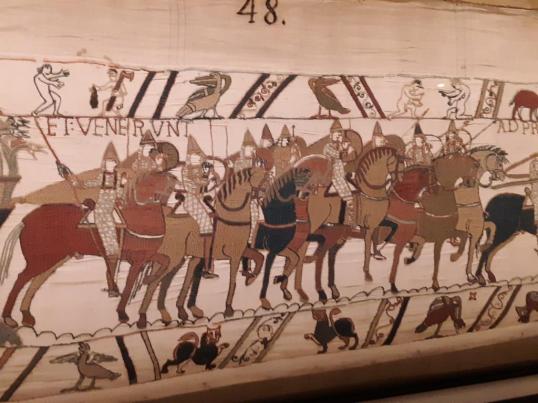
20190604_161740webOf course, Bayeux is most famous for that other artifact of war, the Bayeux Tapestry, now displayed beautifully in a circular museum which allows the entire 200 feet of  embroidered cloth to be shown, accompanied by an audio commentary provided through headsets to each visitor.  (This device not only fills you on details a guidebook may have overlooked, but it artfully keeps the visitors moving forward as the audio commentary moves forward to the next panel.  No pause button. ) Notice the way the borders complement the action, with dead and dying soldiers, archers, and mythic beast bordering the action-packed cavalry sequences.  The Bayeux tapestry is like an early graphic novel, with leading characters easily identified by distinctive dress or hair, and scenes of ribaldry aleternating with the diplomacy and bloodshed.  Definitely a Don’t Miss!

Freeway-Free in France: Ceremonies (LATC July 3, 2019, for our Veterans)

20190606_102633docI had the good fortune to be among the 12,000 + invited guests at the 75th anniversary ceremonies commemorating the D-Day landings in Normandy.

All 12,000 + guests were brought in by shuttle buses from staging areas in nearby towns (except for the VIPs, like Presidents Macron and Trump and their supporting cast, who arrived by helicopter). The security lines were long, but we passed the time checking out the helicopter arrivals, and applauding the mostly wheelchair-bound, heavily be-medaled D-Day survivors as they wheeled past on the way to the VIP tent.

20190606_114147cropWe were among the last 4000 to arrive at the American Cemetery, and the stage and podium seemed several football fields away in the distance.  But giant Jumbotron screens gave us close up views of Air Force One (both jet and helicopter) and its occupants as they landed, and of President Trump’s ceremonial greeting of guests President and Mrs. Macron onto what is considered American soil.

When we took our eyes from the screens, we looked out over a sea of white crosses, each decorated with a  American and a French flag,  stretching beyond the audience area for even more hundreds of yards. So many dead buried in tidy rows, as if drawn up for a regimental parade. An occasional Star of David marked a grave instead of a cross. A rare cross with gold lettering indicated a Medal of Honor recipient. An occasional soldier is “known only to God.” It seems right that all the soldiers are equal in death, except for those singled out for their valor.  The son of a US President has the same marker as an unknown soldier.

Before the speeches, national anthems were sung.  During the speeches, 12,000 people listened quietly.  President  Macron thanked the veterans who were present in English, and presented four of them with the French Legion of Honor (including air kisses on both cheeks).  President Trump told stories of the heroics of two D-Day soldiers, then turned to shake their hands personally on the stage.

Afterward, the ceremony continued.  We heard taps played by a distant trumpet, followed by a 21- gun salute, delivered by three mighty howitzers aimed out over Omaha Beach. Five fighter jets flew over in the missing man formation. A platoon of other military aircraft filled the sky, emulating the flocks of fighters and bombers on D-day.  Finally, a second squadron of nine jets, trailing red, white, and blue contrails, roared across the sky.20190606_130439doc

The whole event was both humbling and satisfying.  We had paid appropriate homage to those who fought for us, and in doing so honored those who are still fighting.

Our French guide had told us that, in France, the D-day landings are never referred to as an invasion.  Instead, they were the forces of liberation. Tomorrow, if this piece is published on schedule, will be Independence Day.  Let’s celebrate our own liberation with due ceremony, while remembering those we owe it to.

[Article first published in the Los Altos Town Crier this summer;  still appropriate as Veteran’s Day approaches.]

Freeway Free in California – Adventures up the Empty Coast – Day 2 (continued)

IMG_0251docThe weather was perfect: warm, no fog or wind, as we left Hearst Castle.

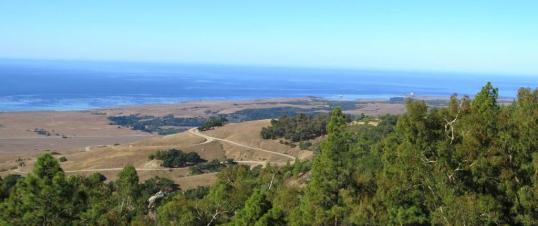
We meandered up Hwy. 1, ooh-ing and aah-ing alternately at the gorgeous scenery and at the huge scars on the hillsides marking the winter landslides of several seasons. South of tiny Gordo men were still working to clear a large slide – the influx of workers must have been a boon to the intesnsely cute Whale Watcher’s Café which dominates the one-block town.

Fountains of invasive pampas grass flaunt their rusty pink plumes all over the scarred hillsides. It’s clear that they have gotten the jump on native vegetation, but one must be thankful for any roots that will hold back more landfalls. Not encouraging to start the trips with a sign saying “Rock Slide area – next 60 miles.

We snuck into the Los Padres National Forest’s Plaskett Creek Campground despite the signs saying “Campground Full,” and ate sandwiches and chips we had bought at the Hearst cafeteria/deli. The group camp, with a beautiful ocean view, was deserted at midday, except for a group of grackles generaled by jays which hovered ever closer to our crumbs. Then after our lunch, only about 500 yards further down the road we saw a sign for “Beach and Picnic Area”. Our lunch tasted better for being illicit, though.


20191002_125717docFurther up the road there was an even bigger slide, with an obviously temporary one-lane road perched nervously across the new ground. But it was fascinating to watch the big diggers roaming and scooping  atop huge mounds of dirt and stone. And that road remains a marvel of impossible engineering, spectacular vistas, and a maddening plodding pace behind the inevitable road boulder, often a “Rent-Me-RV” whose first-time RV driver is scared to death of his rig and the road.  And they won’t pull out to let the long line of vehicles behind them to pass, which is the law, or, if it isn’t, there oughta be.20191002_132921doc

And finally we made it to Big Sur, with its redwoods, its fire-scars, its resorts both humble and ostentatious nestled in the piney woods.  Only another hour of gorgeous scenery to go before we hit the traffic and tourists of the Monterey Peninsula.  It’s been a great ride.

Freeway-Free in California: Exploring the Castle on the Empty Coast (Day 2)

IMG_0260docWe had perfectly an ordinary breakfast at Cambria’s Creekside Garden Diner,  which we would probably have liked a lot better if it had been warmer and we had eaten on their attractive creekside patio. There are two breakfast/lunch places in the same Redwood Square shopping center, both  recommended by a local as the best options for breakfast – next time we will try the other one. No complaints about the French toast with strawberries I had – but it was ordinary, as was the hole-in-the-wall decor.

Then, for a complete contrast, we headed up the coast for the Grand Rooms Tour of Hearst Castle at San Simeon.  We had last visited the Castle several decades ago.  Things have changed.  There is now an elaborate Visitor’s Center with a movie theater and a number of exhibits relating to Hearst’s parents, the Hearst fortune, Hearst’s travels, and more.


Previously we  had been able to drive up close to the castle;  now there is a large parking lot near the Visitor’s Center and a shuttle bus which follows a loop driveway through the estate, with a recorded commentary on Hearst’s wildlife collection, riding trails, and so on. We had perfect weather to enjoy the spectacular views  of ocean and mountains from inside the bus and from the patios surrounding the castle.

At the steps of the castle we met our excellent guide.  We were asked to imagine ourselves as guests just arriving on the front patio of the Castle.  Our host might or might not be there to greet us. Meanwhile we  marveled at the fountains and statues which surrounded the entry, and the famous Roman swimming pool.

Inside, we saw the tapestry-clad reception room, the expansive dining room with its regal beamed ceilings and proletarian catsup bottles on the table.

The whole place is like a combination of Versailles and San Jose’s Winchester Mystery House. Hearst was constantly acquiring antiquities, constantly planning more building. Only the collapse of his publishing fortune during the Depression halted the expansion of his plans. Some of the items he purchased were never used;  some, like the room bought from Gwydir Castle in Wales in a bankruptcy sale,  (see my earlier article “Freeway- Free in Wales”) have even been lost.

20191002_110452webSome of the acquisitions were puzzling – what was the meaning of the Arabic writing in mosaic tile positioned over the player piano in the alcove off the billiard room? The guide was too far away to ask, so this remans a mystery.
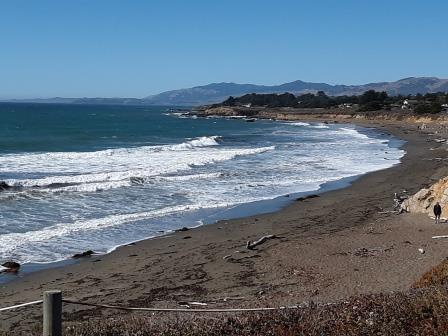
Questions had to be asked fast, as the tours are carefully timed – a group could be spied leaving each of the rooms just as we entered, and after  the final room (the spectacular indoor swimming pool)  we had an option of getting on a bus to descend the hill or wandering a bit more about the grounds.  I’d like to go back for a second tour, to see the bedrooms (42)  and bathrooms (61)where the guests could stay and relax. But that’s the secret of a great host, to keep you wanting to come back.IMG_0274doc


Freeway Free in CAlifornia – Adventures on the Empty Coast (Day 1)

20191001_145603web

What’s the empty coast? Where Highway 1 clings to the cliff faces south of Carmel, with basically no left turns and few habitations until it regains civilization and a few crossroads south of San Simeon.

We needed a fall getaway, so D and I headed lickety-split down US-101, aiming for a calm coastal stay in Cambria, followed by a visit to Hearst San Simeon National Monument, and a scenic trip back up through Big Sur and the stretch of California Highway 1 that had been cut off by landslides and fires for several of the past years.

We stopped for lunch in Paso Robles, one of my favorite pauses for trips south and north on Historic El Camino Real. There are several good restaurants in Paso. This time we stopped at the Berry Hill Bistro, where the paninis are huge, the salads ample, and the servers slim and smiling. (I always think it’s a good sign if a restaurant’s waitresses are thin. It means they are running off the calories serving customers as fast as they can, rather than sitting around eating the leftovers.)

Just past Paso we found our exit on CA Highway 46, and sailed along a well maintained road through San Luis Obispo wine country. Acres of grapevines in fall colors cloaked the dry hills, and each winery seemed to be vying with the next to have the most oddly memorable name (my favorite: Tooth and Nail Winery.)

Only a half hour later we were cruising along Cambria’s Main Street. To our delight, we discovered that the entire month of October in Cambria is devoted to a Scarecrow Festival, and each retail, educational, and many private establishments compete for the notice of passers-by. There were Mexican-themed flamenco scarecrows for the Mexican restaurants, a Victorian lady in blue and white next to the blue and white Chase bank logo, and my favorite Raggedy Ann and Andy from my childhood next to a toy and gift store.

After checking into our beachfront motel, the Little Sur Inn,  we walked along the boardwalk bordering Moonstone Beach to check out the Moonstone Beach Bar and Grill as a dinner prospect, but although it has a lovely front veranda with a stunning sunset view,  and seemed to have a lively patronage, we would have been walking back in the dark, and it seemed a bit far.

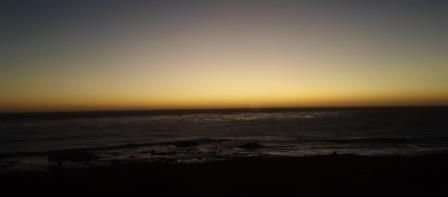
We has our traditional champagne on the balcony of our room, looking out over Moonstone Beach. The sunset looked like a banana skin shading around the curve from pale yellow to golden brown.   We lingered until we both thought we saw the green flash accompanying the last rays of the sun. Lovely.20191001_190339web

As long as we would be getting in the car anyway, we decided to try Robin’s Restaurant in Cambria’s east village, a recommendation from a friend. It is a beautiful adapted home just a block from the Main Street, with a quiet ambiance, excellent service and good food (roasted Brussels sprouts with pine nuts and blue cheese, miso sea bass, firecracker shrimp).

One caveat: As we watched, there were maybe three younger couples coming in or leaving during the evening, but this is definitely a quiet restaurant for an older crowd.  D and I are used to upping the average age of the customer base by 10 years when we enter a restaurant. In this case we were right on average. D observed thatRobin’s does not have high chairs or booster seats, but they do seem to have an ample supply of walkers and supplemental oxygen bottles.  I guess the younger crowd was still quaffing brewskis on the Moonstone Beach Bar and Grill veranda.

IMG_0247webWe took the remains of a bottle of local Pinot Noir back to our balcony to finish off the evening with the complimentary chocolate chip cookies from our check- in desk. We sat on our balcony again to watch the crescent moon setting near where the sun had set before our dinner. Suddenly stars! The Milky Way! D even saw a shooting star. Only one spotlight shining on the entry sign for our hotel spoiled the dark sky.


Post Navigation