Freeway-free in France:Medieval Market and Marketing in Sarlat


Exploring the medieval village of Sarlat out-appealed walking in the surrounding countryside, and gave us each an opportunity to occupy our time without being one wheel of a four-wheel drive vehicle. DM and I did shopping in the justly- famous Sarlat Saturday market, while DB walked the self-guided city tour and W did tai qi and sudoku in the park. We met for lunch at a quaint courtyard, then DB went back to the hotel to relax while the other three did the city tour. We all spent an hour or so doing email and post cards in the mid-afternoon and then the D’s invited us up to their roomier (set up for handicapped) suite for a pre-prandial cordial. So we are learning how to be apart as well as together – A good travel skill. 
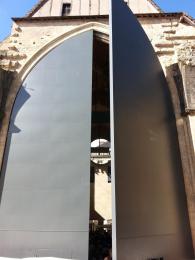
The Saturday market in Sarlat attracts vendors from all over the regions, with lots of opportunities to sampled the key products: olives and their oil, walnuts and their oil, and (less lavishly set out for tasting) duck and goose foie gras. The market fills several streets, the main public square, and the inside of an abandoned church whose entire back wall has been converted to a giant portal allowing free circulation of both air and people to the market stalls inside.
 Having figured out the advantage of attracting tourists to their market on Saturday morning, the city fathers of Sarlat have lost no time in figuring out ways to keep those walking cash dispensers in town as long as possible. On the Saturday of our stay we were tempted back onto the streets long after the market closed with an evening sound-and-light presentation called “Un Patrimoine sous les Etoiles” [A Patrimony under the Stars] in the old city starting at 9pm.


W and DB begged off, but DM and I set out after dinner to find the streets and ramparts lined with votive candles , the public buildings and cathedral lit with patriotic blue, white, and red, an artist drawing calligraphy with a light torch in the public square, and a buxom artiste on a balcony reading patriotic excerpts from Sarlat’s leading literary light Etienne de La Boetie accompanied by a cello. The ostensible theme of the evening was something to do with the responsibilities of citizenship, but the real point was to see how different and how cool the old city looked with candle-lit paths and colored light effects.


 At about the halfway point of our first day of hiking (9km) we felt raindrops. Drizzle turned to gentle rain, enough to rate dragging out our rain gear – all except DB, who had left her poncho behind to save weight. (DB has some curvature of the spine and her backpack is not very comfortable, so she chose to leave some basic stuff, including sufficient water. Fortunately both W and I tend to err in the opposite direction, and were able to keep her hydrated with our extra bottles, and fairly dry with my little polka-dot umbrella.). The ponchos added an unnecessary extra layer of warmth, so we kept trying to do without every time we felt the rain slacken, and then had to re-don when we got out of the sheltering woods or the rain renewed its attack.
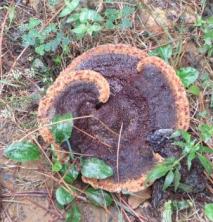 We oohed and ached over a chateau whose ruined towers loomed above the woods on the left (it was burned by the Nazis in WWII) and exclaimed over weird fungi growing on logs and near the edges of the path. We noted pear orchards, apple trees heavy with fruit, an occasional vineyard lush with grapes awaiting harvest. We sampled wild blackberries at the side of the road, and tried to open chestnut husks to get at the chestnuts inside. (Chestnuts are stickery!” And we were counting down the remaining KM by tenths.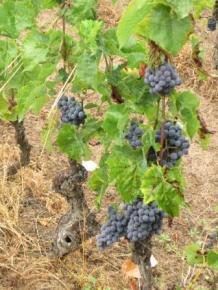


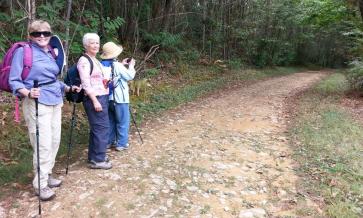 We were dropped off in Roufillac after a brief orientation on French hiking route markings, and told to “go between the houses and up the path”. Packs on back, hiking sticks in hand, we set off. The sky was partly cloudy, the temperature was in the low 70s, couldn’t have been nicer for our purposes. We wound up through wooded hills past houses and barns built of glowing yellow sandstone, some with tile roofs, many with stone roofs. We came to a small village perched at the top of the hill and realized we had climbed quite far, and there was a ruined castle inviting us to explore just at the tip of the cliff overlooking the valley.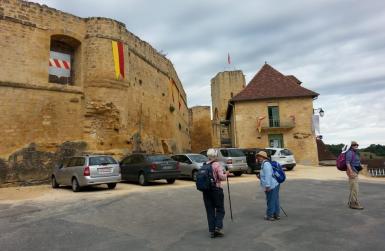

 The Dordogne area of southwestern France is rife with sandstone caverns, many of which hold spectacular displays of calcite formations, and several of which hold samples of Paleolithic art, most preserved unseen for over 20,000 years because the entrances to the caves collapsed, cutting off access.
 We have a French road map courtesy of AAA.
 We have a GPS which came with our car.
 Albi did not disappoint.


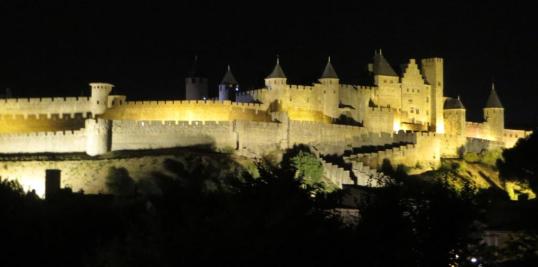


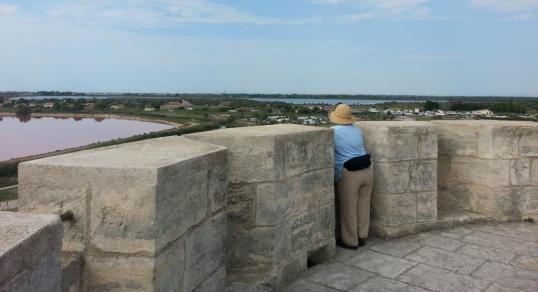
 Neglect means no development, so the medieval town, with its defensive wall, royal apartments, and battlements are all pretty much intact, despite some quarrying of the walls to build more modern edifices (pig sties, sheep pens, etc.). Later when the Huguenots were being suppressed by Henry II, a number of them were imprisoned here until they would renounce their heresy. Some stayed for 35 years until finally freed by Louis XV.
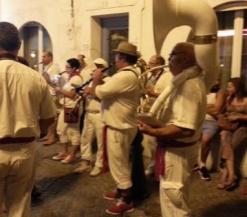

 Still in Arles
 We started off with a stop in the 12th century at the Cloistre de St. Trophies, a cool and calm spot right off the main square. The cloister included many statues which had been so badly eroded you could hardly make them out, but a few that had been sheltered are very human and evocative. Then we walked along the wall of the city overlooking the Rhone, well culverted against flooding, admiring an old Romanesque church which had been converted during the Revolution to a union hall for shepherds, a large domed building which was the remains of a steam bath built by Constantine, and a number of long views down the river to unnamed castles and fortifications in the distance.
 Scanning the arena, we spotted her in the Tower! Heading back to the tower, I heard my name called. It was DB, AWOL from the garden, who had just seen WB at the base of the tower. “I’ll meet you at the entrance to the tower, ” she said. By the time we got there, WB was back a quarter of the way around the arena, and DB was nowhere to be seen. And so on. We finally joined forces and made our last tourist stop at the old Roman theatre, much pillaged (as was the Arena) for building materials over the years, but now set up for open air musical and theatrical performances. We tested the acoustics and found them sadly lacking compared to Ephesus in Turkey or the Mormon Tabernacle in Salt Lake City.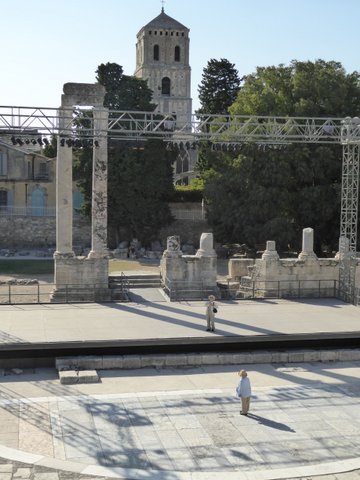
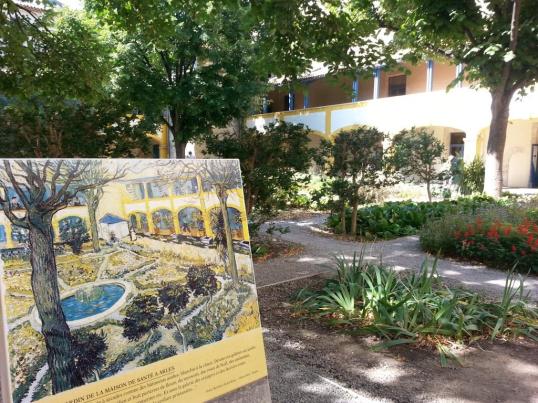
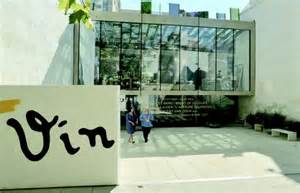 Once we got to Arles and rather miraculously found a free parking space that I could maneuver into, we headed first for the Bureau Touristique for city maps, and then, at WB’s insistence, went first to the


 Allyson Johnson