Freeway Free in Oregon: Exploring Astoria
[AKA “Travels with a Tiny Teardrop Trailer – Day 4 (cont.)”]
 Astoria is way out on the furthest northwestern tip of Oregon, at the mouth of the Columbia River. It is the oldest city in the state of Oregon, founded in 1811, and named for John Jacob Astor, the New York investor whose American Fur Company founded Fort Astoria at the site. (Yes, the Waldorf-Astoria in New York is also named for him.) In bygone years Astoria was a bustling harbor, with schooner after schooner fighting her way past the dreaded Columbia River bar to pick up timber, fish, and furs, dropping off supplies and merchandise for the well-to-do families of trappers, fishermen, and lumberjacks.
The Victorian heart of the city was demolished by fire in 1922. This happened to coincide with the peak population – above 14,000 – so there were resources and energy to rebuild in the Art Deco style of the 1920’s. Fortunately for architecture buffs, the population began a steady decline shortly after rebuilding, as port activity moved inland to Portland, and northward to Seattle. The last fish cannery closed in 1980, the last lumber mill closed in 1989, and the railroad service was discontinued in 1996. This left Astoria with a population of under 10,000, no funding for demolition/modernization in the town center, and plenty of warehouse space for the brewpubs and artist cooperatives which began to move in.
 We stopped for lunch after our museum visit at the Rogue Public House, a brewpub located in a re-purposed fish cannery out on a pier just down from the museum. We enjoyed their boutique beer, plus an excellent pizza and salad. Then we took advantage of a temporary cessation of rainfall to stroll the delightfully un-restored, un-modernized, un-redeveloped downtown.
The downtown is haunted by the ghosts of retailers past: the signs for JC Penney and Sears still deck the storefronts, though the shops underneath are now boutiques such as Garbo’s Vintage Wear, Purple Cow Toys, and Arachne’s Hand-Crafted Yarns. Our favorite was FinnWare, a wonderful collection of Scandinavian design and décor, made even more special by a flotilla of Christmasy items sparkling and spinning on display.
We also stopped in at several of the art galleries which line Commercial Street, just to gawk at the creativity on display and wonder who actually puts these things in their houses. The Riversea Gallery was particularly comprehensively amazing.
 At one end of Commercial Street is the wonderful wedding cake-like Liberty Theatre, located, of course, in the Astor Building. (See photo above.) We were visiting in October, so the Box Office was spectrally staffed.
After an hour or two of strolling and shopping we had had enough retail therapy and headed for the beach. The sun was actually shining as we hit the sand at the tip of Oregon. We could see the remains of the Peter Iredale rusting peacefully in the distance, one of the victims of the treacherous Columbia River Bar.

Will the sunshine stay? Will we be able to use the outdoor kitchen on the Titanic ? Or will we head back to that cozy brewpub as refugees? Stay tuned!
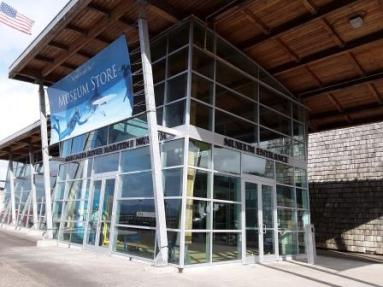 If you are going camping in a tiny trailer, and you left your bikes at home because the forecast call for a 99% chance of rain, better hope you can find some indoor activity to pass the time! If you are camping at
 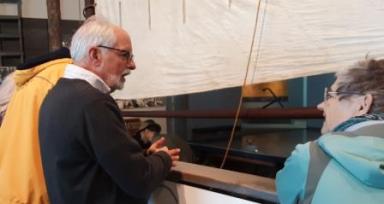 If you are going to spend some time in a small museum on a rainy weekend, it helps if Executive Director happens to be an old friend from college. Dr. Samuel E. Johnson and I had more than a few memories dating back to our freshman year Ballroom Dancing classes together. (I took the class to fill a Physical Education requirement; I suspect Sam took it because at that time the ratio of men to women at our college was officially 3.5 / 1, and it was chance to meet girls.)

 We are all familiar with pictures of the


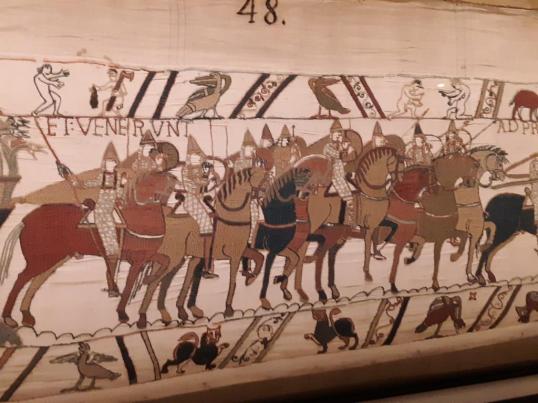 Bayeux was the first French city to be liberated by Allied Forces. Troops marched into the city on a street bordered with cheering townsfolk who waved French and American flags, and offered kisses from happy young women and fresh baked treats from older ones. The Germans evacuated so quickly that they had no time to organize a defense, so the most of the medieval structures remained intact.
 We first stopped at Bayeux Cathedral, with its mix of old and new stained glass, its ornate Gothic verticality, its mystic paintings decorating the crypt beneath the alter. The apse was decked in French tricolor, British Union Jacks, Canadian maple leafs, and American stars and stripes. Behind the altar there was a large concert band practicing for Prince Charles’ visit the following day (Wed. June 5). This was a truly excellent brass ensemble, plus some woodwinds and tympani. The sound reverberating through the cathedral was thrilling. One piece was “The Spitfire Overture” and another, appropriate for a visiting Brit, was the lovely, noble main theme from “Jupiter” from “The Planets” by Gustav Holst. My partner, a music-lover with bad knees, stayed in the church for the whole rehearsal while I wandered around the side chapels and lower levels.


 Right across from the cathedral is an old store front set us as a
  Of course, Bayeux is most famous for that other artifact of war, the


 I had the good fortune to be among the 12,000 + invited guests at the 75th anniversary ceremonies commemorating the D-Day landings in Normandy.
 We were among the last 4000 to arrive at the American Cemetery, and the stage and podium seemed several football fields away in the distance. But giant Jumbotron screens gave us close up views of Air Force One (both jet and helicopter) and its occupants as they landed, and of President Trump’s ceremonial greeting of guests President and Mrs. Macron onto what is considered American soil.


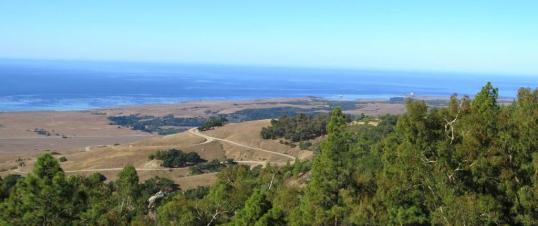 The weather was perfect: warm, no fog or wind, as we left Hearst Castle.

 Further up the road there was an even bigger slide, with an obviously temporary one-lane road perched nervously across the new ground. But it was fascinating to watch the big diggers roaming and scooping atop huge mounds of dirt and stone. And that road remains a marvel of impossible engineering, spectacular vistas, and a maddening plodding pace behind the inevitable road boulder, often a “Rent-Me-RV” whose first-time RV driver is scared to death of his rig and the road. And they won’t pull out to let the long line of vehicles behind them to pass, which is the law, or, if it isn’t, there oughta be.
 We had perfectly an ordinary breakfast at Cambria’s


 Some of the acquisitions were puzzling – what was the meaning of the Arabic writing in mosaic tile positioned over the player piano in the alcove off the billiard room? The guide was too far away to ask, so this remans a mystery.
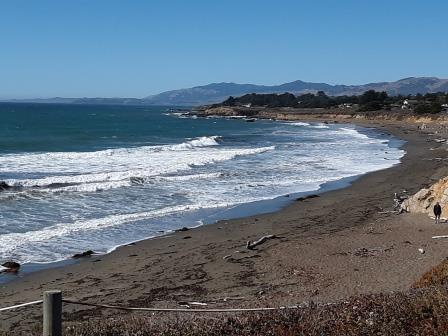


 We took the remains of a bottle of local Pinot Noir back to our balcony to finish off the evening with the complimentary chocolate chip cookies from our check- in desk. We sat on our balcony again to watch the crescent moon setting near where the sun had set before our dinner. Suddenly stars! The Milky Way! D even saw a shooting star. Only one spotlight shining on the entry sign for our hotel spoiled the dark sky.
 Did I mention that Bilbao is the unofficial capital of the Basque region of Spain? I am a little bit familiar with Basque family-style dining due to the heritage of Basque shepherds which has been perpetuated in part of northern California. But nothing had prepared me for the pintxos (appetizer plate) bars which are the pride of Bilbao and San Sebastian. Above you see a typical spread (pardon me and my spouse for having partially blocked the view).


 Allyson Johnson