Arturo Perez-Reverte has constructed a marvelous mystery which spans centuries. One mystery involves the restoration of a 15th century Flemish painting which depicts a chess game in progress. In the course of the restoration the cryptic inscription “Who killed/took the knight?” is revealed. Does the painting hold the clue to solving a 15th-century murder?
The second mystery develops as Julia, the young art restorer, tries to decipher the painting’s mystery and becomes involved in a series of murders which seem to be related to the painted chess game.
If you are interested in art history, or the miracle of modern art restoration, and have even a passing interest in the game of chess, you will be charmed by this novel. The setting, in Madrid, with some of the key incidents occurring in El Prado, enhances the action perfectly. The solution – without giving the story away, I will say that it is both outrageous and satisfying.
Arles, of course, was one of the stops Vincent van Gogh made while searching for sanity and artistic fulfillment in Provence. After the dark murk of the Netherlands, the bright colors and warm weather seemed to galvanize his artistic expression, but unfortunately did little to stabilize his mercurial mood swings.
Arles was van Gogh’s home for eighteen months, and some of his best-known paintings were executed during that period. Modern Arles has seized on van Gogh’s posthumous popularity by providing posters marking the sites as above.
In Arles, van Gogh lived for a time with Paul Gauguin in the Yellow House which appears in several paintings. This house no longer exists. However, the hospital to which he was committed after he cut off his ear in an alcohol-enhanced rage still exists, its courtyard now filled with post cards, posters, t-shirts, and other memorabilia of the artist’s stay.
Just a block or so away is the cafe where van Gogh and Gauguin hung out. At the time, the cafe was painted a modest beige with brown trim, but that’s not the way van Gogh saw it or painted it. Surprise! the restaurant is now bright yellow with blue trim and yellow awnings, just as van Gogh saw it.
Outside the center of town is Alyscamp, a park centered on an avenue of trees leading to a Romanesque chapel. The trees cannot be painted to match van Gogh’s vision, but it is interesting to compare that vision with reality. in a mental hospital. The park is green and peaceful, with romantic ruins and vistas. The interior of the chapel includes a pool filling the lower lever -not clear whether this is intentional or an accident of age.
As van Gogh’s mental instability grew, Gauguin moved out, and van Gogh’s brother Theo enabled him to relocate to a mental hospital in St. Remy, which still exists. Reading the lists of treatments to which mental patients were subjected at this time is like reading of the Spanish Inquisition. The patients were confined in ice cold baths, bound, beaten, and burned, all with the idea of driving out the devils which had taken over their thoughts and actions.
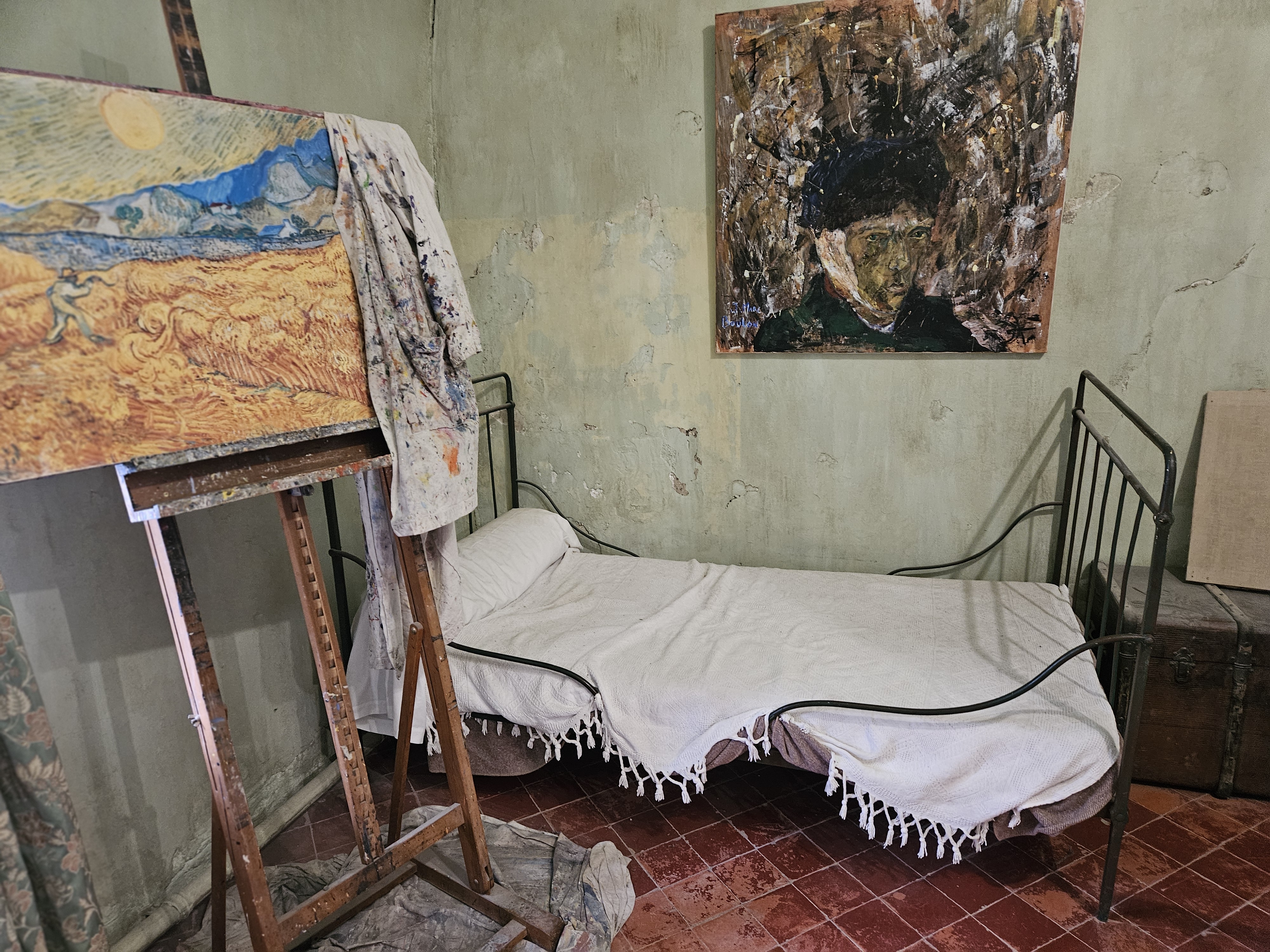
Part of the hospital is still used as an asylum, but one can still see van Gogh’s bedroom and the tubs used for the ice cold baths to reduce his choleric humors.
But outside, one can still see the orchard which inspired his painting, and iris are still blooming in the garden.
Later van Gogh was released from the hospital at St. Remy, and went to stay at Auvers, where he pained perhaps his best-known work “The Starry Night.” He died two days after suffering a gunshot wound. There is controversy about whether the wound was self-inflicted or whether it was the result of an accidental shooting by a group of teenagers who alternately patronized and teased van Gogh.
The leader of the group was the son of the local pharmacist, who owned the only gun in town. The son was prone to dress up in cowboy garb after seeing the Buffalo Bill Wild West show in Paris, and left town abruptly the evening that van Gogh appeared with his gunshot wound. Of course, this theory is not as attractive as the image of the tormented artist driven to suicide by a lack of appreciation, as Don McClain’s “Starry Starry Night” would have it.
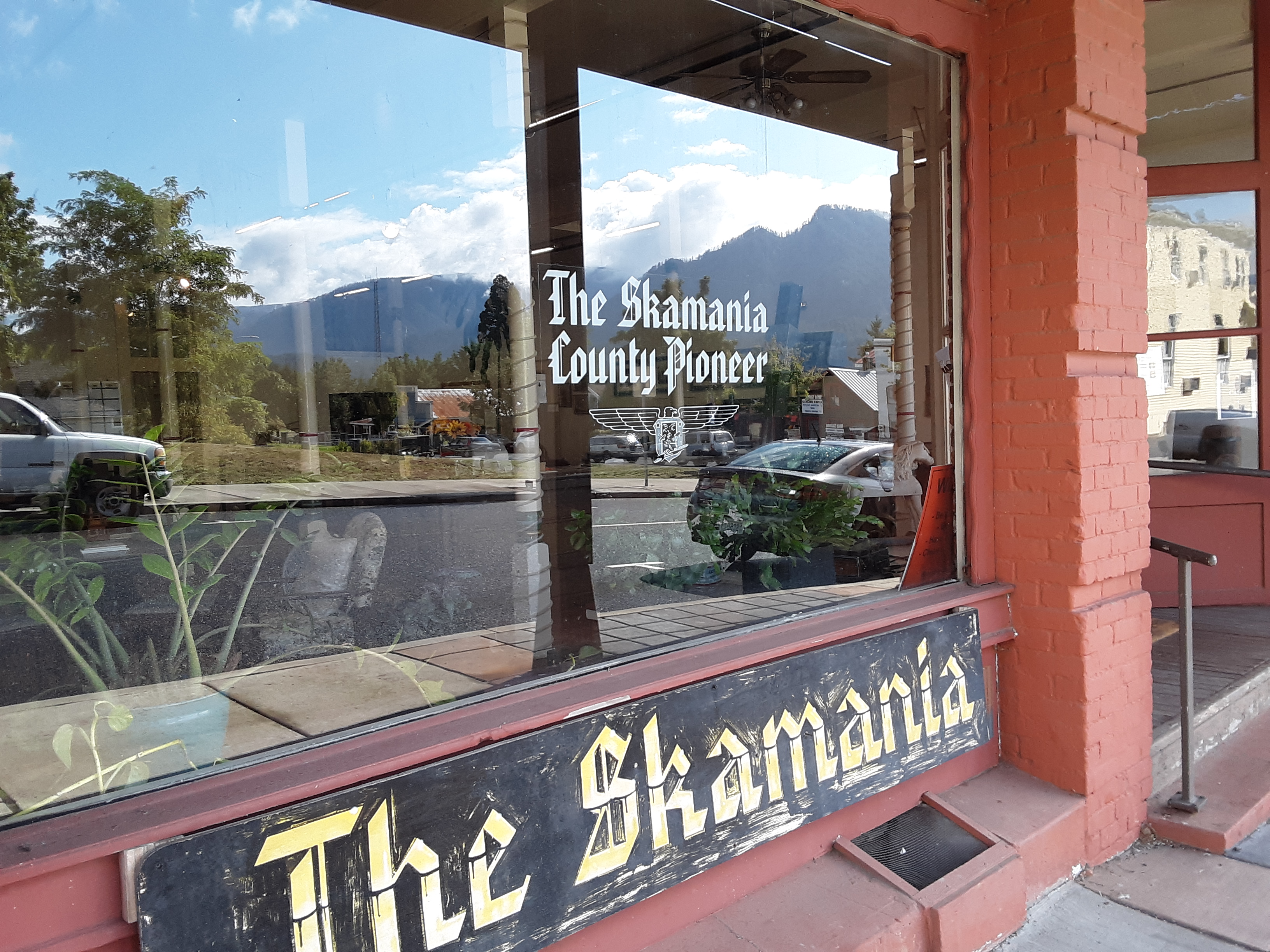
Stevenson Washington is a town of no more than 2000 people, with one main street that stretches from the Port of Skamania boat dock and park along the north bank of the Columbia River up three blocks to the brutally modern Skamania County Courthouse, with two cross streets, one of which is Washington State Route 14. But those three blocks are oddly charming, with shops that would be perfectly at home in an elegant Palo Alto shopping center. How do they survive?
Probably they survive because the boat dock is host several times a week during the summer months to American Cruise Line riverboats, which have picked Stevenson for a stopping point due to its convenient access to the Bonneville Dam, the Columbia Gorge Interpretive Center, and Multnomah Falls. In between excursions, the passengers are tempted to stroll off the boat, through the green and inviting park, and up the gentle hill to browse in North Bank Books, one of the prettiest and best curated bookstores I have ever seen, or examine goods in Out and About, a purveyor of beautifully tailored outdoor clothing, look for buried treasures at the Gorge Thrift Store, or taste a local craft beer at the Big River Grill, admire local art and crafts at Riverhouse III Gallery, or… but you should stop in Stevenson and see for yourself.
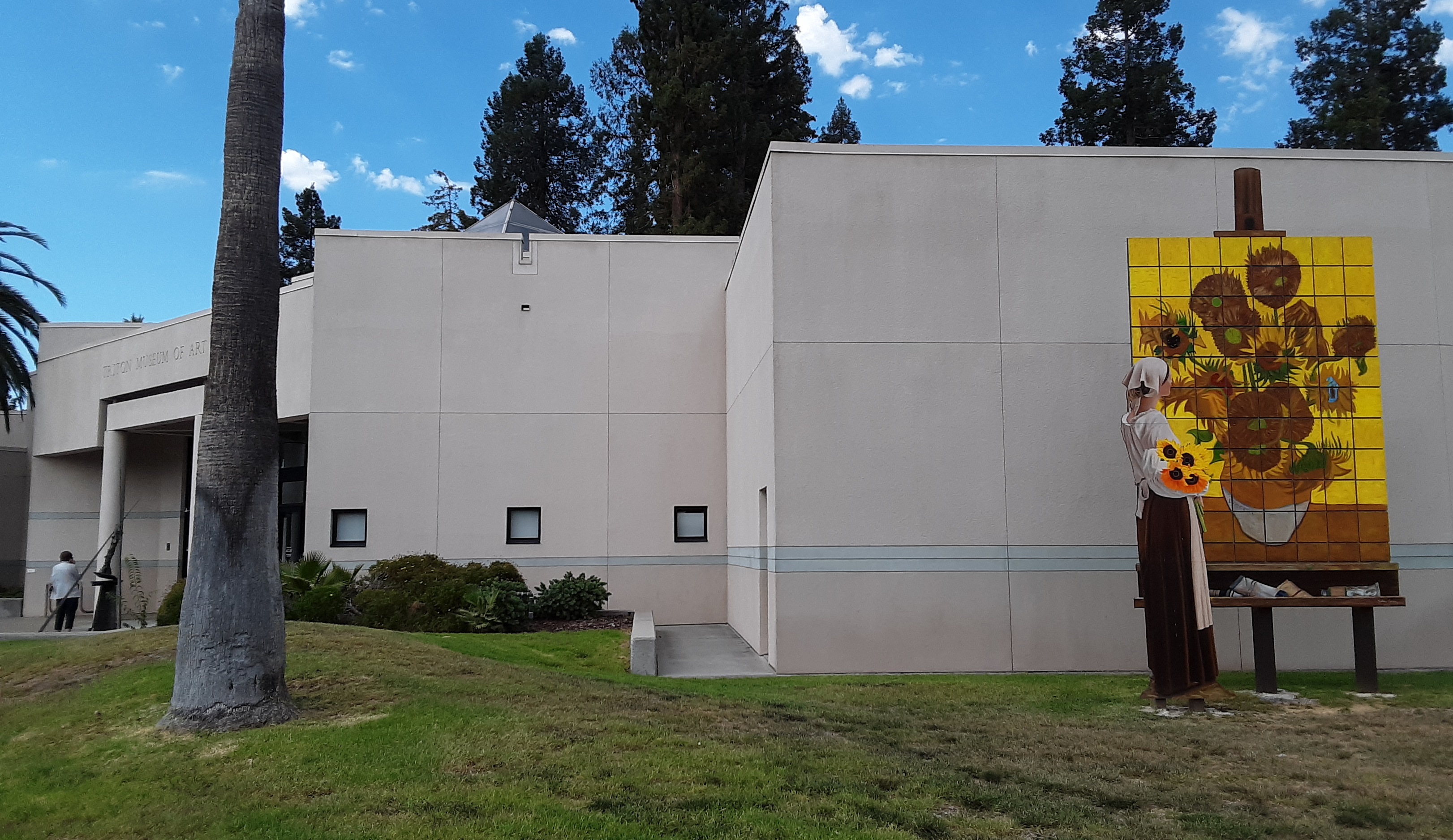
The Triton Museum of Art, tucked away in a quiet corner near the City Hall, is one of the many small museums dotting the Bay Area, and one of the pleasantest. It specializes in contemporary and historical works with an emphasis on artists of the Greater Bay Area. The permanent collection includes 19th and 20th century American art of the Pacific Rim, Europe and beyond plus an extensive collection of American Indian art and artifacts. The museum was founded in 1965 in San Jose, California, by rancher, lawyer and art patron W. Robert Morgan and his wife June.[3][4] It is the oldest non-university museum in Santa Clara County.
On a recent visit, there were four major exhibits being celebrated. The first featured abstract sculptures by Jeff Owen, placed around the lobby in accessible spots. I saw one man taking a picture of his wife peeking through the circle of a sculpture, like one of those carnival sets where you are invited to put your face on a blowup of Marilyn Monroe.
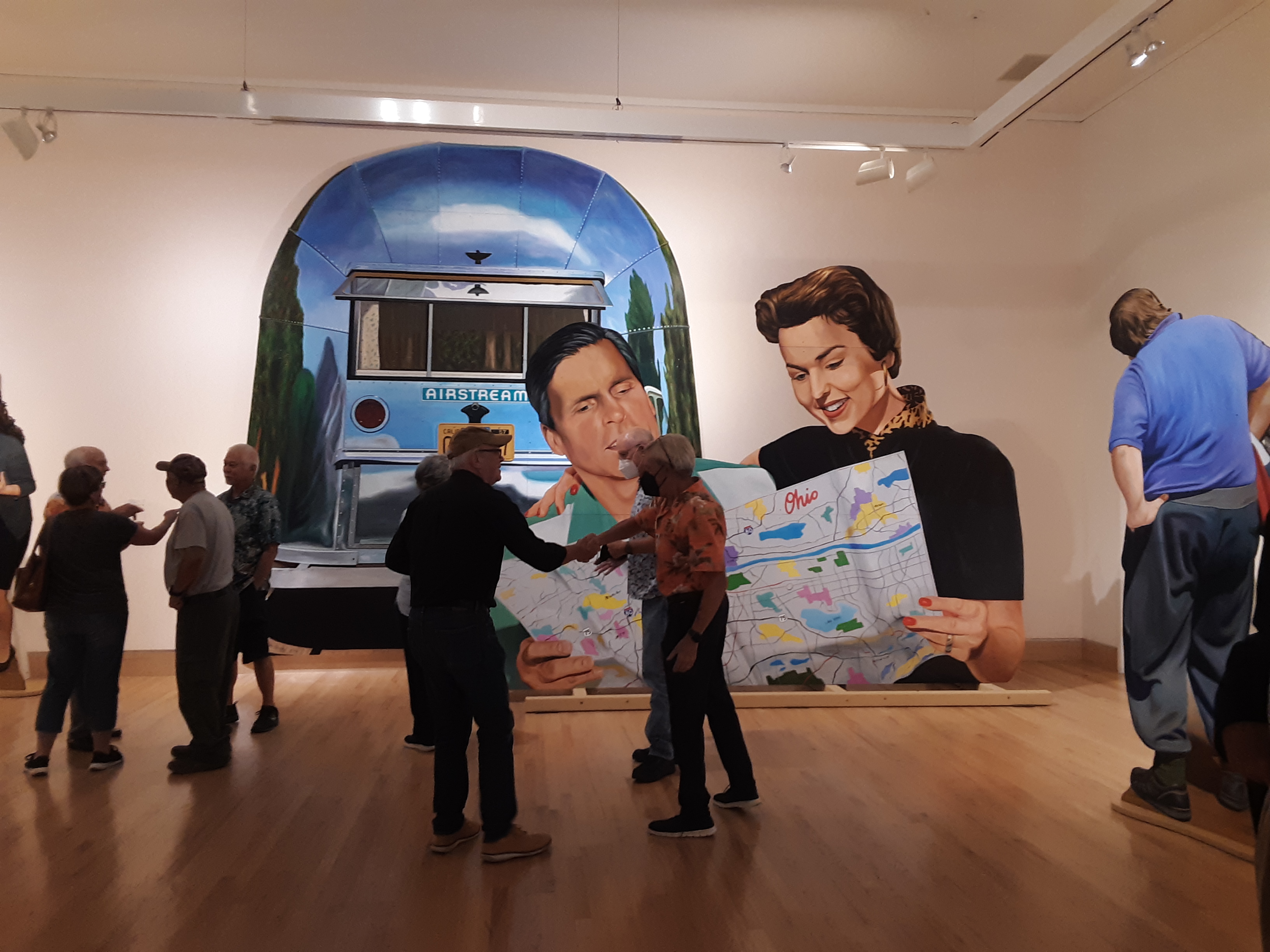
Perhaps she was inspired by the second exhibit, a collection of larger-than-life bill-board-like figures conceived by John Cerney and inviting viewers to make themselves part of the scene.
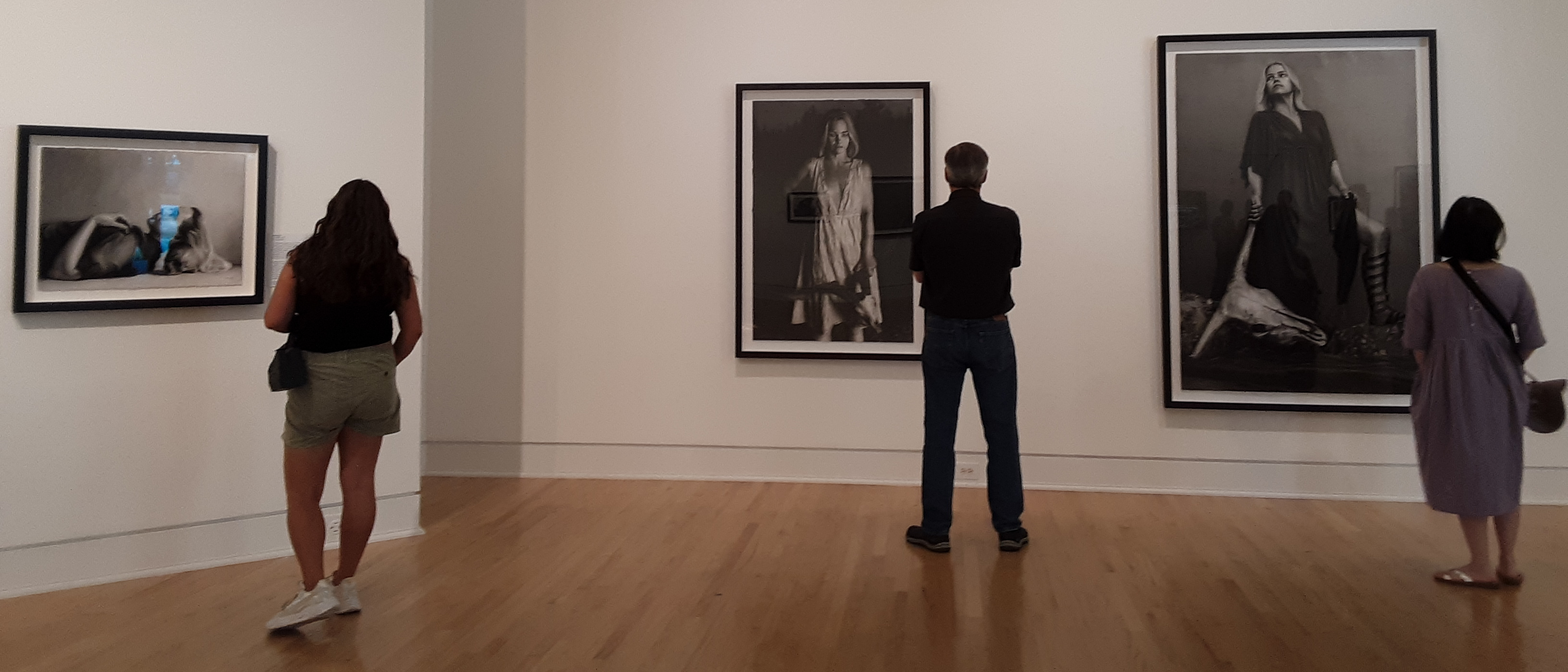
The third exhibit was a series of larger-than-life charcoal drawings, most of them self portraits of the artist Julie Grantz, and embodying a series of feminist themes.
The last and largest exhibit was a roomful of paintings by May Shei, inspired by Chinese tradition. They included calligraphy scrolls, delicate nature vignettes, vibrantly colored still lifes, and monumental landscapes in the style of Zhang Da Qian.
The Triton is perfectly sized to allow appreciation of the diversity of its offerings without wearing the viewer out with an over-supply of stimulation. Admission is free, as is the plentiful parking, though of course donations are encouraged.
W and I agreed on the first day to shift off driving every two hours, although she grew a bit impatient at my refusing to drive faster than 65 on a two-lane road where the posted speed is 75. Texas drivers seem to have no fear of oncoming traffic or soft shoulders. As we move along and I figure out the cruise control I am more daring, but still not able to pass anyone unless there is a passing lane.
The first day my two hours ends in Hamilton at lunch time. Yelp reviews speak well of Garlands, but this turns out to be a little blue trailer kitchen in an RV park, with nary so much as a picnic table to eat at. The fallback is Central Perk, a funky converted home with a wide veranda which would have been charming to sit on if the weather had not been in the 50’s and windy. They were out of soup, and the Veggie Panini was… interesting. Whole wheat bread grilled on one side, with eggplant, zucchini, bell pepper, and onion with a slice of Romano cheese. The cheese was melted, but the vegetables were raw. I’ve never had raw eggplant before, and hope not to ever again. but the rest was surprisingly good, with a copious salad of greens, a tomato, and honey mustard dressing. The wall held several certificates lauding CP as “best sandwiches in four counties” which considering where we were may very well have been true.
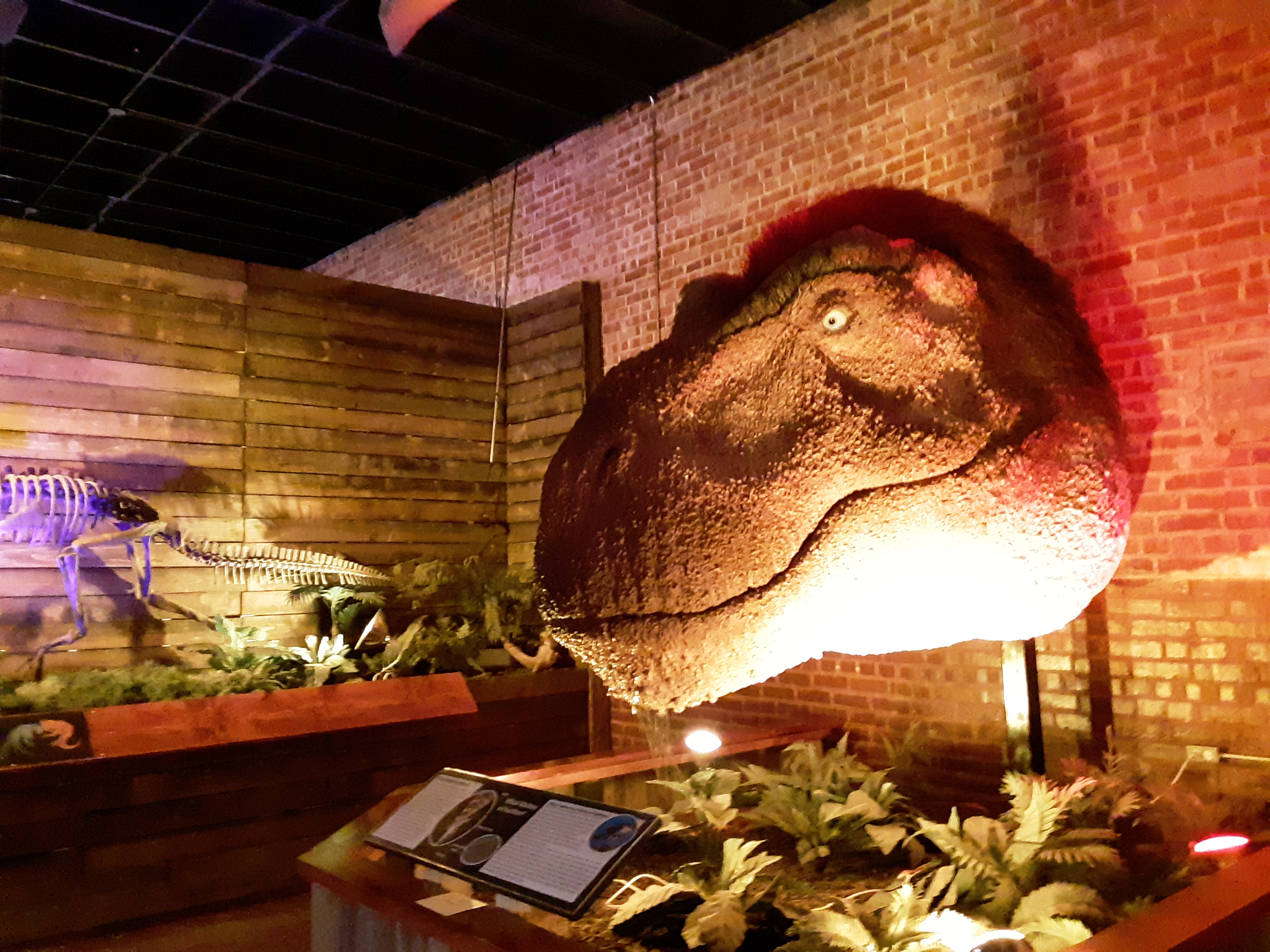
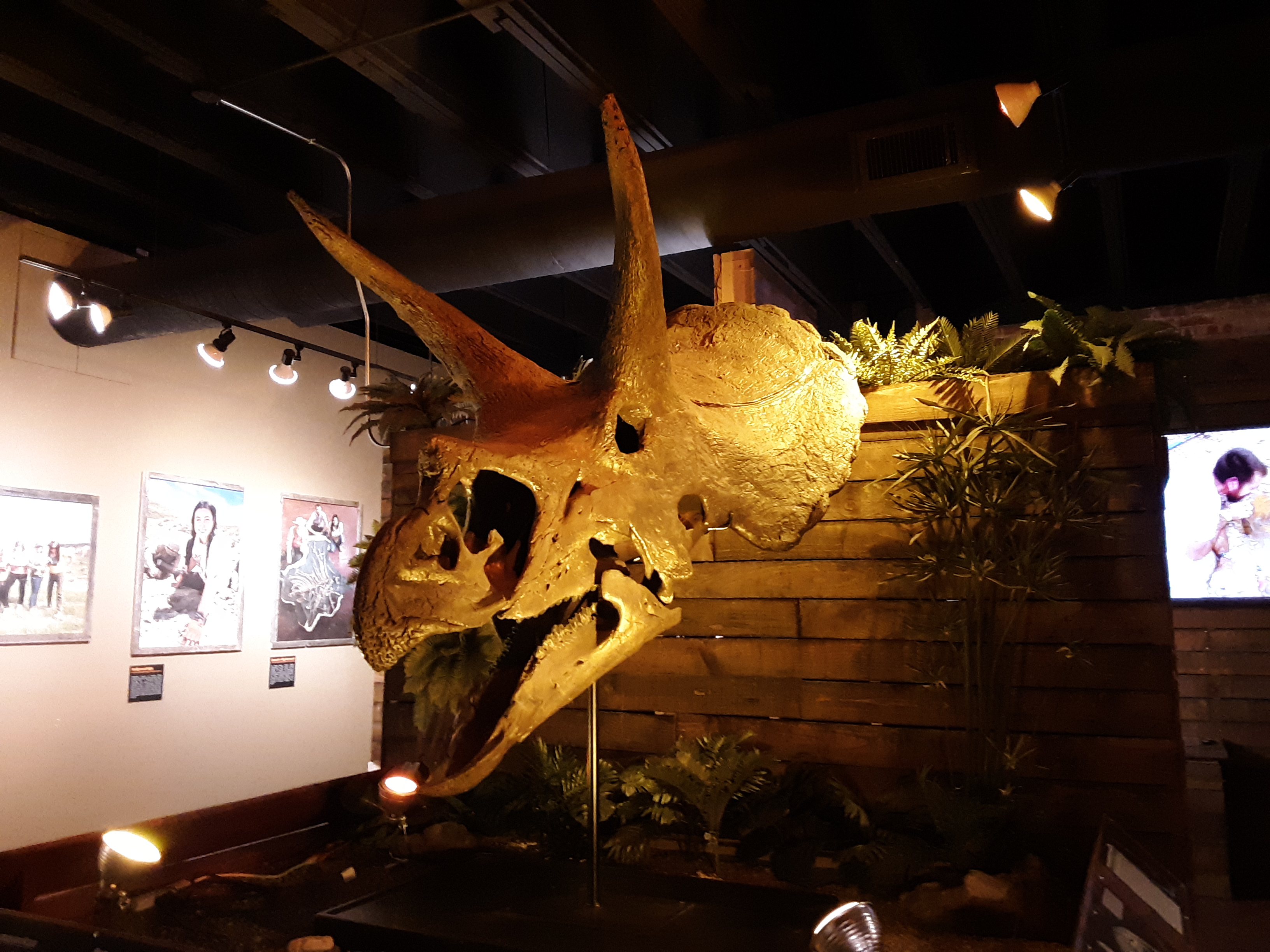
I’m always on the alert for reasons to stop along the way beyond simply natural necessities. Seymour, Texas, strategically located on the way between Archer City and Turkey, boasts the excellent Whiteside Museum of Natural History, with a Sound Garden across the street, in addition to the requisite gas stations. Two busloads of I’d judge third graders were also exploring the museum and the sound garden at the time we dropped in, but their chaperones kept them well in hand, and we dodged around the Pleistocene and Jurassic and other exhibits in avoidance. I’ve not seen a better T Rex simulacrum, the Triceratops skull was awesome, lots of other excellent taxidermy of currently thriving wildlife all around. The only complaint I have is regarding the sole, ridiculously expensive ($2.50) and very ugly post card available in the rudimentary gift shop.
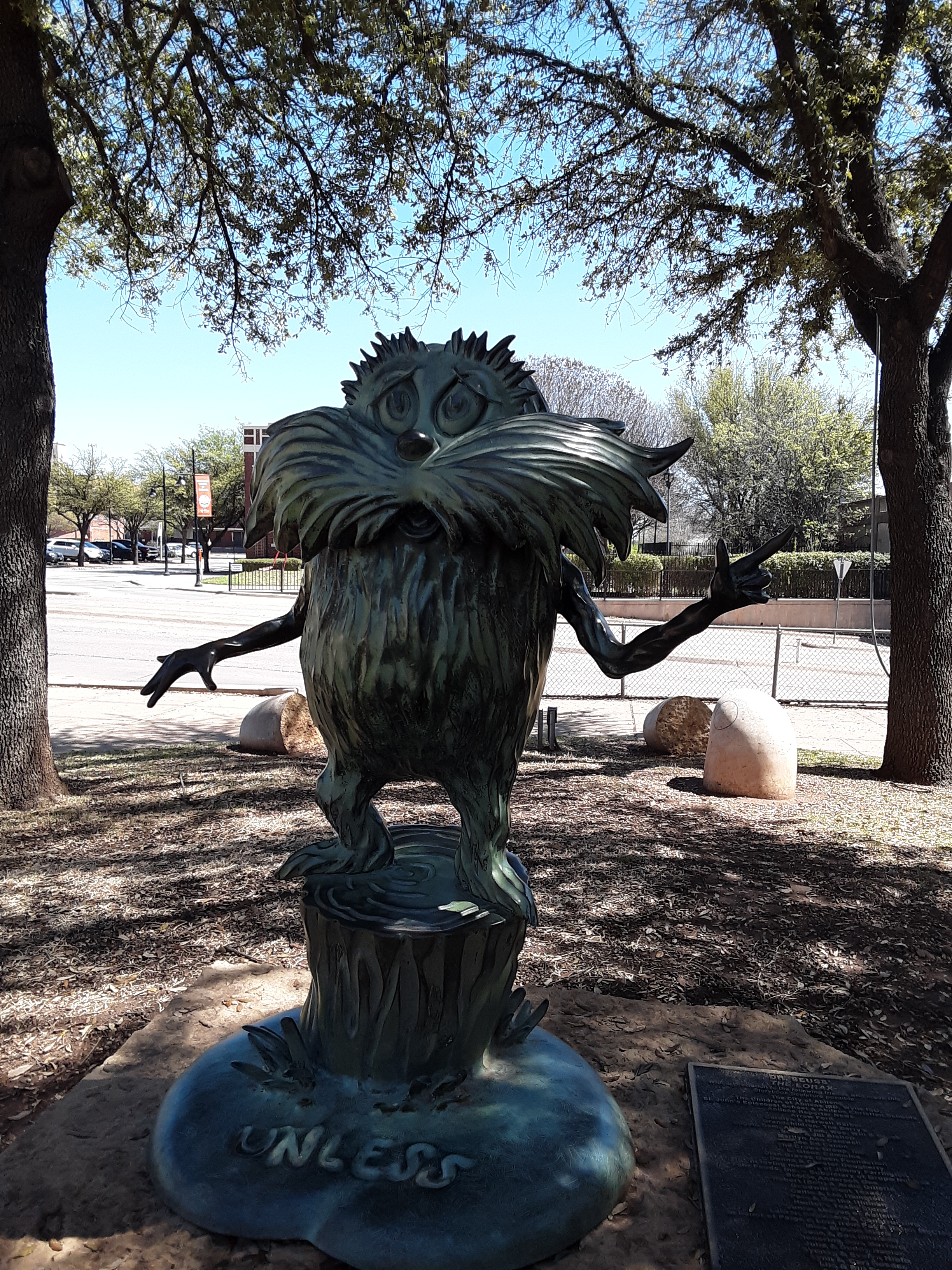
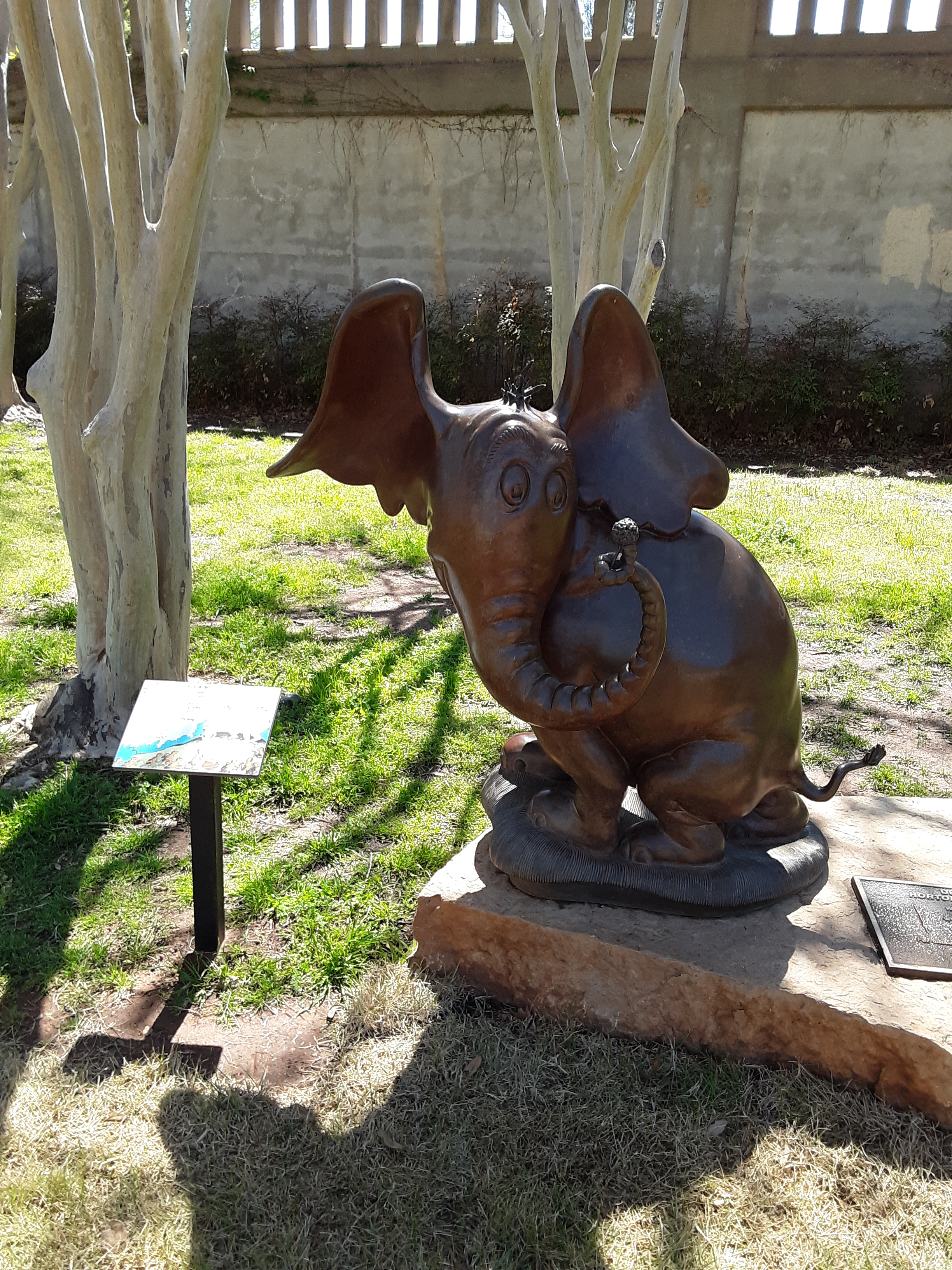
From Turkey we headed east off across the boundless open high plains to Abilene. It seemed odd to see banners in this North Central Texas cattle capital, proclaiming it to be the “Storybook Capital of the World”, but in the downtown area a former commercial building across from the historic railroad station houses the National Center for Children’s Illustrated Literature Illustration, and a number of statues depicting storybook characters can be found on rooftops, on corners, and in parks around the downtown area. We lunched in the Storybook Garden down the street from the museum. next to a statue of the Lorax. The museum itself is fascinating, full of memories of stories I read to my kids as well as stories read to me.
Abilene also boasts of Frontier Texas! a history museum with modern interactive exhibits which also serves as the official Visitors Center for Abilene and the Texas Forts Trail Region. We did not stop here, nor did we take in The Grace Museum, an art museum featuring rotating exhibits of contemporary art and local history, located in a handsome re-purposed circa 1909 hotel in the historic downtown center of Abilene.
Abilene is doing its best to be Somewhere. It’s certainly worth a second stop, the next time we go west from Dallas.
=====
My debut novel, Fox Spirit, is appearing episode by episode on my sister blog, ajmccready.wordpress.com. New episodes arrive every Monday and Thursday. They’re short, so you’re not too late to check them out, and sign up for future happenings. Here’s a link to the first episode: http://ajmccready.wordpress.com/2023/02.
Bayeux was the first French city to be liberated by Allied Forces. Troops marched into the city on a street bordered with cheering townsfolk who waved French and American flags, and offered kisses from happy young women and fresh baked treats from older ones. The Germans evacuated so quickly that they had no time to organize a defense, so the most of the medieval structures remained intact.
We first stopped at Bayeux Cathedral, with its mix of old and new stained glass, its ornate Gothic verticality, its mystic paintings decorating the crypt beneath the alter. The apse was decked in French tricolor, British Union Jacks, Canadian maple leafs, and American stars and stripes. Behind the altar there was a large concert band practicing for Prince Charles’ visit the following day (Wed. June 5). This was a truly excellent brass ensemble, plus some woodwinds and tympani. The sound reverberating through the cathedral was thrilling. One piece was “The Spitfire Overture” and another, appropriate for a visiting Brit, was the lovely, noble main theme from “Jupiter” from “The Planets” by Gustav Holst. My partner, a music-lover with bad knees, stayed in the church for the whole rehearsal while I wandered around the side chapels and lower levels.
Right across from the cathedral is an old store front set us as a Lace Museum, with lovely examples of the prototypically Breton/Norman craft. Unfortunately, I have since read that the Lace Museum is in danger of being closed, as it is funded by the city of Bayeux and patronage has been light. So don’t forget to stop in!
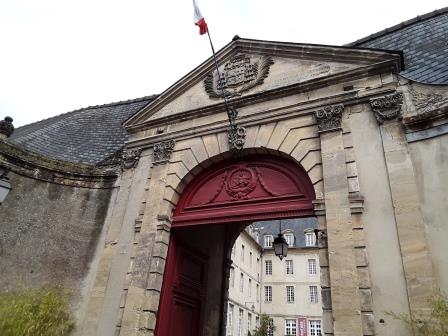
Just down the street is a more modern museum of Breton arts and crafts, housed in a former bishop’s palace, with lovely landscape paintings, more lace samples, and a well-stocked gift shop offering post cards and booklets about the medieval city, its role in World War II, and its artistic heritage.
Of course, Bayeux is most famous for that other artifact of war, the Bayeux Tapestry, now displayed beautifully in a circular museum which allows the entire 200 feet of embroidered cloth to be shown, accompanied by an audio commentary provided through headsets to each visitor. (This device not only fills you on details a guidebook may have overlooked, but it artfully keeps the visitors moving forward as the audio commentary moves forward to the next panel. No pause button. ) Notice the way the borders complement the action, with dead and dying soldiers, archers, and mythic beast bordering the action-packed cavalry sequences. The Bayeux tapestry is like an early graphic novel, with leading characters easily identified by distinctive dress or hair, and scenes of ribaldry aleternating with the diplomacy and bloodshed. Definitely a Don’t Miss!
We had perfectly an ordinary breakfast at Cambria’s Creekside Garden Diner, which we would probably have liked a lot better if it had been warmer and we had eaten on their attractive creekside patio. There are two breakfast/lunch places in the same Redwood Square shopping center, both recommended by a local as the best options for breakfast – next time we will try the other one. No complaints about the French toast with strawberries I had – but it was ordinary, as was the hole-in-the-wall decor.
Then, for a complete contrast, we headed up the coast for the Grand Rooms Tour of Hearst Castle at San Simeon. We had last visited the Castle several decades ago. Things have changed. There is now an elaborate Visitor’s Center with a movie theater and a number of exhibits relating to Hearst’s parents, the Hearst fortune, Hearst’s travels, and more.
Previously we had been able to drive up close to the castle; now there is a large parking lot near the Visitor’s Center and a shuttle bus which follows a loop driveway through the estate, with a recorded commentary on Hearst’s wildlife collection, riding trails, and so on. We had perfect weather to enjoy the spectacular views of ocean and mountains from inside the bus and from the patios surrounding the castle.
At the steps of the castle we met our excellent guide. We were asked to imagine ourselves as guests just arriving on the front patio of the Castle. Our host might or might not be there to greet us. Meanwhile we marveled at the fountains and statues which surrounded the entry, and the famous Roman swimming pool.
Inside, we saw the tapestry-clad reception room, the expansive dining room with its regal beamed ceilings and proletarian catsup bottles on the table.
The whole place is like a combination of Versailles and San Jose’s Winchester Mystery House. Hearst was constantly acquiring antiquities, constantly planning more building. Only the collapse of his publishing fortune during the Depression halted the expansion of his plans. Some of the items he purchased were never used; some, like the room bought from Gwydir Castle in Wales in a bankruptcy sale, (see my earlier article “Freeway- Free in Wales”) have even been lost.
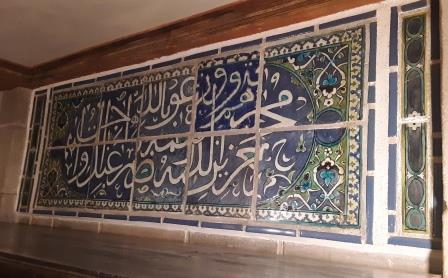
Some of the acquisitions were puzzling – what was the meaning of the Arabic writing in mosaic tile positioned over the player piano in the alcove off the billiard room? The guide was too far away to ask, so this remans a mystery.
Questions had to be asked fast, as the tours are carefully timed – a group could be spied leaving each of the rooms just as we entered, and after the final room (the spectacular indoor swimming pool) we had an option of getting on a bus to descend the hill or wandering a bit more about the grounds. I’d like to go back for a second tour, to see the bedrooms (42) and bathrooms (61)where the guests could stay and relax. But that’s the secret of a great host, to keep you wanting to come back.
Bilbao’s Promenade along the Estuary is anchored at each end by a world-class museum. The Bilbao Fine Arts Museum looks like a traditional museum from the outside – a blockish building with a fountain courtyard, a lobby with a gift shop. Ho hum. But the museum has re-invented itself in competition with its more famous colleague at the other end of the promenade and its exhibit space, when I visited, was among the most interesting and inventive I have seen.
At the time of my visit, the museum had thrown the traditional chronological arrangement of its art right out the window, and had rearranged its El Greco’s, its Goyas, its Gauguin in alphabetical order by subject. So the Gauguin was exhibited under A for ART, taken out of its frame and put between glass panels so you could see the paint smudges on the edges of the canvas, and some scribbles by the artist on the back of the canvas. In the same room were examples of art by paleolithic artists as well as moderns ones. It made me think about the Gauguan in a completely different way.
Here’s a sample of the many pieces of Spanish and European art on view at the Fine Arts Museum:
(The picture on the lower left was taken, of course, in the room labeled “P for Portrait”.)
It was a rainy day when I visited, and I could have happily stayed for hours.
The next day I visited the other end of the Promenade, the Guggenheim Bilbao. This museum is really all about the building. The architecture inside and out is so curvaceously fascinating that the art pieces serve as much to enhance the building as to display themselves. Here’s a sample:
Of course, Bilbao is more than the sum of two museums and a promenade along the estuary. There is an old town. There are modern buildings. I’ll give you a glimpse of that Bilbao next time.
All I knew of Bilbao before arriving was what I learned from Andy Williams in the song about “that old Bilbao moon/I shan’t forget it soon…/While Tony’s beach saloon/Rocked with an old-time tune”.
Whatever Bilbao Andy was singing about has gone, if it ever existed. For one thing, there is no beach at Bilbao; it gained its success as a port because it was situated on a wide river inlet, well away from storms AND sand.
Bilbao was the Pittsburg of Spain, a busy port located near iron deposits, and thus steel mills and manufacturing plants. Like Pittsburg, when the iron gave out, the city verged on collapse. The warehouses emptied, the port facilities were allowed to become outmoded, and manufacturing jobs left for cheaper labor pools.
City visionaries hit on the idea of re-positioning Bilbao as a cultural center, and reclaiming its idle port as a riverside sculpture park and promenade. Someone heard that the Guggenheims were thinking of establishing a satellite museum in Europe, and Bilbao pulled out all the stops to secure this prize. The result: a voluptuously curved Frank Gehry–designed building which is a destination in itself, supplemented by The Museum of Fine Arts (the second largest museum of Spanish art in the country after El Prado in Madrid) at the other end of the promenade,, and between them a lovely open green space bordering the reclaimed river, studded with sculptures, bridges, fountains, playgrounds, and outdoor performance spaces.
Sculptures vary from realistic to very abstract:
The fountains bubble graciously from traditional to naturalistic:
And the playgrounds are well-used (note: the red-capped youth on the rope net are the same ones you can spot starting their school field trip in the first photo above).
So – come to Bilbao for the walk, the outdoor art, the architecture, the parks… and that’s only the first day!
San Jose’s Japantown, centered around the intersection of Jackson and Fifth Restaurant, is one of only three remaining centers of Japanese culture in the US (the other two being in San Francisco and in Los Angeles.) Almost destroyed by the forced internment of most of its citizens during World War II, it has bounced back as a nucleus of Japanese restaurants, shops, and community organizations.
If you go to Japantown, it’s best to start with a good meal. Kubota’s on 5th is an upscale favorite of local Japanese businessmen and their visitors from Japan. I’m a big fan of their chirashi, which comes with a really good tofu salad along with a sizable bowl of rice topped with generous slices of raw fish. If you want a more casual meal you might try Gombei, the sister restaurant around the corner on Jackson, which specializes in sushi.
After lunch, a stroll along 5th street on the other side from Kubota’s will lead you to the San Jose Betsuin Buddhist Temple, with its serene garden inviting some digestive meditation. If you can, enter the temple and admire its beautiful sliding shoji screens, gilded lanterns, and handsome icons.
From the intersection of 5th and Jackson, a stroll up and down Fifth Street gives you a chance to browse in shops featuring Japanese anime action figures and bobble-head toys, music stores featuring Japanese stringed instruments and taiko drums, houseware stores, and a variety of Japanese and Korean restaurants and tea shops.
My favorite is Nichi Bei Bussan – a gift shop which has been in business over 100 years, featuring all things Japanese, including kimono fabric and patterns, whimsically decorated socks designed to be worn with flip-flops or Japanese sandals, beautiful tea sets and platters, origami paper, craft books, gift wraps, Japanese graphic novels and magazines and charming, helpful sales people who will gladly help you find the perfect item.
After shopping, time to reflect on the history of Japantown. Go back down Fifth street past Kubota’s and find the memorial sculpture and garden next to the Nissei Memorial Building housing the Japanese American Citizens League. It’s worth studying each face of the three-sided memorial before visiting the Japanese American Museum just a few doors further down.
The Japanese-American Museum traces the history of Japanese immigrants in the US, from their being imported as easy-to-exploit agricultural laborers to their forced removal to concentration camps during World War II. The museum includes videos, recorded intreviews, and a replica of a family’s space at Manzanar, one of the relocation camps. You cannot spend time in this museum without feeling a bit queasy at how easy it seemed to have been to deprive thousands of U.S. citizens of their rights, even as our country fought against the same arbitrary cruelty as seen in Nazi Germany.
On a lighter note, try to schedule your visit to coincide with one of the special festivals. I recently happened to arrive during the summer Obon Festival, which featured dancers, taiko drummers, men and women in traditional costumes, lots of food and crafts booths, and an open house at the Buddhist temple offering one-hour classes in “Buddhism 101”.











 Bayeux was the first French city to be liberated by Allied Forces. Troops marched into the city on a street bordered with cheering townsfolk who waved French and American flags, and offered kisses from happy young women and fresh baked treats from older ones. The Germans evacuated so quickly that they had no time to organize a defense, so the most of the medieval structures remained intact.
 We first stopped at Bayeux Cathedral, with its mix of old and new stained glass, its ornate Gothic verticality, its mystic paintings decorating the crypt beneath the alter. The apse was decked in French tricolor, British Union Jacks, Canadian maple leafs, and American stars and stripes. Behind the altar there was a large concert band practicing for Prince Charles’ visit the following day (Wed. June 5). This was a truly excellent brass ensemble, plus some woodwinds and tympani. The sound reverberating through the cathedral was thrilling. One piece was “The Spitfire Overture” and another, appropriate for a visiting Brit, was the lovely, noble main theme from “Jupiter” from “The Planets” by Gustav Holst. My partner, a music-lover with bad knees, stayed in the church for the whole rehearsal while I wandered around the side chapels and lower levels.


 Right across from the cathedral is an old store front set us as a
  Of course, Bayeux is most famous for that other artifact of war, the


 We had perfectly an ordinary breakfast at Cambria’s


 Some of the acquisitions were puzzling – what was the meaning of the Arabic writing in mosaic tile positioned over the player piano in the alcove off the billiard room? The guide was too far away to ask, so this remans a mystery.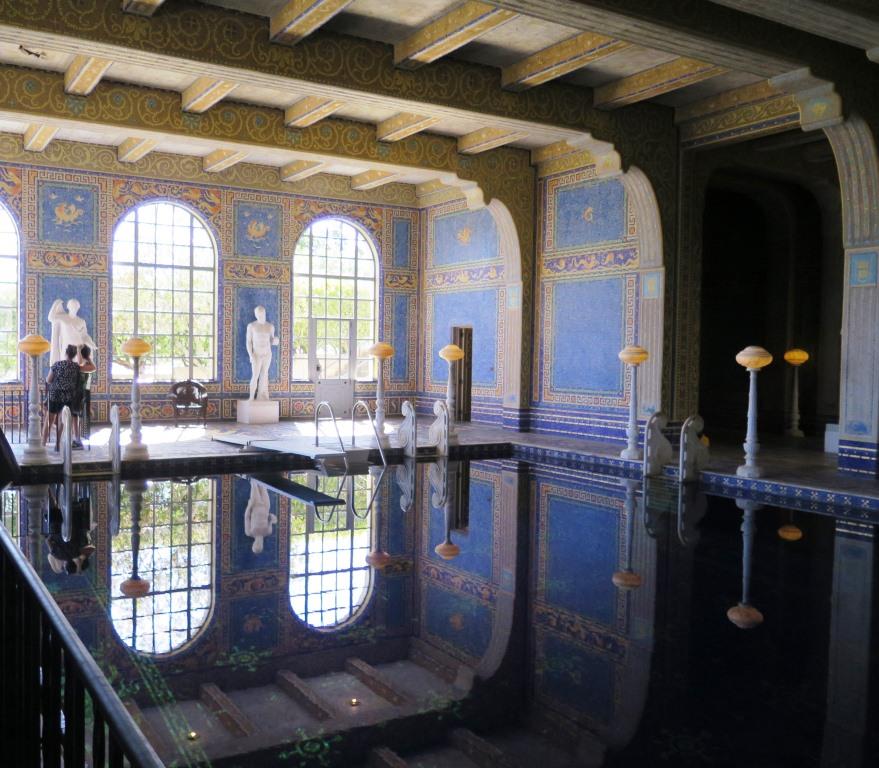


 At the time of my visit, the museum had thrown the traditional chronological arrangement of its art right out the window, and had rearranged its El Greco’s, its Goyas, its Gauguin in alphabetical order by subject. So the Gauguin was exhibited under A for ART, taken out of its frame and put between glass panels so you could see the paint smudges on the edges of the canvas, and some scribbles by the artist on the back of the canvas. In the same room were examples of art by paleolithic artists as well as moderns ones. It made me think about the Gauguan in a completely different way.


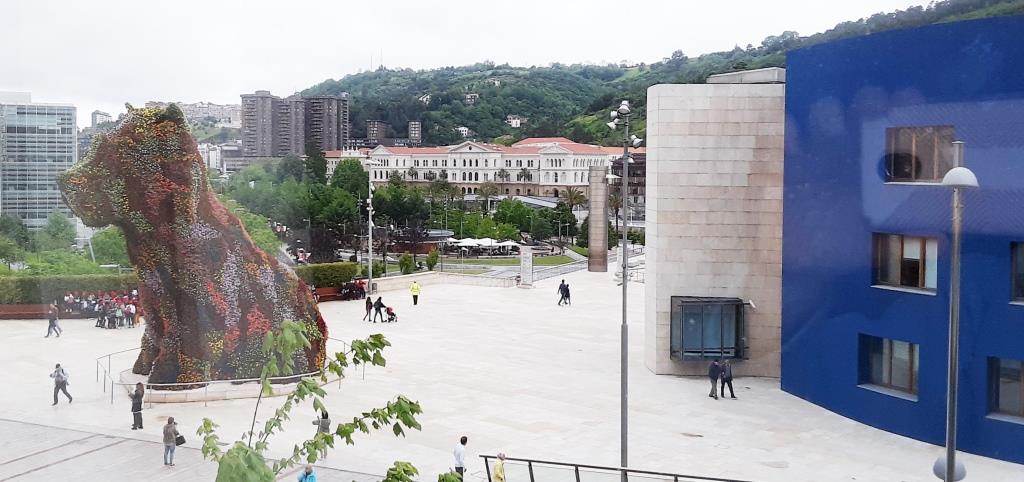


 So – come to Bilbao for the walk, the outdoor art, the architecture, the parks… and that’s only the first day!
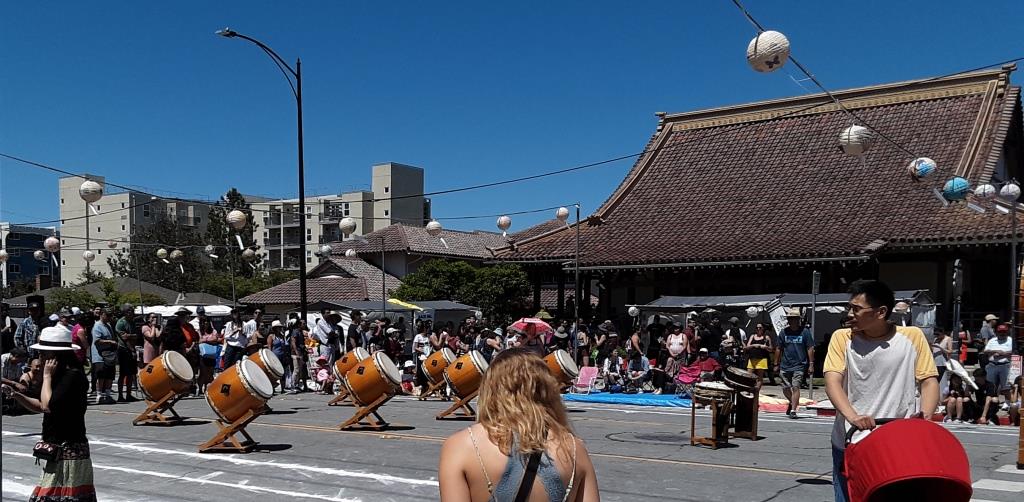 San Jose’s Japantown, centered around the intersection of Jackson and Fifth Restaurant, is one of only three remaining centers of Japanese culture in the US (the other two being in San Francisco and in Los Angeles.) Almost destroyed by the forced internment of most of its citizens during World War II, it has bounced back as a nucleus of Japanese restaurants, shops, and community organizations.
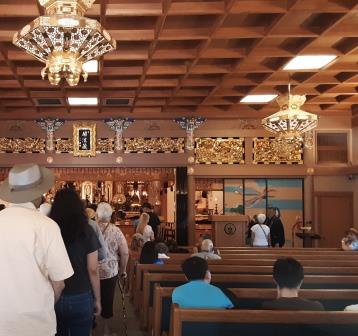 After lunch, a stroll along 5th street on the other side from Kubota’s will lead you to the


 Allyson Johnson