Freeway Free in France: Tales of War in Bayeux
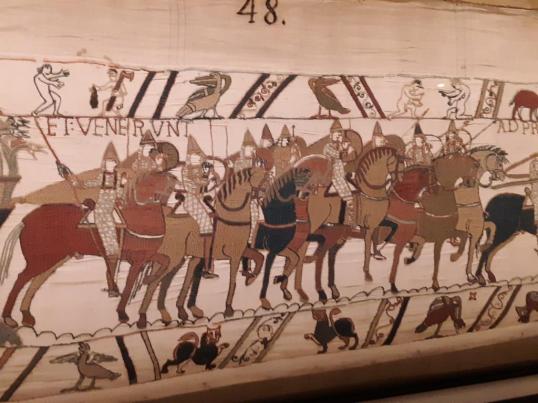 Bayeux was the first French city to be liberated by Allied Forces. Troops marched into the city on a street bordered with cheering townsfolk who waved French and American flags, and offered kisses from happy young women and fresh baked treats from older ones. The Germans evacuated so quickly that they had no time to organize a defense, so the most of the medieval structures remained intact.
 We first stopped at Bayeux Cathedral, with its mix of old and new stained glass, its ornate Gothic verticality, its mystic paintings decorating the crypt beneath the alter. The apse was decked in French tricolor, British Union Jacks, Canadian maple leafs, and American stars and stripes. Behind the altar there was a large concert band practicing for Prince Charles’ visit the following day (Wed. June 5). This was a truly excellent brass ensemble, plus some woodwinds and tympani. The sound reverberating through the cathedral was thrilling. One piece was “The Spitfire Overture” and another, appropriate for a visiting Brit, was the lovely, noble main theme from “Jupiter” from “The Planets” by Gustav Holst. My partner, a music-lover with bad knees, stayed in the church for the whole rehearsal while I wandered around the side chapels and lower levels.


 Right across from the cathedral is an old store front set us as a Lace Museum, with lovely examples of the prototypically Breton/Norman craft. Unfortunately, I have since read that the Lace Museum is in danger of being closed, as it is funded by the city of Bayeux and patronage has been light. So don’t forget to stop in!
Just down the street is a more modern museum of Breton arts and crafts, housed in a former bishop’s palace, with lovely landscape paintings, more lace samples, and a well-stocked gift shop offering post cards and booklets about the medieval city, its role in World War II, and its artistic heritage.
 Of course, Bayeux is most famous for that other artifact of war, the Bayeux Tapestry, now displayed beautifully in a circular museum which allows the entire 200 feet of embroidered cloth to be shown, accompanied by an audio commentary provided through headsets to each visitor. (This device not only fills you on details a guidebook may have overlooked, but it artfully keeps the visitors moving forward as the audio commentary moves forward to the next panel. No pause button. ) Notice the way the borders complement the action, with dead and dying soldiers, archers, and mythic beast bordering the action-packed cavalry sequences. The Bayeux tapestry is like an early graphic novel, with leading characters easily identified by distinctive dress or hair, and scenes of ribaldry aleternating with the diplomacy and bloodshed. Definitely a Don’t Miss!


 I had the good fortune to be among the 12,000 + invited guests at the 75th anniversary ceremonies commemorating the D-Day landings in Normandy.
 We were among the last 4000 to arrive at the American Cemetery, and the stage and podium seemed several football fields away in the distance. But giant Jumbotron screens gave us close up views of Air Force One (both jet and helicopter) and its occupants as they landed, and of President Trump’s ceremonial greeting of guests President and Mrs. Macron onto what is considered American soil.


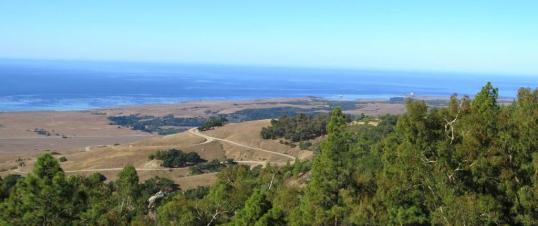 The weather was perfect: warm, no fog or wind, as we left Hearst Castle.

 Further up the road there was an even bigger slide, with an obviously temporary one-lane road perched nervously across the new ground. But it was fascinating to watch the big diggers roaming and scooping atop huge mounds of dirt and stone. And that road remains a marvel of impossible engineering, spectacular vistas, and a maddening plodding pace behind the inevitable road boulder, often a “Rent-Me-RV” whose first-time RV driver is scared to death of his rig and the road. And they won’t pull out to let the long line of vehicles behind them to pass, which is the law, or, if it isn’t, there oughta be.
 We had perfectly an ordinary breakfast at Cambria’s


 Some of the acquisitions were puzzling – what was the meaning of the Arabic writing in mosaic tile positioned over the player piano in the alcove off the billiard room? The guide was too far away to ask, so this remans a mystery.


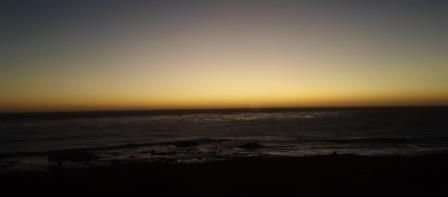
 We took the remains of a bottle of local Pinot Noir back to our balcony to finish off the evening with the complimentary chocolate chip cookies from our check- in desk. We sat on our balcony again to watch the crescent moon setting near where the sun had set before our dinner. Suddenly stars! The Milky Way! D even saw a shooting star. Only one spotlight shining on the entry sign for our hotel spoiled the dark sky.
 Did I mention that Bilbao is the unofficial capital of the Basque region of Spain? I am a little bit familiar with Basque family-style dining due to the heritage of Basque shepherds which has been perpetuated in part of northern California. But nothing had prepared me for the pintxos (appetizer plate) bars which are the pride of Bilbao and San Sebastian. Above you see a typical spread (pardon me and my spouse for having partially blocked the view).


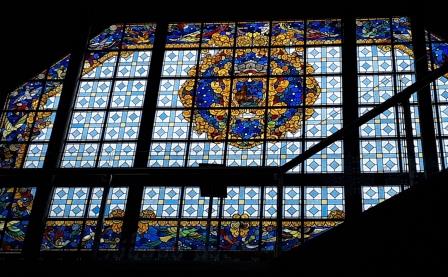


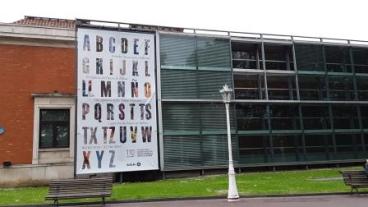 At the time of my visit, the museum had thrown the traditional chronological arrangement of its art right out the window, and had rearranged its El Greco’s, its Goyas, its Gauguin in alphabetical order by subject. So the Gauguin was exhibited under A for ART, taken out of its frame and put between glass panels so you could see the paint smudges on the edges of the canvas, and some scribbles by the artist on the back of the canvas. In the same room were examples of art by paleolithic artists as well as moderns ones. It made me think about the Gauguan in a completely different way.


 So – come to Bilbao for the walk, the outdoor art, the architecture, the parks… and that’s only the first day!
 The
The 


 Allyson Johnson