 I have mentioned before on this blog that I am something of a connoisseur of libraries. A few weeks ago I had the chance to explore a local GEM, as Stanford University celebrated the 100th Birthday of its Main Library (now known, in Stanford’s frenzy of naming buildings after wealthy donors, as the Bing Wing of the Green Library).
The stately façade, with its Façade obscured by renovation scaffolding but we were assured that the look would remain unchanged, including Stanford’s trademark rough-hewn sandstone and terra-cotta roof tiles. After a barbecue buffet and birthday cake, we were escorted into the library in groups for guided tours of the exhibits.
But here’s the secret: you don’t need an invitation or a tour guide to explore the marvels of the Main – all you need to register for use is a government-issued photo ID, which gives you seven days a year of access at no charge. Access to what? you may ask. Let’s explore.
 Register at the entry inside the big wooden doors of the Main Library. Then head up the stairs to the rotunda. On the day of the birthday, there was a harpist playing near the center of the rodunda, the delicate sounds reverberating in the giant space. When I was a student, the Stanford Choir would give impromptu concerts on the stairs, especially wonderful at Christmas time, when we were swotting away in preparation for final exams.
I f there is no harpist, turn left into the spacious reading room. In earlier days it served as the Reserve Book Room where students waited their turn to read the assigned texts for Western Civ and other limited-access materials. Hoover Tower looms just out the windows. As a student, I remember watching from the Reserve Book Room as suicide-prevention grates were lifted up to install at the top-most level. Stanford legend holds that someone studying in the RBR looked up from his textbook and and actually saw that guy fall. 
Currently, the space where I used to wait impatiently for my number to come up is known as the Lane Reading Room, and as one of the best spots to study on campus.
At the entrance is a fascinating clock, which looks like a fishbowl with a globe somehow floating magically in the middle. A fish points to the correct time. Along the walls are portraits of past presidents of Stanford, most posed staidly in suits or academic robes. My favorite is of Gerhard Caspar, the German iconoclast who came in to shake things up in the 80’s. It’s the only one that looks like the artist or the subject were enjoying the process
If you come back to the rotunda and go left away from the stairs, you will end up in the newer part of the Green Library, which is much less interesting, in my view. Instead, go straight across the rotunda and look for the stairs on the right, leading up to the Romsey Map Room.
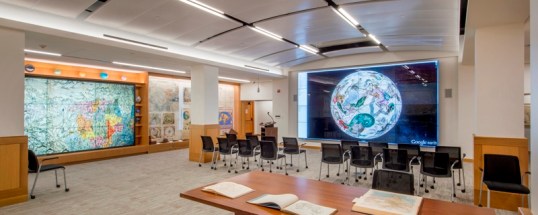 The stairs alone are worth the price of admission, as each wall is covered with giant reproductions of antique maps and charts, covering everything from a visual representation of the longest rivers on earth vs the highest mountains, to a 3-D rendering of Manhattan Island in the 50’s, and much more.
The Romsey Map Room itself is a magic place where you can seemingly travel through time and space, thanks to the technology of Google Earth combined with Stanford’s amazing collection of maps and globes.
If you need a rest after zooming in and out with Google Earth, exit the back door of the Map Room and take the elevator up to the fifth floor, where you can rest up in the Bender Room, one of the most peaceful retreats on campus. It has deep leather chairs, capable reading lamps, and windows allowing you to look out of the Main’s front windows over the Quad.
Display cases around the rotunda and in the Bender Room often display special exhibits featuring treasures from Stanford’s collection. If you want more personal access, you can check out the digital catalogue, and even order up an arcane book for perusal. (I was excited to find a childhood favorite, The Magic Doll of Roumania, long out of print and invisible on Amazon’s and Ex Libris websites, listed in the catalog. I put in a request, and three days later I was invited to come up and examine the book at my leisure. I couldn’t take it out of the building, but if I needed more than a couple of hours, they would be glad to hold it for me for several days. Amazing!) Spend some time, and see what treasures you can unearth!
 We are all familiar with pictures of the American Cemetery in Normandy, with its rows of white crosses stretching into the distance. I had not known that the United States was the only combatant in World War II which offered families of its dead an option to repatriate their remains for burial in the US. The nine thousand plus graves at the American Cemetery are only a third of the fallen. These are those soldiers who had no family, or whose families lacked means or desire to hold funeral rites at home, so they preferred to let the government bury their dead.


 I had the good fortune to be among the 12,000 + invited guests at the 75th anniversary ceremonies commemorating the D-Day landings in Normandy.
 We were among the last 4000 to arrive at the American Cemetery, and the stage and podium seemed several football fields away in the distance. But giant Jumbotron screens gave us close up views of Air Force One (both jet and helicopter) and its occupants as they landed, and of President Trump’s ceremonial greeting of guests President and Mrs. Macron onto what is considered American soil.


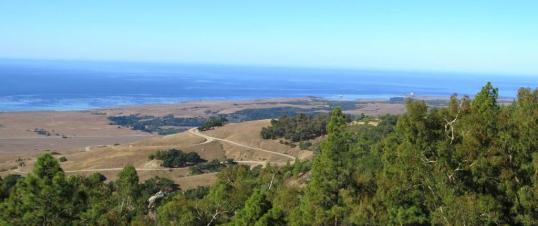 The weather was perfect: warm, no fog or wind, as we left Hearst Castle.

 Further up the road there was an even bigger slide, with an obviously temporary one-lane road perched nervously across the new ground. But it was fascinating to watch the big diggers roaming and scooping atop huge mounds of dirt and stone. And that road remains a marvel of impossible engineering, spectacular vistas, and a maddening plodding pace behind the inevitable road boulder, often a “Rent-Me-RV” whose first-time RV driver is scared to death of his rig and the road. And they won’t pull out to let the long line of vehicles behind them to pass, which is the law, or, if it isn’t, there oughta be.
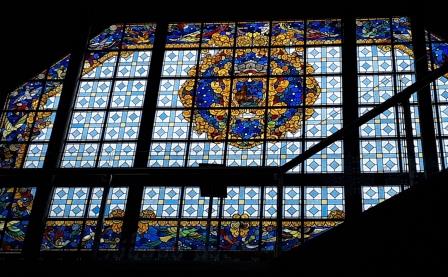


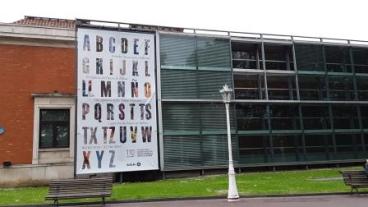 At the time of my visit, the museum had thrown the traditional chronological arrangement of its art right out the window, and had rearranged its El Greco’s, its Goyas, its Gauguin in alphabetical order by subject. So the Gauguin was exhibited under A for ART, taken out of its frame and put between glass panels so you could see the paint smudges on the edges of the canvas, and some scribbles by the artist on the back of the canvas. In the same room were examples of art by paleolithic artists as well as moderns ones. It made me think about the Gauguan in a completely different way.


 OK, I’m cheating a little. We actually spent quite a bit of time on the freeway on our way to the Big Bend area of west Texas – there is no other way to get there.
 So off we go out of Austin and past places that we have visited before, into the unknown spaces of the Big Bend country of southwest Texas. We move out of the area where bluebonnets and scarlet paintbrush are blooming and into an area where odd geological formations punctuate the skyline like very broad pencils with sharp tips. Scattered yuccas bloom like pale torches among the scrubby bushes. The occasional farm augments its income with pumpjacks in the valleys and windmills on the ridges, hedging its bets between the old energy and the new.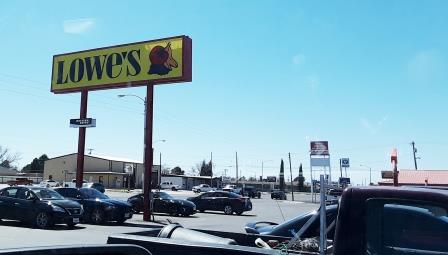



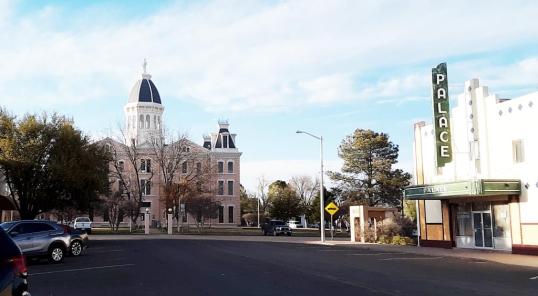 Marfa, in the Big Bend Country of Texas, is the home of the mysterious
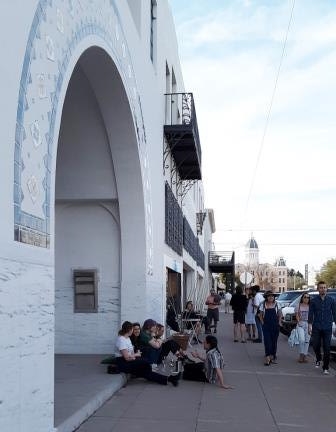
  But the real mystery of Marfa is not the lights, but how a town of scarcely 3000 manages to maintain not just the grand old


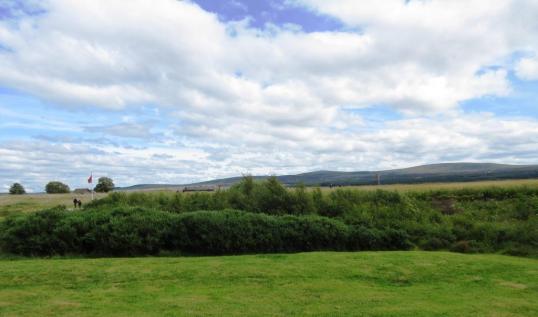 Why do we yearn over battlefields and lost causes? At the Battle of Gettysburg, the High Water Mark of the Confederacy gets more photos than any other monument. Even on our cruise in Alaska we toured a battlefield – the last stand of the Kwakiutls or some such. We are in awe of places where lots of young men died for reasons they and we no longer understand. And here we are at Culloden, where young Scotsmen in kilts wielded swords and battle axes against British cannon and riflery, and died bravely for a prince who escaped the carnage and lived out a wastrel life in Italy. .


 You see, you understand.
 Allyson Johnson