Freeway Free in California: A Serene Escape from COVID-19 Stress
 I live in a COVID-19 hotspot – 43 cases and one death since the beginning of March – and public and private events are being cancelled left and right to prevent transmission. So what is one to do if you are healthy, not in one of the “vulnerable” groups, and needing some relief from the stress of it all? Maybe it’s time to visit a local museum.
The Asian Art Museum in San Francisco is one of my favorites. I visited this week and found plenty of parking in the Civic Center Garage ($12.00 for 5 hours), two featured exhibits of great interest, no crowds, and decent food at the museum restaurant. And if you are looking for stress relief, Asian art is all about serenity.
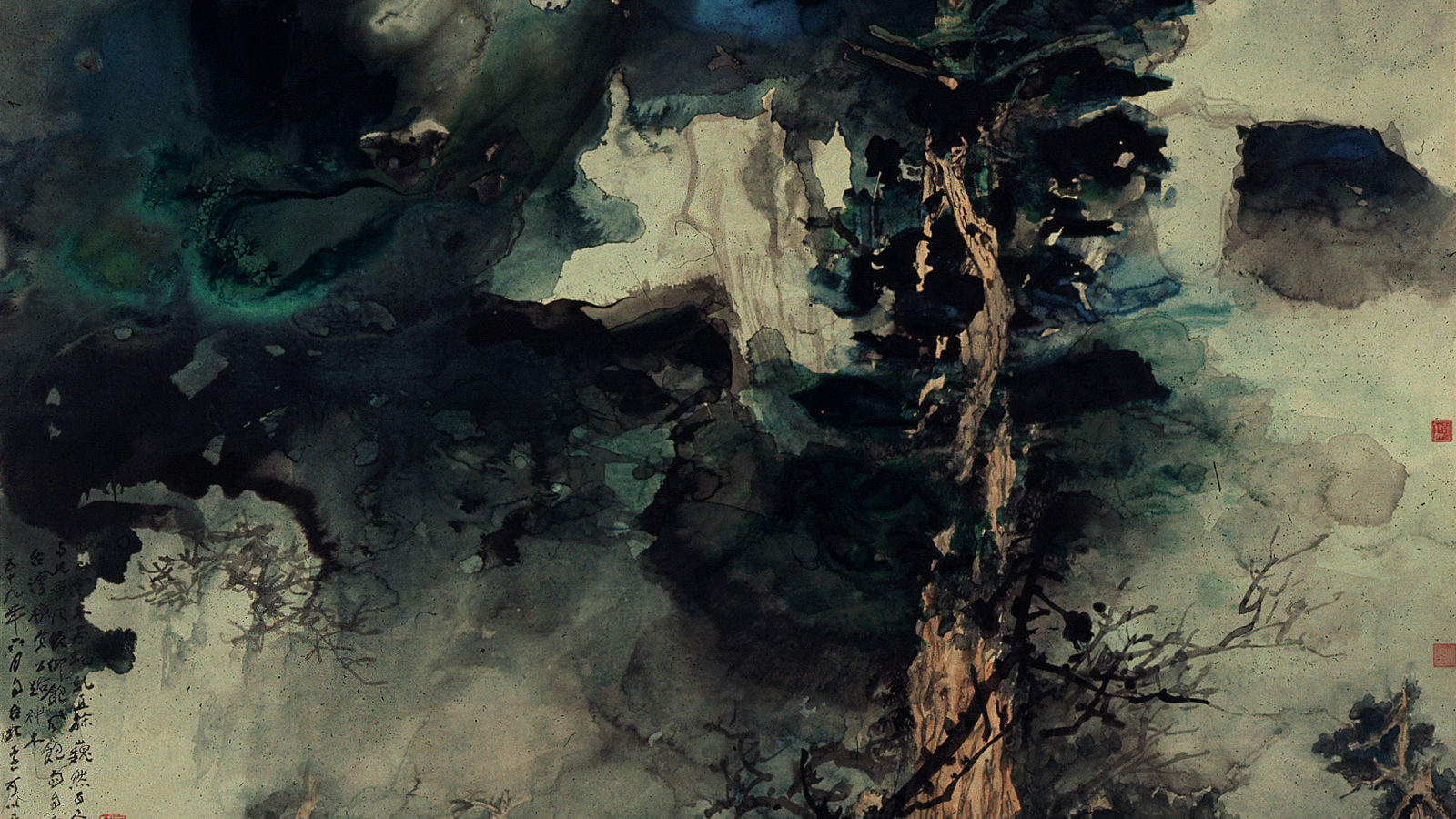
 The exhibit that drew me to the museum featured Zhang Da Qian (Chiang Dai-Chien in traditional transcription) who was the Pablo Picasso of 20th Century Chinese art. His work spans styles ranging from impeccable copies of venerated Chinese master artists of the past, to modern splash-ink impressions worthy of Jackson Pollock. He lived in mainland China, Brazil, Argentina, Taiwan, and California, and in each venue did his best to promote appreciation of Chinese art. One of the featured works in this exhibit is titled “Scholars on a wilderness path”, but the giant monolith in the background must be Half Dome.
Other paintings include a marvelous white gibbon, a black horse grazing in a blue-green pasture, a Tibetan dancer, several giant lotuses, and landscapes formed from giant splashes of ink enhanced with a few brush-strokes to define space, foliage, light, and dark.


After studying Zhang’s various works, a stroll through the adjacent Korean gallery offers a different range of experiences.


You can admire a glowing white “moon jar”, pristine on its wooden shelf, and discover an Asian precursor of the classic patchwork quilt, made from silken scraps.
Or perhaps you will spend some time in another featured exhibit, called “Awakening” which walks you through several centuries of Buddhist tradition, juxtaposing ceremonial vessels made from human skulls, many-armed monsters intricately carved and painted, and dainty gilded bronze sculptures celebrating sensual tenderness.


Or maybe some of the more modern pieces will appeal to you, like this sculpture by Liu Jianhua formed of letters and Chinese characters on view just outside the Korean section. 
The museum restaurant,Sunday at the Museum, features Asian style street food such as Vietnamese Pulled pork sandwiches, Japanese ramen noodles, and Chinese dumplings. You order at a counter and the food is brought piping hot to your table. Of course you could get better Chinese food in Chinatown, better ramen in Japantown, but the setting attractive and the service is fast and friendly.
If you have children tossed out of their school/daycare, the museum usually has some activities geared toward children set up either in an activity area or in the Shriram Learning Center on the first floor.


 All is well as we head out. We make a brief stop at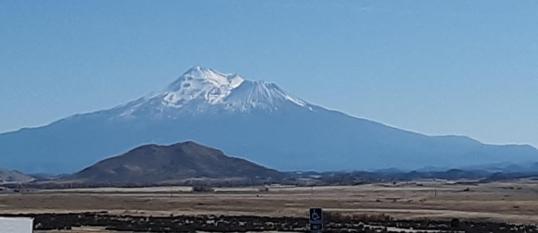
 Back to Bro’s house after our wet, windy, but wonderful weekend at
  Our first stop – a quick visit to the local grocery to replenish our stocks of butter, cheese, and wine. By the time we exit the grocery, the morning drizzle has given way to sunshine. We make excellent progress down I-5 through Portland and Salem, and stop for our mid-day refreshment at the Albany rest stop about 15 miles south of Salem. Okay, so a highway rest-stop is not exactly a camping haven, but the big rigs kept their distance, and this particular stop does boast the world’s quaintest rest stop visitors’ center.






 Astoria is way out on the furthest northwestern tip of Oregon, at the mouth of the Columbia River. It is the oldest city in the state of Oregon, founded in 1811, and named for John Jacob Astor, the New York investor whose American Fur Company founded Fort Astoria at the site. (Yes, the Waldorf-Astoria in New York is also named for him.) In bygone years Astoria was a bustling harbor, with schooner after schooner fighting her way past the dreaded Columbia River bar to pick up timber, fish, and furs, dropping off supplies and merchandise for the well-to-do families of trappers, fishermen, and lumberjacks.
 We stopped for lunch after our museum visit at the Rogue Public House, a brewpub located in a re-purposed fish cannery out on a pier just down from the museum. We enjoyed their boutique beer, plus an excellent pizza and salad. Then we took advantage of a temporary cessation of rainfall to stroll the delightfully un-restored, un-modernized, un-redeveloped downtown.
 At one end of Commercial Street is the wonderful wedding cake-like Liberty Theatre, located, of course, in the Astor Building. (See photo above.) We were visiting in October, so the Box Office was spectrally staffed.
 If you are going camping in a tiny trailer, and you left your bikes at home because the forecast call for a 99% chance of rain, better hope you can find some indoor activity to pass the time! If you are camping at
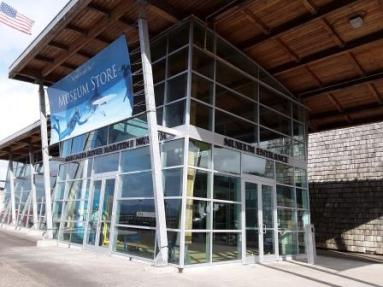
 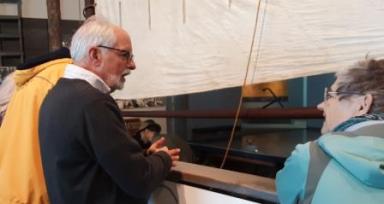 If you are going to spend some time in a small museum on a rainy weekend, it helps if Executive Director happens to be an old friend from college. Dr. Samuel E. Johnson and I had more than a few memories dating back to our freshman year Ballroom Dancing classes together. (I took the class to fill a Physical Education requirement; I suspect Sam took it because at that time the ratio of men to women at our college was officially 3.5 / 1, and it was chance to meet girls.)



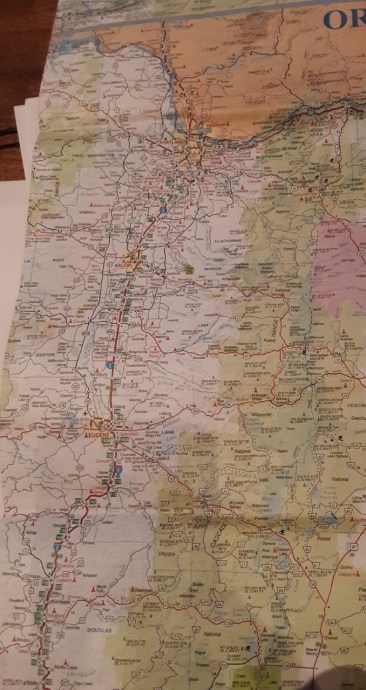 Dry shoes for Sis, a couple of chocolate bars, working lighters for the stove, and a hot lunch in our stomachs – what could be finer than driving up I-5 as the sky clears and the sun shines on us. Our operating rule is that the driver minds the road while the person riding shotgun manages the heater/AC and the sound track. I’m driving so we are listening to Sis’s playlist of Scottish reels, blue grass, and Nova Scotian folk music. Not my favorite but she put up with my Johnny Cash, Kris Kristofferson, Joan Baez, and other 60’s relics for the previous day. Won’t hurt me to listen to something different.
 The Douglas County Museum is at the far end of the
 Allyson Johnson