Freeway Free in France: Awesome Albi
I had always wanted to go to Albi ever since in college I saw a poster a roommate had, which looked almost other worldly in its having no relation whatsoever to my ideas of Romanesque or Gothic cathedrals. Somehow I missed Albi when I was a student traveler, and when I saw that a small detour could take us there, all it took was to point out that Albi is also the home of the Toulouse-Lautrec Museum to convince my travel mates to make a stop.
 Albi did not disappoint. The cathedral of Ste Cecile is the largest brick building in the world. Brick, not stone, not concrete. It rises from the central plaza in Albi at the side of the Rhone River like some kind of fantasy, all smooth curves and unbroken surfaces. Only slits for Windows. Towers that just keep on going. Our first glimpse had us tripping over our jaws. We walked around from the back of the church looking for the entrance, and found a welcoming Gothic/Baroque carnival of white stone at the top of marble steps leading into the brick fantasy.
Our guidebooks told us that the original cathedral had been build with an uneasy eye to the local Albigensian sect, a group which had been declared heretic by the Pope, but was thriving in Albi. The new bishop designed his cathedral as much as a defensible fortress as a place of worship, just in case the local heretics got rebellious. Only a hundred years after the completion of the vertical cathedral had the welcoming entrance been added.
Once inside, our jaws dropped again. If Escher had combined with Joan Miro and Provençal fabric designers to color the interior of this building, they might have come up with something like this – a riot of pattern and geometry in bright reds, yellows, greens, and blues, ending in arched recesses painted in equally diverse designs, one a yellow sun on a blue field decked with stars, another twining with ivy, etc. 
Most cathedrals draw your eye to the front with a representation of Jesus triumphant at the right hand of God with Mary beaming proudly and all the apostles lined up. How sissified. Ste Cecilia devotes the entire wall to a representation of the Last Judgement, with the apostles, yes, lined up, and then maybe 1/5th of the available space devoted to the saved, in order of rank, with the clergy first, Archbishops and bishops leading, followed by virtuous royalty, and then by the hoi polloi, many of whom have the list of their good and bad deeds hanging in book form around their necks. Some of the dead are still rising from their graves, while the ones who are not saved are already beginning to writhe. The bottom third of the space shows most graphically what kind of punishment awaits the greedy, the lustful, the proud, the gluttonous, the envious, and the slothful. But where is Anger? And where is Christ sitting in judgment? Oops – the Bishops wanted to expand the nave and create a special chapel for themselves, so Christ and the Angry sinners made way for a nicely arched door behind the altar.

After touring the cathedral (a well arranged and narrated audio tour takes about an hour) we went for another outdoor lunch at the Clos de Ste. Cecile, in an former school behind the cathedral. Excellent. More Foie Gras, more goat cheese, more dried duck breast, more walnuts. 
Then we started on the Toulouse Lautrec museum. This is the worlds largest collection of TL, but much of it is devoted to sketches and preliminary studies for the works we have seen in the Musee d’Orsay. Still a lot of information.
We finished our trip with a short stroll around the Bishop’s Garden, a formal boxwood arrangement whose floral elements are changed regularly to reflect the theme of the season. Oddly, this season’s theme was a tribute to Joan Miro, so the floral elements reflected the colors of his painting in non-symmetrical arrangements. Quite interesting once you figured out what they were trying to do.


So far, no hassles, no arguments, no breakdowns, and nothing but sunny (though a bit over-warm) weather. Cross fingers.
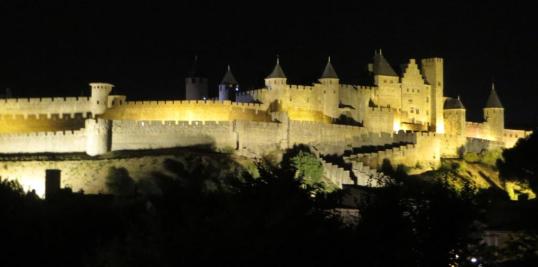


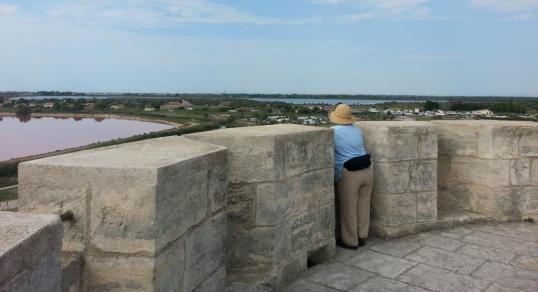
 Neglect means no development, so the medieval town, with its defensive wall, royal apartments, and battlements are all pretty much intact, despite some quarrying of the walls to build more modern edifices (pig sties, sheep pens, etc.). Later when the Huguenots were being suppressed by Henry II, a number of them were imprisoned here until they would renounce their heresy. Some stayed for 35 years until finally freed by Louis XV.

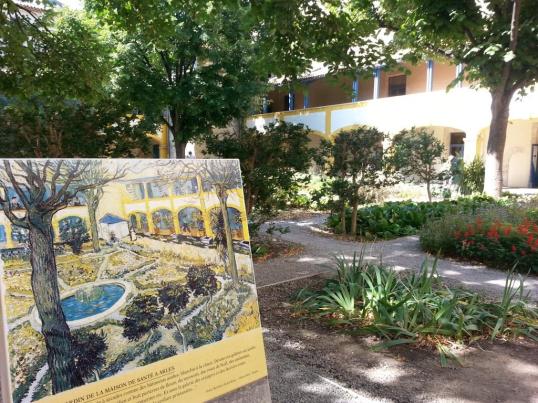
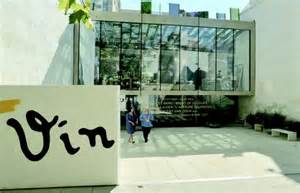 Once we got to Arles and rather miraculously found a free parking space that I could maneuver into, we headed first for the Bureau Touristique for city maps, and then, at WB’s insistence, went first to the


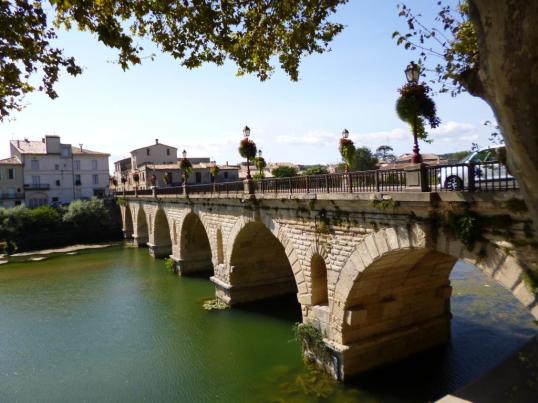 From Lunel:


 We had been told in the US that we could easily swap out the SIM cards in our phones for one which would give us cheap European internet, wireless, and phone capability. We headed for the SFN store in the local Intermarche, where after over an hour of effort by the two very polite and patient clerks, it was clear that NONE of the five phones DM, WB and I had between us would accept data from the SFN SIM card. Fortunately, I had received a “Welcome to Paris” phone text message from Verizon encouraging me to call if there was any problem, and both DB and I were soon set up with $40/month international roaming data plans (which we could have easily set up in the US in advance, but thought the local SIM cards would be more flexible.) WB opted for purchasing a cheap flip phone so she could make calls and text – it turned out having both types of service was very handy depending on what kind of coverage was available in which areas we traveled.
 Allyson Johnson