Freeway Free in France: the other national cemeteries of Normandy
 We are all familiar with pictures of the American Cemetery in Normandy, with its rows of white crosses stretching into the distance. I had not known that the United States was the only combatant in World War II which offered families of its dead an option to repatriate their remains for burial in the US. The nine thousand plus graves at the American Cemetery are only a third of the fallen. These are those soldiers who had no family, or whose families lacked means or desire to hold funeral rites at home, so they preferred to let the government bury their dead.
Soldiers from other countries were buried near where they fell. There is a cemetery for Commonwealth soldiers in Bayeux, with tombstones rather than crosses. There is a Canadian cemetery near Caen. And, most ironically, there is a German cemetery. at LaCambe, also near Bayeux.
The German cemetery is quite different in look and feel from the rows of white marble favored by the victors. One enters the cemetery through what seems like a large arch, but once inside, the spacious entrance gives onto a small room with a memorial wall on one side and a listing of the cemetery’s occupants on the other. Exit into the cemetery is through a narrow and low door. The symbolism, we were told, is that the soldiers entered the war as a group, but died individually, one by one.


The central feature of the cemetery is a tumulus which contains the remains of mostly unidentified German soldiers, topped by a black lava cross and two human figures, one of Jesus, the other of Mary. Scattered around the grounds are groups of black crosses, some slightly larger than others. The individual graves are marked by brown plaques laid flat in the grass, each bearing the names of two German soldiers, with their dates of birth and death, and sometimes merely the inscription “Ein Deutcher Soldat”. The plaques are made of German clay.


In school we learned Rupert Brooke’s elegy “The Soldier” which begins

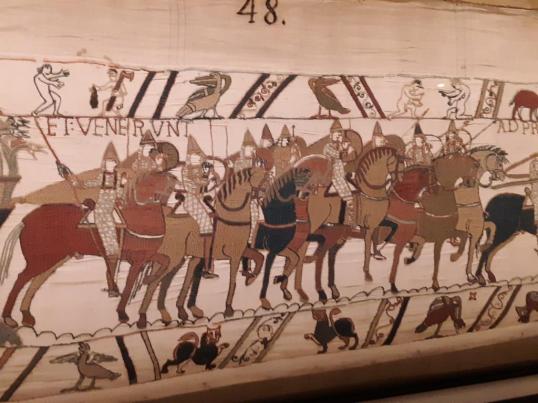 Bayeux was the first French city to be liberated by Allied Forces. Troops marched into the city on a street bordered with cheering townsfolk who waved French and American flags, and offered kisses from happy young women and fresh baked treats from older ones. The Germans evacuated so quickly that they had no time to organize a defense, so the most of the medieval structures remained intact.
 We first stopped at Bayeux Cathedral, with its mix of old and new stained glass, its ornate Gothic verticality, its mystic paintings decorating the crypt beneath the alter. The apse was decked in French tricolor, British Union Jacks, Canadian maple leafs, and American stars and stripes. Behind the altar there was a large concert band practicing for Prince Charles’ visit the following day (Wed. June 5). This was a truly excellent brass ensemble, plus some woodwinds and tympani. The sound reverberating through the cathedral was thrilling. One piece was “The Spitfire Overture” and another, appropriate for a visiting Brit, was the lovely, noble main theme from “Jupiter” from “The Planets” by Gustav Holst. My partner, a music-lover with bad knees, stayed in the church for the whole rehearsal while I wandered around the side chapels and lower levels.


 Right across from the cathedral is an old store front set us as a
  Of course, Bayeux is most famous for that other artifact of war, the


 I had the good fortune to be among the 12,000 + invited guests at the 75th anniversary ceremonies commemorating the D-Day landings in Normandy.
 We were among the last 4000 to arrive at the American Cemetery, and the stage and podium seemed several football fields away in the distance. But giant Jumbotron screens gave us close up views of Air Force One (both jet and helicopter) and its occupants as they landed, and of President Trump’s ceremonial greeting of guests President and Mrs. Macron onto what is considered American soil.


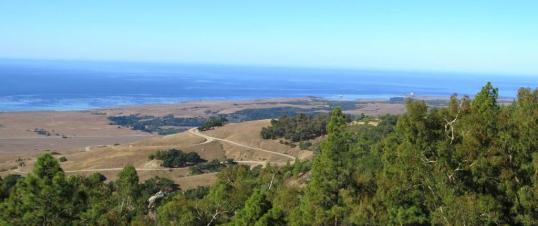 The weather was perfect: warm, no fog or wind, as we left Hearst Castle.

 Further up the road there was an even bigger slide, with an obviously temporary one-lane road perched nervously across the new ground. But it was fascinating to watch the big diggers roaming and scooping atop huge mounds of dirt and stone. And that road remains a marvel of impossible engineering, spectacular vistas, and a maddening plodding pace behind the inevitable road boulder, often a “Rent-Me-RV” whose first-time RV driver is scared to death of his rig and the road. And they won’t pull out to let the long line of vehicles behind them to pass, which is the law, or, if it isn’t, there oughta be.
 Allyson Johnson