Allyson Johnson

Pieces of my Mind

Archive for the tag “World Heritage sites”

From Russia with Mom – Day 7 – Helsinki

I awake at 6:30 (fortunately we get an hour back as we journey westward toward Copenhagen) and catch a glimpse of Finland’s World Heritage site Suomenlinna skimming by the railing – an old fort, a tower, and then we are at the port and docking.  We have a bus tour of the city scheduled;  we endeavor to be ready on time, but Mom has misplaced the key card which she needs to get on and off the boat and by the time we get to the bus they have been waiting pretty patiently for almost 15 minutes.  But everyone is very nice to a smiling nonagenarian and her escort.
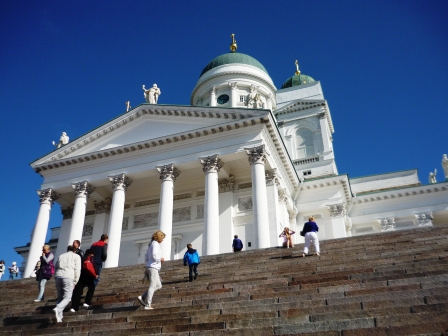
Helsinki is a small city of only about 600,000 people, so the bus drives in circles to spend the time required to justify the cost of the expedition.  We see the Senate Square, the Parliament Building, pass the National Museum twice before going inside, park several blocks from the Church of the Rock and walk a few blocks.  Helsinki is all about the architecture –the gleaming white Lutheran cathedral which gives the  White City of the Baltic its nickname,  the red brick Russian Orthodox church on an opposing hill, and the eco-modern architecture of the Church of the Rock (so called because it is built into a hill so as not to disturb the neighborhood sight lines.

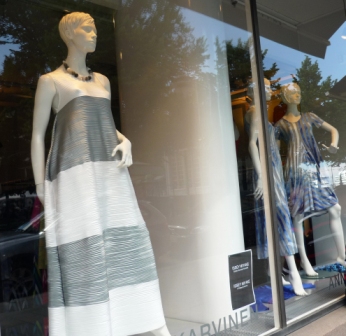
We end at an outdoor café by the harbor for Finnish snacks: rye flatbread with smoked reindeer and mustard; Karelli Pie – a sort of cheese pastry with diced hard-boiled egg on top, then we browse the adjacent food and craft open-air market.  After lunch Mom opts again for a nap and I go storming off up the hill to Marimekko, drawn irresistibly by the SALE 40% sign I had spotted earlier. I admire Finnish design in all its maifestations, purchase a few gifts, and amble down the warm sunny tree-lined streets full of mimes, street musicians, outdoor diners – it is like Paris without the horns and humidity.  I step into a shop to price their postcards, step out again without buying and the day is transformed.  It is pouring rain – I mean a real gully-washer – gutters overflowing, street flooded, rain-spouts fountaining… everyone is laughing at being so caught by surprise.
Luckier than some, I am wearing my nearly-waterproof windbreaker (only because it had a nice pocket for the camera) so I raise the hood, cover my purse with the Marimekko bag, and make a dash for the boat.  Fortunately I am not very far from the harbor, and there are a couple of covered arcades to shelter in.  I make it through the customs center and wait on the porch looking at the ship with a couple of other soggy but smiling passengers until a helpful and vigilant sprite from the ship spots us and comes over with a couple of huge umbrellas – so of course the deluge stops as suddenly as it began.

Tonight is Formal Night and the Captain’s Cocktail Party, so I shed my wet clothes and we dress for the occation, then go for tea in the Panorama lounge.  As we linger over our finger sandwiches, cookies, and mini-pastries, a couple scurries in from the outside promenade-  it is pouring rain again.   We retreat to our room to watch the lightning and the rain bouncing off the balcony railing.
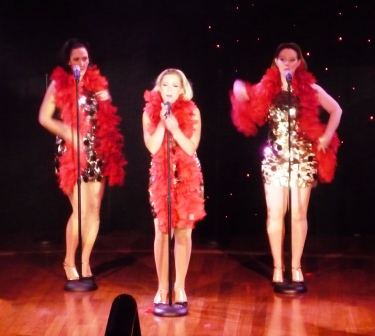
This first evening shows off the crew:  first the cocktail party and introductions, then a full restaurant where we shared our table gregariously, then  a Musical Extravaganza –  an all-white Motown show, complete with feather boas and choreographed dance moves – I was remembering seeing the Temptations in Las Vegas years back. I talked with “Duke” , the tenor, afterward;  he said the group were somewhat limited in their dancing due to the movement of the boat. I thought “yeah, right” but now that I am typing in the quiet of my cabin I am aware of the shifting basis of the boat world I am on.

[Note: Turns out Duke Zoran has written his own blog posts about this trip – Check it out!]

Tomorrow: Stockholm and the Swedes!
To Russia with Mom – Day 4 – Parks, Palaces and Caviar

Our Sunday plan to go by boat to Peterhof was foiled:  the indefatigable  Maxas went online to get boat tickets and found that the entire morning was sold out – so instead he  drove us expeditiously through empty Sunday morning streets and we arrived at Peterhof at least as quickly as the boat could have, parking with a good entry to the palace.  A light drizzle reinforced our gratitude for the cozy car as opposed to the open-air boat ride.

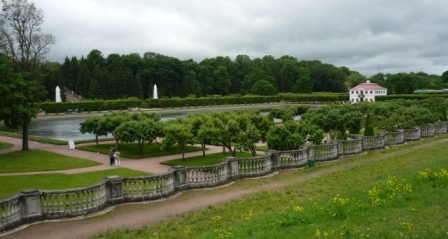
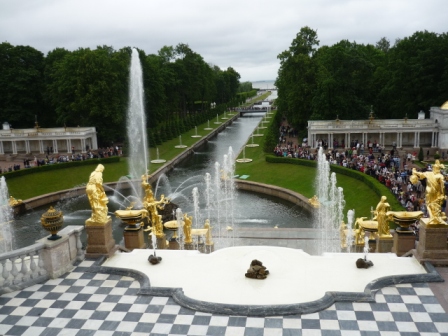
There was already a line to see the Palace, and we decided to concentrate on the park with its gilded statues, fountains, benches, birch woods, more fountains, hide-away mini-palaces and more fountains.

I liked best the small mini-castle “pavilion” where Peter the Great could hang out with his young wife without a lot of pomp. It has a tidy kitchen with delft tiles around the oven.  Martha Stewart would apporve the  matchy-matchy wall-papered, draperied, bed-curtained bedroom.  The bed is immense to accomodate Peter, who was well over six feet tall in an age where 5’3″ was the average; Peter’s  heavily embroidered nightshirt is laid out on the bed ready to be donned.  Off the bedroom a small office with some maritime-ish instruments evoke  Peter’s maritime interests.

Maxas, Mom, and Russian pigeon – Baltic in background

We walked a lot;   finally we found a bench and sat eating our granola bars shared around.  Good kind Maxas suggested that as Mom needed a rest, we could forego the upper formal French gardens and go over to the town of Pushkin to see the Catharine Palace and where Pushkin went to school.

This was a mixed success – Mom napped in the car, but it was windier and colder at Pushkin;  the line at 4PM to get into the palace was 90 minutes long and the palace closed at 5;  we went to Pushkin’s school which has four floors with no elevators – Mom made it up and down three but we gave up seeing Pushkins bedroom.

We said good-bye to Maxas at the end of the afternoon, tried to thank him but he would have none of it.  He had given us two entire days of thoughtful guidance and  would not even let me buy our tickets to the parks.  I had been warned of Russian hospitality – this  example shines.

Crystal! Chandeliers! Soprano! Mirrors! Dr. Zhivago was here!

We decided to splurge for dinner at the Grand Hotel l’Europe, just a few blocks from our modest digs.  Their Caviar Bar is another ornate, mirrored, chandeliered venue complete with a blonde singer in a red satin gown to match the red-velvet and gilt decor.  She was backed by an acoustic guitarist and string base;  I was appreciating the Slavic folk tunes when I recognized “Granada” – maybe not so authentic after all.

Our two appetizers, two cocktails, and an amuse-bouche from the chef came to about $80, all worth it for the assiduous service and the baroque atmosphere – I kept expecting Lara and Yuri to step into the frame at any minute.

At the hotel, we were greeted wih a sign saying that we would be without electricity from 6AM to 10AM on Monday.  No explanation, just smiles and shrugs from the suddenly non-English-speaking staff.  OK, as long as we don’t have to use the elevator before 10AM.  Tomorrow we board our boat!

To Russia With Mom: Elder-Friendly Spots in St. Petersburg – and Not

Flat and sheltered as far as the eye can see!

Gostiny Dvor –  The Good:  half of the shops are on ground level with both an exterior rain-sheltering arcade and an interior path that leads from one end to the other of this long mercantile block.  Service was friendly and if the shop-owner did not have what we needed, we were given direction to another shop that might. Recommended:  the ice cream shop in the far left corner (from Nevsky Prospekt)

The Bad: There are two floors and if there is an elevator, we did not find it.

The Grand Hotel Europe on Nevsky Prospekt –  The Good: A gorgeous lobby, and elevator to the Mezzanine location of the relatively inexpensive and very attractive Mezzanine Café, or the elegant but pricey  Caviar Bar.  Recommend: the Caviar Bar Appetizer menu and a cocktail for your last-night splurge.

The Bad:  Must get on the right elevator to descend to the ground floor, or face elegant but slippery marble staircase.   Two appetizers and two cocktails at the Caviar Bar ran us close to $100 US including tip.

The Mariinsky Theatre (formerly known as the Kirov under the Soviets): The Good: Beautiful theatre, only a few steps to seating on the ground floor.  Just looking at the baroque interior is entertainment;  the world class opera and ballet is a bonus.

The Bad: Ladies room is down a steep flight of stairs; no visible elevator.

The Hermitage Museum – The Good: Wheelchair service gets you royal treatment from tour guides and tourists alike.  Elevators are available –  only to wheelchair users and pushers. Unbelievable art hung in an amazing baroque palace.

The Bad:  Only two  restrooms, at very beginning and at very end of tour. Need 60 hours at least to really appreciate all that is here;  our tour took 3 hours.    Still 3 hours of wonderful is better than none!

Peterhof:  – The good: miles of wonderful level strolling paths in a garden fantasy of fountains, pools, pavilions, and statuary.  You enter at the top of the Grand Cascade;  there is a ramp entrance down to the right in the direction of the Pagoda Fountains.  (If you miss this ramp, the staircases down at the middle and the far side are VERY long.)  Lots of benches for sitting and admiring.  The Pavilions  were Peter the Great and his Catharine took refuge are charming and much as they might have been in Peter’s time.

The Bad: No elevators in the historic pavilions and stairs to upper  floors are steep with minimal handrails.  Path up to walkway on levy for view of Baltic Sea is steep.  Line to see inside main palace is long. (We skipped it.)

Catharine’s Palace: the Good: the exterior of Catharine’s palace is lovely  – if you like Wedgwood china you will love the effect of white and gilt trim on blue.

The Bad: the line for seeing the interior of Catharine’s palace is very long.  I’m sorry we missed this, as friends had told me the Amber Room is a DON’T MISS, but it was starting to rain, the wind was picking up, and we lost our nerve.

Queue for entry 45 minutes before closing…

Pushkin –  the Good: The school where Pushkin studied is very evocative of the life of aristocratic young scholars – lots of fascinating artifacts.

The Bad: NO ELEVATOR, and a brutal spiral staircase thronged with Russian school children on field trips. Also almost no benches for resting between ascents.  Pushkin’s room is on the 4th floor (effectively the 5th).  We got only as far as the 3rd floor;  I couldn’t force Mom’s bad knee any higher.

To Russia with Mom – Day 3 (part 2) : Breakfast, Ballet, Brides, Bistro a la Russe

Bright and sunny morning.  Seating for our complimenatary breakfast was up a steep flight of stairs on a mezzanine above the buffet service counter – not a good way for Mom to start the day.  Our accomodating hostess made space for us at the side of the counter.   Breakfast very Russian: 2 kinds of porridge (neither one oatmeal), tomato omelet or hard-boiled eggs, white or rye bread, waffles, yogurt, apple/orange fruit salad, cucumber/tomato salad, cold cuts, cheese, and coffee strong enough to float the spoon. (This was standard fare for our Russian mornings).

Maxas picked us up promptly at 11:15 for the ballet performance at the Mariinsky theatre, a wonderfully baroque structure inside and out.  This matinee was a “graduation performance” of the Mariinsky Ballet Conservatory (known as the Kirov School of Ballet under the Soviets) – 3.5 hours of varied performance – everything from modern dance to Pierrette/Pierrot mime to pseudo-West Side Story to a court dance from a Glinka opera (Glinka is big in St. Petersburg). Mom had the aisle seat, which she held onto even after “the biggest man in all of Russia” sat in front of her.

The audience was almost as varied as the ballet, with lots of doting grandparent and parents,  adorable kid sisters in braids and ruffled dresses, younger ballet school classmates holding themselves very upright, as well as scruffy boy friends and girl friends of the graduates in tattoos, jacket and jeans.

Some bits were just wonderful – the first with the company in flowing slips or simple tights and just exploding like fireworks as the music and movement called for it.  Another bit which was comedic but required tremendous athletic elevation and extension from the cocky little bantam rooster balletomane.

Mom and Maxas

Maxas is a student of Soviet history and an aficionado of classic ballet and symphony, so he was a wellspring of information. I was so impressed not only by his depth of info but also his instant understanding or and consideration for Mom’s limitations – we did a lot of driving around points of interest after the ballet rather than walking as he originally planned; the restaurant where we had lunch/tea after the ballet was quiet with an English menu in large print, and he was careful to look directly at Mom and speak as clearly as possible. This helped a lot.

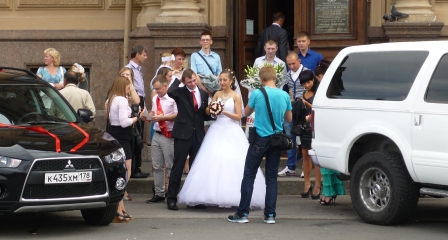
After tea we drove along the Neva River admiring the green lawns, the over-flowing flower boxes and plantings, the gilded domes and spires of the Admiralty Fortress and St Isaacs Cathedral.  We did some bride-spotting – at least six Saturday bridal parties emerging like butterflies from their BMW, Mercedes, and Hum-Vee stretch limo cocoons, getting their ritual pix taken. Fashion note: Russian bridal gowns a little more ruffly and top-of-the-wedding-cake-y than at the Stanford Chape;  I saw one with a bright red sash on cream, one with a white lace corset laced up the back, one with a 12-foot tulle veil/train fighting the wind.  I also noted Russian  bridesmaids’ gowns tending more to bright-colored chiffon rather than black satin.

In the evening Mom decided that she needed a drink before dinner even more than she needed dinner.  I had spotted a bar with nice outside seating the day before.  We set off sheltered from the rain by my faithful blue umbrella, by a wonderful long arcade around the shopping mall – and by a few side trips into the shopping mall.  We got to the place – no outside seating in the rain even if we had wanted. The place was full, but a kind young server lady took pity on our dampness, age and infirmity and found us a table.  It was only after we had placed our order  for a Jack Daniels with Ice, water mit gaz,  a Greek salad and some spicy chicken wings that I noticed a number of hookahs being employed at at least half the tables around us.   There we were, two little silver-haired Alices surrounded by puffing caterpillars blowing smoke rings.  Mom got a huge charge out of it once I had explained what was going on.

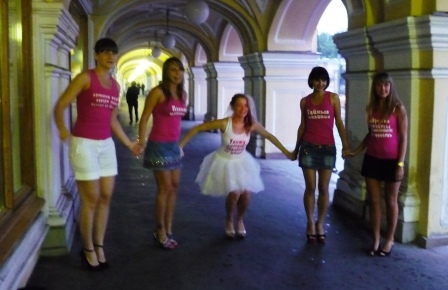
On the way home we got a bonus bride-spotting – In the Gostiny Dvor arcade a guy was shooting a lipstick commercial involving a “bride” in slogan  T-shirt and tulle, throwing her lipstick to the panting bridesmaids in pink slogan T-shirts.  Then he had them all jumping for the lipstick – bride included.  Cute!

To Russia with Mom – Day 3 – Martyr’s Manic Monument

Mom and the Church on Spilled Blood

The Church on Spilled Blood erupts from the site of the assassination of Csar Alexander II like a clump of maniacally multicolored mushrooms.  Yes, that is an over-the-top opening sentence, and this over-the-top icon of St. Petersburg deserves it. The church’s exterior façade is made up of elaborate brickwork with gilded mosaic insets, topped by seven onion-shaped domes, either gilded, painted or tiled in colorful patterns of checks and swirls. If you can imagine Disneyland’s Sleeping Beauty castle covered in vari-colored gumdrops held on with gold-leaf staples, you might have an inkling of what the outside is like. It is surrounded by tourists, brides, and wedding parties, all enthusiastically snapping photos of the Church and each other as well as of the erzatz Catherine and Peter the Greats who hang about in period costume hoping to be paid for a photo.

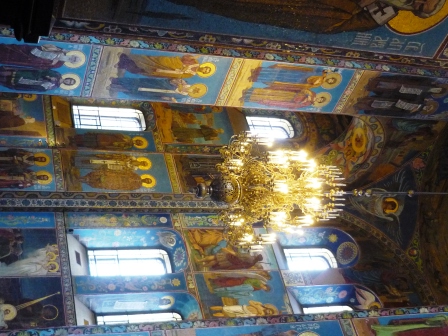
Interior with saints – Church on Spilled Blood

Inside is another unworldly vision – a vertical mosaic world of golden-haloed giants against an ethereal blue background.  Anything not covered by mosaic tile is gilded. The floors are inlaid with marble in diverse colors and intricate patterns.

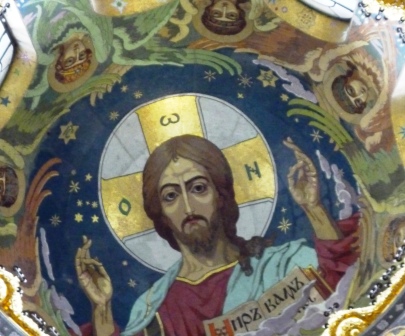
High in the dome above a compassionate and sorrowful Christ looks down at the sinners below. Mysteriously, his fingers area crossed.  Is he wishing us luck against the odds?

Christ in his heaven

A sunken , flower-decked spot in the floor surmounted by an elaborately carved wooden gazebo marks the actual site of the czar’s assassination by a terrorist bomb attack in 1881. Mom is convinced that this gazebo was build first and then the rest of the church built around it – I’m not sure if this is true or a garbled version of a half-heard tour guide’s talk.Origin tale true or not, the Church on Spilled Blood  is also one of Mom’s favorite sights of our whole trip. If you are visually impaired, an outsize and brightly colored landmark is sure to be a hit.

Mom inside the Church of Spilled Blood

Nepal – in and around Kathmandu – Day 6

The holiday is over, and the people of Kathmandu have returned from their families and festivities to normal – and so has the pollution level in the city.   We steered through appalling traffic and dust and made our way outward and upward into the foothills.  The further away from the valley we got, the clearer the air, but the haze was still evident until we were well up the foothills.  It is hard to know how to fix this problem – like all cities in developing countries Kathmandu is a magnet for people looking for education, opportunity, excitement.

We headed for Dawainkali –  the temple dedicated to Kali, goddess of death and destruction.  “We are lucky you took a break day,” says Shaku, our guide.  “If we had come on Monday as planned, there would be little to see, but Tuesday is a day for sacrifices.”  We look at each other dubiously.

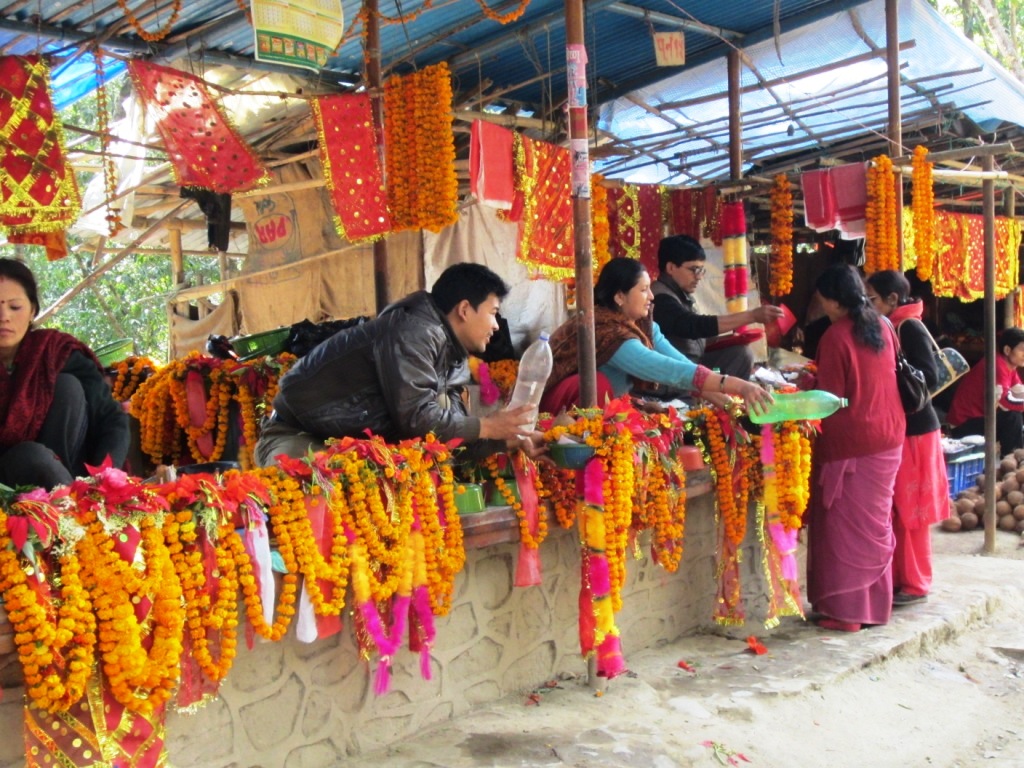
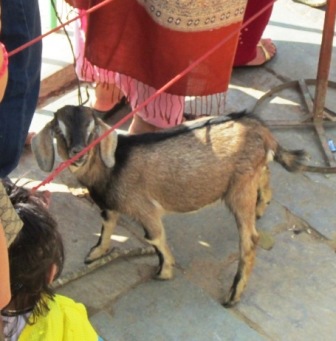
We arrive at the site, and walk up a cobbled street past blocks and blocks of people selling items for sacrifice, ranging from bouquets of roses and garlands of marigolds to chickens and baby goats. Not so many souvenir sellers – these stalls are for genuine Nepali worshippers, not just for tourist show.

At the site two long queues of people writhe around the shrine.  In addition, paths are set aside for non-Hindus and others excluded from the temple to observe the proceedings.  Shaku confided that she was very unhappy not to be able to participate, as she was  the wrong time of the month; women in menses cannot enter the temple.  However, she directs us to the best vantage point, and we are able to witness the decapitation of a goat as well as the axing of a number of chickens and coconuts.

Once the sacrifice is made, the blood is sprinkled on Kali’s image, and the devotee is free to reclaim the chicken, goat, or coconut.  Just outside the inner shrine is a shed where the animals are plucked, gutted, and dismembered for later barbequing.  The marble floor of the area was stippled with blood drippings and mud – the thought crosses my mind that if I slip and fall I will probably have to be air-lifted to Delhi for blood purification.
Next we climb up a steep hill of steps to a second, less blood-thirsty shrine overlooking the first, where the worship of Vishnu goes on inside  while at the same time at a corner of the plaza has been set up as  a small temporary Buddhist shrine , festooned with prayer flags, and a group of Buddhists are devoutly reciting scriptures under the tutelage of a white-garbed teacher.  A nice example of Nepali’s peaceful coexistence of religions. (Maybe it’s only the Muslims and Christians whose evangelical fervor makes trouble?)

On the way down we stop for tea and sai, a sort of Nepalese donut.  Since we eat with our guide, the entire set including a Coke came to 70NP (the going rate for a Coke alone in Thamel is 80NP). However, the Nepalese make no secret of their double standard in pricing;  all the museums and historic sites charge foreigners and tourists 3-5 times as much as ‘citizens of the SAARC” – which includes India, Cambodia, Thailand, Nepal, Bhutan, etc.  This seems fair for the historic sites, as the funds are used for maintenance and restoration, and even at restaurants the tourist rate is still very reasonable – we have not paid more than $6 / person for any dinner.

Next we visit a relatively new Buddhist stupa founded by Thai Airlines in memory of the crew members and passengers of a Thai Airways flight between Bangkok and Katmandu that crashed in 1992.  Golden buddhas, and a good view of smoggy Kathmandu below.

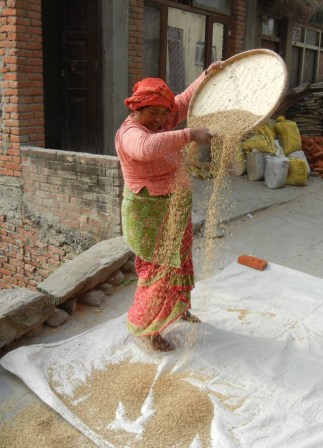
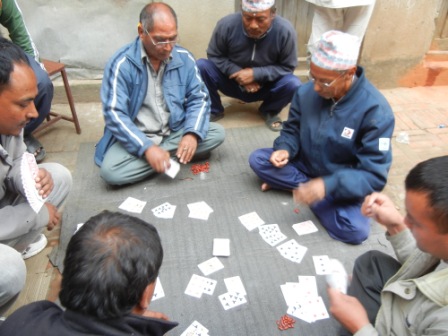
Our final stop is at a traditional Newari village, where  women in traditional costumes are threshing and winnowing rice using woven trays – tirelessly filling the trays and tossing the rice to the wind to allow the chaff to float away.  Where were the men?  Groups of them squat on street corners playing cards with dried beans for markers.  “It is a festival time for them,” explains Shaku – but evidently not for the women.

Back through the dust and pollution and traffic to our hotel – this time I use my neck scarf as a face mask and it was better.  We bid our escorts good by with generous tips (I am not the wife of an ex-tour guide for nothing.)

Our third friend has joined us, and we have been moved to the Holy Himalayan Hotel’s equivalent of a penthouse suite -two rooms, one with a king bed and bathroom with a tub, the other with twin beds, a balcony, and a small kitchen.   The cost is actually less per person.

For dinner we follow the recommendation of my sister’s colleague and hit  Fire and Ice Pizzeria.  Like other restaurants in Thamel it was founded by people who came to hike and stayed – the pizzas are as authentic as can be made with Nepalese ingredients, and the place is packed.

We sat at table with a charming young Belgian couple who had just completed much of the Annapurna circuit and had also gone to the Chitwan national wildlife park – another of the World heritage sites in Nepal where one can enjoy bathing with the elephants,  canoeing through the rain forest, spotting rhinos, and dodging crocodiles.  Maybe next time.

Note to travelers in Kathmandu:  If you want to get seated promptly at a restaurant, arrive at 6PM or shortly after – by 7PM the joint was jammed and jumping.

Second note to travellers in Kathmandu:  if you want to get your check in a hurry at a restaurant that is jammed and jumping, fugeddaboudit.

Third note: When you get the bill, be sure they return the credit card BEFORE you sign the chit.

Nepal – Day 5 – the Wonder of Bhaktapur

What makes a spot qualify as a Wonder?  Not just beauty or history or size – it must induce a certain giddy glee at the sheer audacity and over-reaching achievement that makes you want to laugh with pleasure.  The Great Wall made me feel like this.  So did the Taj Mahal, and Chichen Itza.  So did the Katmandu Valley’s Bhaktapur.

Unlike the other World Historic Sites we had seen, Bhaktapur embodies a sense of order – not just in the relative homogeneitiy and symmetry of its large public squares, but vertically, as its pagodas reach toward the sky on carefully sequenced plinths representing logarithmic orders of power. (Is that cool or what?  Never have I ever simagined logarithmic progressions embodied in material form, and certainly never expected to see an embodiment in a 400-year-old brick-and timber Hindu temple.)

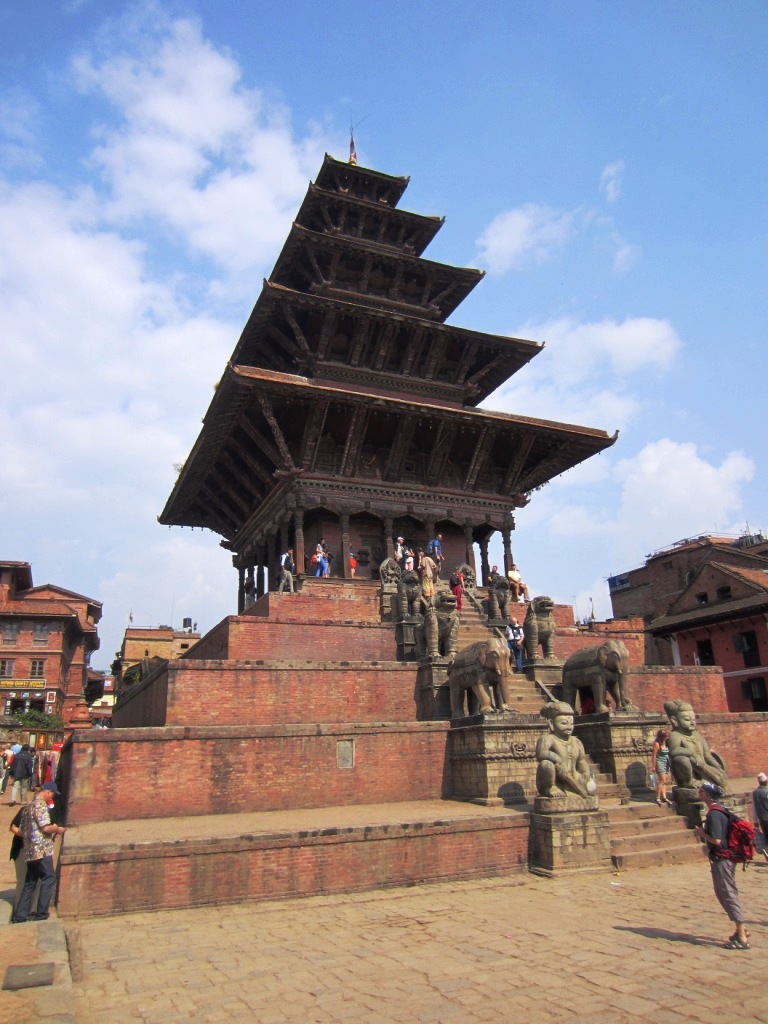
Maybe you, like me, had never heard of Bhaktapur, much less seen a picture.  Here is the Nayatopola Temple which so impressed me.

This temple is the tallest in the Kathmandu Valley, and in my eyes the most beautiful and interesting.  The  guardians on the five plinths are carefully selected:  the first level shows two legendary champion wrestlers, the most powerful humans in Nepali lore.  Above them, ten times more powerful, are two elephants.  Above them, and again ten times more powerful, two  royal lions.  Above them, again ten times more powerful, two griffons from Nepali myth.  And representing the final level of guardian power, two goddesses.

Inside the temple is an image of Durga, the blood-thirsty avatar of Parvati, Vishnu’s consort.  Only priests are allowed inside.  The temple rises five stories tall, each roof seeming about to take wing.  The final spire points the way to heaven.

I can’t stop thinking about the concept of the levels of power, and the thinking that enabled this representation of Man’s humble place in the universal order in such a masterfully graphic way.  Not only does it take my imagination from the human to the divine, but leaves five more orders of power and divinity which are invisible and unknowable, beyond our ability to conceive.  I can’t think of a better monument to the limitations of our knowledge of God.

Day Three – Kathmandu

Three major World Heritage Sites, all within a few kilometers of our hotel.  This happens because the Kathmandu Valley was formerly cut up into a number of little fiefdoms, each of which had its royal family, royal palace, and religious centers, so we get a bunch of World Heritage Sites all balled up in one touring package.

Other World Heritage Sites I have seen, – the Taj Mahal, the Forbitten City in Beijing, Chitchen Itza – seemed  ruled by a sense of order – the rigid geometrical symmetry of the Forbidden City and the Taj, the graceful balance of temple sites in Japan, all seemed to reach toward some ideal perfection.

Nothing remotely orderly about either of the public spaces we saw in Kathmandu and Patan – I felt as though I was seeing some sort of divine rummage sale – Hindu, Buddhist, Animist shrines all jumbled together in one space with no attempt to organize.  I was dazed by the clutter.

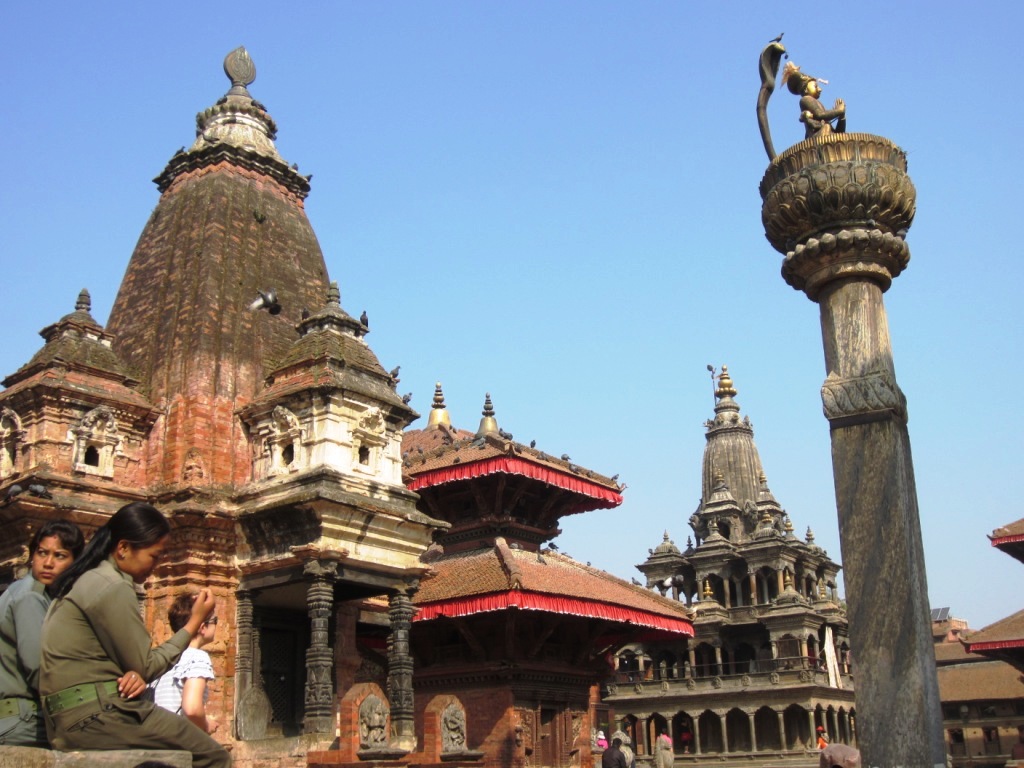
Patan Durbar Square:  Durbar means “palace” and indeed there is a palace on one side, now transformed into a museum.    The square is packed haphazardly with buildings and monuments and plinths, some topped with gilded statues, some ringed with stone lions, some of brick, some of white stone.  The whole effect is something like a garage sale of religions.   Shaku pointed out that the general architecture of some of the buildings echoed the pagoda idea of China, and she seemed to say that a great architect of Nepal went to China and influenced this style there.


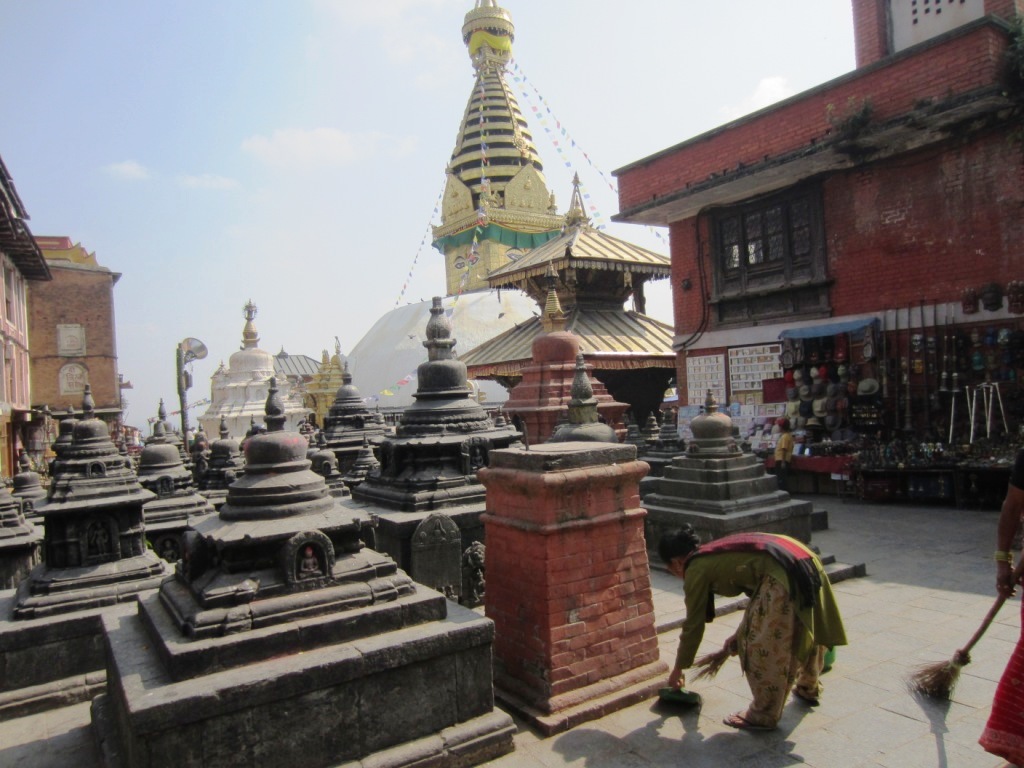
Swayambunath -The “Monkey Temple” – The biggest stupa yet, perched on a hillside high above the valley, ringed by yet higher hills unfortunately obscured by valley smog on this warm day.

Kathmandu Durbar Square: yet another jumble, of stupas, temples, and shrines, plus a schizophrenic palace-now-museum with one huge wing in the old style of Kathmandu (red brick trimmed with heavily carved dark wood doorframes, window grilles, and balconies) and the other a glaring white Doric-columned wedding cake in the style of a very pompous British bank – grafted onto the old palace by a turn-of-the-century king who unfortunately visited the UK and came back with Modern Ideas.

In the evening, Shaku had arranged for us to attend an “authentic Nepalese” dinner/folk dance performance at the Kathmandu Kitchen.  She does well with restaurants.  The outside looked dubious, the bar above the street deserted, but on the third floor a banquet hall was set with tables of various sizes with room for about 80 people, and at one end a mural depicting Patan Durbar Square and a raised platform.  We got good seats at the side front along the wall;  by the end of the second course the room was nearly filled by two large tour groups (one German, one maybe Australian), a party of French people, and a few others whose languages we didn’t catch.

The performance was high-spirited and varied, four young people dancing in the mode of the Sherpa, the Tibetan, the Pathan, the Nepali – some seeming influenced by Mongolia, some by India.  The highlight was the Peacock Dance, in which a dancer arrived in a giant peacock costume, complete with bobbing head and a tail which rose and spread into an impressive fan at the conclusion of the dance.  The last “dance” was actually a comedy routine involving fire breathing – the one Nepali speaker in the room laughed a lot at the dialogue, but I think she was a girl friend of one of the performers. 

Dory and I ended the day triumphant – we were able to guide our taxi driver back to the hotel with no glitches.

Nepal – Day 2 PM – Culture-hopping

You know World Heritage sites – the Pyramids, the Great Wall, Chitchen Itza, Macchu Picchu, the Taj Mahal – but you may never have heard of Bhaktapur, Patan and Kathmandu’s Durbar Squares, the Buddhist stupas of Swayambu and Boudha, and the Hindu temples of Pashupati and Changu Narayan.  Tiny Nepal is the home of ten World Heritage sites, of which seven are in the valley of Kathmandu.

On our first afternoon we saw

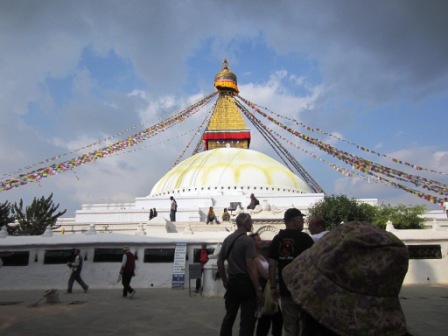
Boudha – a huge stupa (Buddhist temple) surrounded by Buddhist schools and monasteries.  The stupa consists of a very large square structure with a staircase at the center of each side, decorated with prayerwheels in niches all around at elbow height.  This is very convenient for the pilgrims who orbit the stupa, always going clockwise, as they constantly reach out to keep the prayer wheels spinning as they walk. (Do you think they get Prayer-wheel elbow?)

On top of the square structure, which symbolizes the earth, is a very large white dome decorated with faded yellow paint in lotus petal designs – this symbolizes the air.  Atop the dome is another square structure painted gold, with two huge eyes looking out from each side – this symbolizes the all-seeing Buddha.  Atop the Buddha block are 13 more blocks, gradually diminishing in size – these are the 13 steps toward enlightenment.  And on top of these – a golden umbrella, symbolizing the cosmos.

And everywhere are flags, fluttering prayers into the breeze.

I compare this structure to the great Gothic cathedrals with their cross shape, and the huge symmetrical mosques of Istanbul carefully oriented toward Mecca – the attempt to embody the universe in a building takes my breath away.

Pashupatinath – this is a very holy Hindu site in Nepal, along one of the sacred rivers coming from Tibet.  We saw several cremations in progress in various stages, from the dipping of the body into the sacred river, to the preparation of the pyre, the covering of the body with straw, the burning, the sweeping up of the ashes afterward – all from a distance from the other side of the river.

The temple is a favorite destination spot for Sadhus, the holy pilgrims who smear themselves with ashes, leave their hair uncut, and wander in from India with only a cloth for decency, a trident, and a begging bowl – right out of Rudyard Kipling!

And for monkeys – we saw a few hanging about on the fences and steps, but suddenly at the ringing of the temple bell at 4:30 they came over the steps in a wave, screeching, scuffling, carrying babies clinging to stomach and backs of the mothers.  They all headed across the bridge nearest us, and within a few minutes the opposite side of the bank nearest the temple was scrambling with monkeys on every step and protuberance, where there had been none before.  Our guide swore that no monkey-feeding goes on – what could have happened in the monkey-mind to drive this impulse?

OR2K

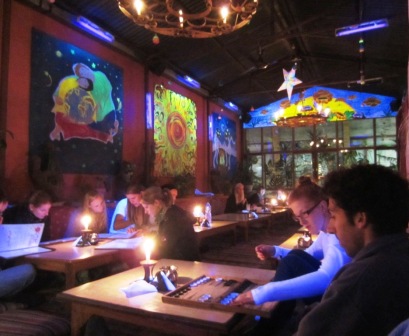
We ended the day at an Israeli-run vegetarian restaurant called, obscurely, OR2K.  Or2K is a fallback to the 60’s – no chairs, low tables, lots of cushions, black light causing white shirts, socks, and various decorations about the restaurant to glow fluorescently.  The food turned out to be both excellent and abundant.  It was rather restful to sit on the floor against the cushioned backrest, eat mostly with our hands, listen to music inspired by George Harrison, and try to figure out which of the young trekkers coming in and out were connected or likely to be.

From reminders of Rudyard Kipling to evocations of George Harrison in a few hours – I had the sense of being in a berserk time machine skipping from century to century and culture to culture. This would recur to me a lot during my time in Nepal.

Post Navigation