Allyson Johnson

Pieces of my Mind

Archive for the tag “women trekkers”

Trekking in Nepal – Day 10 – Mulktinath to Jomsom

The last day of the trek is a 5 hour hike from Mulktinath to Jomsom, partly across a rocky river bed along the bus road going into the sun and a cold wind. DB took the jeep again, as she has had a lot of trouble coping with the altitude.

DM and I were apprehensive about the dusty, rocky riverbed section of the trail, remembering how un-happy the trekkers on that path had looked when we had passed them in the jeep two days before.  However, our guides led up to the high path away from the road going from Mulktinath toward Jomsom, which cut out a lot of the riverbed section.

The first  section of the road retraced our path back toward Kagbeni, but then it branched up over the shoulder of the hill so we looked at Kagbeni far down in the basin of the valley with snowy peaks rising in all directions.  In the distant downhill we could see the small nameless town where we would have our tea break.  We passed a herd of domesticated mountain goats, built low to the ground with long shaggy coats of black, tan, or a splotched blend of both.  Each had one horn painted blue to show the ownership.  They munched eagerly on thorny gray scrub bushes which I would be ashamed to put in the recycling, much less use to sustain life.

At tea break, we talked with an Australian and a couple from the UK who had just come down from the high pass at Thorung La (5540 M).  The lady said “I just looked at Sindu’s feet and followed where they went.”  I congratulated her, but thought privately “Don’t forget to look up – it’s why you’re here!”

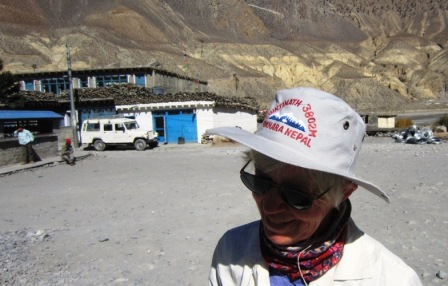
From this comfortable spot we continued down to the riverbed, the road barely discernible and the wind picking up as promised.  But the traffic was light – one tractor, two jeeps, two scooters, a half-dozen trekkers.  The wind was cool, the sun was welcome.  My new hat, pulled down tightly over my hood, blew off only once; the shoelace cord I had contrived to secure it was so inextricably tangled in my camera lanyard that no harm was done.

The hill trail cut half the distance between Jomsom and Kagbeni – we arrived in Jomsom in good spirits, but with the fog closing in.  On the good side, fog in Pokhara had prevented flights into Jomsom, so the premier guest house was able to find room for us despite having been fully booked when we checked on our way to Mulktinath.  On the downside, the hardest stretch of the day was getting from the near side of town – the jeep park – to the far side of town where this hotel was located.  (Strange but true – no matter which direction you are going, your hotel is always on the far side of town.) My feet protested each step on the cobbled street, which seemed to stretch on forever.  We finally made it to the Majesty Hotel, complete with chandelier in the three-story atrium lobby (see earlier post).  The service was slow, the internet connection was down, the ATM did not work, but all was excused: double blankets on the bed!  Attached bathroom!  And HOT SHOWER!

This was supposed to be the last day on the trail, but… men make plans so the gods can laugh.

Tips for Travellers in Nepal – Food, Shelter, Communication

My basic tip is: don’t worry about it. If you are doing the Annapurna circuit you will not be far from a roof or a kitchen;  BUT

in the high season you WILL need reservations or risk sleeping on the dining room floor.

Other thoughts:

  1. Set expectations realistically for communicating with family and friends during the trek. Let me first dispel the myth that “there are cybercafes everywhere”.  There was rumored to be one in Tadupani, but as I walked down the narrow twisting street suddenly everything went dark – power outage.  By the time I returned to the guest house it was aglow with candles on every table – evidently power outages are common – but internet connections do not run on candle-power.  Somehow, though, our guides’ cellphones never seemed to be out of reception range.
  2. Don’t worry about the food. This is not Sir Edmund Hillary’s Himalayas.  The tea houses/hotels are governed by regional associations which set standards and offer an established menu of dishes with familiar names such as pizza, spaghetti, and eggroll.  The fare is largely vegetarian, and might include fried rice, macaroni and cheese, mashed potatoes, apple pie, and cornbread.  Although the pizza may be like no pizza you ever ate before, and the cheese may be yak cheese, you will discover some reliable choices.  The vegetable soups (tomato, pumpkin, carrot) are consistently excellent, and the dal bhat platter is a nutritional powerhouse. Our guides ate this at least twice a day and their slogan was “Dal bhat power – good for 24 hours!”  And for your daily laugh, be sure to check the menu for typos.  (Would you like to try the Greed Salad? Or the Chocolate Crap?)
  3. Don’t worry about the beds.  The trekking trade is a key part of any upward mobility story in Nepal;  each teahouse must meet minimum standards for accomodations, and most will exceed.  Some of the teahouses are downright lovely, taking every advantage they can of the views and environment.
  4. Take time to check your room completely before starting out each day – including under the bed, under the blankets, in the corners.  It is amazing what slips to the floor when you are tired and not looking. I managed to leave my favorite Biffie on the bed in Kalipani (fortunately I had a backup); my backup glasses/sunglasses never made it out of Pokhara, and DM rescued my favorite jade necklace from under the bed in Marfa. If you are traveling with a team as I did, check for each other.

Trekking in Nepal – Day 9 – Jharkot to Mulktinath

This was a very easy day, hiking only 45 minues up the hill from Jharkot to Mulktinath, where we stayed in a more primitive guest house (Asian-style toilets, 3 beds shoehorned into a room meant for two, one sink for all to use outside, pay-per-use propane-fueled shower) but with a fantastic 270-degree view of the peaks around.  Mulktinath is a holy pilgrimage site for both Buddhists and Hindus, and has the requisite Vishnu temple, Buddhist gompa, and Buddhist nunnery.

Since Mulktinath is almost the first point of civilization for people descending from the highest point of the full Annapurna circuit, it has also blossomed in the last few years (since the most recent Lonely Planet, even) with fancy new guest houses and scores of Tibetan refugees selling hand-woven belts, hand-knit hats, and scarves which may or may not be handwoven pashmina or yak fur.

We ran the gauntlet of scarf-sellers and made it to the temple, where Bina, our guide, observed devotions and showed us how it is done.  She and Bandana, one of the assistants, had brought empty plastic liter bottles and carefully filled them with water from each of the 108 spouting bull’s heads fountaining around the Vishnu temple.  She also tied a lucky mallahi string around each of our necks and gave us each a tika  – the red dot in the center of the forehead. 

We also were admitted to the most sacred site, which is an eternal flame burning from a natural gas vent next to an underground river – this combines the sacred elements of earth, air, fire, and water in a way which is thrilling to Hindus and Buddhists alike.
The hills behind the site are a spider web of prayer flags;  the path up to the site is lined with stones piled one atop another – these are believed to be homes provided for souls which have not yet found their way to judgment, so building a nice one for yourself in afterlife is a good investment of time – especially if you need to pause for breath while climbing the stairs at 3800 M.

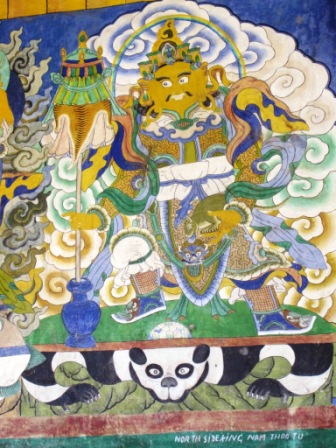
Following our descent and our mollifying the sellers by purchasing several scarves, necklaces, and whatnot, we made it back to the hotel for lunch.  After lunch DM and I visited a Buddhist monastery (brand new and painted lavender, for some reason).  Murals outside the shrine depict the “King of the North (China), yellow-skinned and standing on a panda. The King of the West is pale-skinned and stands on a Lion – influenced by early British contact, maybe?  The King of the East (Tibet)  stands on a tiger, while the King of the South – the Kathmandu region relative to Mulktinath – stands on an eland. Inside the shrine has the usual portraits of current and former Lamas, but the monastery is down to only five monks.
In town DM and I  did our best to send some email.   The young man who runs the internet café spends the winter months in Kathmandu playing in a band;  in the trekking season he spotted an opportunity and set up the internet café in Mulktinath – but the connection is iffy before 6PM because of the limited power allowance in the mountains.

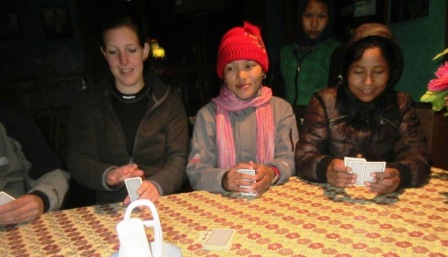
In the evening the three of us and two of the guides drug out a battered deck of cards and played gin rummy and a new game called “five-or-less” to great laughter.  There is something universal about a deck of cards; I wish we’d discovered this sooner.

Trekking in Nepal – Day 8 – Kagbeni to Jharkot

This day we again put DB on a jeep – this time first thing in the morning – and DM and I set out on foot for a four hour trek partly along the bus road (DB and Bina waved at us as they passed) and partly along the old trekking road.  We had the three assistants as guides – nice young things with big smiles and minimal English – and we had a fine time walking through a series of small stone-built villages, over stone bridges, along an amazing series of conduits for flowing water (the actual river was way downhill from us).  We shared trail mix and granola bars and rested frequently, but still made our destination in the four hours allotted.

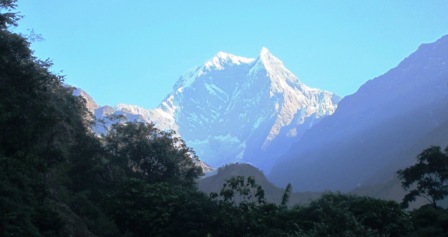
Jharkot is just a smidge(3500M)  down the hill from Mulktinath, the high point of the trek (3802M according to my new hat).  Since we arrived before noon, we had a leisurely lunch on the veranda looking at Nilghiri Peak across the valley, then explored the town, including an ancient Buddhist monastery dating back to the 700s, with some fascinating paintings and artifacts.  We are amazed still at how cavalierly the Nepalese treat their history – no hesitation about touching a fragile old canvas, or allowing flash photos of an ancient wall mural.  The town was very Tibetan in feeling, according to Dianne, who has been to Tibet, all gray stone and low doorways leading into dark corridors or bright courtyards; lots of Buddhist elements mixed in with ancient animist totems – very alien to us.

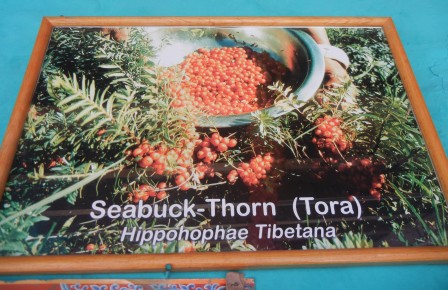
We also had an impromptu tour of a women’s collective engaged inproducing seabuckthorn juice concentrate for the local market. (If seabuckthorn replaces the acai berries craze, you read it here first!) The women do everything from gathering, crushing, and simmering the berries for juice to scalding, labeling and filling recycled bottles for the market.  The space for the seasonal operation is provided by the local Buddhist monastery;  the proceeds are used to assist poor families in the village.  (The catch is that much of the money goes back to the monastery to pay for religious services)

In the evening we gathered around the table under which a charcoal brazier radiated warmth, and after dinner ended up playing a Nepalese version of gin rummy with our guide Bina; assistant Bandana; Katharine, a Dutch management consultant who was trekking solo with a guide, and a charming Italo-French skydiving instructor named David who had just come over the Thang Lo pass solo – no guide, no porter.  We had a lot of inter-generational, inter-cultural laughing and silliness, and at 8:30 the three of us decided it was past our bedtime and left the younger folk to it.

I was amazed at the ability of a battered deck of cards to erase boundaries – we need to play  more often!

Tips for Travelers in Nepal – Equipment

Here are some suggestions regarding equipment you will need for the Annapurna circuit trek, and my recommendations for the best way to manage it.

  1. If you are not a frequent and dedicated backpacker hiker with your own tried and true equipment, and you are doing a tea-house trek with someone else carrying most of your gear, consider a rental option for items that are necessary but not size – related.  Why schlepp a down sleeping bag, back pack, down jacket, and trekking poles half-way around the world if you can rent them from your trekking guide group at a total charge of less that $2/day? These necessary items can be rented in Thamel or Pokhara and save you a lot of baggage bulk on the way to and from those locations.  Some necessary rentables:
    1.  1. Down sleeping bag – you may hike all day in a T-shirt but the temperatures plummet when the sun goes down, and there is no central heat in the guest houses.
    2. 2. Trekking poles.  They will save a lot of wear and tear on knees and hips, as well as saving you from a fall here and there.  The extra security – priceless.
    3. 3. Down Jacket – I needed mine three times in 12 days of hiking – but oh, when I needed it, it was lovely to have!
    4. Large back pack – Remember – it’s not you that will be carrying this pack, it’s the assistant guide assigned to you, so it doesn’t matter how well it fits you. It will hold your sleeping bag, extra clothes, and everything else you don’t need during the day, as well as a small amount of the guide’s gear. Instead of traveling with a backpack as my main piece of luggage, I took an expandable suitcase as far as Pokhara, stashed it at the guest house, and had lots of room for gifts and mementoes.
  2. Bring a silk liner for the down sleeping bag – it will add extra warmth at very little weight and if you are renting it is nice not to worry about who last used the bag. I recommend sewing a bright strip of bias tape across the top opening edge of the liner so it is easy to find when you need to slither in after dark. (thanks to a customer comment on the REI site for this tip!)
  3. Take good care of your feet.  This includes
    1. Good hiking boots, well broken in
    2. Several pairs of wool hiking socks
    3. Silk liners for the hiking socks to wick away sweat and help prevent blisters
    4. Dr. Scholls’ Blister Prevention pads, because you will get “hot spots” despite the good boots and the silk liners. (mentioned already in “Sanitation“, but worth saying twice)
  4. Bring a headlamp.  If you are getting up early to see the sunrise, by definition you will be hiking in the dark.  You will need both hands free for your hiking poles, so an ordinary flashlight will not do.  You will be pleased at how useful it will also be if your roommate in the guest house wants to sleep while you want to read about next day’s route, or if you need to find your way to that outside toilet in the middle of the night.
  5. Bring a deck of cards.  In the evening, a game of cards around a charcoal brazier bridges all culture gaps –French, Swiss, and Dutch and American guests joined by our Nepali guides with the common language of gin rummy.
  6. Bring a long-sleeved cotton shirt with a front breast pocket into which your camera will fit.  Your camera should be on a lanyard around your neck so that if you drop it, no harm. The pocket will take the weight off your neck.


Trekking in Nepal – Day 7 – Marfa to Kagbeni

This day is full of new sights, new surprises.  Today I felt the foreignness of Nepal as I have not before.  We have left the Hindu lowlands behind, and are now in the area settled a decade ago or more by Tibetan refugees.  There is no lush greenery, no fertile croplands or orchards, only the austere high desert surrounded by snowy mountains whose remoteness only adds to the austerity.

This morning as we leave town Bima, our head guide, spots a Multinath/Pokhara/Nepal twin of my  wind-snatched Monterey Kayak hat hanging in a window – now I am equipped again!

We walk along the river bed in the morning cool, watching the airplanes fly in low toward Jomsom, our lunch destination. It is heartening to see that air traffic is moving again, since our plan is to fly back to Pokhara in a couple of days and have a day to unwind before getting back to Kathmandu, also by plane, if all goes as planned (but it won’t.)

When we get to Jomsom  DB again wants to take a jeep for the next leg up the hill .  Hearing of the gray, rocky, dry, dusty, flat hike ahead to Kagbeni, DM and I wimped out and agreed to join her on the jeep.  In fact, a certain amount of bravery is required to get into one of these 4-wheeled engines of doom;  we careen along at probably a top speed of 30 mph but it feels like 70, dodging weary trekkers, donkey caravans, motor scooters, and one very large bus, which brings muffled shrieks from DB in the front seat.  We only ford a few streams, only come perilously close to the edge of the eroded road once or twice, and it is only 45 minutes. The hikers we pass look every bit as unhappy as we feared we would have been, scarved against our dust, bent under their burdens, squinting as we pass.

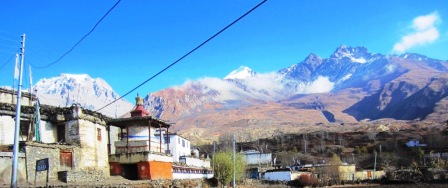
Kagbeni offers a lovely guest house in a very old Tibetan style village;  We enjoy lunch on the sunporch and then spend the afternoon exploring the village.  We visit the gaily painted Buddhist monastery which dates back to 749 AD, and has marvelous murals, mandalas, carved and painted pillars, and all sorts of ritual objects, including ancient scrolls kept under lock and key, intricate marzipan figurines made as sacrificial offerings, conch shells from who knows what distant ocean used on ceremonial occasions, and countless statues and portraits of Buddhas and Bhodisattvas.

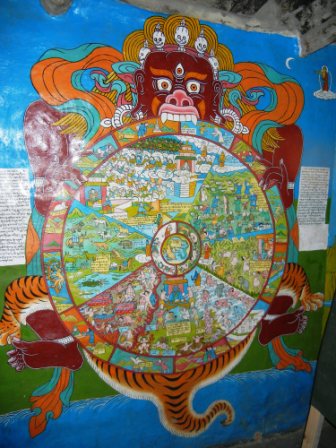
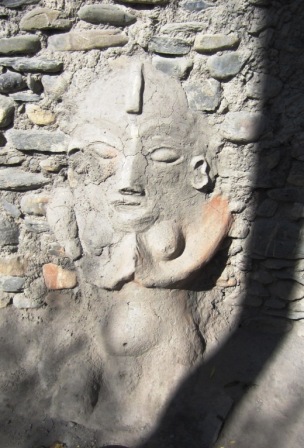
The Wheel of Life at the top of this post  shows humans progressing toward heaven or hell (was Breughel influenced by Tibetan Buddists?  Hell looks truly horrible!), but the entire Wheel is threatened by the God of Death ready to destroy the entire cosmos.

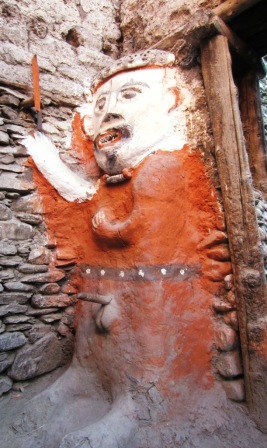
We also admire the graphically  male and female effigies of the village gods who protected the village before Buddhism arrived.   who is also endowed with genuine yak fur mustache and eyebrows, real teeth, a painted cloak and belt, and a real metal knife. The female effigy is about half the size of the male, and gets no paint or fur embellishment.

In the evening we all sit around a big table with a bunch of Germans and one Dutch girl enjoying the charcoal brazier warming our feet under the table, with our down jackets keeping us warm above the table, reluctant to leave in fear of the cold distance between charcoal brazier and sleeping bag.  Despite the differences in languages and nationality around the table, we feel closer to these Europeans in outlook than to the folks who created and maintain both the village guardians and the Wheel of Life.

Trekking in Nepal – Day 6 – Kalipani to Marfa

The ecology and culture of the area has changed completely.  Instead of blue guesthouses haphazardly cleaned and decorated with marigolds and Hindu shrines, we now have gleaming whitewashed homes with wood (a sign of wealth) piled on the roofs and Buddhist stupas appear at the entrance to each tiny town.

Instead of banana trees we are now passing apple orchards, with the cored and peeled apple rings hung to dry on racks above the houses. (Question – why don’t birds eat them?  Why aren’t there roof rats or other rodents to wreak destruction? Maybe the apples are exotic and the local fauna doesn’t recognize them as edible? A mystery.)

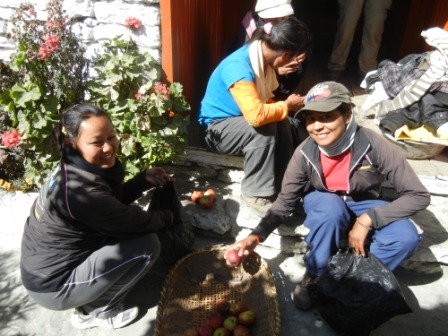
We had a lovely morning walk along the glacial green Kali Gulkhari river, encountering a group of German mountain bikers who enjoyed barreling across the suspension bridges.  Then a tea break amid the apple orchards.  The guides sorted through a bushel of apples and bagged the best to take with them – because area transportation is so spotty, these apples will be greeted as a luxury back in Pokhara.

Then came a stretch of flat gray desolate land along the flood plain of the Kali Gulkhari: we crossed its tributaries on stepping stones and log bridges, waiting our turn with the oxen.

By the time we rejoined the bus road the wind and dust  were picking up along the river.  We left DB, one of the assistants, and all the large packs at one of the small villages  to catch a jeep to Marfa while DM, the other three guides and I pressed on.  We spotted DB’s jeep coming and I struggled with my trekking poles, grit in my eye from the wind and dust, and my camera in my right hand trying to take a picture;  a sudden gust of wind seized my trusty Monterey Kayaks hat and swept it over the parapet and at least 100 feet straight down.  Rats!

I used my Biffie to shield my scalp for the rest of the day’s walk, wide brimmed sunhats being scarce at the Tibetan craft shops on the way to Marfa.

We reached Marfa just as the sun was setting beyond the mountains, leaving the town in dusky shade (and giving an unreal blue tinge to my photos.  The white-washed stones and pale cobbles contrast with the heavy dark doorways and windows;  the streets are so narrow that the houses seem to loom over the passersby.  Where the  casual litter of towns on the lower level leds to a feeling of  congenial informality, in Marfa and other high-elevation towns there are communal sanctions for any shopkeeper who does not keep his shop in order and his share of sidewalk swept and neat.  Even the dogs are well-behaved.

The guest house at Marfa gave us a lovely large room with big windows looking out at the mountains. 300 steps up from the guest house was a Buddhist monastery, with a lavishly painted shrine, cubbyholes for storing ancient religious scrolls, prayer flags fluttering everywhere.  But there are only 20 or so monks in residence – it is  hard to keep them, we were told – the young men keep leaving for warmer altitudes, busier throughways.

Tips for Travelers in Nepal – Clothing

In general, women in the rural areas of Nepal dress very conservatively, with long sleeves and long skirts being the norm outside of Kathmandu and Pokhara.  Nepalese who run guest houses and other tourist services on the Annapurna circuit have become enured to seeing women in trousers, but bare shoulders and short shorts will draw unwanted attention.

To bring:

  1. Two pair of many-pocketed hiking pants – the kind with zip-off legs is good, although I never used that feature.  I had only one pair which I wore for 11 straight days of hiking – by the end of the trek they could stand on their own.
  2. A brimmed hat.  A baseball cap will not be enough to protect your nose and neck at high altitudes. Make sure the hat has ties for under the chin – a brisk wind can carry off your hat in the moment it takes to shift a trekking pole to your other hand and try to grab the hat.
  3. Lots of layers of clothes – short sleeve T’s, long sleeved T’s, preferably wick-away material that keeps moisture away from your skin. A water-resistant lightweight wind-breaker with a hood and lots of pockets. A fleece jacket.
  4. A change of clothes for evening.  I gained a new understanding of the rational behind the old tradition of “dressing for dinner.”  If you have been walking all day, if the shower has only cold water and the sink is for public use in the courtyard, , it is still amazingly refreshing to put on something different, even if the skin underneath is un-scrubbed.  My evening outfit consisted of clean undies, my long johns (top and bottom) and a long skirt, with a T-shirt on top. After dinner I could just take off the skirt and shirt and hop into my sleeping bag.
  5. A change of shoes.  Your feet will thank you if you let them escape the hiking boots for more flexible footwear at the end of the day. Thong sandals are useful for getting in and out of a wet-floored shower/toilet combination room, but they get chilly. DM used Tivo sandals;  I liked the watershoes I brought – waterproof, easy to get on and off, wearable with socks for warmth if needed.
  6. A Biffie – one of those lightweight knit loops of cloth that can be used as a headband, hat, neck scarf, or face-covering.  When a sudden dust storm envelops you on the dusty trail across a dry riverbed, or a giant lorry passes you by, being able to cover your mouth and nose on short notice is a blessing.
  7. A conservative bathing suit and wrap if your route takes you to Tadopani – after several days of iffy hot water supplies the unlimited hot spring should not be missed – even though the fence is lined with ogling Nepali men. A bikini would probably cause a riot. [ See post from Day 4  ]

Trekking in Nepal – Day 5 – Tadupani to Kalipani

If Pun Hill was the overture to the Himalayas, the road to Kalopani is the main movement – we walked all day in a lush landscape decked with marigolds and bougainvillea and ringed by snow peaks.

This was an easy but long walk – 8 KM. Most tours break this segment at Ghasa; our guides had combined what was normally a two day stint into one in order to provide some wiggle room in our schedule for returning to Kathmandu (a very good decision, as it turned out!).

We lunched at a stunning spot overlooking the Kali Gandaki river gorge, with the beautiful Rupse Chharara falls cascading 5000+ feet down the neighboring mountain. We then crossed the first of several spectacular suspension bridges over “the deepest gorge in the world.”  (This is somewhat of an exaggeration, since they count from the top of the surrounding mountains, not from the adjoining roadbed.)

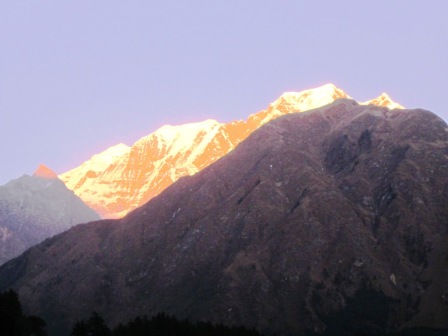
At Ghasa DB decided on a different adventure –at 3PM she could not face another three hours of walking and decided to take the public bus to  (brave lass!).  DB and I kept on to thrill at alpenglow on the peaks, then the full moon rising over the mountains, and arriving at our guest house by moonlight. Bena, our guide, had gone ahead with Dianne, and the three assistants led us on the shortcuts- including a clamber up and across a rocky, pebbly, thin trail across the face of a cliff where we were literally sidling along the trail in the half-dark clinging with our fingertips… we decided we would rather have walked around, thanks, but once started there was no returning – and by that time we were too tired to be actually scared.  The two friendly dogs romping up and down the path around us were not helpful.  And then the full moon rose over the mountains, bathing everything in a silver light almost as bright as day.

Kalopani, like most Nepalese towns, closes at dusk.  We plodded through the town by moonlight, passed by  an occasional motorbike or bus, my feet complaining about every picturesque cobblestone they encountered.  Happily, our trek ended at the Kalopani Guest House, which to our eyes seemed as luxurious as a  Ritz Carlton.  We had a large room with wood paneling, and our own gleaming white ceramic tile bathroom!

The dining room boasted a carved and mirrored bar, a long table occuppied by high-spirited Germans,  and a high-speed internet connection. The charcoal brazier placed under our dinner table to warm our feet was the crowning touch. DB threatened to marry the smiling, English-speaking proprietor, but he demurred on grounds that his existing wife would object.  He explained that he and his family had recently invested their pooled savings to upgrade the guest house in hopes of attracting more tourists, and urged us to spread the word to recruit more trekkers among our friends.  He looked all of eighteen.

Trekking in Nepal – Day 4 – Shikha to Tadupani

Day 4 – Shikha to Tadupani

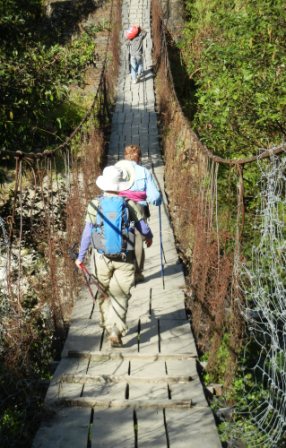
The morning is bright and clear and there is a view of Khilghari Peak out my window.  This is a great day of hiking – we are on ups, downs, and flats, surrounded by snow-capped mountains.  We cross swaying suspension bridges over chasms where the river runs white over huge rocks far below. (This had been one of my fears – that I would have an attack of vertigo in the middle of one of these bridges and freeze in panic.  Happily, these crossings turned out to be thrilling, not terrifying – though both DM and DB confessed to being afraid to look down.)

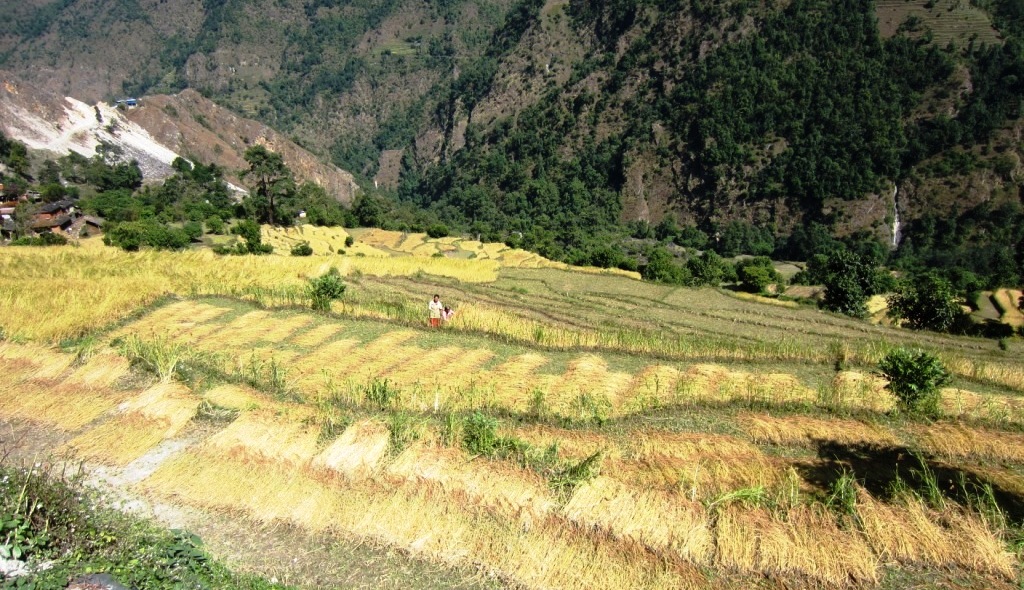
 The fields are golden with the buckwheat harvest.  Every home is trimmed with drying corn cobs hung from the eaves by the hundreds.  Sun means hot – we are stripped down to single layers of clothing as we descend  to rain forest levels again,  some but the brilliance of the flowers and the mountains makes it ok.

Due to our slow descent, we arrive at Tadupani quite late for lunch (3PM).  Hunger does not bring out the best in me!  Once fed, we are free to enjoy “the Palm Springs of Nepal.”  Tadupani literally means “hot water” and at the riverside just below our little cabin are the hot pools – one VERY hot, one deliciously warm, plus a shower with free-flowing warm water where one can wash one’s hair.  The pools are full of trekkers, and surrounded outside the fence by Nepali gawkers – young men staring at the Western women in their revealing swim suits.

The guesthouse at Tadupani comprises a number of little cabins surrounded by a tropical garden.  Our  cabin is a duplex with a shared shower in a separate room behind and a big bunch of green bananas nodding from a banana tree at the front door.  DB locks the entry and is enjoying the shower as DM and I explore the hot spring, but discovers to her embarrassment that the cabin door cannot be unlocked from outside, she must sprint buck-naked from the shower to re-admit DM and I, and meanwhile the other half of the duplex which she had thought was empty is now occupied by two young Frenchmen. They are sitting on the steps smoking as we go up to the lodge for  dinner, and greet us with bland smiles.

The dining room and patio are full of Germans and Americans and Dutch and Israelis and Koreans all swigging beer and swapping stories – in some ways tea-house trekking in Nepal is  a giant mobile summer camp for grown-ups.

Post Navigation