Allyson Johnson

Pieces of my Mind

Archive for the tag “museums”

Freeway Free in Spain: Madrid and its Museums – Thyssen- Bornemizso

the Baron and BaronessThe Thyssen-Bornemizso museum is the last of Madrid’s”Big 3″ and perhaps the most cosmopolitan/ecumenical, as it spans from early medieval art through the impressionsts all the way to Roy Lichtenstein and Marc Rothko. In addition to the core collections, this museum had the most intriguing special exhibitions of the Big 3. On the day of our visit we happened on a special exhibit devoted to the influence of open-air painting on the Impressionists. We took this in first, then approached the regular collection already half-dazzled.

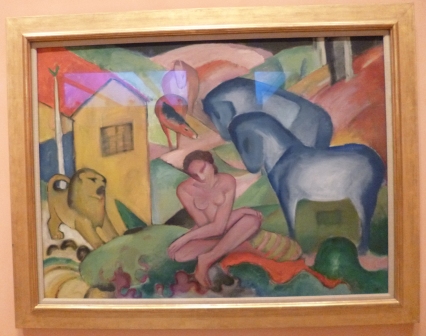
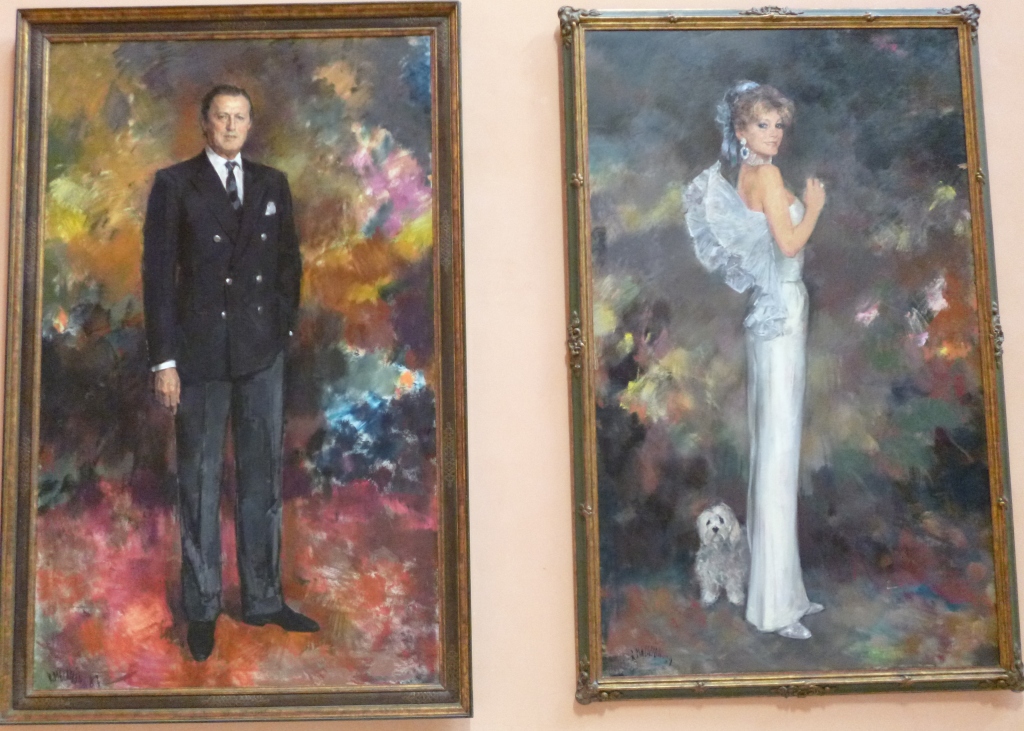
Famous blue horsesThe regular collection is now actually TWO collections, that of the Baron and his family which had been a-building for two generations, and that of late-comer Baroness Carmen Tyssen-Bornemizso (a former Miss Spain, and well-qualified judging by the full-length portrait which hangs in the entry gallery). So one is forced to zig and zag from the Middle Ages to the Barbizon school with the Baron, then leap to an unusual collection of American painters from Winslow Homer to Roy Lichtenstein with Carmen, then back to the Renaissance again with Carmen, then back to the Impressionists with the family collection. One wonders why the two collections could not simply be integrated along chronological lines; probably feminism has something to do with it.

Edward Hopper


A nice small special exhibit of paintings showing women going about daily life rounded off over seven hours at the T-B. There was one more exhibit of modern art entitled “Hyperrealismo” but we ran out of brain cells.

We went back to El Retiro to stop and smell the roses one last time. On this warm sunny Sunday it seemed all Madrid was celebrating La Dia de la Madre in the park: picnicking, strolling with the obligatory gift rose in hand, rowing in the rectangular Estanque. On the way back to the Metro we discovered a street of bookstalls like those along the Seine selling used books of all sorts. I barely resisted “Matilda”, one of my favorites from Roald Dahl. Perhaps in the park we discovered the real elusive center of Madrid.

Freeway Free in Spain: Madrid and its Museums – El Prado

El Prado 3D galleryEl Prado

At El Prado you can thrill your fill on the Big 3 of Spanish painting: Goya, El Greco, Velasquez.  Wow!  I warmed up with a roomful of Hieronymous Bosch (inspiration for every sci fi paperback anthology cover ever printed).  The Garden of Earthly Delights is enough to give one nightmares for a week.  On the wall catty corner is Breughel’s Triumph of Death  with Death leading an army of skeletons against the doomed remainder of mankind – the original zombie apocalypse.Bosch - Earthly Delights and Torments After

Unfortunately, a guard informed me that photos are not allowed soon after I left Bosch and Breughel, so I will have to link you to websites for you to get your tastes of G, V, and el G.

I was headed for Goya but got side-tracked by Velasquez.  Three hundred years before the Impressionists, this man knew exactly how to make light shine out of a picture.  I could have looked at his portrait of the Infanta Maria  and her handmaidens and dwarves for hours speculating on what was happening in each person’s mind, but the traffic of Japanese, German, French, and Spanish tour groups impeded reflection.

So I proceeded on my search for Goya but went the wrong way and got caught by El Greco  – even earlier than Velasquez, and combining use of light and of exaggeration to portray emotion and character in a way that prefigures Toulouse-Lautrec by 400 years.

W and I had split up after Bosch and Breughel.  When we reunited for lunch I was ready to babble about El Greco while she had found and been immersed in Goya, especially the “black Goyas” from his late period.  We exchanged enthusiasms, and then went out to explore again.

This time I found the Goyas and worked backward from the black period all the way to when he was hired to do “cartoons” of designs of frolicking gypsies and children,  to be used as patterns for tapestries at the local royal weavers workshop.  Amazing.  Age and war do alter one’s  point of view, and to go backwards in his career, from the murals of massacre and the blindness of fate to these sunny comic scenes, was especially poignant.

So which was the greatest painter of the Big Three?  Impossible to choose.


Freeway-free in Spain: Madrid and its Museums: Reina Sophia

Line for Dali

Madrid is a big city, the largest we have visited in Spain. Unlike the other largish cities we have visited, it does not seem to have a historic center; the Plaza Mayor is a nice place in daylight, but in the evening it is a haven for the homeless who are sheltering in cardboard boxes left over from the day’s sales of tidbits and trinkets for tourists. The main gathering place for events is the Puerta del Sol, site of the city hall and of Madrid’s civic mascot, the statue of a bear reaching for fruit on a strawberry tree (obviously not the kind of strawberries we grow for shortcake in the US).  Unlike other European capitals, it does not have an iconic identifying landmark, like the Eiffel Tower or Big Ben  or the Brandenburg Gate or St. Paul’s Cathedral.  What Madrid has is Art, in three world-class museums, and in Madrid we looked at Art, with an occasional eyeball-break in the lovely Parque del Buen Retiro.

Here are our experiences with the Big Three (spreading over a couple of posts):

Museo de la Reina Sophia
Reina Sophia focuses on  Spanish modern art with the jewel of the collection being
PIcasso’s  Guernica Pablo-Picassos-Guernica-001.  The museum was having a special exhibit of Dali
which had started two days before our arrival and despite the drizzle the line to get in there was across the plaza  when we arrived at 4:30.  We decided to do the rest of the museum and come  back later for Dali.  We worked our way up in the general admission line, and  discovered gleefully that as seniors we qualified for free admission to  everything but Dali.  W had done her prep and started us on the second floor, but even  then we wore out our feet and our brains before we got to Guernica.  

Two days later we came back to the Reina Sophia for a second go-around.  This time we let ourselves drown in the overwhelming torrents of Dali and Picasso. These had never been my favorite painters, but after learning of the background against which they lived and painted I am more favorably inclined.

I did not know that Guernica had been painted on commission by the republican government of Spain to show at the Spanish pavilion at the 1936 World’s Fair in Paris.  I did not know it  was part of an attempt to win world sympathy for the republicans in the Civil War against Franco. (They got a lot of sympathy, but Franco still won). And I did not know that during World War II Dali had to flee Spain for France, then for the USA. There he became the first performance artist/career celebrity, perfectly reading the needs of the host country, anticipating Paris Hilton and Madonna by a half-century.

After drinking from the fire hydrant of history and art at Reina Sophia, the park was a chance to stretch our legs and our eyes over some longer distances.  There is something very refreshingly basic about a vista that includes a little girl and a pigeon.

Park and Pigeon

Freeway Free in Spain: One-Night Stand in Salamanca

Plaza Mayor - SalamanceMy niece Jen suggested that we should stop in Salamanca on our way to visit her in northern Spain, so we did, on the principle that a traveler should always take advantage of local recommendation when you can get them. Salamanca is famous for its beautiful Plaza Mayor, for its university, and for its cathedral, and justly so. You can read about those things in Lonely Planet and Fodor, just like I did.

In twenty-four hours, guide books in hand, we did there mostly what tourists do, saw what the guidebooks said we should see. For every other stopover we had established a home base and enjoyed day trips. Somehow, the home base gave me more of a feeling that I was getting to know an area, where the one-night-stopover felt like… a one-night–stand.

Salamanca- suburban desertOn entering the outskirts of Salamanca we saw the evidence of the disastrous Spanish housing bubble – acres of empty scraped land, streets laid out, with sidewalks and street lights intact, but no paving, set with lollipop trees all dead of neglect except for the hardy pine trees, no sign of construction activity. Gives new meaning to the term “desert”.

After settling into the Hostal Concejo looking out at the small Playa de Libertad, we set out to see Salamanca, maps in hand, cameras at the ready. We toured the famous plaza and dutifully took pictures of the much-defaced, often-replaced plaque of Franco among the other Spanish dignitaries honored on the Plaza in bas-relief.Franco and colleague

A better alternative: Down the hill along the Calle de San Pablo we found the convent de las Duenas.  Here in the cloister the carvings of demons and souls in torment are much more lively and evocative than the formal portraits of the Plaza. One wonders what the nuns made of some of the more explicit carvngs – they  would not seem to lend themselves to calm meditation and spiritual uplift. Adam unleashes demons

We strolled our way down to the old Roman Bridge across the Rio Tormes, admiring the golden carved façade and gilded carved interior of the Cathedral on the way. It felt a little ho-hum after the Roman remains of Merida and the Conquistadors’ gold we had seen flaunted in Trujillo. From the bridge we turned back to look at the city and spotted the amazing blue-stained-glass Art Deco façade of the Museo de Art Nouveau y Art Deco soaring above the river.

Museo Art Nouveau y Art DecoOf course we had to go look. Totally not Romanesque, Gothic, Classic, Baroque, or Ho-hum! Very strict rules against taking pictures inside, though, so you will have to take my word that the interior includes everything from Limoges and Lalique figurines to Kewpie dolls and scatological ashtrays, in a setting inspired by Gaudi and Louis Tiffany. A must-see (and a nice change of pace from all that Old Stuff.)

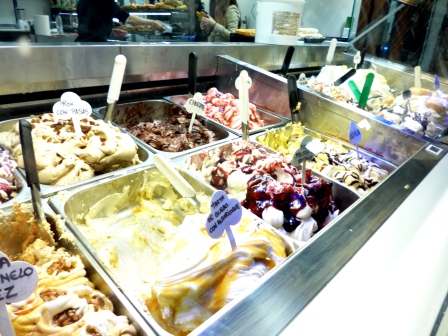
In Salamanca we had our first real culinary disappointment. The desk attendant at our hotel was not the comfortable matron of the afternoon – perhaps it was her son. We asked him for a recommendation to a local tapateria and he sent us to just the place a beardless youth would like: noisy, crowded,cheap ,bright, beery, and full of soccer fans. We fled, but try as we might we could not locate the kind of cheerful,friendly conversation-friendly place we had enjoyed in Caceras. We ended up in a near-by and near-empty joint with only a few middle aged soccer fans clustered at the bar. Too late we realized this dearth was a reflection of the fare and the service, but we were too hungry to look further . We drowned our disappointment in striacchiatti (chocolate chip gelato) and fresh berry yogurt from a shop on the way back to our plaza.Helado - Spanish comfort food

Freeway Free in Spain: Livin’ the High Life in Caceras

Bride #3 and littlest guestCaceras Bride #2Saturday is the best day for  touring the medieval lchurches in Caceres. In addition to the wonders of the Old Town, you are likely to spot a bevy of up-to-date brides – always a great insight into the local culture.

The Old Town is very old indeed, with Hapsburg castles built on Castilian palaces built on Moorish forts built on Roman walls.  We wandered through maybe a quarter of the
Old Town, taking in the Visitor Center (highly recommended)  in a 14th century lookout tower outside  the wall and the Church of Santa Maria with its carved reredos and 14th century
Christo Negro.   This area was the home of Pizarro and Cortez (more on them later) and the church museum is full of silver and gold reliquaries and croziers made from New World gold and silver.

Caceras Bride #1At the Plaza San Jorge we spotted our first bride of the day, dressed in a very modern white gown – above the knee in front and trailing to the ground in back  –  posing on the step with her family including a tiny ring-bearer who was doing his version of  Gangnam Style   in the front row.

The cathedral of St. Francis Xavier  has a three story gilded reredos studded with saints.  In case there was not enough gilt on view, this particular weekend also featured  a special exhibition of icons from around the world.  In this setting all that glitters is not gold, but might well be ruby, emerald, or mother-of-pearl.Altarpiece, Church of San Francisco Xavier

After being dazzled, we  squeezed our way up a two-story wrought iron spiral staircase (not for the vertiginous!) and then up the spiral stone steps of the two towers, from which one could peer across to say hello to storks guarding their nests at eye level.    A beautiful day  allowed us to look across the green valley to the peaks of the Greda range still well-covered with snow.Stork at home

Second church, second bride (see above leftf).  At the Plaza San Mateo we found a VERY upscale wedding, with the female guests wearing Jimmy Choos and fascinators a la Kate and William’s wedding, and the male guests wearing silk ties which coordinated with their wives’/girlfriends’ dresses.  When the bride and groom emerged the air was full of red and white rice-paper hearts which were carried everywhere and up by the wind.

Taxis whisked the most important guests to the reception, while the other female guests tottered off over the cobblestones in their 5 inch heels. Some had to be assisted on both sides to keep from falling, just like the Chinese ladies of old with their bound feet.  To each her own torture.These shoes ain't made for walkin'

We hit the Cultural Center (also recommended)  and the Artisan Coop (interesting local art, but pricey!)  and headed for our hotel in  time to catch the 3rd bride exiting from the church of San Juan just outside the old city –  more fascinators, more silk gowns.  I felt way under-dressed in my well-traveled raffia hat and cargo pants, but that didn’t stop my snapping pictures of the elegant display.  And no one preening in their finery seemed to object to becoming part of my travel story – no Mafia dons in Spain?

Freeway Free in Merida: Ramblin’ round the Roman Ruins

Roman theatre in MericaIf you OD on medieval ruins in Caceras, you have options.  How about Roman ruins instead?  Merida, another World Heritage Site, is only an hour’s train ride away.

Wow!  Those Romans were some engineers!  Stuff they built 2000 years ago is still being used  in Merida, such as a magical open air theatre where we happened upon a kind of rock n roll High School Musical version of “The Rape of Europa” (That giant white caterpillar with black antennae is supposed to be Jupiter as a white bull).

Temple of Diana - Merida

The Temple of Diana has a 15th Century villa built INSIDE.

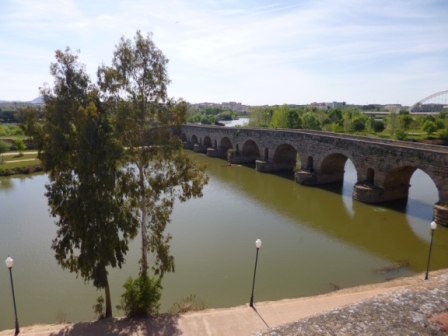
Roman bridge - Merida

A graceful bridge across the Guardiana River is used now by pedestrians and bicycles as part of an extensive trail network.

Arc of Trajan - Merida

Cars still rumble under Trajan’s Arch.

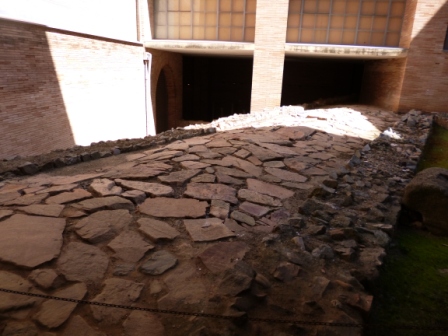
Roman road leads to ongoing archaeology

In many places the original Roman roads form the substrata for current city streets.

I

Museo National de Arte Romano

And there is a great museum next to the theatre and amphitheater which makes sense of it all.

Houston – Major and Minor Museum Highlights

Disclaimer:  To get Perfect Days in Houston, it helps to  have a Knowledgeable Friend (KF) with a pied-a-terre smack in the center of town within walking or biking distance of the most beautiful neighborhoods, interesting locations, and good eats. Unseeasonably perfect weather helps also.  Of course, this is true of any city…

So, that condition satisfied – off we go!

Up, shower, tea, yogurt, on the bikes by 9:30 – to the Cafe Croissant- Brioche, home of excellent croissants almost up to Rue Cler standard. Lingered over cafe latte, then biked through the leafy lawny street of the Rice University neighborhood (the trees really do meet over the center of the street – though many died in last year’s drought) and along a bike trail through Hermann Park, into the Museum District. The Houston Fine Arts Museum spreads across several large buildings – we parked alongside a medical building and negotiated our way across the light rail line (much fancier cars than the SJLR), past the bag checkers, into a subterranean tunnel with a light sculpture effect which was quite magical (an optical illusion which created walls of color where none existed) and up and down and up until we reached the “Tutankhamun: the Golden King”  installation.

There were very few people on a Friday morning well into the exhibit’s run, so we saw everything at our leisure. The National Geographic (show organizer) made up in presentation what was lacking in content – Harrison Ford as narrator, a breathless Egypian archaeologist to comment in awestruck fashion on every artifact (“When I found this statue, I felt I was holding the universe in my hand.”), videos, photomurals, and special effects galore. But the golden guardians of the coffins, and the coffins themselves, were present only in pictures – I missed them.

Next, to the Museum’s Express Cafe, which like most Museum Cafes offered excellent Ladies Luncheon type food, but unlike most, offered it in Large Portions, so that we were obliged to leave a lot of King Tut’s Trio (an appetizer plate of Eastern Mediterranean dips and pita bread) behind.

Next to the Impressionist Gallery – a very competent collection of B pictures by every artist you ever heard of – refreshingly familiar after we had worked our brains being taught so much about King T.

Next to the Gift Shop, again like most Museum Gift Shops with a collection of interesting and expensive items more or less inspired by the art available, but since this is Texas, bigger and more. Friday afternoon is evidently Field Trip Day, and we arrived at the Gift Shop just as the kids did – the clerks were going quietly mad trying to keep track and keep order. I managed to get away with only a couple of post cards.

Back to the bikes, and off to the Hermann Park Rose Garden. Houston is ahead of Northern California in this respect and we saw a very respectable number of blooms.

Then to the small but interesting Weather Museum, where we learned more about hurricanes and tornados. I had seen a lot of information on the Great Storm which wiped out Galveston in 1900, but this museum filled us on on some of the other titanic storms since. (Sample trivia: Tropical Storm Allison is the only Tropical Storm to have its name retired due to its impact although it never reached hurricane force. The Houston Airport registered 37 inches of rain in three days.) Some bemoaning that the areas devastated by Ike didn’t get nearly the same degree of celebrity and other response that New Orleans got for Katrina – I remember towns in Mississippi made the same complaint.
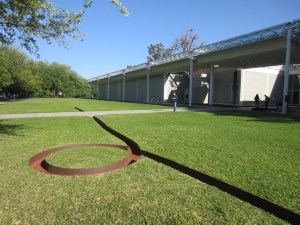
Then to the Menil Collection – an amazing private collection of modern art open to the public free of charge, hidden away in a Houston neighborhood near Rice, filling a large central  building plus a warehouse, two bungalows, and a few other out-buildings with modern art – lots of Magritte, some Braque, some Royko, and other artists too arcane and indecipherable to mention. The photo is  of one of the outdoor sculptures which reminded me of Stanford’s “Stone River” – a channel about 8 inches wide and 6 inches deep, lined in rusted steel, running across the lawn now straight, now curliqueing, now invisibly coming up into the air, then bouncing down again… oddly fascinating.

Dinner at a bustling seafood restaurant, Pappa’s Seafood Kitchen. I had spicy Crayfish Etouffe, KF had Texas Redfish, and we each brought enough home so that we did not have to cook the next day.
Post Navigation