Allyson Johnson

Pieces of my Mind

Archive for the tag “museums”

Freeway-free in France:Medieval Market and Marketing in Sarlat


Exploring the medieval village of Sarlat out-appealed  walking in the surrounding countryside,  and gave us each an opportunity to occupy our time without being one wheel of a four-wheel drive vehicle.  DM and I did shopping in the justly- famous Sarlat Saturday market, while DB walked the self-guided city tour and W did tai qi and sudoku in the park. We met for lunch at a quaint courtyard,  then DB went back to the hotel to relax while the other  three did the city tour. We all spent an hour or so doing email and post cards in the mid-afternoon and then the D’s invited us up to their roomier (set up for handicapped) suite for a pre-prandial cordial. So we are learning how to be apart as well as together –  A good travel skill. september-2016-410web

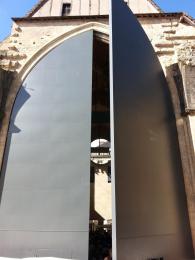
The Saturday market in Sarlat attracts vendors from all over the regions, with lots of opportunities to sampled the  key products: olives and their oil, walnuts and their oil, and (less lavishly set out for tasting) duck and goose foie gras.  The market fills several streets, the main public square, and the inside of an abandoned church whose entire back wall has been converted to a giant portal allowing free circulation of both air and people to the market stalls inside. 
 20160917_021452docHaving figured out the advantage of attracting tourists to their market on Saturday morning, the city fathers of Sarlat have lost no time in figuring out ways to keep those walking cash dispensers in town as long as possible.  On the Saturday of our stay we were tempted back onto the streets long after the market closed with an evening sound-and-light presentation called “Un Patrimoine sous les Etoiles” [A Patrimony under the Stars]  in the old city starting at 9pm.


W and DB begged off, but DM and I set out after dinner to find the streets and ramparts lined with votive candles , the public buildings and cathedral lit with patriotic blue, white, and red, an artist drawing calligraphy with a light torch in the public square, and a buxom artiste on a balcony reading patriotic excerpts from Sarlat’s leading literary light Etienne de La Boetie accompanied by a cello.  The ostensible theme of the evening was something to do with the responsibilities of citizenship, but the real point was to see how different and how cool the old city looked with candle-lit paths and colored light effects. 


Freeway Free in France: Medieval Memories in Aigues Mortes


20160910_023539doc

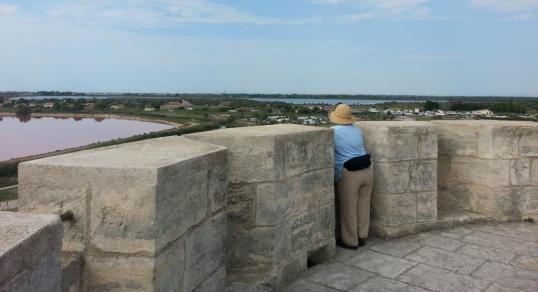
We spent most of Day 5 in Aigues Mortes ( “Dead Waters” in Provençal), a town which was extensively fortified by Louis IX (later St Louis) back when he was extending his kingdom south and needed a Mediterranean port.  Unfortunately, the port location was badly chosen, the harbor kept silting up, and eventually Louis conquered enough of Provence to make Marseilles his lead port, leaving Aigues Mortes to molder neglected at the end of a rather barren peninsula.

 20160910_035659docNeglect means no development, so the medieval town, with its defensive wall, royal apartments, and battlements are all pretty much intact, despite some quarrying of the walls to build more modern edifices (pig sties, sheep pens, etc.). Later when the Huguenots were being suppressed by Henry II, a number of them were imprisoned here until they would renounce their heresy. Some stayed for 35 years until finally freed by Louis XV.  Still later, imported Italian workers being exploited in the nearby saltworks were cruelly suppressed by the French authorities – some striking artworks made of salt crystals commemorate the injustice.allyson-and-friends-070web


The day was quite warm, but a nice breeze off the sea and a number of displays, educational materials, and art projects located in cool interior rooms make our tour of the battlements very pleasant. We stopped for ice cream on the way out of town, and Chantal located a boulangerie which sold fougasse, a kind of Provencale specialty bread  made with olive oil, olives, and bacon bits, which I had heard about and wanted to try.  Yummy greasy flaky rich.

 20160910_131116web

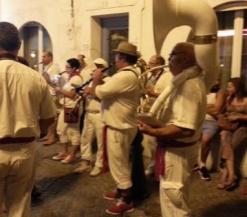
That evening the five of us went out for a seafood dinner at a little harbor town near Lunel.  On a Saturday night the place was jumping, with each outdoor restaurant competing with the next in loudness and variety of bands (mariachi, hip hop, rock, all going noisily at each other across the canal.). It was not exactly the quiet atmospheric dinner we had expected, but it was certainly a change of pace. 

20160910_131748doc 


Freeway Free in France: Rockin’ with the Romans

20160909_071609docStill in Arles

After our homage to Vincent, we switched back about two millenia to the time when Pompey was conquering the southern Mediterranean, just before he was recalled to Rome to help put down the slave rebellion led by Spartacus.  He helped establish the fort we visited yesterday at Ambrussum, but it was Augustus Caesar who visited a few assassinations and de-throneings later and established the Arena and the theatre, both of which are still in use.

20160909_055112docWe started off with a stop in the 12th century at the Cloistre de St. Trophies, a cool and calm spot right off the main square. The cloister included many  statues which had been so badly eroded you could hardly make them out, but a few that had been sheltered are very human and evocative.   Then we walked along the wall of the city overlooking the Rhone, well culverted against flooding, admiring an old Romanesque church which had been converted during the Revolution to a union hall for shepherds, a large domed building which was the remains of a steam bath built by Constantine, and a number of long views down the river to unnamed castles and fortifications in the distance.20160909_065114doc

The Arena was being set up for a cordillera that evening (that’s a kind of bloodless Provençal bullfight). In exploring the arcades,  we entered into a sort of human Whack-a-mole game.  DB had decided not to do the river walk but instead to meet us at a garden after our Arena visit.  C and I somehow got separated from WB, and we next spotted her halfway around the arena as we waved from the tower.  Ten minutes of brisk walking through the arcades later we arrived at where she had been, but no WB.

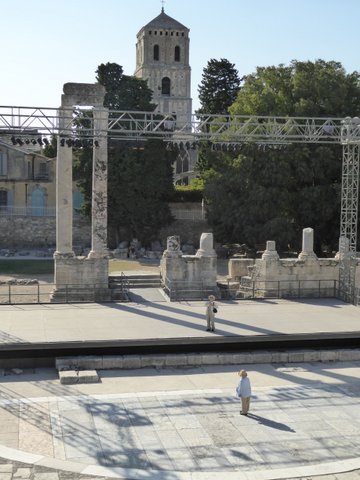
20160909_071525web Scanning the arena, we spotted her in the Tower!  Heading back to the tower, I heard my name called.  It was DB, AWOL from the garden, who had just seen WB at the base of the tower.  “I’ll meet you at the entrance to the tower, ” she said.  By the time we got there, WB  was back a quarter of the way around the arena, and DB was nowhere to be seen.  And so on. We finally joined forces and made our last tourist stop at the old Roman theatre, much pillaged (as was the Arena) for building materials over the years, but now set up for open air musical and theatrical performances. We tested the acoustics and found them sadly lacking compared to Ephesus in Turkey or the Mormon Tabernacle in Salt Lake City. allyson-and-friends-063web
Travel Tip:  Arles is a busy city as well as a tourist stop.  It is also home to many festivals throughout the year, attracting still more people.  If you are arriving by car, try to get there early in the day, and find a parking place by going off the main road through the center city (Preferably downhill – you’ll appreciate that after exploring all day!)  Once you have a parking place, the next stop could be the Office de Tourisme de Arles, conveniently located on the Blvd. des Lices, near the Theatre Antique. Here you will find excellent maps of the center city, friendly advice about getting around, and zillions of beautiful postcards.  Enjoy!

Freeway Free in France: Ambling around Arles in Vincent’s Footsteps

20160909_063127doc

This morning DM was picked up at 9″30 by her Swiss cousin and his wife who happen to live about a half hour from Lunel.  Right afterward the remaining four of us set out for Arles, known for its Roman ruins and former resident Vincent Van Gogh.  We saw a lot of both.

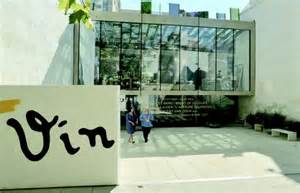
vvgoghfondOnce we got to Arles and rather miraculously found a free parking space that I could maneuver into, we headed first for the Bureau Touristique for city maps, and then, at WB’s insistence, went first to the Fondation de Vincent Van Gogh, which was sponsoring a special exhibit of Arles’ favorite summer tourist. C scoffed “This isn’t Paris!  There will be no queue!” But there was one, and a twenty minute wait for tickets.  Rather than retrace steps, we shifted our plan of saving the nice air conditioned museum for later in the afternoon and plunged into three rooms of I would say B-level van Gogh’s on loan not from the Rijksmuseum but a less prestigious Vincent van Gogh museum in Amsterdam. 20160909_030921doc

The only well known work on view was the one of fishing boats on the beach.  It is a beautiful work.  There were a couple of others that I wouldn’t mind having on my wall, and a couple that I would NOT want to display  too dark and foreboding. Once out of the museum (including an ascent to La Terrace, with a wonderful view over the rooftops of Arles) we discovered we were starving.  We tried a couple of places with recommendations from Michelin and Routiere but found them with no available places, and ended up rather serendipitously at la Cafe de la Nuit, which was famously painted by Van Gogh, and which I had used as a focus point for one of my Lamaze experiences.  The lunch was better than expected, service snail like, but the locale could not be beat!

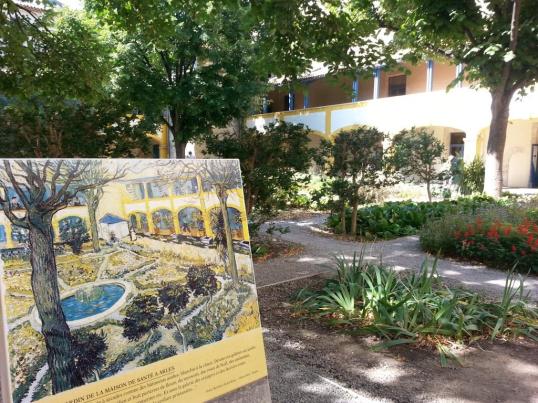
We rounded out our VvG experiences with a visit to l’Espace Van Gogh, which is the asylum to which he repaired after falling out with Gauguin and cutting off his ear.  It is a lovely enclosed space with a garden that blends the formal French garden with an Impressionistic flair. It is now a tourist center with one of the world’s greatest collections of postcards, and tour groups ebbing and flowing constantly.  I had to wonder whether the current buildings are painted as they were when Van Gogh was there or painted as he painted them (not necessarily the same.) Then we started our Roman ramblings. Maybe it would be good to consign that part of the day to a separate email.

Freeway Free in Santa Fe

IMG_0476doc

If you are in Santa Fe, stay at the La Fonda. Why not? It has all the historic charm of the Ahwahnee Hotel in Yosemite, or the El Tovar at the rim of the Grand Canyon. It is not located in a national park, so it went through some hard times before being lovingly restored to splendid 1920’s level grandeur. And it is MUCH more affordable than the Ahwahnee with all the wonderful hand-hewn timber, eccentric architecture (there are at least three different ways to get to any given room), interesting restaurant menus and wonderful service.P1020698web


IMG_0471webOnce you are there on the square, take a city tour. Why not? It will give you an overview of what you can walk to or drive to, some historical background, some pretty corny jokes, and an interesting group of fellow tourist to exchange home town data with. It’s a pleasantly slow ramp-up to the day, and you can hop on a trolley right outside the La Fonda. It will take you through the art scene street (see above), some excellent outdoor sculpture, and leave you with lots of ideas on how to spend your NEXT trip to Santa Fe. (Museum Hill?  A whole day we didn’t have to spend this time!)


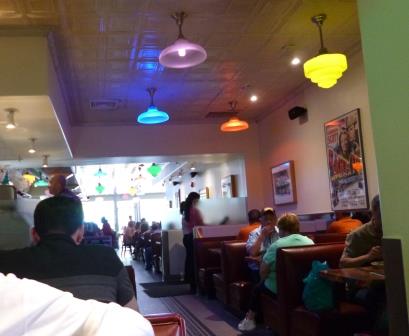
Once you have finished your city tour, you will want lunch. There you are on the plaza/. Try the Famous Plaza Cafe – lots of history on the plaza, pressed tin ceiling, friendly and fast service, and killer fish tacos.P1020721web


Now it’s time for the museums. The New Mexico History Museum  is a GEM according to AAA’s road guide, and rightfully so. With admission you also get to explore the Palace of the Governors, one of the few surviving real adobe buildings in Santa Fe (the others are brick coated with stucco in imitation) and probably one of the few single-story palaces in the world.  And if you have read Willa Cather’s “Death Comes to the Archbishop” (and I hope you have, as a prep for your Santa Fe visit) you will find portraits of ALL the main characters hanging in the Museum or the Palace – instantly recognizable.


P1020741webOn your way back to La Fonda, be sure to explore inside the Cathedral of St. Francis of Assisi which faces the square. Again, if you have read “DCttAB” you cannot fail to be moved by the statue of the austere Archbishop Lamy who reformed and re-energized the New Mexico church mission, and by the little wooden Madonna, regally gowned by the devout needlewomen of the Santa Fe diocese, who is the core of Catholic tradition in the area, paraded around the square in her finery once eacy year.


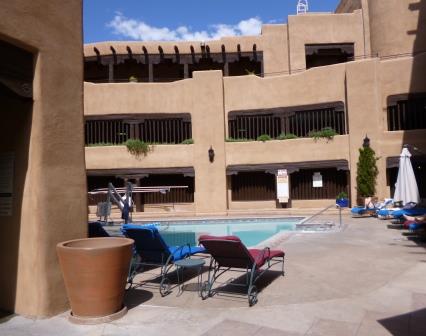
You’ve walked a lot. Time to relax at the pool in the La Fonda central courtyard. It’s shielded from wind and sun and kept at a perfect temperature.P1020734web


Once you are dry and dressed, present yourself at the Bell Tower Bar at the very top of the LaFonda, with a 360 degree view of the square,the town, the mountains, and the clouds. Everyone up here is in a good mood – what nicer place could there be to strike up a conversation with the folks around the firepit or cocktail table?

And if you have not filled yourself up on appetizers at the Bell Tower, finish off your Santa Fe day at La Plazuela, the restaurant in the former courtyard (now roofed with a skylight) around the fountain at the center of La Fonda. There are other restaurants in town which boast Michelin stars, but none that can boast more atmosphere or history. I recommend the pork tamales.


The evening is up to you.

Freeway Free in New Mexico: The Town that Wasn’t There

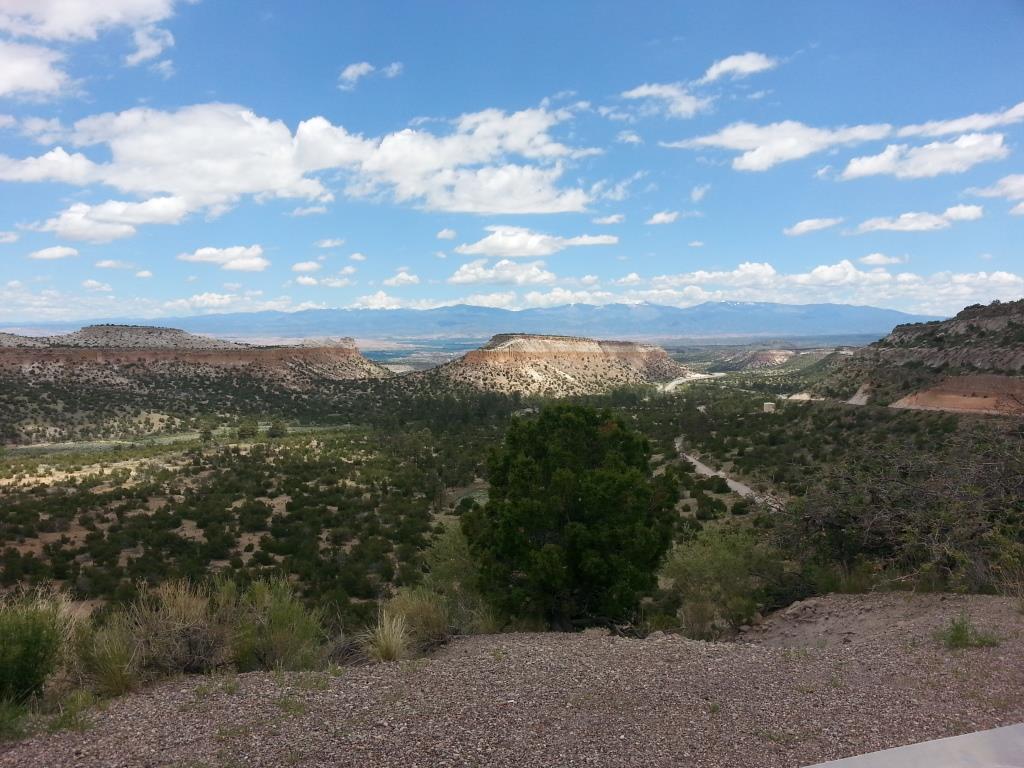
The view from the road to Nowhere

The view from the road to Nowhere

The road to Los Alamos is paved now, and there are comforting stone barriers separating the driver from the precipitous drops edging the switchbacks as you climb from the valley of the Santa Fe River.  There are even scenic viewpoints provided so that you can look out over the valley of the Rio Grande as it carves its way toward El Paso.  It’s a long way from those days in the early 1940’s when the town was as isolated and exotic as Narnia, its only entrance through an inconspicuous door of an old adobe on the Plaza in Santa Fe.

In those days the inhabitants of Los Alamos were divided, like Narnia, into two very different groups, but unlike Narnia, they were putatively on the same side.  The town had been created by the US Military, and its routine labor and its decidedly non-routine security were provided by the Army.  But its purpose was to probe areas of science that had never been explored – to create the weapon that would end World War II, killing hundred of thousands of people, but by doing so save a million other lives which would have been lost through hand-to-hand combat, disease, ritual suicide, and other causes in a drawn-out battle for Japan.

?

Dwarf meets Elf, with Man in the middle

Perhaps the uneasy alliance was more like that of Elves and Dwarves in the battle against the Dark Lord of Mordor. Certainly there was an elfin quality about Robert Oppenheimer, the leader of the scientists, and a foursquare dwarvish solidity about his military counterpart, General Leslie Groves.   And there were ordinary people at Los Alamos, too; there were cleaning women and secretaries and nurses and teachers, who played their roles without ever quite knowing what was going on.

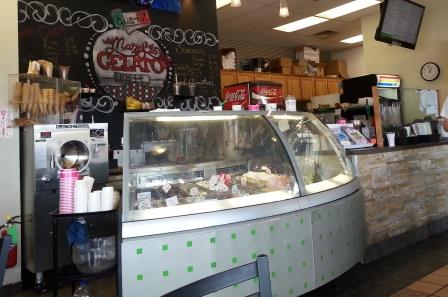
Now the town looks quite ordinary.  There is a struggling downtown area with some small shops and restaurants, and a new shopping mall.  There is an excellent sandwich shop, Daniel’s Café (sharing space with Mary’s Gelato) .  I recommend the Tuna Melt.

If you want room for gelato, split the sandwich!

If you want room for gelato, split the sandwich!

There is a high school which had been originally funded by the Atomic Energy Commission and still gets 22% of its funding from the FEderal Government.  Since the principal employer in Los Alamos is still the Laboratory, it is not surprising that the sons and daughters of physicists have gained national recognition for their school’s academic program.

And there is a wonderful museum, the Bradbury Science Museum, which tells the story of the Manhattan Project from the point of view of all three groups who worked there, as well as revealing as much as can be told about the lab’s current activities

For more about Los Alamos and the Mahattan Project, you can’t go wrong reading Day of Trinity by Lansing Lamont, and then watching “The Day After Trinity”, a  fine documentary about Robert Oppenheimer.  And when you walk the sidewalks of  the Town that Wasn’t There, you’ll hear history echoing in your footsteps.

Arizona Highways: Some worthwhile stops

In Phoenix:  The Heard Museum of Native American Art.  This museum is fascinating, exhaustive, instructive and almost overwhelming in the size of its collection and the detail in which it explains the many culuture of Native Americans of Arizona.  Fortunately, we had a time limit.  We focused first on a special exhibit of Georgia O’Keefe paintings of the Southwest.  This was on its last day, but if it is a sample of the quality of special exhibits at the Heard, I would suggest you pay attention to whatever is being featured on your visti.

Of the Heard collection I was most fascinated by the collection of kachina dolls donated by the late Senator Barry Goldwater, maybe because as a child I was given a Kachina doll by a visiting relative.  Learning the stories and symbology of these artifacts could have enthralled me for the entire afternoon.Tribal Dance

Another bonus which lured us back outside was the  Annual Indian Market and Fair, featuring Indian dancers in elaborate Hopi feather costumes and juried Indian art.

If you go to the Heard and need a break from all that culture, I can recommend their lunch restaurant.  We ate  tacos and Mexican salad in the plaza – a lovely, lively setting.

Along Higway 17 to Sedona –

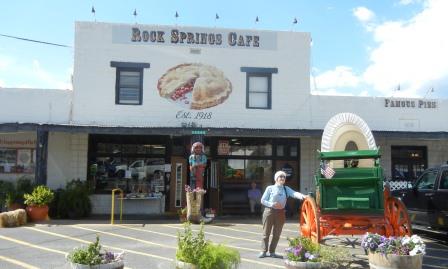
Rock Springs Famous PiesAbout half-way to Sedona you’ll need a rest stop.  The Rock Springs Café offers deservedly famous pie: a killer lemon meringue, pecan pie made with Jim Beam, plus serviceable salads, burgers, and homey fare.  And a stuffed polar bear in the gift shop.

Montezuma’s Castle National Monument  – this small but fascinating park features a  5 story cliff dwelling, positioned high on a cliff overlooking a lovely sycamore-lined creek.  The visitor’s center is a fine introduction to the site, and the stroll on the loop trail looking up at the mysteriously abandoned structure is a welcome break to the highway.  Montezuma's Castle

Once you get to Sedona, you’ll need to get in tune with the New Age vibe, so you better seek out a good Vegan restaurant.  I can recommend Chocolatree, an unpretentious combination restaurant and chocolateria along the road west from the main Y intersection.  My less-adventurous companion  was dubious bout the tarot cards on the table, but  ate every bit of her black bean chili. My Meatless Mushroom Medley was gray but yummy. The Mediterranean Madness ordered by my other fellow traveler  -quinoa, almonds, raisins, sunflower seeds, coconut milk, and more- was too rich to finish.  Still we managed to share a Chocolate Ganache of dates, raisins, macadamia nuts, coconut milk, and raw cacao, but we had enough leavings to share the next night with a table of 8 and it went around twice.

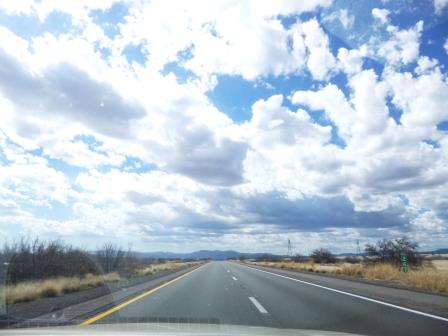
Arizona Highway


Arizona Highways: Scottsdale – not just Carmel with Cactus

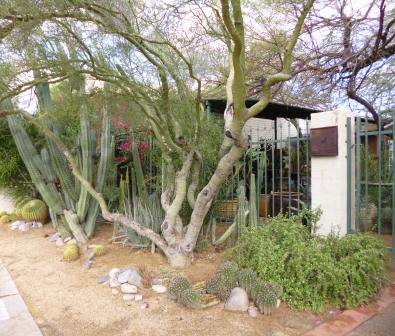
Scottsdale gardenVisiting Scottsdale had not been high on my list.  After all, I grew up only an hour from Carmel, the West Coast apogee of artsy quaintness-by-the-sea.  What was Scottsdale with its art galleries but Carmel with cactus instead of ocean?  As usual, once I had visited, I knew once again how wrong preconceptions can be. Scottsdale is to Carmel as meaty BBQ ribs are to seared sea scallops – both wonderful, but incomparable.

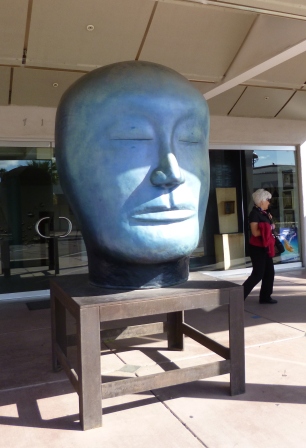
Scottsdale mustangWe visited on a Sunday morning, so the galleries along the Art Walk were closed.  We were more relieved than disappointed:  the galleries would have seduced us into dallying inside, while on a temperate and sunny morning there was plenty to see in the sculptures that lined the sidewalk and rose from the median. At first I noted the proliferation of horses frozen in wood, ceramic, steel, and bronze, galloping, rearing, bareback in herds or straddled by cowboys, cowgirls, or the Original Inhabitants. [Note:  We met several locals with red-brown skin and aquiline noses, who told us to “Relax.  We call ourselves Indians.  It’s easier.”  I will follow this advice hereon.]  But there were also bronze children, artists, and unmounted Indian maidens both nude and clothed.  Also  various vaguely humanoid shapes, and a giant green head which might have been Buddha.Enigmatic head

We left the Art Walk and meandered toward the center of town, a meander made easy by a grass-lined pathway going beside and over a dry creek and eventually leading us to the central plaza, bordered by the City Hall, Art Museum, and Performing Arts Center, all impressive and interestingly designed modern buildings.  The plaza was full of activity:  a craft fair was just setting up, with tents offering Indian artifacts, jewelry, clothing, and food.  A stage at one end promised music to come, and some families were already staking a claim with blankets on the sloping lawn in front of the bandstand.  And at the other side of the plaza I found an old friend, one I had first met in Philadelphia, then encountered again in Tokyo and Taipei.  I was delighted to see again Robert Indiana’s famous LOVE sculpture.LOVE in Scottsdale

On the way back to our car we walked through Old Town Scottsdale, and found the tourist gift shops beginning to open.  I bought a silver-and-turquoise earcuff to replace a much nicer one I had been given and lost years ago, hoping to combine old and new memories.Old Town kitsch


Arizona Highways: Phoenix’s Desert Garden

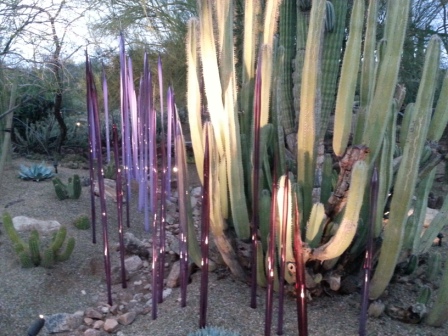
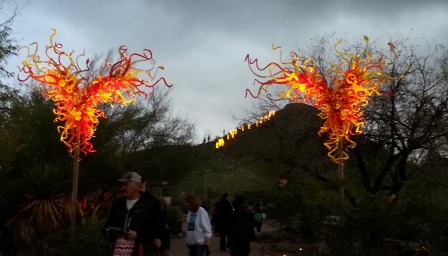
20140301_Chihuly

20140301Chihulyweb620140301Chihulyweb5


I thought of Phoenix as an airport stop on our way to hiking in the red rock country, but my friend B was more curious.  “Let’s stay a day in Phoenix and explore!”  So M, our travel organizer, found an affordable motel in Scottsdale. (“There are art galleries!  Let’s stay close!” B enthused.) We raided the local AAA for maps and guides, and off we went.

M was arriving first, so she rented the car. All the car rental offices for the Phoenix Airport are combined in a single large building at the edge of the airport, along with a food court, rest rooms, and a travel office – an amazingly good idea! B and I had flight delays, so we connected with M too late to do the auto tour we had planned for the afternoon.  But there was still time to walk in the Phoenix Botanical Garden, which was featuring an outdoor exhibit of glassware by the well-known artist/craftsman Dale Chihuly.Entrance-Chihuly exhibit

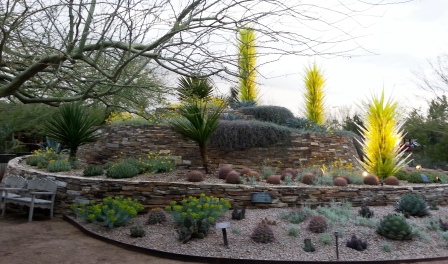
The Chihuly glass exhibit blended beautifully with the otherworldly colors and shapes of the cacti and succulents which are the backbone of the PBG, and glowed against a stormy evening sky. We strolled and pointed and admired as  lightning flashed, thunder crashed, and then came the deluge. We were close to the gift shop by then, which exhibited an amazing collection of small Chihuly pieces, also beautifully illuminated. (see below)   We  waited out the worst of the rain, then strolled a bit further armed with umbrellas. But soon there were too many puddles, too many  flooded paths, and we took refuge again, this time at Gertrude’s, the charming modern restaurant adjacent to the Garden. The tables were full of other soggy visitors, so we snuggled up to the bar watching mysterious cocktails being mixed as we sipped our staid beer and wine and downed excellent sandwiches.  I can recommend the pulled pork sandwich with chili dipping sauce, paired with a Mexica Model Negro beer.
The exhibit continues until May 18th (2014) so you still have time.  Evening viewing is wonderful.

20140301Chihulyweb920140301Chihulyweb7


Freeway-Free in Spain: It is Good to be the King

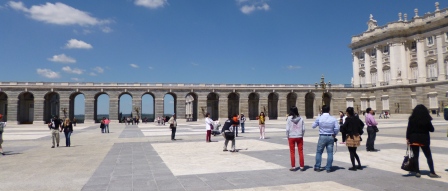
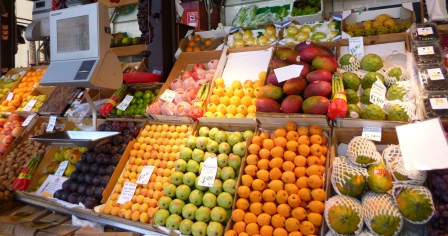
Plaza and Portico and PalaceThis bright sunny morning was almost too nice to spend inside, even if “inside” is the Palacio Real, home to the monarchs of Spain beginning in the 18th century.  We took our time along the way, stopping into a beautiful local market to admire the produce and incidentals on offer.Que Bello Mercado!

At the palace we waited about 10 minutes for entry while being entertained by a guy making giant bubbles and an accordionist playing, inexplicably, “Michele” and “Theme from The Godfather” instead of “Lady of Spain.”

The palace makes  Versailles look tawdry. I never imagined so much gold-and-silver-embroidered silk and velvet existed in the world. The extravagance is excused nowadays because the rooms are opened to the public in general for viewing and are otherwise used only for state occasions; the current king prefers to live in more comfort and less pomp in a smaller palace in the suburbs. But still, the amount of wretched excess is a little stomach-turning after viewing the homeless living in cardboard boxes in the arcades of the closed shops in the Plaza Mayor.

The state rooms are, of course, all tapestry, chandeliers, and mirrors, with frescos on the ceilings painted by Tintoretto and Velasquez and other lesser lights. We also got a glimpse of some of the rooms which had been used as private living quarters by various monarchs; these had been decorated to match  then-current tastes and ranged from a faux-Tyrolean-beer-hall decor for a billiard room through an all-Chinese porcelain and stucco and tile sitting room to an Empire/Egyptian room with sphinx holding up the table.

A visit to the Royal Armory Museum at the close revealed that the excess had been going on for at least 500 years – a wealth of gilded and engraved armor, including lots of matching miniature armor for the princelings to play in, and elaborate headpieces and breast-plates and rump-covers for the horses, all gilded, lavishly engraved or sculpted, and provided with satin covers and embroidered saddles to finish the look. (None of the kings ever actually fought in these things, although they may have jousted once in a while.)

After leaving the Palacio we took refuge in Taberna de Alabardero, an al fresco stree-tside cafe recommended by Lonely Planet AND Rick Steves, overlooking the palace and gardens. The prices were high and the service slow, but the people-watching was prime.

We finished off the afternoon with a stroll in the Royal Gardens and the Campo del Moro, then caught the Metro back to the hotel. For the evening we enjoyed a gala dinner at nearby Tres Encinas, a rather upscale (for us) seafood restaurant nearby. I  seized the opportunity to wear my one “nice” outfit, just so I can say the suitcase space wasn’t wasted.
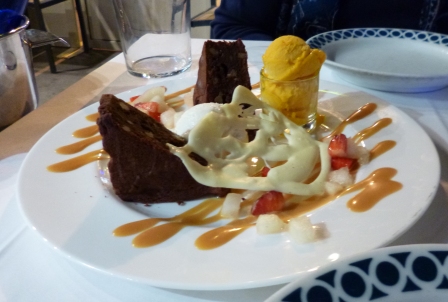
Our maitre’d  was unabashedly charmed by Winifred’s Peruvian-accented Spanish, and monitored our table closely as we divided a wonderful salad of grilled vegetables and prawns (with heads and legs still attached to show how fresh they were) followed by a sole in the same state for the same reason but expertly divided and de-boned, followed by a dessert of chocolate brownie plus trimmings, and a couple of complimentary cuplets of cherry liqueur as a gift of the host. We were very glad we had dressed for the occasion!Shrimp Appetizer - Tres Encinas P1010262web P1010263web

Post Navigation