Freeway-Free in France: Ceremonies (LATC July 3, 2019, for our Veterans)
 I had the good fortune to be among the 12,000 + invited guests at the 75th anniversary ceremonies commemorating the D-Day landings in Normandy.
All 12,000 + guests were brought in by shuttle buses from staging areas in nearby towns (except for the VIPs, like Presidents Macron and Trump and their supporting cast, who arrived by helicopter). The security lines were long, but we passed the time checking out the helicopter arrivals, and applauding the mostly wheelchair-bound, heavily be-medaled D-Day survivors as they wheeled past on the way to the VIP tent.
 We were among the last 4000 to arrive at the American Cemetery, and the stage and podium seemed several football fields away in the distance. But giant Jumbotron screens gave us close up views of Air Force One (both jet and helicopter) and its occupants as they landed, and of President Trump’s ceremonial greeting of guests President and Mrs. Macron onto what is considered American soil.
When we took our eyes from the screens, we looked out over a sea of white crosses, each decorated with a American and a French flag, stretching beyond the audience area for even more hundreds of yards. So many dead buried in tidy rows, as if drawn up for a regimental parade. An occasional Star of David marked a grave instead of a cross. A rare cross with gold lettering indicated a Medal of Honor recipient. An occasional soldier is “known only to God.” It seems right that all the soldiers are equal in death, except for those singled out for their valor. The son of a US President has the same marker as an unknown soldier.


Before the speeches, national anthems were sung. During the speeches, 12,000 people listened quietly. President Macron thanked the veterans who were present in English, and presented four of them with the French Legion of Honor (including air kisses on both cheeks). President Trump told stories of the heroics of two D-Day soldiers, then turned to shake their hands personally on the stage.


Afterward, the ceremony continued. We heard taps played by a distant trumpet, followed by a 21- gun salute, delivered by three mighty howitzers aimed out over Omaha Beach. Five fighter jets flew over in the missing man formation. A platoon of other military aircraft filled the sky, emulating the flocks of fighters and bombers on D-day. Finally, a second squadron of nine jets, trailing red, white, and blue contrails, roared across the sky.
The whole event was both humbling and satisfying. We had paid appropriate homage to those who fought for us, and in doing so honored those who are still fighting.
Our French guide had told us that, in France, the D-day landings are never referred to as an invasion. Instead, they were the forces of liberation. Tomorrow, if this piece is published on schedule, will be Independence Day. Let’s celebrate our own liberation with due ceremony, while remembering those we owe it to.
[Article first published in the Los Altos Town Crier this summer; still appropriate as Veteran’s Day approaches.]


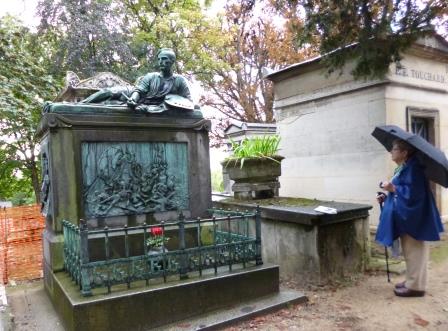 What better way to spend a gray and drizzly Sunday in Paris than wandering around the cemetery of Pere-La-Chaise, site of burial of many notable and not-so-notables of recent (since the 1800’s ) French history? The requirement for burial here is that one must have been a French citizen OR have died in France (which is why Jim Morrison and Maria Callas are here.) WB and I spent several contemplative hours in the light rain contemplating the mortality of such immortals as Delacroix, whose masterpiece “The Raft of the Medusa” is harrowingly evoked in bas relief on his tomb.


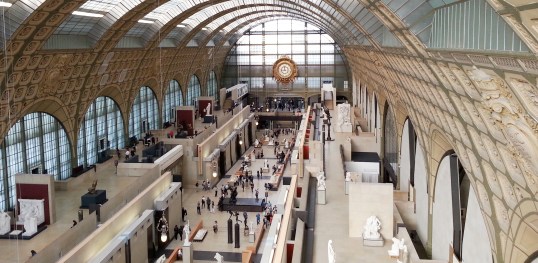




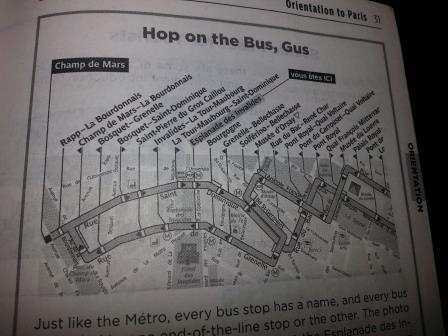
 We decided to walk back from L’Opera (which was undergoing a revamp of its own behind a Rene Magritte-inspired façade) and stopped at a street-side cafe on Rue Tour Maubourg for wine, tea, and people -watching. We saw Cinderella’s glass coach go by, pulled by a rather ordinary brown horse and with two dotty English tourists inside. Such is life in a tourist city.


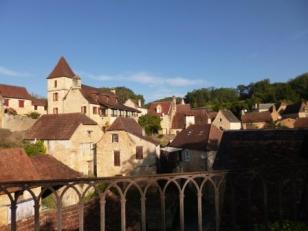
 Then it was down through dappled shade and dappled sun in a woodsy canyon, then down further through more dappled shade and dappled sun as we crossed a series of walnut orchards with beautifully shaped and spaced trees, then down further into the tacky outskirts of Souillac, then down past the cemetery. We got confused, asked a passerby if he knew our hotel, and he pointed to it across the street. Winifred and Dianne had just arrived.

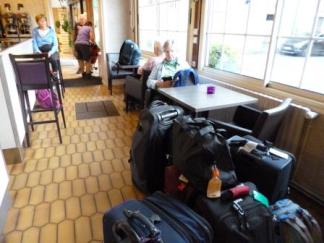
 Unfortunately WB has developed some problems with her knee and has not been able to hike for the last couple of days, but she has gotten a free ride in the luggage van and enjoyed some leisure. The other three have enjoyed walking through the countryside on back roads and grassy trails, sampling wild blackberries, feral figs, late-season asparagus sprouts, and sunflower seeds.
 By noon we were looking for luncheon options, and happily came upon a small shop in a small village which had, to DM’s delight, cold Coca-Cola available. We purchased a few other snacks and continued until we found a convenient stone to serve as both stools and table. We enjoyed the sun, sipping and munching, then snuck through a gap in the wall for a view of the Chateau de Montfort (privately held, unfortunately)


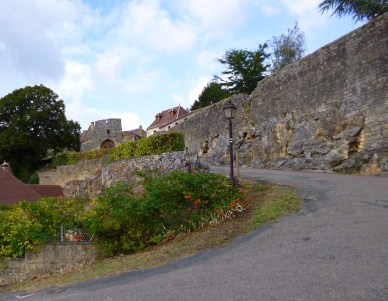
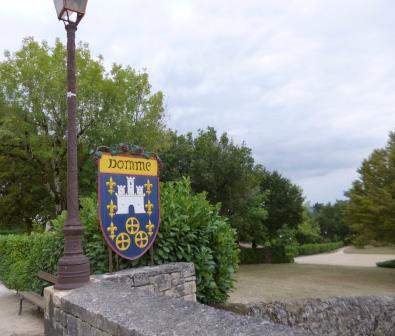 Domme is a medieval island perched on top of a bluff, too remote from normal four-lane roads to have been changed much by the advent of the automobile. As we trudged up the winding road, we were wishing for a donkey cart!


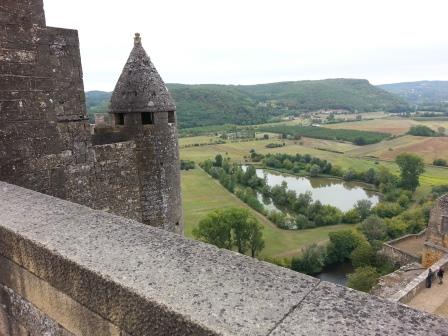
 This day was the scenic highlight of our walking – we stayed the previous night at Beynac, beneath the cliff topped by the medieval fortress which we had wandered through the afternoon before. After our breakfast of croissants, cafe au lait, and local yogurt and strawberries, and after wrestling our luggage down three flights of narrow stairs, DM, DB, and I set out along the “grassy track” by the Dordogne River. (W has developed a painful knee after too many ups and downs and decided to cop a ride in the van.). The path led along the river through woodsy patches – lots of bird calls, some families of ducks on the water, the occasional fisherman, the occasional egret. We stayed mostly level through a series of acricultural meadows and fields (DM sampled the sunflower seeds, I sampled the fresh asparagus spears pushing up from the ground) and took turns pointing out the yellow sandstone castles on the successive cliffs – Beynac behind us, its hated rival Castelroud across the river on the English side.

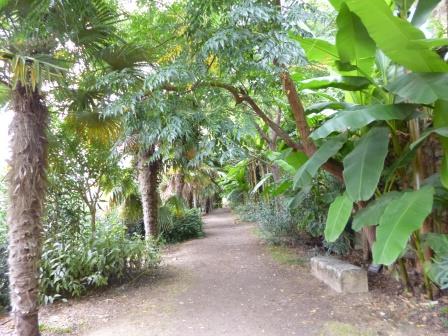
 .
.
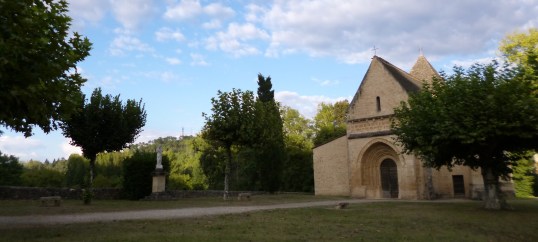
 Our next stint was up and over easy hills, on back roads through small villages. We came across an old church, with a charming graveyard adjacent. Such a contrast to the cemeteries in my neighborhood, where one has a choice of three different styles of stone, and one may not leave anything on the stone which would impede a power lawn mower! Here were live flowers in pots and personalized tributes from family members – one could construct an entire village history from the mementoes pile atop the sacophogi!


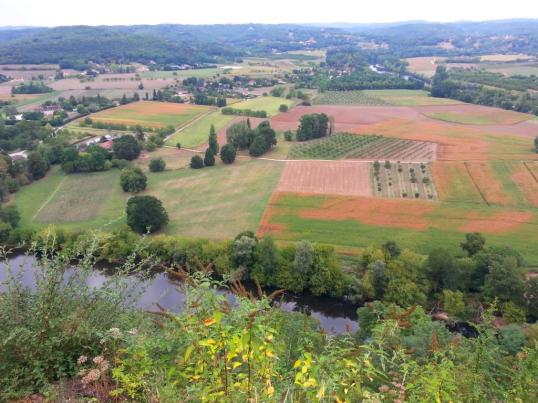
 For hours it seemed like a mirage, always visible, yet never nearer. Then suddenly we were there, on the highlands adjacent to the castle, looking out past the fortifications to the valley of the Dordogne far below.


 Allyson Johnson