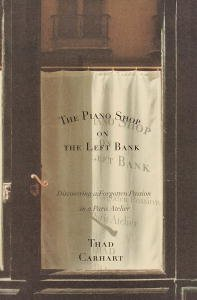
The Piano Shop on the Left Bank If a book cover has the words “Bookshop” or “Paris” or anything evoking those memes, I’m liable to pick it up. If it has “Piano”, that’s almost as magnetic. This memoir of living in Paris and finding access to the neighborhood hidden behind the courtyard doors is charming, full of information about French life and culture, and about the history, development, mechanisms, and lore surrounding the pianoforte.
A perfect bedside book, as it alternates between personal experience and historical reflection in alternating chapters.
Arles, of course, was one of the stops Vincent van Gogh made while searching for sanity and artistic fulfillment in Provence. After the dark murk of the Netherlands, the bright colors and warm weather seemed to galvanize his artistic expression, but unfortunately did little to stabilize his mercurial mood swings.
Arles was van Gogh’s home for eighteen months, and some of his best-known paintings were executed during that period. Modern Arles has seized on van Gogh’s posthumous popularity by providing posters marking the sites as above.
In Arles, van Gogh lived for a time with Paul Gauguin in the Yellow House which appears in several paintings. This house no longer exists. However, the hospital to which he was committed after he cut off his ear in an alcohol-enhanced rage still exists, its courtyard now filled with post cards, posters, t-shirts, and other memorabilia of the artist’s stay.
Just a block or so away is the cafe where van Gogh and Gauguin hung out. At the time, the cafe was painted a modest beige with brown trim, but that’s not the way van Gogh saw it or painted it. Surprise! the restaurant is now bright yellow with blue trim and yellow awnings, just as van Gogh saw it.
Outside the center of town is Alyscamp, a park centered on an avenue of trees leading to a Romanesque chapel. The trees cannot be painted to match van Gogh’s vision, but it is interesting to compare that vision with reality. in a mental hospital. The park is green and peaceful, with romantic ruins and vistas. The interior of the chapel includes a pool filling the lower lever -not clear whether this is intentional or an accident of age.
As van Gogh’s mental instability grew, Gauguin moved out, and van Gogh’s brother Theo enabled him to relocate to a mental hospital in St. Remy, which still exists. Reading the lists of treatments to which mental patients were subjected at this time is like reading of the Spanish Inquisition. The patients were confined in ice cold baths, bound, beaten, and burned, all with the idea of driving out the devils which had taken over their thoughts and actions.
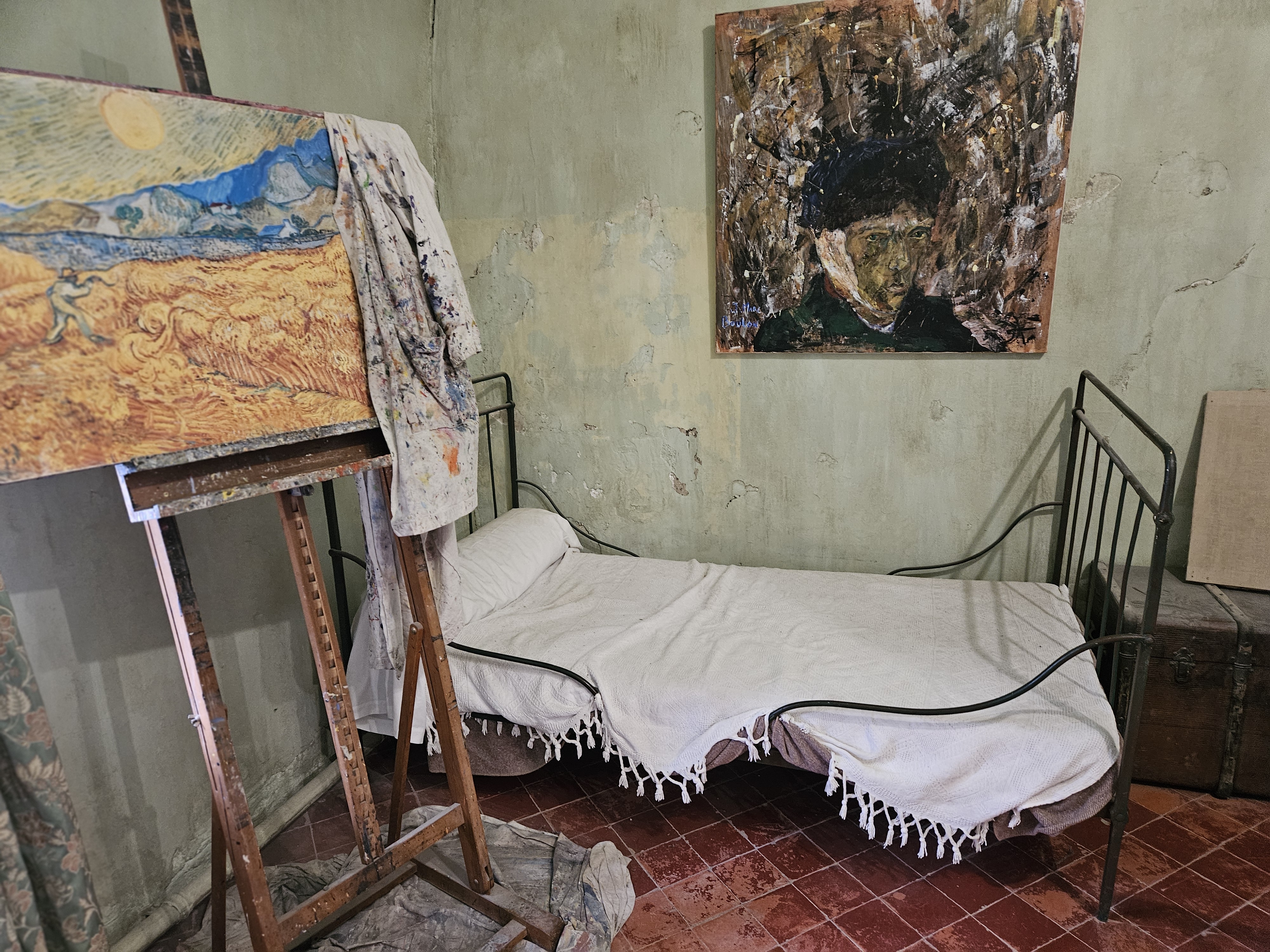
Part of the hospital is still used as an asylum, but one can still see van Gogh’s bedroom and the tubs used for the ice cold baths to reduce his choleric humors.
But outside, one can still see the orchard which inspired his painting, and iris are still blooming in the garden.
Later van Gogh was released from the hospital at St. Remy, and went to stay at Auvers, where he pained perhaps his best-known work “The Starry Night.” He died two days after suffering a gunshot wound. There is controversy about whether the wound was self-inflicted or whether it was the result of an accidental shooting by a group of teenagers who alternately patronized and teased van Gogh.
The leader of the group was the son of the local pharmacist, who owned the only gun in town. The son was prone to dress up in cowboy garb after seeing the Buffalo Bill Wild West show in Paris, and left town abruptly the evening that van Gogh appeared with his gunshot wound. Of course, this theory is not as attractive as the image of the tormented artist driven to suicide by a lack of appreciation, as Don McClain’s “Starry Starry Night” would have it.
On our first evening in Arles we rendez-vous with our friends at the Cafe Factory Republique, a modest bistro with comfortable outside seating, where it seemed all the customers were English-speaking expats. EJ’s Duolingo French being limited, he exploits the change to get insider tips from the expats, which we will benefit from for the rest of the trip.
The next day, EJ and I stop for lunch at one of the places recommended by his new Canadian friends, Le Criquet. For my enthusiastic thoughts about this spot, check my previous post. Only later did I discover that Rick Steves is also a fan of this spot, and we were lucky to get a last-minute table.
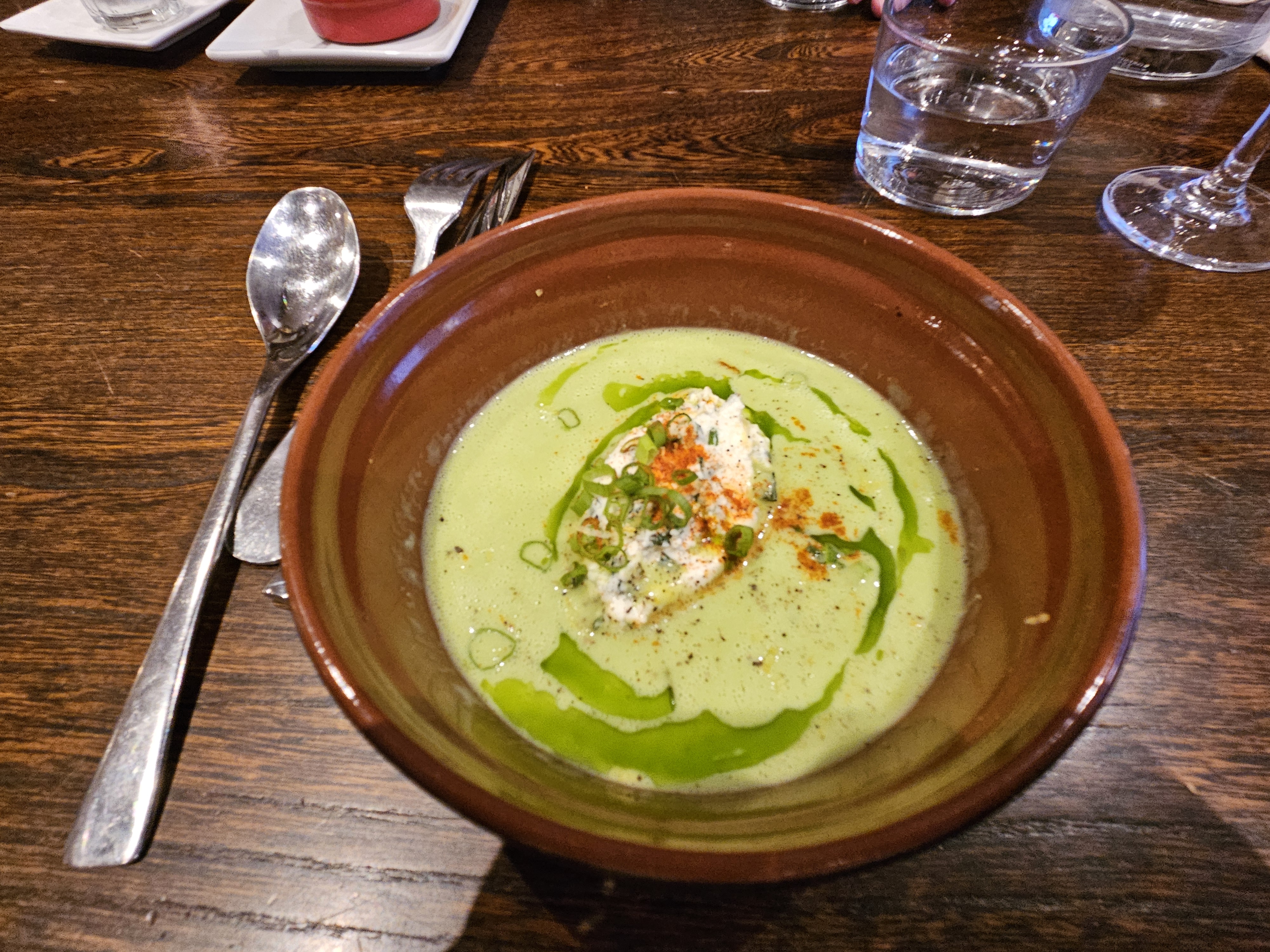
EJ went birding and missed a dinner at Michelin-recommended Le Gibolin. This is a small bistro with a remarkable wine list. The dish we all focused on was an appetizer, the spring pea soup, a brilliant green concoction with all the springy sweetness of a vegetable straight off the vine, somehow preserved in a bowl.
The next night EJ, BB and I ate deliciously at l’Entrevue, a Moroccan restaurant by the river recommended by my French friend CRH. This restaurant is affiliated with an excellent bookstore, Actes Sud, a cinema specializing in films related to the Arles area and history, and a Turkish-style hammam, offering various spa-type services in addition to the steam bath. The menu offers a number of vegetarian options, in addition to some really wonderful lamb stews, all at a very affordable price in an outdoor setting bordering the Rhone. This was so good that we came back two nights later bringing our other two friends PS and MV along so they would not miss out.
In the intervening night we had a luxe meal at l’Arlatan, a lovely restaurant located in the atrium of the hotel of the same name. This is a beautifully updated hotel, with trendy bright colors in the lobby and restrooms so artfully designed that they are almost impossible to locate in the panelled hallway. We ate under wisteria trained high above, excellent “brousse” cheese with spicy tomato sauce, (five of us share) excellent monkfish with spinach and tiny asparagus (four of us order, Ps has a compressed block of chicken with excellent sauce) then three of us order decaf coffee while PS and MV wait and wait and wait for a chestnut tart. I finally leave to meet EJ just as the waiter comes runnng with the dessert. So – five stars for the food and the locale, but only two for the service. (Were they changing shifts? Who knows?)
I meet EJ at the Wauxhall on George Clemenceau Blvd just opposite the Tourist Bureau. This busy indoor/outdoor place boasts of having been a fixture in Arles since 1771. EJ had not dined, and filled his empty spaces with a bread/cheese/salami platter. I ordered what I thought would be a cup of chocolate flavored coffee, but evidently cafe mocha in Arles means something quite different:. Fortunately EJ was able to help me out with this mountain of ice cream, chocolate mousse, caramel sauce, whipped cream, and cinnamon.
On our last night in Arles I made reservations on the website of another Rick Steves-recommended restaurant, and had no trouble reserving a table for five, though the (out-dated) RS guide told me it would be closed. It was pouring rain when I got to the place, and RS was right. The also-recommended bistro next door was already reserved for a special banquet. Thanks be, the third restaurant on the street was open and empty, so I was able to stand out under the awning in the downpour and re-direct my friends to Le Plaza La Paillotte, a very happy outcome. I found later that this is rated # 8 of 230 restaurants in Arles by Trip Advisor, which only goes to support my feeling that it is almost impossible to blunder into a bad meal in Arles.
We happen to be in Arles as France prepares for the Olympics to take place in Paris later in the year.
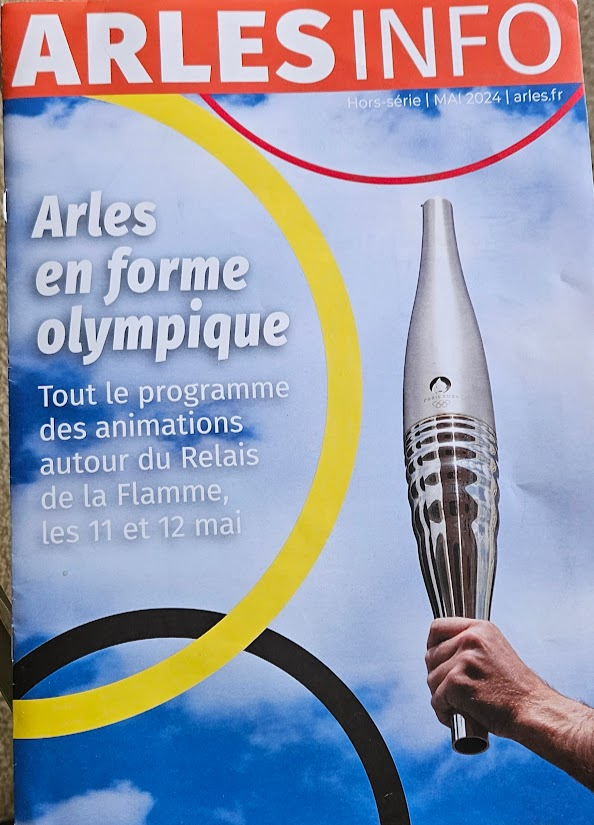
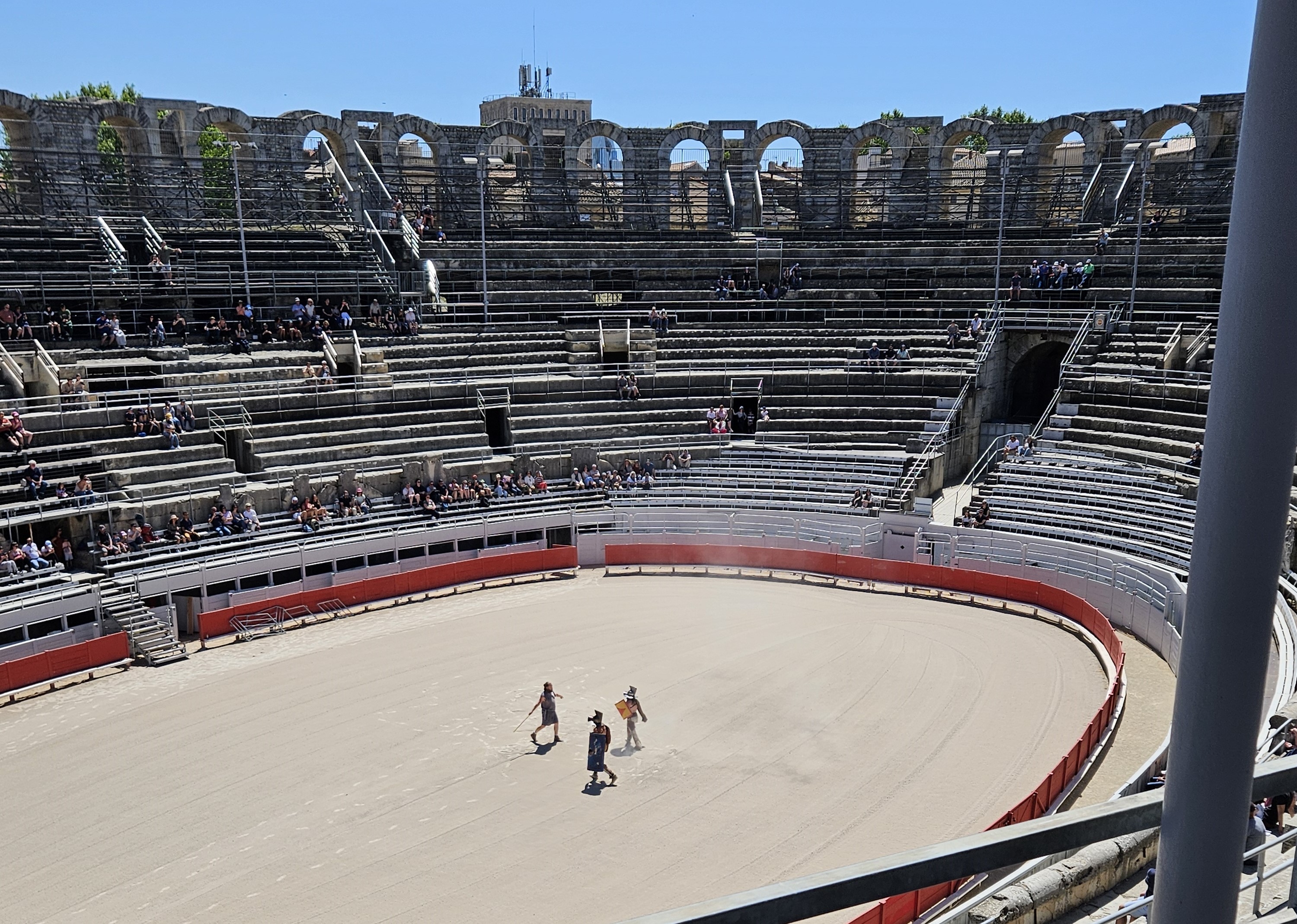
This is a really big deal. The Tourist office has an eight-page magazine detailing all the civic celebrations which will precede and follow the actual passing of the torch. (the gladiator combat and bull fight we saw earlier in the week were part of the celebration) and also includes a detailed map of the route the torch will take through Arles, beginning at the Musee d’Arles Antiques and continuing through the center of town past all the major monuments and ending with a “dance spectacle” at the riverside.
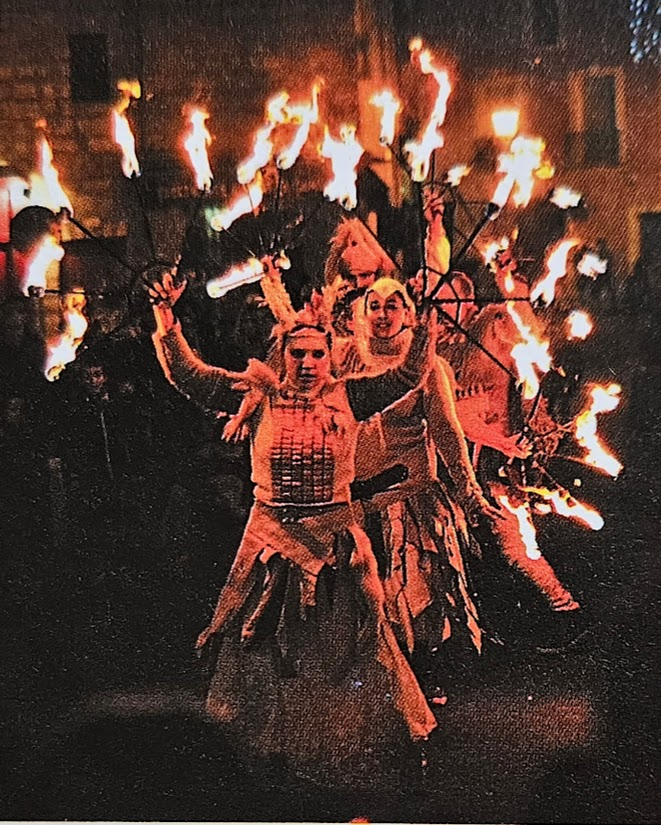
The night before the actual running of the torch offers a free fireworks display, so after dinner EJ and I joined the throngs heading to the Roman Amphitheatre. The spectacle, presented in a completely dark Amphitheatre, involved a lot of torches swung in pattterns by people of indeterminate sex wearing costumes made out of what looked like burlap bags, a juggling unicyclist, a lot of kerosene dripped on the ground and lit in patterns, fireworks, and skyrockets. Wow. Happily the lights came on as we descended from our nosebleed seats.
The next day I walk through the city center and next to the Tourist Office is a street fair, with a community band playing, and a number of booths set up to allow children to practice American football, or play ping pong, or show off their karate moves. A lot of dumb fun for parents and kids.
Fortuitously, our hotel is right on the path of the Olympic torch as it passes through the city, and as I leave to meet our friends for dinner the next evening , I come out the door to see the actual passing of the torch from one former French Olympian to another.
The side of the street are packed with smiling on-lookers. At one point, a young man who is apparently on one of the French teams stopped the parade for a quick interview, surrounded by his teammates and applauding fans.
I understand that Parisians are griping about the upset to normalcy required to prepare the City of LIght for a week of Olympic competition. From down here in the provinces, though, it’s hard to feel bad about something which is making so many people happy.
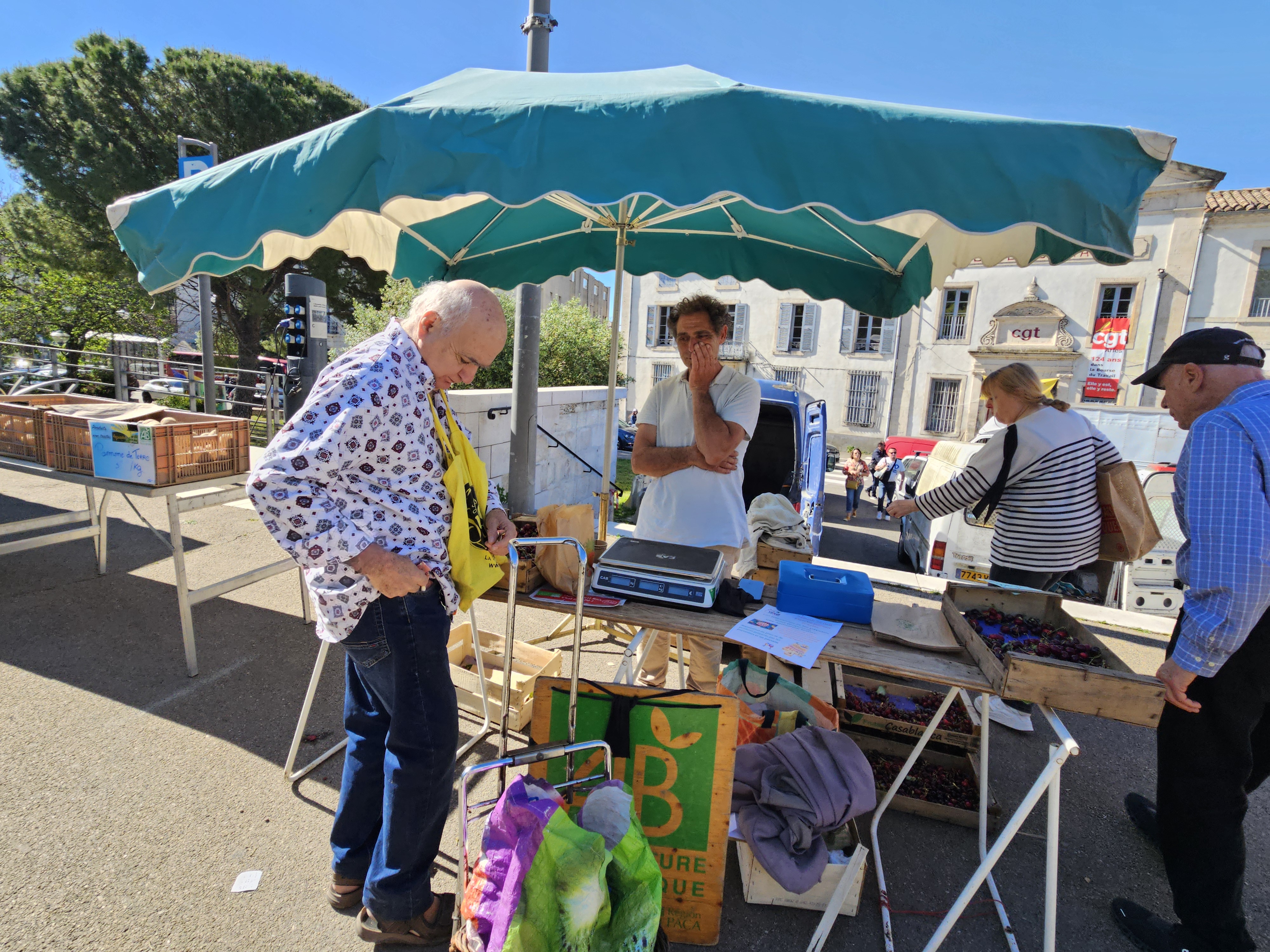
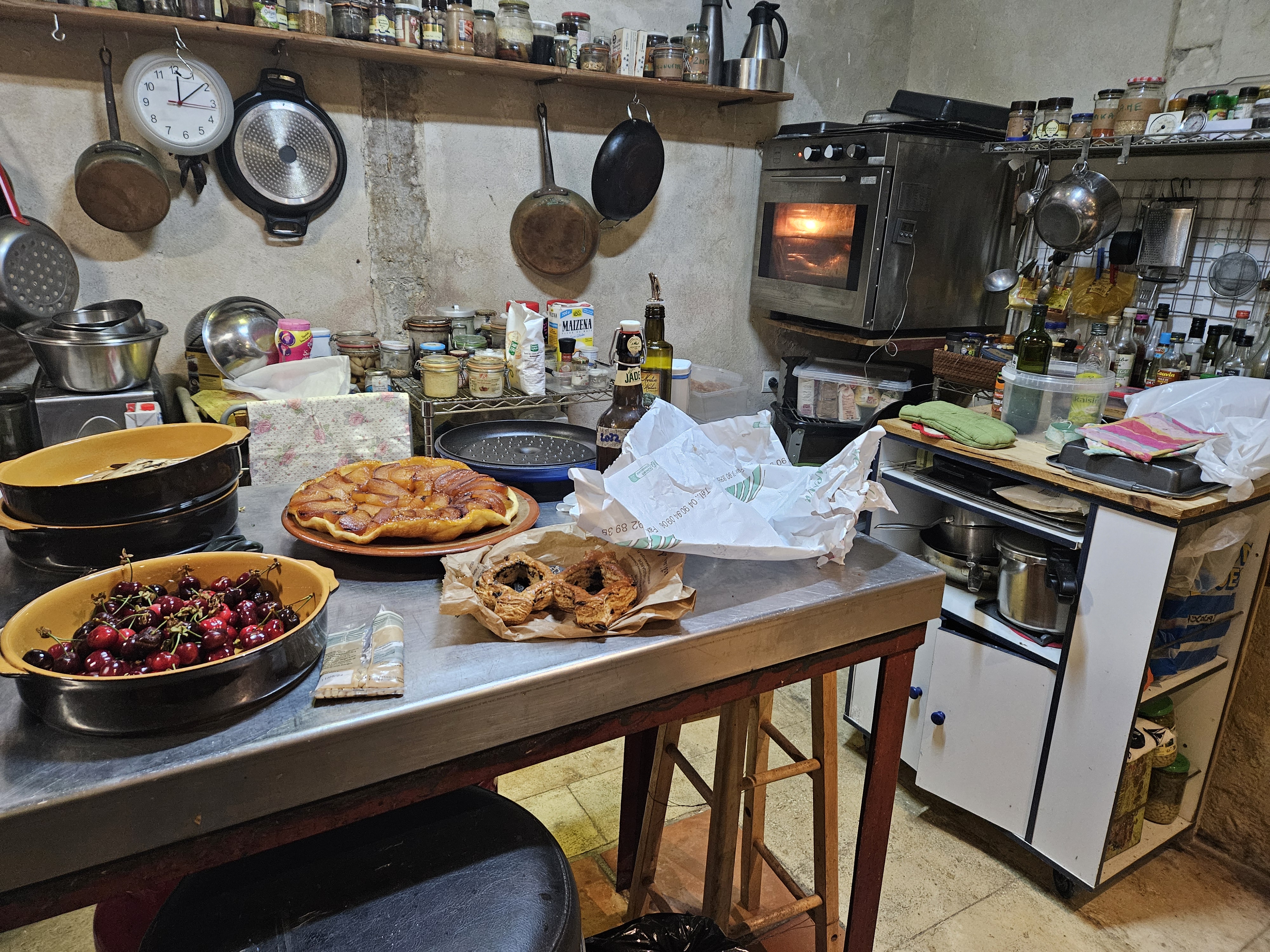
EJ suggested that a Provencale cooking class would be fun, and two of us took up the suggestion. EJ, SF and I meet Erick Vendel at his home, and proceed with him and his assistant Sylvia to the vast Saturday market along George Clemenceau Blvd in central Arles. I heroically walk past the racks of 5 euro dresses and 7 euro hats but allow myself tastes of wonderful cheese, olive bread, salami,and other bits while odors of paella, falafel, and various exotic spices waft past, while Erick chooses supplies from his favorite vendors
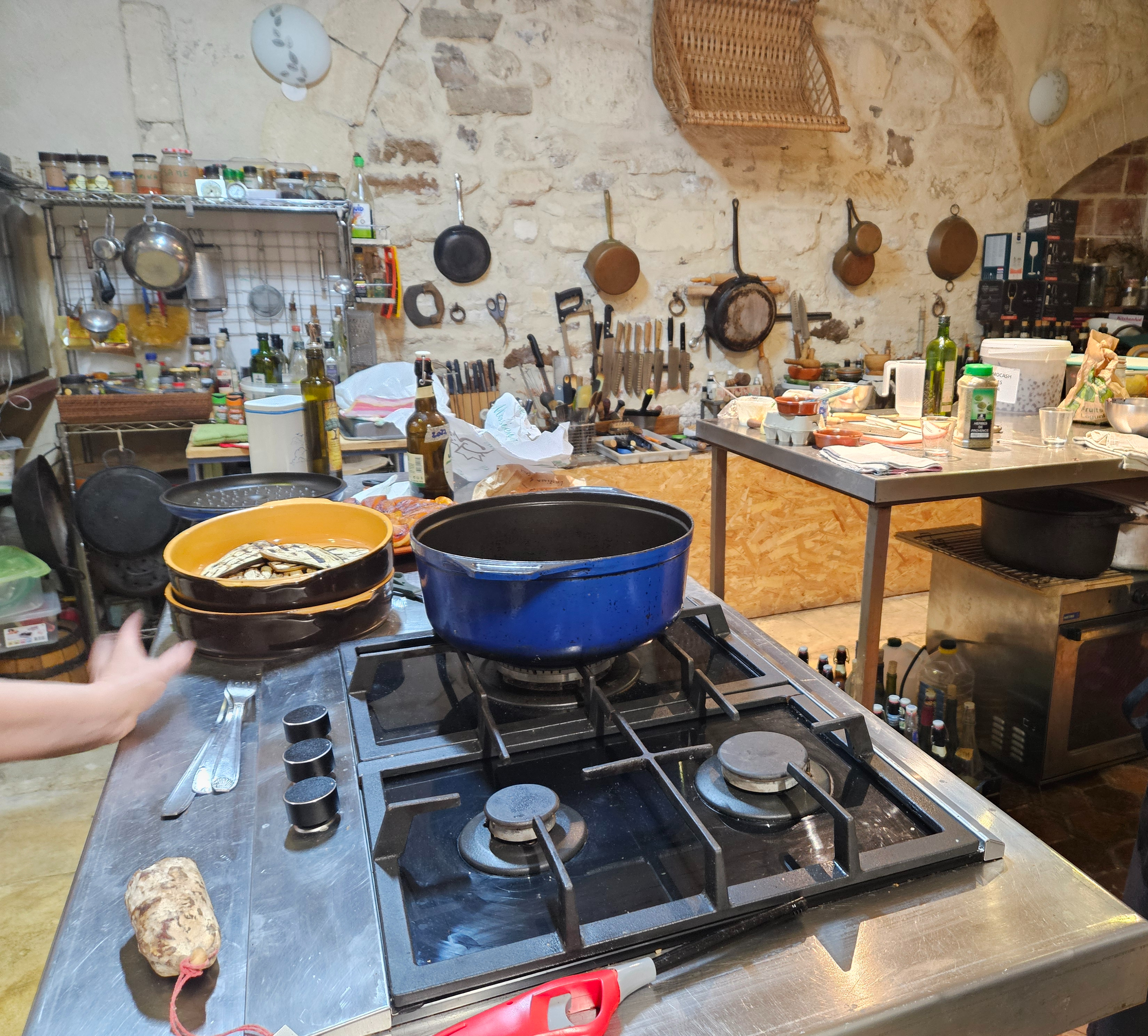
Once back at the well-supplied cooking kitchen, we learn how to make Mille feiulles de legumes (there’s a trick to grating the garlic) pintade aux olives, (Chef Erick gallantly chopped off the head and feet of the pintade [guinea fowl] for us), torte aux blettes (be sure to wring out the chard), riz au gingembre and tarte tatin (amazingly easy and dramatic upside-down apple pie dessert!)
Everything in the oven or on the rack! Triumphant sous-chefs take a moment.
Then we sit down and eat it all, together with wine and digestif, which makes conversation lively in English and French. Then, clutching our recipes, we totter back to our hotels for what will probably be naptime.
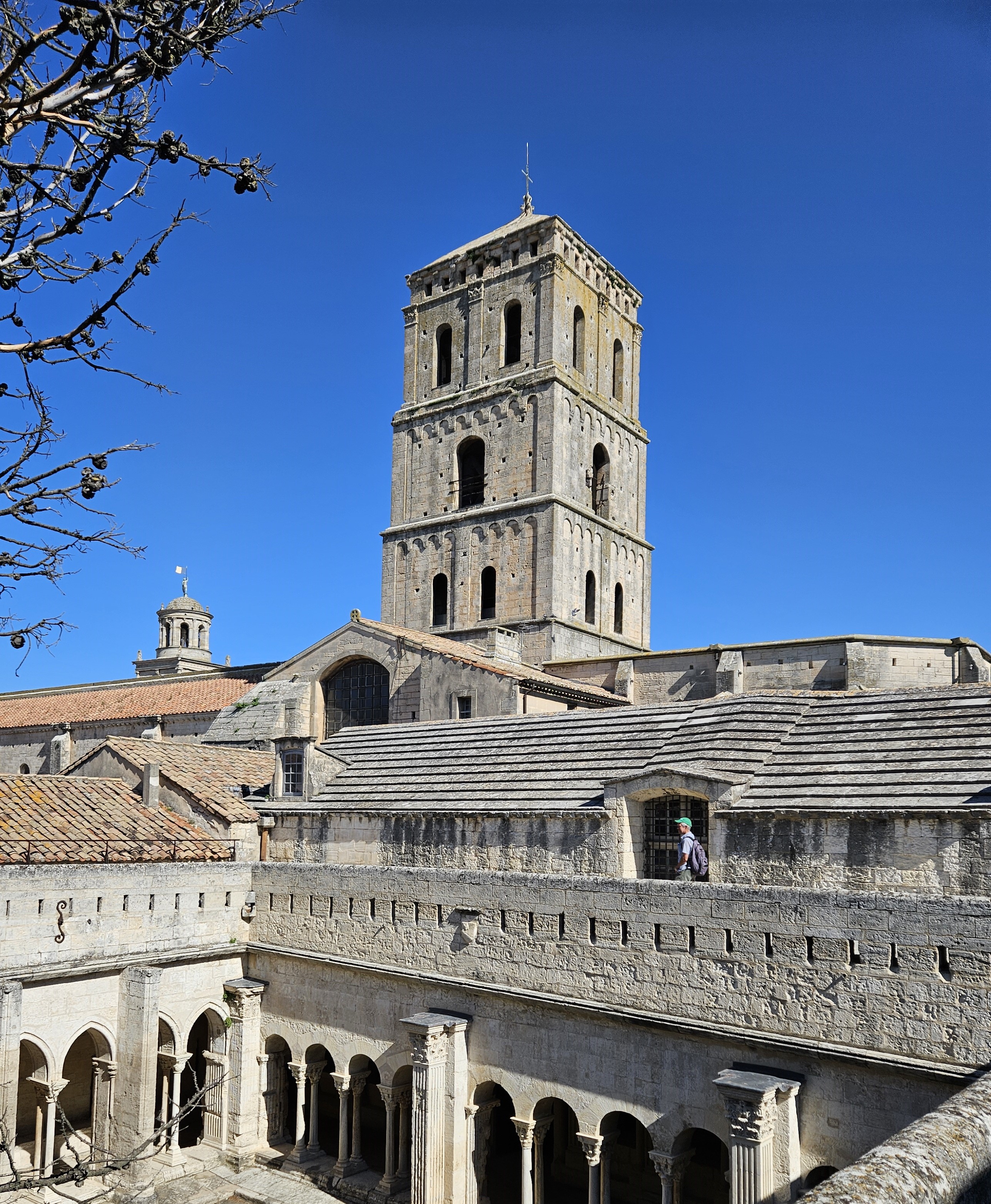
This was our “What shall we do while the rest of the group goes to Avignon?” Day. EJ and I met for breakfast (rather ordinary, but fortifying) downstairs, put on our walking shoes, and set off for the Tourist Information Office down the street. We picked up our Arles 365 Passes, allowing us into ten historical sites and museums, and started across the street directly to the Hotel de Ville (City hall) and the neighboring Cloitre de St. Trophime (St. Trophime’s Church And Cloister). This was our dose of Gothic/medieval Architecture – lots of biblical motifs, Christ in judgment with unhappy souls being led off in chains to the left, while the sanctified get their angel wings on the right, all over the Church door in graphic detail. Inside, lots of chapels with minor saints (St. Roch is my new favorite dressed in the garb of a Conquistadore, but evidently he lived in the time of the plague, and had one of those incredibly faithful dogs.)
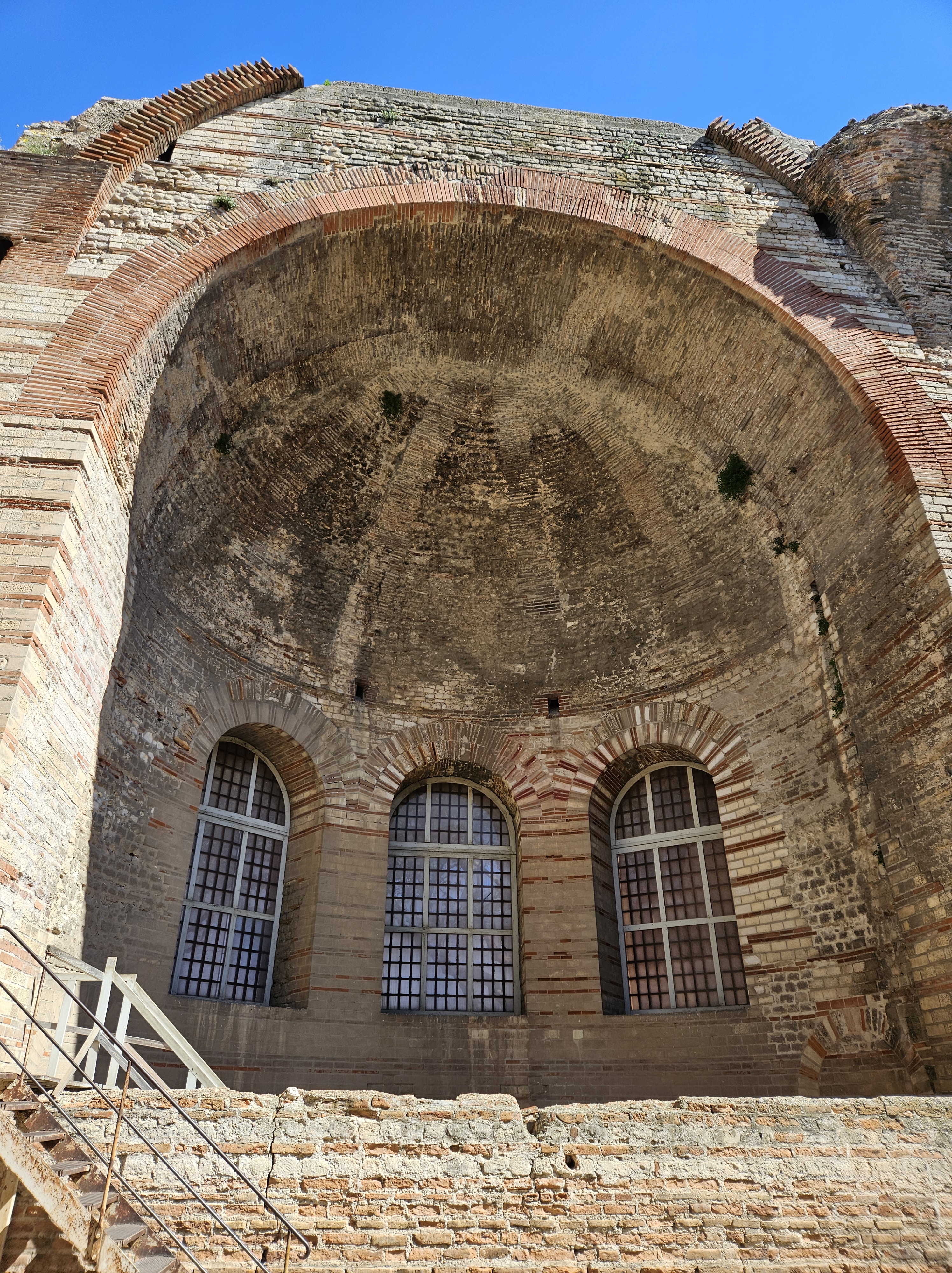
Then up to the riverside where we explored Constantine’s Baths (public steam room, exercise room, sun room, swimming pool – an incredible structure which, when first unearthed, was assumed to be a palace) Then through the adjacent Musee Reattu, an odd collection of 18th century and modern works (“The museum went to sleep during the world wars” explained the catalog), and down to the Arena, where we saw two gladiators battling rather cheesily.
Hungry and hot, we spotted the sign of Le Criquet, a restaurant that had been highly recommended by the Canadians EJ met the previous night, so we plopped down and were treated to delicious fresh shellfish over linguini or over potatoes (we had 2 different entrees) and a floating island pudding that relates to what they used to serve in our college dormitory as Italian gelato relates to a Fudgecicle. Fluffy, meringue, creamy pudding…. The picture can’t do it justice.
Almost dizzy from deliciousness, we decided to work off lunch by walking the length of George Clemenceau Blvd to the Musee d’Arles Antiques.
The museum’s modern bright-blue exterior belies the wealth of ancient artifacts contained within, including a cemetery’s worth of sculpted sarcophagi, murals re-constructed from villas excavated in the neighborhood, an ancient wooden boat retrieved from the Rhone river, its cargo of urns intact, and reconstructed, Greek statuary… and on and on. And, an extra plus after a day of sight-seeing – it’s air-conditioned.
EJ has scheduled a birding expedition led by an expert local guide this evening and may miss dinner, which is why we splurged on lunch a bit. After a short rest back at the Hotel Constantin he leaves to rendezvous with his guide, while BB and I walk to meet the rest of the group at Le Gibolin, a Michelin -recommended restaurant within walking distance.
There we meet PS, former leader of our student group in France, whom I briefly dated afterward (he taught me to appreciate hot buttered rum), and SF, who traveled with me and two other students for three weeks crammed into a VW beetle – and still remained friends afterward! Rounding out our table was MV, who had been a high school student in Tours during our stay and whose family had informally adopted PS and me. I had not seen her for over 60 years – the other three I had seen briefly at reunions or visits. Would our camaraderie endure after all this time?
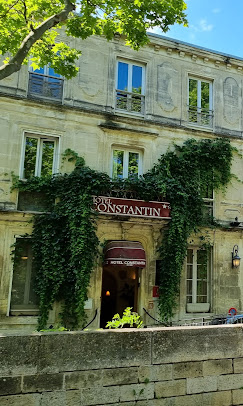
EJ and I arrive in Arles via an earlier train than originally planned, having discovered that our tickets would be good for any TER train at any time in any direction as long as it is on the same date (what a convenience for the traveler!) We catch a taxi, overtip the driver, and arrive at the Hotel Constantin just as the lobby re-opens for business after the mid-day siesta which is common in southern France.
We picked the Hotel Constantin on the recommendation of our friend BB who was also staying there and was enthusiastic about the service she had received on a previous visit. We were a bit dubious, as it boasts only a 2-star rating, but the location on a narrow street just a footbridge away from the Boulevard George Clemenceau proved to be practically perfect, with easy access to museums, monuments, and the amazing Saturday street market. And we even had excellent viewing of the passing of the Olympic torch right outside the hotel steps! (more on that later).
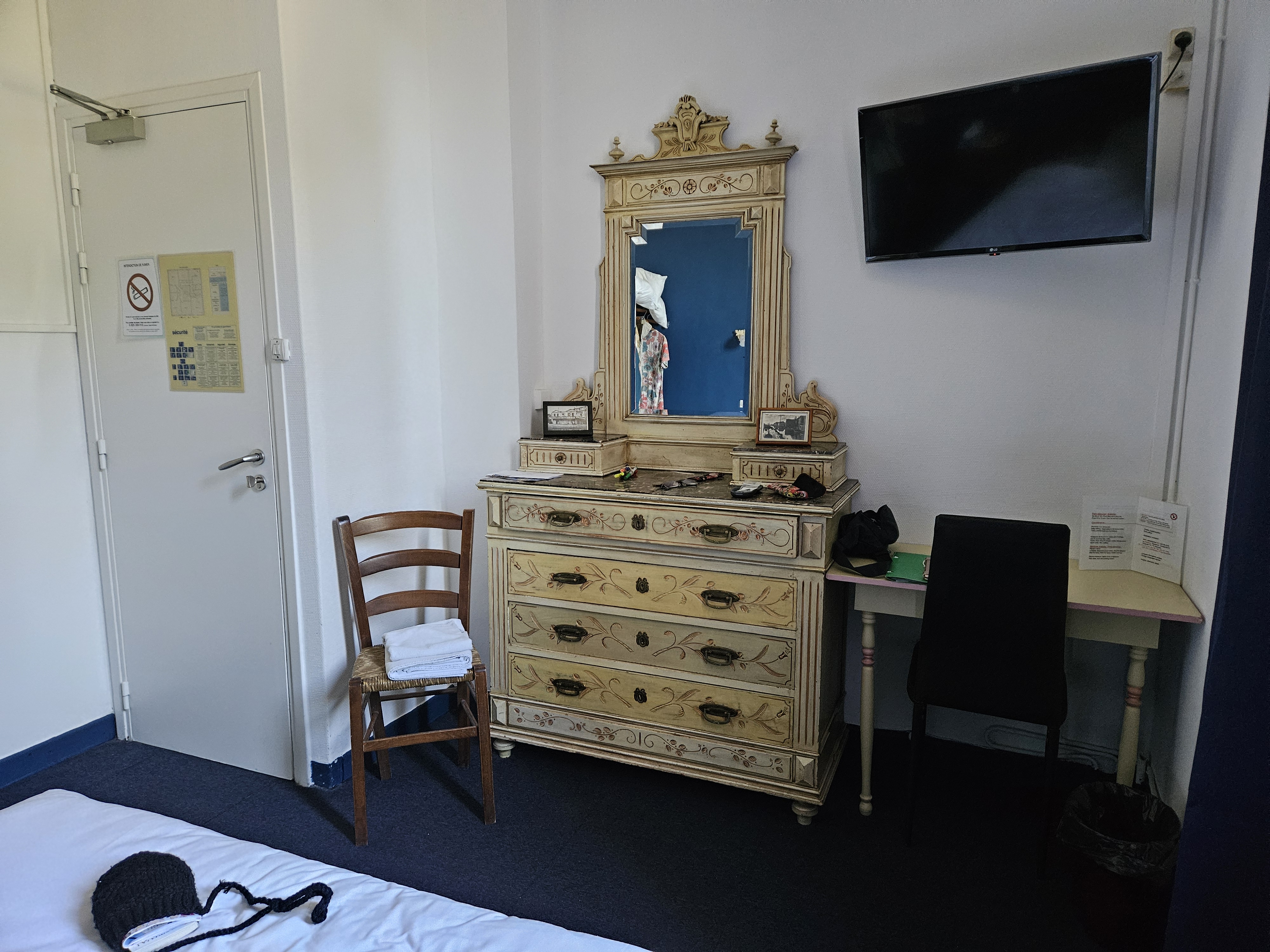
According to the website, the rooms are “furnished with handsome items picked from various Antique markets”; I myself would describe the style as “vintage Garage Sale.” But the bed is comfortable, there are plenty of drawers for storage, the WiFi works well, and the plumbing provides a reviving hot shower. (Caveat: We learn later that the hot water is only available after 7AM and before midnight).
The breakfasts at the Hotel Constantin are a bit more spartan than as depicted on the website. Croissants and baguettes are fresh, yogurt and orange juice are available, but the only fresh fruit offered throughout our stay was bananas.
The other shortcomings which might have prompted a 2-star rating are
1) the lack of an elevator. The stairs are fit to star in Hitchcock’s Vertigo, and there is a trick to getting the lights to come on. (Motion-sensors are not perfectly placed, but a wave of the arms will usually get their attention.)
2) a shortage of electric plugs, and the one available being oddly placed at eye level just outside the bathroom. Fortunately, I brought an extension cord which served me well.
Did I mention how stellar is the location? At the end of the first day, we walked away from the city center along the Boulevard George Clemenceau which takes a sharp turn just past Hotel Constantin, and there we found Le Grand Rhone, and this lovely sunset:
One of my recent posts covered four airports in the US where I had touched down in the course of one trip. Since then I have had exposure to additional airports on an extended trip in Europe. Do overseas airports manage better?
Not quite fair to start the discussion with the San Francisco International Airport (SFO) This is my home port, I’m quite familiar with it, and to boot, I had a business-class ticket which put me in United’s Polaris Lounge before the flight. I and my companion enjoyed champagne/grapefruit juice mimosas, tomato soup, cheese and crackers, fruit tarts, chocolate mousse – it was hard to tear ourselves away when our flight was boarding. My father used to say “It only costs a little more to go first class” but unfortunately that is no longer true, so I can only say “If you can afford it, it’s a great way to start a trip. A+
We had checked our flights before leaving and were pleased to see that our departure gate at Munich’s International Airport (MUC) was only steps from our arrival gate in terminal G – no problem with making the connection, and maybe a quick stop in the Lufthansa lounge while we waited. But no; our gate has been changed from nearly-adjacent G32 to different-terminal K01. This means a stop through passport control, and then along endless moving and not moving sidewalks, up and down escalators to our gate. We breeze past attractive looking shops and eateries, wave at the Lufthansa lounge, and make it to the gate just as boarding is called. The only thing I can vouch for at MUC is that the unexpected passage through passport control was efficient, and the signage is excellent. B+
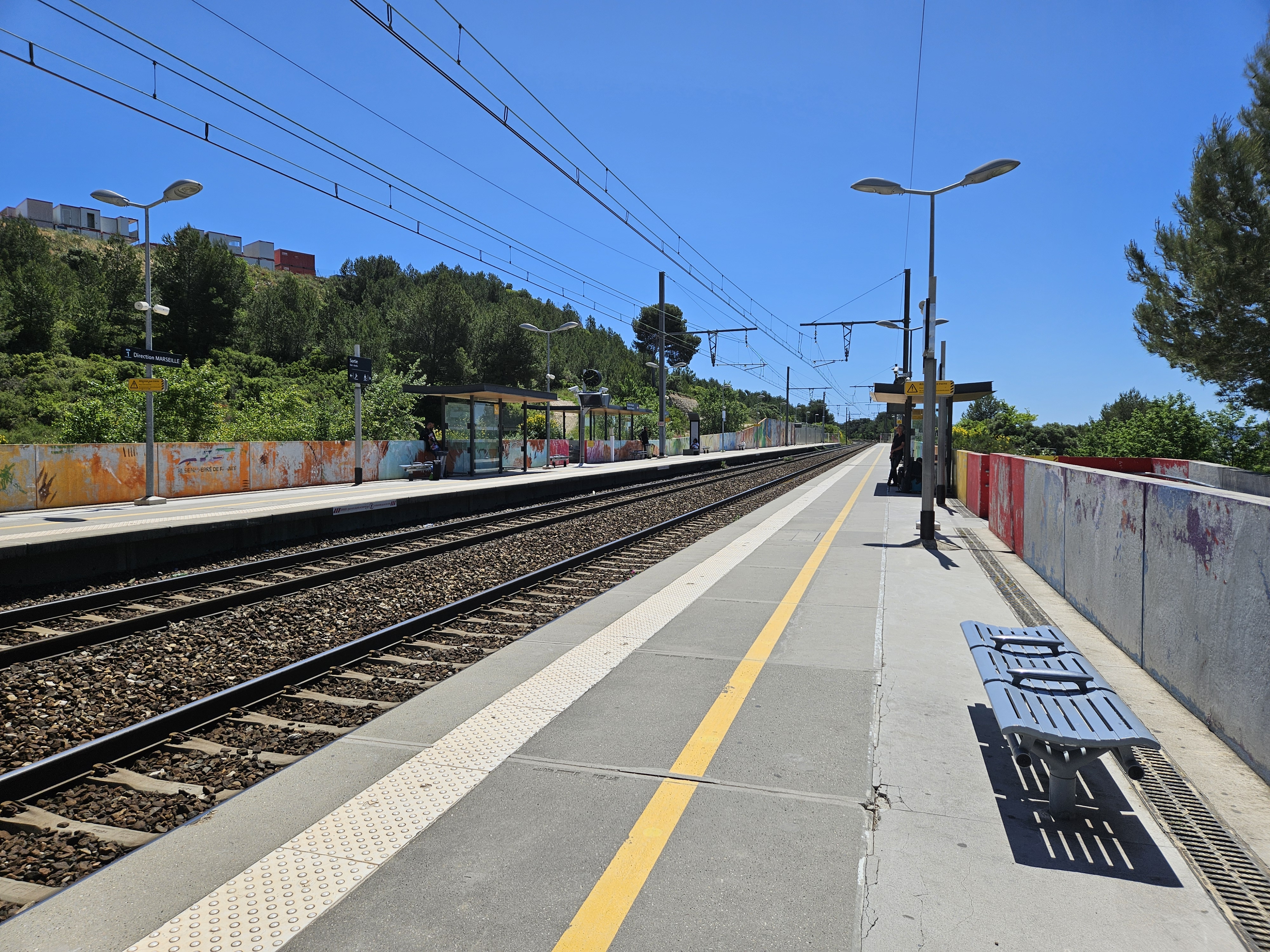
Next stop: Marseilles (MRS): This is a huge airport, hub for all sorts of African, Asian, and European airlines. We stopped at an ATM for cash, at a friendly information booth for directions to the train shuttle, and were on our way on the shuttle within twenty minutes of landing – slick as goose grease! [Full disclosure: We had carry-on luggage, and I speak pretty good French, which helped a lot]. Again, our rapid passage precluded any evaluation of amenities. One surprise: we expected the train shuttle to take us to central Marseilles, where we would have to negotiate a bustling station with lots of noise, people, and confusion. Instead, the shuttle dropped us at what seemed a remote suburban station, Vitrolles. Almost no-one waiting there, a small building with restrooms a quarter-mile from the tracks, and no posted routes. I looked at my trusty French map to confirm that any passing train would actually take us where we wanted to go. Reassured, we hopped the next train going north, and no worries.
On our return trip through MRS we had a bit more time to be confused by the construction at the entry and by the hugeness of the airport, and due to very poor signage we had to ask directions from a janitor to be directed to our proper terminal. I also was unable to download my boarding pass to my phone while inside the terminal, so we had to circle back to the check-in counter, where my carry-on was deemed too thick to make it onto my smaller plane to Lisbon (LIS). No more business class for us, but the waiting area was comfortable and not too noisy. C+
Zoomed through LIS as my flight from MRS left 40 minutes late. At the TAP gate there was confusion; it seemed there was a problem with my seat (2C) , so I was sent to the rear (8C) But there was a uniformed pilot sitting in 8C. More confusion. Eventually I was seated in 8C with many apologies, while the pilot dead-heading home was put in my original seat. Oh well. The flight to Porto (OPO) was easy and the young man in the adjoining seat friendly. But I can’t really give a grade to LIS – I have a hazy impression of lots of shops and advertisements and having to peer over the shelves to find the signage to my gate, but I will withhold judgment – InComplete
The Porto airport (OPO) is small and easy to negotiate. My hosts met me on exiting the baggage claim and guide me from there. On my return, I found my way to THE Business Lounge – all airlines share the same rather spartan space on the mezzanine level. Only later did I realize my good fortune in having access to the Lounge lavatories – there was not a trace of a WC visible on the plebeian level of the airport, although I’m convinced there must be at least a few. What’s fun about the Porto airport is the cosmopolitan veneer: Porto has a large expatriate colony from all over, and it shows in the variety of shops and food available. B+
And then I flew into Frankfurt (FRA), the largest, busiest, most harrowing airport in Europe. We landed a mile from the terminals, disembarked down a rolled-up stair onto the tarmac, boarded a bus, and drove through every ugly airline backyard the airport could show us before finally reaching Terminal A, Lufthansa’s pride. Unfortunately, it seems Lufthansa has quarreled with its code-share partner United, as my flight back to SFO was switched to Terminal Z. Are you kidding? No, Terminal Z is in fact at the far end of the line in Frankfurt, a dark, gray tunnel remote from any comforting Lounge. Its only recommending features are its Germanically hygienic rest rooms and the promptness of our departure from this depressing cave. D-
We are all familiar with pictures of the American Cemetery in Normandy, with its rows of white crosses stretching into the distance. I had not known that the United States was the only combatant in World War II which offered families of its dead an option to repatriate their remains for burial in the US. The nine thousand plus graves at the American Cemetery are only a third of the fallen. These are those soldiers who had no family, or whose families lacked means or desire to hold funeral rites at home, so they preferred to let the government bury their dead.
The German cemetery is quite different in look and feel from the rows of white marble favored by the victors. One enters the cemetery through what seems like a large arch, but once inside, the spacious entrance gives onto a small room with a memorial wall on one side and a listing of the cemetery’s occupants on the other. Exit into the cemetery is through a narrow and low door. The symbolism, we were told, is that the soldiers entered the war as a group, but died individually, one by one.
The central feature of the cemetery is a tumulus which contains the remains of mostly unidentified German soldiers, topped by a black lava cross and two human figures, one of Jesus, the other of Mary. Scattered around the grounds are groups of black crosses, some slightly larger than others. The individual graves are marked by brown plaques laid flat in the grass, each bearing the names of two German soldiers, with their dates of birth and death, and sometimes merely the inscription “Ein Deutcher Soldat”. The plaques are made of German clay.
In school we learned Rupert Brooke’s elegy “The Soldier” which begins
If I should die, think only this of me:
That there’s some corner of a foreign field
That is for ever England.
France has ceded the land which contains the World War II cemeteries to the respective nations which maintain them. (Thus President Trump acted as host for ceremonies on D-Day at the American cemetery, arriving first and greeting French President Macon and his wife as guests.) It is sobering to realize that this corner of France will be forever Germany, peacefully coexisting in death with its former enemies.
Bayeux was the first French city to be liberated by Allied Forces. Troops marched into the city on a street bordered with cheering townsfolk who waved French and American flags, and offered kisses from happy young women and fresh baked treats from older ones. The Germans evacuated so quickly that they had no time to organize a defense, so the most of the medieval structures remained intact.
We first stopped at Bayeux Cathedral, with its mix of old and new stained glass, its ornate Gothic verticality, its mystic paintings decorating the crypt beneath the alter. The apse was decked in French tricolor, British Union Jacks, Canadian maple leafs, and American stars and stripes. Behind the altar there was a large concert band practicing for Prince Charles’ visit the following day (Wed. June 5). This was a truly excellent brass ensemble, plus some woodwinds and tympani. The sound reverberating through the cathedral was thrilling. One piece was “The Spitfire Overture” and another, appropriate for a visiting Brit, was the lovely, noble main theme from “Jupiter” from “The Planets” by Gustav Holst. My partner, a music-lover with bad knees, stayed in the church for the whole rehearsal while I wandered around the side chapels and lower levels.
Right across from the cathedral is an old store front set us as a Lace Museum, with lovely examples of the prototypically Breton/Norman craft. Unfortunately, I have since read that the Lace Museum is in danger of being closed, as it is funded by the city of Bayeux and patronage has been light. So don’t forget to stop in!
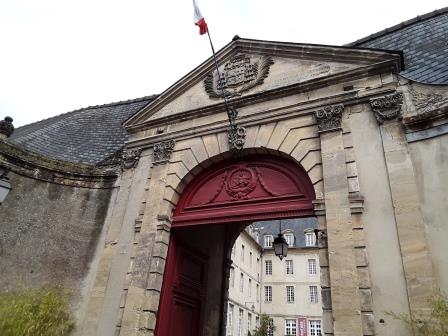
Just down the street is a more modern museum of Breton arts and crafts, housed in a former bishop’s palace, with lovely landscape paintings, more lace samples, and a well-stocked gift shop offering post cards and booklets about the medieval city, its role in World War II, and its artistic heritage.
Of course, Bayeux is most famous for that other artifact of war, the Bayeux Tapestry, now displayed beautifully in a circular museum which allows the entire 200 feet of embroidered cloth to be shown, accompanied by an audio commentary provided through headsets to each visitor. (This device not only fills you on details a guidebook may have overlooked, but it artfully keeps the visitors moving forward as the audio commentary moves forward to the next panel. No pause button. ) Notice the way the borders complement the action, with dead and dying soldiers, archers, and mythic beast bordering the action-packed cavalry sequences. The Bayeux tapestry is like an early graphic novel, with leading characters easily identified by distinctive dress or hair, and scenes of ribaldry aleternating with the diplomacy and bloodshed. Definitely a Don’t Miss!



















 We are all familiar with pictures of the


 Bayeux was the first French city to be liberated by Allied Forces. Troops marched into the city on a street bordered with cheering townsfolk who waved French and American flags, and offered kisses from happy young women and fresh baked treats from older ones. The Germans evacuated so quickly that they had no time to organize a defense, so the most of the medieval structures remained intact.
 We first stopped at Bayeux Cathedral, with its mix of old and new stained glass, its ornate Gothic verticality, its mystic paintings decorating the crypt beneath the alter. The apse was decked in French tricolor, British Union Jacks, Canadian maple leafs, and American stars and stripes. Behind the altar there was a large concert band practicing for Prince Charles’ visit the following day (Wed. June 5). This was a truly excellent brass ensemble, plus some woodwinds and tympani. The sound reverberating through the cathedral was thrilling. One piece was “The Spitfire Overture” and another, appropriate for a visiting Brit, was the lovely, noble main theme from “Jupiter” from “The Planets” by Gustav Holst. My partner, a music-lover with bad knees, stayed in the church for the whole rehearsal while I wandered around the side chapels and lower levels.


 Right across from the cathedral is an old store front set us as a
  Of course, Bayeux is most famous for that other artifact of war, the


 Allyson Johnson