Freeway Free in San Francisco: A Touch of Class

My father used to say, in justifying a splurge, “It only costs a little more to go first class.” This is no longer true when flying across the country, perhaps, when an upgrade to first class was a two-digit expense, but it can still apply to other aspects of travel. When my childhood friend came for a visit, we decided to spend a weekend in San Francisco together, and we went in style.
Instead of paging through TripAdvisor, we simply made a list of what we wanted to do. We wanted to have easy access to a BART station, since traveling up to the city by BART is much easier than driving and parking (not to say cheaper), and we also wanted access to public transportation. We wanted to be able to walk to the San Francisco Modern Art Museum, as the Magritte exhibit was on my friend’s bucket list. We wanted to be close to some good restaurants, and we wanted to be able to get to Golden Gate Park.
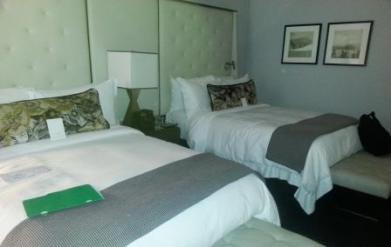 We ended up staying two nights at the Palace – the grand dame of San Francisco hotels, with its glass-domed atrium, high-ceilinged rooms, and courtly servitors. Our room had two queen-sized beds, a marble bath, and cozy bathrobes to wear afterward.
One morning we had breakfast at the Palace buffet in the sunlint atrium. We were early, so we had first pick of a continental buffet which included yogurt, cottage cheese, excellent fruits, cold cuts, cheese, pastries, toast, jam, bagels, cream cheese, lox, juices, cereals, hard-boiled eggs, coffee, tea… we did not miss the scrambled eggs and sausage from the steam table.
We walked to SFMOMA, as planned, and spent a luxurious four hours exploring all seven floors, broken by an excellent lunch at the Café 5 on the 5th floor. (OK, “first class” might have been down on ground level at the highly regarded but often crowded In Situ – but we decided “first class” also means “no waiting.” 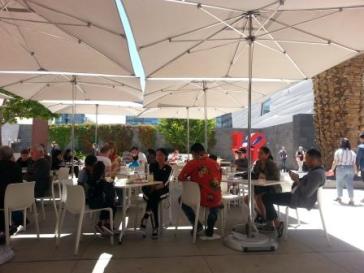
That evening we walked to The Grove, a trendy restaurant half-way between the Palace and MOMA. We people watched, ate wonderfully, and ambled back to our hotel for a swim and soak in the pool and hot tub located three floors up from our room.
The Grove is also known for its Sunday brunch, so we opted for their poached eggs on asparagus toast rather than another go-round at the Palace buffet. Afterward we checked our baggage at the Palace and hopped the N-Judah street car to Golden Gate Park, where we took a Segway tour of the park. (Yes, true luxury might have opted for a limo, but the N-Judah, again, involved no waiting. Actually, the N-Judah is just about everything you need to know about public transportation in San Francisco. It starts at the King Street train station near the SF Giants’ ball park, circles the Embarcadero, dives underground past the Civic Center, and surfaces in the lower Haight on its way to Ocean Beach. Give it a try!)
We lunched at Nopalito’s, a top-line Mexican restaurant on 9th Avenue. Here there was a wait, but it was made painless by the availability of a branch of the Green Apple Bookstore right across the street.
That evening reclaimed our bags and BARTed back down the Peninsula, completely satisfied with our taste of luxurious living. And since my friend and I split the bills, it really did only cost a little more to go first class.


 As I walked back through the grove, I noticed that many of the boulders had small cairns built on top of them, perhaps related to the Jewish custom of putting a stone on the grave of a relative or friends when you visit. I stopped by an empty boulder and piled up a cairn – one for my college friend, one for two boys I had known well in high school, one for the son of my high school principal, one for another close friend who is, so far, as survivor. I had not thought of them for a long time. It felt good to think about them here.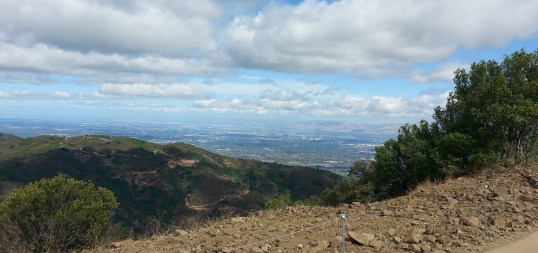
 Then a controversy prompted action. In 2009 Midpen obtained Federal funding to clean up the site, and one of its first ideas was to tear down the remains of the radar tower and restore the site to its pristine pre-Cold War state. Valley residents erupted with letters and meetings – the tower was ugly and dilapidated, but it was an icon none the less, part of the Valley’s landscape and history for 60 years, and we didn’t want it to disappear without ever having had the chance to visit it.


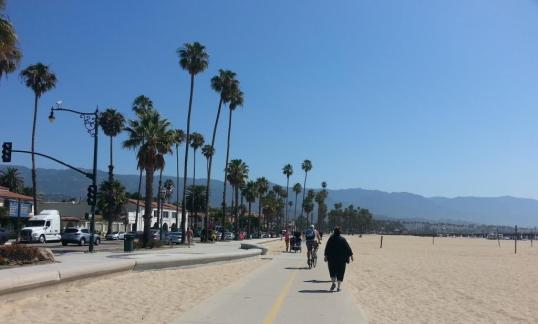
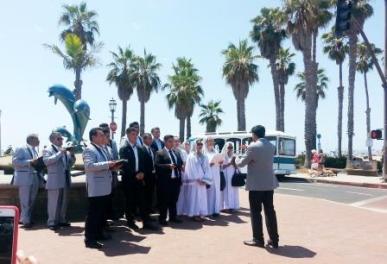
 We proposed at first to walk uptown, but W noticed signs for a shuttle going up and down State street every 1o minutes. The trolley was open air, crowded with tanned beachgoers and families, and at 25 cents for Seniors , 50 cents for youth, it was a bargain. Looking for historic Santa Barbara, we set down at the Paseo, but we were disappointed to find that it was merely a modern shopping center dressed up in red tile roofs and Adobe.



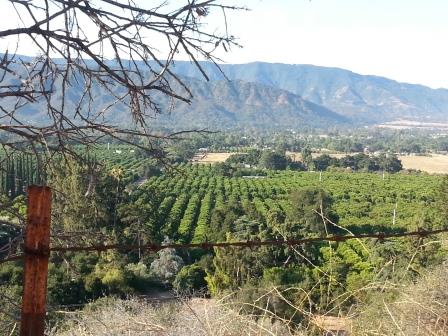
 After breakfast we headed out to Carol Vesecky’s organic orchard, where she cultivates about 40 different varieties of fruit. These included several varieties of mulberry, oranges, grapefruit, apples, figs, and several exotic south and Central American varieties that I did not recognize, though my companions who had spent time in South America greeted them like old friends. After picking some mulberries (and eating half of what we harvested as it was picked) we headed for the
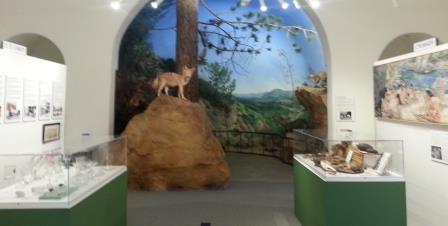
 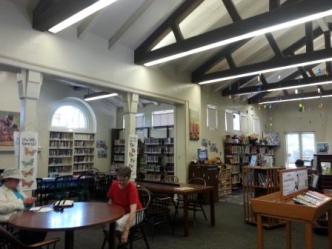 We checked in at the library, an old -style adobe and beam rambling building, then left W there, still writing, and continued to the Ojai Museum, located in a re-purposed church. My cousin, a long-time resident, had never visited before, and found out quite a few things about Ojai that after 27 years of residence she had never learned.
 Some might have been daunted at prescribing mission architecture when in fact Ojai had nothing resembling a mission. No problem. Libbey engineered the building of a mission-style Post Office, complete with a four-story bell tower which chimed each quarter hour. The false storefronts were replaced with cream-colored stucco and tile roofs; the wooden sidewalks were replaced with terra-cotta pavers and covered with arched arcades. Abracadabra! – Instant ambience!
 I am off to visit my cousin and friends who are rendezvousing in Ojai, 500 miles south. Google Maps sends me down the old main artery of California, US Highway 101, known as the Bayshore on the San Francisco Peninsula, the Monterey Highway in San Jose, and a dozen other names as it passes, (or nowadays bypasses) every mission town – the brown Historical Marker signs for San Juan Baptista, San Carlos Borroméo del Carmelo, San Miguel, La Purissima, and a number of crumbling Adobe dwellings are more abundant than the Golden Arches on this particular road. But today I am on the freeway, dodging big rigs and RV’s, not looking for picturesque byways.
  For lunch, I treat myself to a stop at the


 I am a big fan of public transit, taking the train regularly to Sacramento and San Francisco to visit family, taking BART to the Symphony or to museums in San Francisco, riding Light Rail and Muni in San Jose and San Francisco.

 Allyson Johnson