Allyson Johnson

Pieces of my Mind

Archive for the category “hidden treasures”

Hiking Boots to Buzzards’ Roost
Having nothing scheduled, we sleep until 6:30, when we both wake with the same need, scrambling for our camp shoes so we can hustle off to the nearby loo.  If we were at home, we would have stayed upright, made coffee, and begun the day.  But in camp, it seems still too dark to do anything serious, so M curls up for an additional doze, while I pull out my iPad to churn out another 1500 words of my latest imaginary adventure.

After a lovely camp breakfast of Raisin Bran, blueberries, raspberries and oranges, washed down with French pressed coffee, and milk, I do the washing up while M puts together a portable lunch in preparation for our hike to Buzzard’s Roost.  We intend to leave by 10, but what with one thing and another it’s 11:15 by the time we set our feet on the path toward the Buzzard’s Roost trailhead.

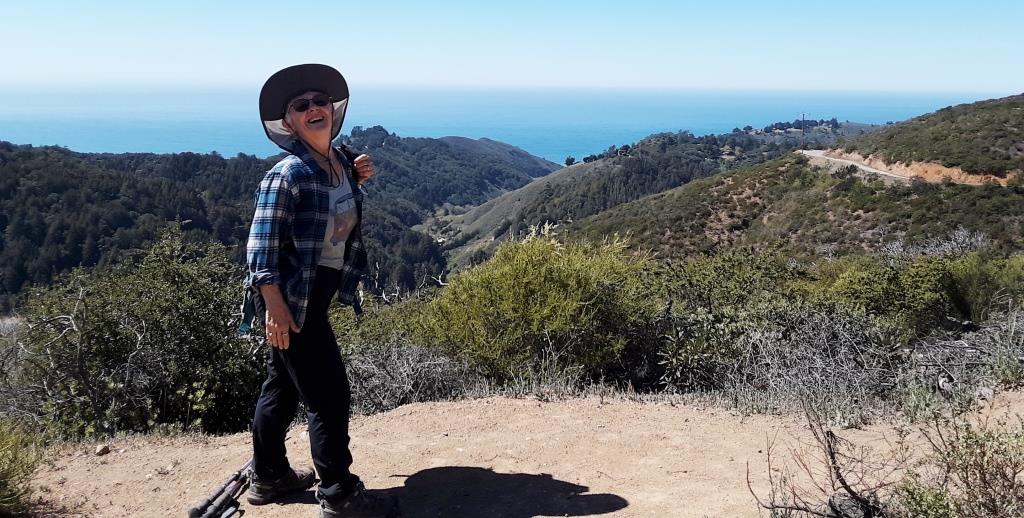
It’s a lovely walk under the Highway One overpass, up through stands of redwoods terribly scorched by the Basin Complex fire of 2008, but still bravely pushing out green shoots of new growth.  Then we’re in ceanothus and scrub oak country, then manzanita, and finally barren red rock with a vantage point that looks over to Mount Manuel landward and to the brilliant blue Pacific to seaward.  We spread our unneeded extra layers of shirts over the red dirt and set out a lavish lunch of hard-boiled eggs, carrots, hummus, crackers, string cheese, grapes, apples, and prunes – all finger food, no grease.  We stay looking out to sea until our spines begin to protest against sitting unsupported on the hard ground, then round up the eggshells and cheese wrappers with other leftovers and set off on the return loop.

One of my perennial games on a hike is to count how many different kinds of wildflowers Ican spot.  In Edgewood Park near where I live, I have counted as many as forty in the spring, due to the many different micro-biomes there.  On this day at Big Sur we tally twenty one, including columbine, native iris, wild strawberry, dandelion, buttercup, trillium, and others of which I do not know the names.  Counting varieties is a great way of forcing yourself to be on the lookout and to really notice what is around you.

Our plan after returning to our campsite had been to hop in the car, take care of a couple of small purchases at the general store down the road, and then to drive down to Pfeiffer Beach.  But after our purchases M turns to me and asks “Do you mind if we don’t go to the beach?  I just want to veg.”
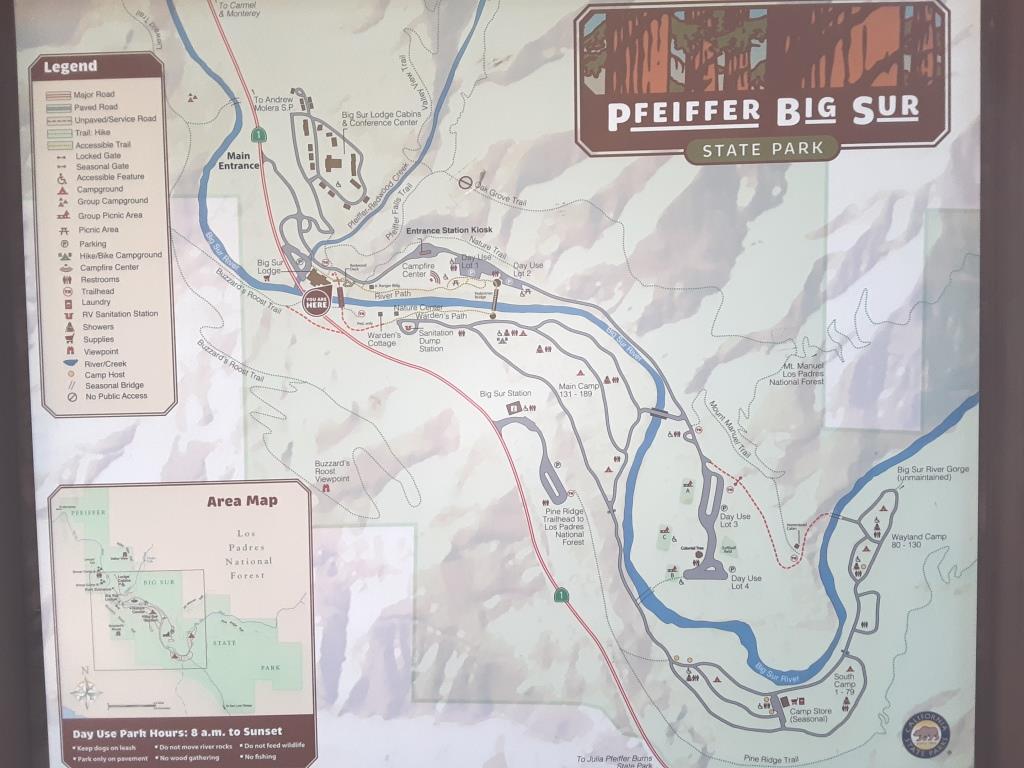
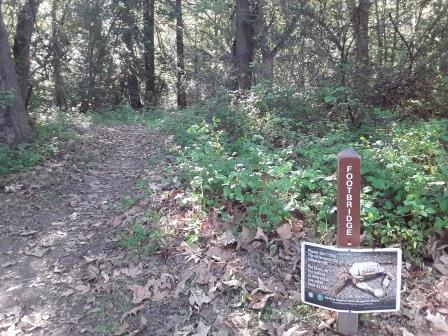
Instead we drive to the end of the road on the side of the river opposite our campground, just to see what is there. We watch a family playing softball on the weedy field for a while, and I want to check out the “seasonal footbridge” that the map shows opposite our campground (See the dotted line crossing the river at the end of Day Use Lot 4 on the above map?) M drops me off at the end of Parking lot 4 and drives away, while I follow the trail from the sign that says “Footbridge.”

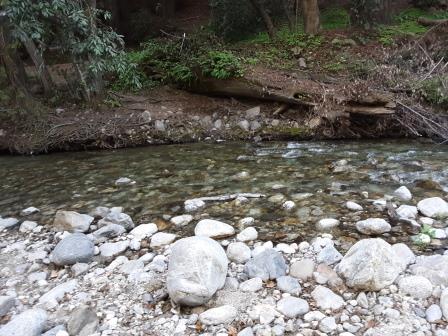
Guess what.  No footbridge. Must not be the season yet.  I debate wading across the shallowest portion of the Big Sur River as it ripples past where the bridge should have been. I’m wearing my water shoes, and my cargo pants with the roll up option, and the water looks shallow.  On the other hand, the bottom of the river is paved with rounded stones of varied sizes which could be very unstable and slippery, the water is so clear that it’s hard to gauge how deep it really is, and getting up the steep bank on the opposite side looks chancy. So I opt for the half-mile walk around to the far bridge at the end of the campground.  (It would have been shorter, but the most direct route was “authorized vehicles only,” and a ranger directed me in a friendly but definitive way to the trail around, not through.)
By the time I make it to our campsite, M has gotten worried and set out in search of me.  By the time we reunite the sun is definitely over the yardarm. She lights the portable campfire, I run cold water from the camp faucet over my tired feet, and we settle to reading, phoning, and munching the last of the crackers and hummus.

Dinner is experimental but turns out well. A vegetable medley cooked in Frying Pan #1, sliced parboiled potatoes with onions sautéed in frying pan #2, and lamb chops sauteed in Frying Pan #1 after the veggie medley had been evacuated, along with a nice Pinot Noir, dessert of shortbread and chocolate squares, and some sisterly discussion ranging from “Do you think Mom resented me?” to “Have you smoked marijuana?” to “I have this genetic deformity. Do you have it too?”

And by 9PM we are snuggled in our teardrop cocoon once more.

Coming next: The Beach! .

Freeway Free at Lake Tahoe: Fusion Feeding

Busy at Harumi Sushi bar

After our first night of hamburger casserole cooked at the timeshare, C and I felt we should be more adventurous at dining. Not wanting to drive far, we decided to try the sushi place across the highway. Harumi Sushi – good choice!  The place was packed on a Monday night (not that many restaurants open in a tourist town on a Monday) but we managed two seats together at the end of the sushi bar. Although most of the workers and chefs are not Japanese and the tea was not matcha, the edamame was tender, and the White Dragon roll (salmon, spicy tuna, avocado, and more) was only surpassed by the Gabrielle roll (snapper, fried asparagus, sweet sauce, and more.) C had some sake – I tasted, and we split an order of fried cheesecake – a very peculiar sweet which I’m pretty confident is not traditional Japanese.

Toast Tahoe – lower level

For our third night we had planned to dine in South Lake Tahoe, but the Thai restaurant we had hoped to eat at was CLOSED for remodeling, and its sister restaurant at the other end of town was simply CLOSED, and as we had started our culinary search late, we headed north to Zephyr Cove again, to Toast Tahoe. This large restaurant on two levels is obviously equipped to handle large parties, but tonight the upstairs is closed and down in the bar C and I are almost the only diners. Our server is the owner, her daughter buses dishes, her mother and husband are in the kitchen.

No sushi here, but delicious and unusual menu items.  We shared Calamari breaded in toasted coconut, Cindy had crab cakes and roasted Caesar salad, I had mussels in curried coconut milk and rice. Yum.

Since we had failed at finding Thai food previously, we were delighted to find one listed back in South Shore and made Thai on Ski Run our destination. We discovered that this was only one of a little nexus of attractive restaurants off the US50 track – a Japanese, a Nepalese, and an Italian in addition to the Thai, all brightly lit with Christmas lights still up, and all welcoming.  But C had checked out the Thai restaurant online and had drooled at the pix, so we kept to our original plan.  She had a beef curry, I had a not-very Spicy Thai Eggplant/vegetable mix, and we shared, with enough for another meal boxed up afterward for the condo. The restaurant is not as pretty as the pix of its closed rivals, but the friendly and quick service more than made up for the rather bare-bones decor. And I’d come back to this corner of Ski Run to sample the other three restaurants.

Thai on Ski Run beckons on a cold night

Hidden Treasure at Lake Tahoe: LTCC Nordic Center

C and I had promised each other that vigorous exercise would be part of each day at Tahoe, so what to do while my hiking boots were drying out? (See previous post). C had never been cross country skiing, and I had not done it since my children were small, so we set out with a bit of trepidation to find equipment and trails suitable for brittle-boned ski bunnies.

C is a tiger when it comes to locating options. After a short internet search, she discovers that the Lake Tahoe Community College campus includes a Nordic Center with over five kilometers of “groomed trails.” After some misdirection we were in touch with Meghan, who not only welcomed us with the news that we could have a day pass at the Nordic Center for only $7.50 each, but also referred us to Gary at the nearby Sierra Ski and Cycle Works to rent equipment. We set off just before noon.

Gary lives up to his recommendation, giving us well-fitted boots, skis, poles, and clear and succinct instruction on how to don and doff our skis. We head up the road to the LGCC campus, beautifully draped in snow several feet deep. The Nordic Center office is in the Campus Library, the entrance to the trails is just across the parking lot next to the Gym. We park, purchase our day passes, sling our skis and poles over our shoulders, clamber up the snow bank, and set off.

Good news:; the sky is blue, the snow is white and clean, the trails are clearly marked (no falling into the creek here!) Bad news: there has been no fresh snow, and the trails are quite icy.  The ice makes for easy gliding on the flats, but more speed than we can handle at first even on the gentle slopes, so we each take a couple of falls on the first couple of downhills.  Ice is a lot harder to fall on than snow, and a lot harder to get up from as the skis kept wanting to sail away downhill.  But we gradually get the hang of it, shuffling along easily and enjoying the beautiful mountains and snowy woodlands scenery.

Gary had told us that we could keep the boots, skis, and poles if we wanted to use them for a second day, and we decide to try a different loop at LTCC the next day, going in the afternoon when the ice might be melting and the going (and falling) a bit less crusty. A good long soaking in the time-share hot tub has kept the bruises at bay, and we are confident that a second day will see vast improvement, especially since we have both watched a couple of YouTube videos on beginning cross-country skiing.

Well, a bit. The trail is still icy, and the downhills are still too hard and slick for our attempts at snowplowing to slow us down noticeably. It isn’t that I fall less often, but I fall smarter and get up faster. And today we have role models to inspire us: the LTCC Nordic Ski Team is practicing for a meet. The young skiers, helmet-less, long-hair flying, bright-colored tights and sweaters glowing against the snow, must have lapped us at least eight times, swooping and darting past like a bevy of dragonflies. We do our best to stay out of their way, but no worries – they use us as if we were obstacles in a slalom course, and toss us words of encouragement as they see us tumble. Who needs the Olympics?

Waiting for you!

Freeway Free in San Francisco: Hangin’ out in the ‘Hood

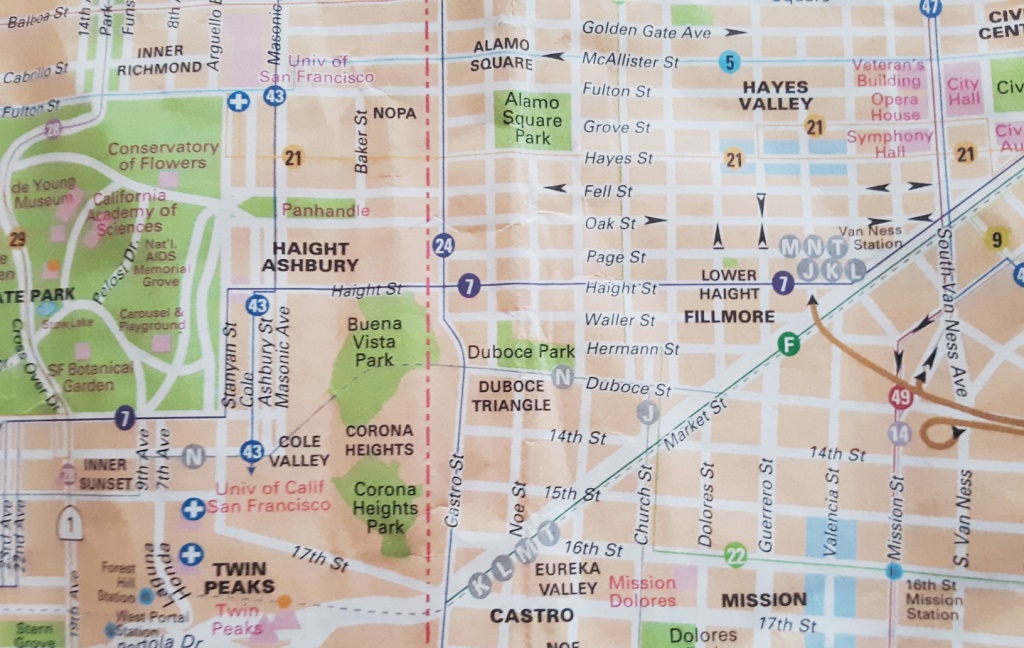
San Francisco is a city of neighborhoods. Each has its distinctive personality, though they do evolve slowly. The Tenderloin has retained its seedy Character ever since the days of Dashiell Hammett, even though it is tightly sandwiched in between upscale Union Square and the culture-heavy Civic Center. Sea Cliff and Pacific Heights are posh, the Richmond and Sunset districts are full of fog and families, while South of Market (SOMA) is still heavily ethnic and blue-collar.

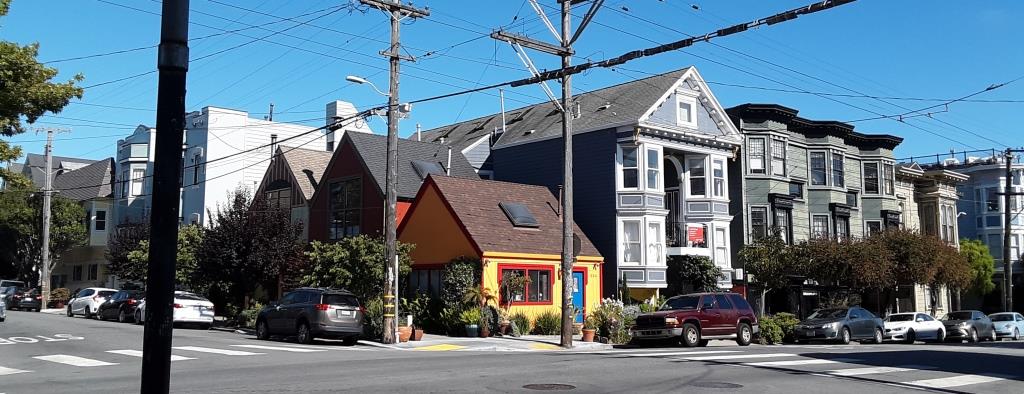
W and I were invited for dinner in the Dubose Triangle. This is a quiet neighborhood of Victorians which have been cut up into apartments and condos, tucked between the flamboyant Castro District and trendy Cole Valley. We met our host at Dubose Park, just next to the runner where the N-Judah dives underground below Twin Peaks before surfacing in the Sunset District near the beach. The lower section of Dubose Park is dedicated to dogs , with all varieties of mutt and breed frolicking on green and well-kept lawn. The upper section requires leashing so that toddlers can learn to crawl on the grass and families can picnic.

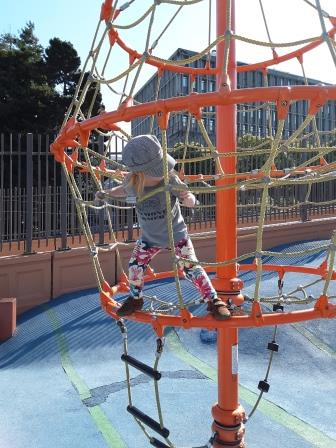
We met our host next to the fenced=in play structure, where he and his neighbors were chatting about good places to camp with children, plans for their next getaway, and the difficulties of finding contractors to do minor remodeling and repairs.

When our hostess arrived after her work-from-home meeting, we pulled the pre-schooler away from her posse and ambled back down to the house. On the way my host was greeted over and over by passers by. “I’ve lived in this neighborhood for fifteen years,” he shrugged. “i know a lot of people.”

Who says urban life is cold?

Freeway-Free in Texas: Past Presence in Bosque County

The day dawned gray and gloomy, with promise of drizzle to come, but we had planned for some weather, and had an indoor outing in our mental hip pockets (I should say W had planned; I was along for the ride.) After a bracing breakfast of yogurt and tangerines, washed down with hot tea, we headed for Clifton, the county seat of Bosque County, and its Bosque Museum.

As you enter the museum, you pass a small oak tree, with a plaque noting that the tree was planted in 1982 by King Olav V of Norway. It’s amazing to think that European royalty made a pilgrimage to this area in honor of its early Norwegian settlers. A section of the museum is devoted to this colony of Norwegians, and features charming displays of furniture and other artifacts which were crafted by these early settlers.

Near the entry lobby of the museum is an animatronic recreation of county resident Al Redder, an amateur archaeologist who in 1967 suspected that a cave overlooking the Brazos River on his ranch might harbor some traces of earlier settlements. After carefully marking off and mapping the site according to the requirements of a proper archaeological dig, he began excavation. He found signs of camps by several different Indian tribes who had passed through the area, and he kept going. More artifacts surfaced. And more. Finally, 14 feet down, he found bones, those of a 40ish man and a young girl, buried together, both in fetal position, and surrounded by traces of jewelry and tools. It turned out that these were the second oldest human remains found in North America, and one of only three burial sites that included ritual artifacts. The exhibit chronicling the discovery and its signficance is fascinating.

The third section of the museum is devoted to the “Bosque Seven.” Bosque County has attracted a number of artist who specialize in Western themes and landscapes, and a large room is devoted to examples of their work. I’m not one who would hang a painting of a roundup in my family room, but some of the landscapes were very lovely.

Following our time in the museum, we explored downtown Clifton. There is the mandatory confection of a courthouse, commons to every county seat in Texas that has not succumbed to Urban Renewal, a Main Street that seems frozen in the 1920’s, including a genuine soda fountain still in business, and the usual stores featuring antiques, collectibles, and souvenirs. W bought a kerosene lamp to have on hand for the next Texas energy emergency. Then back to our shelter, with rain still threatening, we had our midday dinner and settled into a quiet afternoon and evening.

That didn’t last.

Life in a COVID-19 Hot Spot- Week 29: Getaway Gone

Our favorite getaway spot, just an hour and a half from the busy Bay Area, has been the Asilomar Conference Center in Pacific Grove.  This historic retreat was originally a YWCA leadership camp , with historic redwood buildings designed by Julia Morgan, who also designed many of the buildings at William Randolph Hearst’s La Cuesta Encantada in San Simeon (AKA Hearst Castle).    The Center is nestled amid cypress trees and sand dunes just across from Asilomar State Beach on the quiet side of the Monterey Peninsula, separated from touristy and cutesified Carmel by the gorgeous twisting 17-Mile-Drive along the Monterey coastline. .

For the first part of the Lockdown, the Conference center was commandeered by the State as a place to quarantine people who had been exposed to the virus.   After the first surge, the center was emptied and sanitized, but its conference business had dropped to zero.  It reopened to the public only a few weeks ago.  D and I were desperate to get away from our same daily rooms, and reserved a night.  That week the wildfires blazed up, and the Air Quality in Pacific Grove was rated Hazardous.  We rescheduled.  Two weeks later the fires were contained, the air had cleared and we were on our way.

Usually the Conference Center is humming with conferees, who might include  quilters, nutritionists, corporate retreaters, and many other groups.  But there are usually a few unfilled rooms which are available at reasonable cost to the non-conferring public at the last minute.  If you have breakfast in the Dining Hall you will sit at whatever table is not filled, and be liable to have an interesting conversations with whatever genial strangers share the table.  The Lodge is full of teenagers waiting their turn at the pool table or conferees scanning brochures about local activities, or picking up souvenirs at the Park Store.

But that was Before.

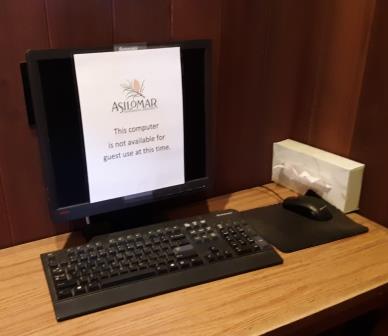
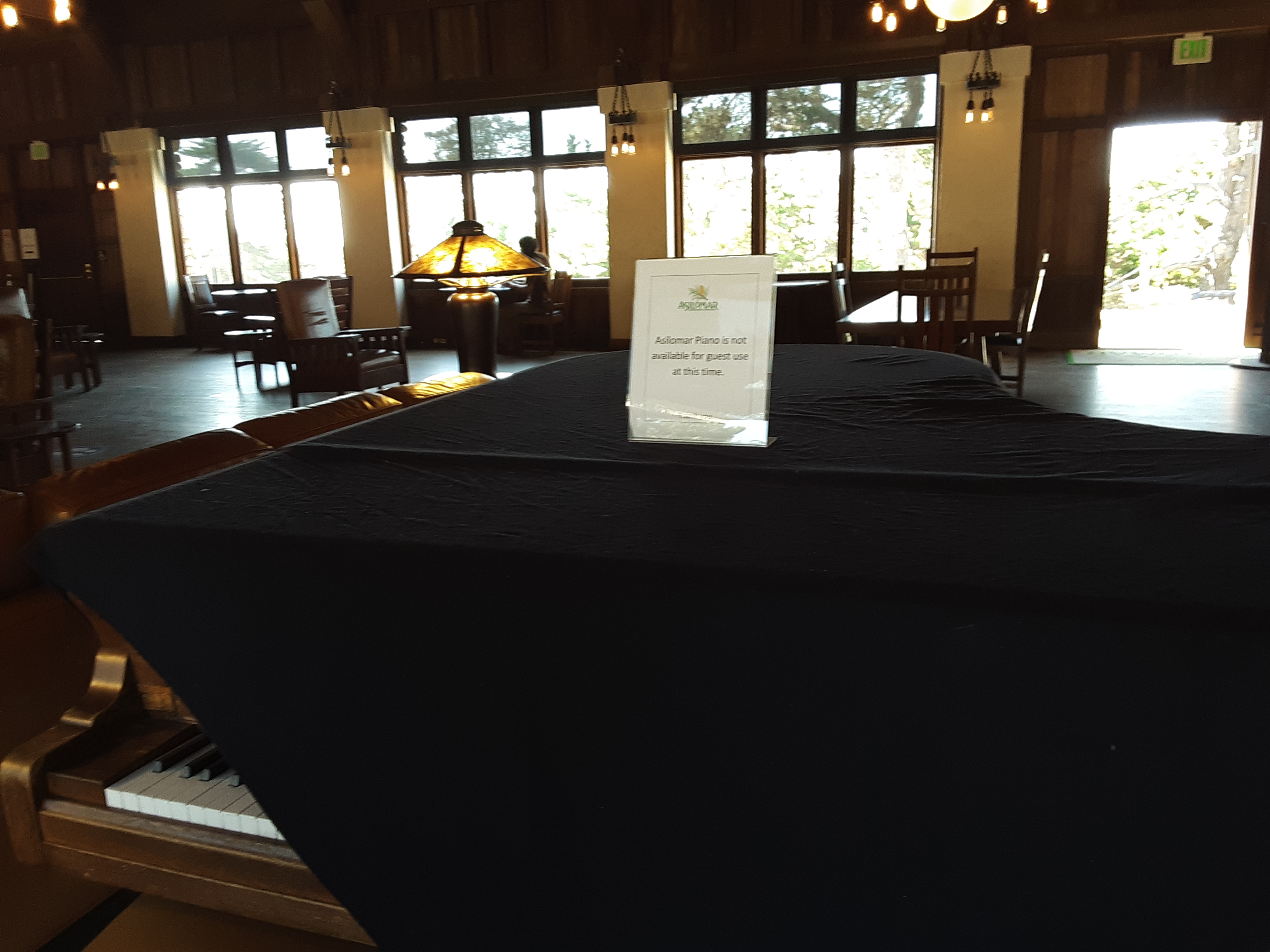
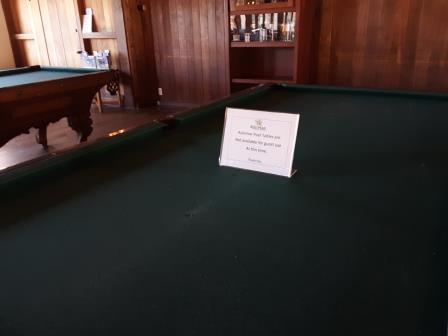
As we drove in, the parking lots were nearly empty.  The lodge itself was posted with the first of many signs notifying visitors of curtailed services. “Lodge open for check-in from 2PM to 8PM.”  It was 3PM, so we entered .  The cavernous lodge was empty except for the young lady at the reception desk and one computer jockey at a well-isolated table.  The room was posted with signs saying “[fill in blank] is not available to guests at this time.” (e.g. swimming pool, lodge fireplace, park store, pool table, piano…).  The brochure stand was empty, but we invited to hold up your phones to a QRcode to download information.  The Dining Room was closed also, as were the bike rentals.

All the same, it was a wonderful getaway.  We could sit on our balcony among the cypress trees and look out to a sparkling ocean.  And when we walked down to the beach, we saw that there are some family pleasures that even COVID-19 cannot close down.

Life in a COVID-19 Hot Spot: Week 19 – Revisiting a Blast from the Past

tarzan_jumpdocYears ago, my father used to say “Everything I know about life I learned from  Tarzan of the Apes.” Although some tattered Tarzan paperbacks were around the house, somehow I never got around to reading them, though my kid sister read the series avidly.  Some time back I mentioned this family story to my husband, and as a gag gift at Christmas he gave me the first four books of the series.  They sat on my bookshelf untouched until four months into lockdown.  With all libraries closed and the neighborhood Little Free Libraries exhausted, I turned in desperation  to the Lord of the Jungle for escape.


Fortunately, I was able to remember that my father was laughing when he claimed Tarzan as his literary preceptor.  The book was published in 1912, and by today’s standards is offensively racist, with its portrayals of black Africans as vicious and cowardly: sexist, with its portrayals of Jane Porter and other women as helpless creatures instinctively drawn to the alpha male; and even animalist – Jane Goodall would shudder at the way Burroughs describes the life and traits of the Great Apes.TarzanJanedoc

If you can overlook the above offensiveness, the story can suck you in.  Tarzan’s birth, adoption by the apes, upbringing, and his discovery by other white men are ingeniously plotted (though Burroughs probably owes a lot to Rudyard Kipling’s Mowgli of The Jungle Book). The first volume, Tarzan of the Apes, takes our hero through the events of the above paragraph, terminating with his unselfish refusal to claim either his title of Lord Greystoke or the woman he loves from the hands of the man, his friend, who has  taken both.

Tarzan2Of course, we couldn’t leave it there.  The second volume, The Return of Tarzan, sees Tarzan transformed into a 1912 version of Lee Child’s Jack Reacher: handsome, well-spoken, without ties, and able to fend off an adoring female or fight off  a dozen malefactors without suffering a scratch. I’m about half-way through this volume, but I’m pretty sure that Tarzan’s true love Jane Porter will end up in his arms by the end.  After all, I still have Son of Tarzan and Tarzan the Untamed waiting on the shelf, and I’m pretty sure Tarzan didn’t get it on with any of the apes.

Life in a COVID-19 Hot Spot – Week 7: Nature’s soft side shows in Spring

Nature has been throwing  us a lot of nasties in the last months – pandemic, killer tornados, smothering snow, torrential rain, and historic drought levels, to name a few.  And then, as if to make up for the tantrums, she sends us a Spring as lavish and luscious as any I can remember.  From native-plant gardens,  to cultivated rose gardens, to bursting containers, everything that has ever thought of blooming in my own garden and my neighborhood is out-doing itself this year.

Above: Poppies, sage, lupine, and blue-eyed grass from a native-plant garden in a nearby park.

Above: calendula, roses, raphiolepsis and orchids in my own garden.

Above: ranunculus border, tulips, wisteria, and rhododendron from a heritage garden nearby.

Above: cultivated roses at a neighboring university campus.

I hope these pix refresh you a bit, especially those of you who are still snowbound as well as lockdown-bound.  Spring still arrives, in spite of everything!

Life in a COVID-19 Hot Spot – Week 6 -Lockdown Extended 4 more weeks!


Cooped up with the morning paper and the hourly news, one would think the apocalypse is at hand.  A walk in nature is called for, but where does one go during lockdown?   Many parks are closed, or have closed the  parking lots  in order to discourage crowding, or at least have cordoned off picnic tables and playgrounds.

20200403_172027webWe found a little oasis not too far from our home – theBlackberry Farm Preserve.  Normally, this green dell offers visits to farm animals and truck gardens as well as grassy paths, but these tours and visits are now locked off.  The playground and picnic areas are also marked as dubious.  But the stately redwoods, the creek,  the twisted bay trees, the fearless deer, and the feral vincas are all still available to soothe the restless mind.


Life in a COVID-19 Hot Spot – Week 5 – in praise of Little Free Libraries

20200407_074235web

Thank goodness for the Little Free Libraries which have popped up over the last several years in my neighborhood!  With the public libraries closed during Lockdown, these are the source for books I would not have thought of reading an movies I would not have thought of watching. These little neighborhood oases of exchange are so welcome!

Each library has its own style.  Some are shingled, some are stained wood, some are gaily painted.  I’ve seen one made from a doll house,  and one  splash- painted with peace symbols.  On my street is ones built into a stone pillar,  with an accompanying bench seat if you can’t wait to start reading. One is decorated inside with  origami flowers, and gives away origami bookmark.  One gives away colored pencils, sharpeners, and erasers as well as books.

And each has its own literary personality.  One  offers a lot of teenage fantasy novels featuring magic and quests.  One is almost exclusively filled with early-reader story books. One has a lot of 20200406_114628webclassy trade paperbacks which look like they were originally purchased for a book club. Another features a variety of interesting non-fiction.
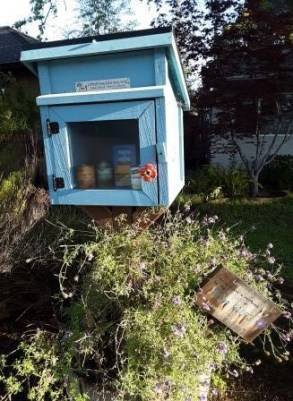
20200407_080112webOf course, anything you put out for the public is liable to malicious abuse.  A neighbor had worked with her daughter’s Girl Scout troop to set up a Little Free Library in front of her house.  The girls decided it would be good to make it into a food pantry during the Lockdown, and stocked it with canned goods and dried pasta.  The next morning the door had been ripped off and the canned goods had been scattered around, dented, wrappers ripped off.  The debate began – was it vicious mean-spirited teens, or was it racoons attracted by the food?  A neighbor’s security camera settled the question several days later:  it was a person, not an animal.  Maybe he was crazy-mad because he was hoping to find a book?  New hinges were bought, and the Little Free Pantry is open again, fingers crossed.

Each one of these carefully built, gaily decorated, and communally filled mini-libraries is like one of those magic boxes in fairy tales that, no matter how much you draw from it, is never empty, but always refills with a new treasure.  Every time I pass one and open the door, I might find a book I will never want to give away.  And if not, I’ll be able to try again. Thanks to all my librarian neighbors!


Post Navigation