Allyson Johnson

Pieces of my Mind

Archive for the category “Freeway Free”

Freeway Free in San Francisco: The AIDS Memorial Grove

AIDSGrove5

Perhaps one of the smallest National Memorial Sites in the country, and certainly one of the most affecting, is the National AIDS Memorial Grove, tucked into a corner of San Francisco’s Golden Gate Park.   It is easy to miss, on a side street on the eastern end of the park, well away from the bustle of the Music Concourse, the Conservatory, and the Museums.

You follow a fernlined path down into a deep hollow.   It is very quiet, below the level of street noise, and it is easy to be reverent in the shade of tall redwood and oak trees lining a boulder-strewn creek.  As you look closer, you see that many of the boulders are etched with messages of love for someone who has died.

In a sunny clearing at the end of the grove is a paved circle – the Circle of Friends.  Radiating out from the center in concentric circles are names.  Some are the names of AIDS victims, others of AIDS survivors, still more of friends and family members whose lives have been irrevocably changed by AIDS in some way.  Often there are bouquets of fresh flowers at the center of the circle. AIDSGrove3

New names can be added only once a year – on November 1, the National Day of Remembrance for AIDS victims.  On the website you can search for the names of people you know whose names are already in the circle.  I found a college friend’s name, and the names of his parents.  He had been one of the early ones to die.

AIDSGrove2As I walked back through the grove, I noticed that many of the boulders had small cairns built on top of them, perhaps related to the Jewish custom of putting a stone on the grave of a relative or friends when you visit.  I stopped by an empty boulder and piled up a cairn – one for my college friend, one for two boys I had known well in high school, one for the son of my high school principal, one for another close friend who is, so far, as survivor.  I had not thought of them for a long time.  It felt good to think about them here.


Freeway Free in Memphis: Browsing Around Downtown

20180511_162220cropYes, that’s Beale Street, home of the blues, looking pretty tame on a Friday afternoon.  But I am on my way to the Gibson guitar factory just a few blocks further down BB King Boulevard.  I know I am close when I see the iconic image on the corner.20180511_162010doc

Inside I latch onto a tour just starting. The production line is almost empty of workers, as they are free to leave early on a Friday afternoon once their daily quota has been met.  When I say “production line”, I don’t want you thinking of whirring machines and automated conveyor belt.  Every step of construction of a Gibson guitar is meticulously done by hand, from pressing the contours of the belly to painting and lacquering the final finish.  The last two people, still at work, must have one of the coolest jobs in the world.  It is their responsibility to test each guitar once finished, to make sure it can riff, slide, and slither up to Gibson standards.

I’m not allowed to take pictures during the tour, but I spend a lot of time lingering in the attached store.  Some of the most beautiful instruments I’ve ever seen are here, and the clerk offers to take down any one I want to try.  I’m intimidated by the price tags though, and settle for a box of Gibson guitar picks. 20180511_160944crop

After the Gibson Guitar factory visit, I still have  some time, so I wander back up BB King Boulevard to Main Street.  I’ve always heard that the way to tell a real hick town is if the main street is actually called Main Street;  in this case it looks like Main Street probably used to be major, but is now in the process of cutesification, with  former dive bars metamorphosing into upscale restaurants, and former retail stores finding new lives as souvenir shops and museums.

One of these is the Center for Southern Folklore, which includes exhibits of folk art, a room where one can view videos and hear tapes of storytellers and singers, and in the evening offers performances by classic and not-so-classic musicians.  The night I was there featured a wonderful woman who took us through the history of the blues from gospel to Jerry Lee Lewis to Paul Simon.  You might be equally lucky.
155456816.eGvdYlMX.IMG_0702BelzMuseumMemphispbase

The CSF oddly shares space in the same building with the Belz Museum of Asian and Judaic Art. This basement space has an amazing collection of jade carvings, plus a room devoted to contemporary Judaic art, and a Holocaust memorial room. (Unfortunately, the website doesn’t display much of this richness, but if you google “Belz Museum” you will find a lot of pix)

In the evening, the cutesification of Main Street is completed by the arrival of several lighted coaches suitable for Cinderella.  They don’t seem to have much relation to historic Memphis, but they are awfully cute and provide a fantasy end to my informal tour.20180510_210127crop

Freeway Free in Memphis: The Peabody Hotel makes Duck Soup out of Ducks


So many cities have at least one venerable hotel, a historic landmark, often with an upholstered  concierge’s retreat, an elaborate stained glass lobby ceiling, ornate balconies crafted of dark wood, maybe a fountain in the middle of the lobby, and shoeshine stand near the men’s room. BUT the classic hotels are lacking some of the amenities now considered obligatory: no exercise room, no pool with adjacent spa, no escalators between floors.  And that spacious lobby becomes an expensive liability if it can’t be filled with paying customers of the bar, tea room, and restaurant services.

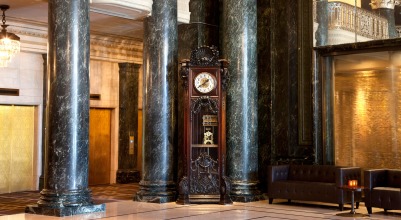
wes1010lo-141720-Lobby-DetailSometimes a hotel gets lucky.  For example, in San Francisco the venerable St. Francis Hotel was and is a traditional meeting place for families and friends after a day of shopping in the city for the wives, and business meetings for the husbands.   The St. Francis’s slogan is “Meet me under the Clock”, a reference to a huge grandfather-style clock that has graced the lobby through many updates and remodelings. And once you have met under the clock, it is natural to take  a seat at the adjacent bar for an end-of-day aperitif for the grownups and a Shirley Temple for the kids.
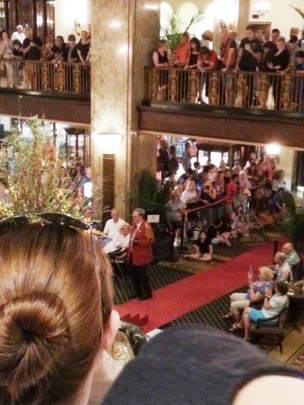
The Peabody Hotel in Memphis has no clock.  But it does have a fountain, and in the fountain there are ducks.   Why ducks? you may well ask.  It seems that some decades ago the proprietor of the hotel and his drinking buddies got a bit inebriated and decided it would be a fine joke to put some live ducks in the fountain in the hotel lobby.  To their surprise and bemusement, the ducks got lots of attention, including radio and newspaper coverage, and generated a lot of foot traffic as folks came in to see the web-footed invaders.  No fool, the proprietor made the ducks a permanent feature.

Now the ducks have become a mini-merchandising empire.  A red carpet stretches from the elevator to the fountain, and at 11 Am the duckmaster (in red jacket with gold braid) places carpeted steps against the fountain and escorts the ducks (who spend their off time in a spacious coop on the roof) to their fountain exercise pool  The balconies are groaning with tourists taking pictures of the ducks.  Many of these tourists will end up having lunch at the Peabody.

20180510_165438adj.jpgAt 5PM the ceremony is reversed, as the ducks are herded out of the fountain and back into the elevator, again with a throng of fans watching, and likely sticking around for a cup of tea or a drink in the lobby lounge.

And if watching the feathery family parade is not enough for you, you can purchase a ducky souvenir at the hotel gift shop: rubber ducks of all descriptions to float in your bathtup, duck-shaped soap, duck-handled umbrellas, duck-embroidered hand towels, duck-billed hoodies, duck-stamped wallets, plus the usual key chains, post cards, snow globes, and so on.

All because a few guys got silly on a Saturday night.


Freeway-Free in Texas – Houston’s Julia Idelson Library – a Hidden Treasure

20180405_Hlibrary2

Some folks probably only visit’s Houston’s main library because you can get validated free parking in the library garage by making a visit to its downstairs lobby.  They miss a lot.

On my recent trip, I was attracted by the garden and wrought iron fence surrounding the OLD library building (now known as the Julia Ideson Building, located right next to the new concrete edifice which supplanted it. )Once in the garden, I had to take a look at the historic building’s insides.  And as often happens in old libraries (I am somewhat of a library junkie) I found hidden treasures.

In the downstairs lobby was an extensive exhibit of original letters and news articles in glass showcases, chronicling the struggle of Houston’s black population to gain entrance to the city’s libraries. It was fascinating and chilling to see how earnestly, politely, and stubbornly the black citizens of Houston staked their claim to equal access to the libraries their taxes helped pay for, and how circuitously, hypocritically, and stubbornly the city and the education system of 1920’s-40’s Houston resisted their claim. (Houston’s black populations did not have equal access to the libraries until the 1950’s, under pressure from returning black veterans and the Eisenhower administration.)

Upstairs we found a beautiful painted ceiling and plaster-relief fresco above the wood-paneled walls.  Off one side of the vaulted second floor landing was a wonderful old reading room, presided over by Venus de Milo herself.

And behind an updated glass door was another exhibit, featuring the first black student to enroll in a major university in the South, John S. Chase. He was an architecture student, and there was no black college in Texas where the university system could pretend to offer him a “separate but equal” education.  Despite many obstacles (e.g. Texas regulations had to be waived to allow him to get an architect’s license without having served an internship, as no architectural firm would hire him) Chase went on to become a successful architect and mentor to a generation of successors. 20180405_HLibrary1

On our way to the ladies’ room, we spotted a door at the end of the corridor marked “Authorized Researchers Only” . Of course we considered ourselves authorized researchers, and went in. Behind the oak doors was the original  children’s room of the old library, with its age-darkened bookshelves crammed with the children’s books which were too old, too little in demand, too overtly racist, or for some other inscrutable reason were deemed unsuitable for general circulation in today’s Houston Library network. 20180405_Hlibrary3

Of course, many of these books were very familiar to W and I and some had been much loved (Robert Lawson’s Smeller Martin and Elizabeth Coatsworth’s The White Horse were two I remember well and paged through once more with great glee, despite their racist stereotypes).  It was an Ali Baba’s cave to booklovers.

If you are in Houston with some hours to while away (I’m thinking maybe a rainy day, of which there are many) this would be a wonderful way to while.


Freeway Free in Memphis: Graceland

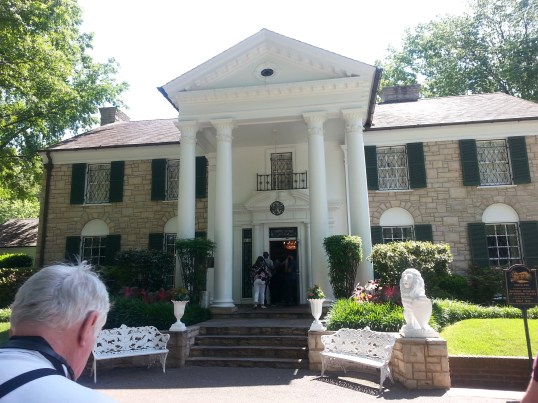
20180511_105302The first record I ever bought (and I still have it) was Elvis Presley’s debut album, “Elvis”. So when we found we had a day to spare in Memphis, of course we decided to make a pilgrimage to Elvis’s realm at Graceland.

It was not what I expected.  True, the original house and grounds have undergone Disneyfication, with separate large exhibition halls devoted to his cars, his costumes, his movies (running all day long)  his gold records,  and his effect on music.  Each hall has its own souvenir shop, and there are also several restaurants on the grounds.

But the original house, accessible by shuttle van only, is like a time capsule of the late 50’s and early 60’s.  The house itself is relatively unpretentious.  Tourists are reminded that Elvis was born in a two-room shack with outdoor plumbing, built by his father in Tupelo Mississippi.  The family moved to Memphis in search of opportunity when Elvis was a teenager.  Memphis was his home town;  this was the place where the people lived whom he trusted, and whose opinion he cared about.  So when he wanted to build a family home, he didn’t think of Beverly Hills.  He bought one of the nicest homes on the outskirts of Memphis.  The previous owner had been a successful dentist.

Inside, the house is decorated in early 60’s middle-class style:  lots of mirrors, lots of white and gilt, lots of crystal chandeliers, lots of silver on display in china cupboards, lots of shag carpeting. The den is upholstered in paisley prints, the TV room with its adjacent bar is lacquered yellow and black, and has three vacuum tube TV sets so Elvis could watch all three major channels at once.  (I guess PBS did not rate its own set.)  We were told that most of the rooms had been redecorated several times, reflecting the taste of whatever girl friend Elvis was hanging out with at the time.  On his own, he tended to like a lot of purple and pink, but his mother (yes, his parents lived in the house with him)exercised some restraint, and would not allow him to fool around with the kitchen at all.

There is a charming story told in a children’s book available at one of the gift shops, about how a young Elvis used to look in the windows of Lansky Bros. clothing store in Memphis, and one day the Mr. Lansky invited him to come in and take a closer look. The two chatted, and later when Elvis needed clothes for his first concert, Mr. Lansky extended him credit purely on his assessment of the boy’s honesty and potential.  , According to the story, after Elvis hit it big, he bought all his  clothes from Lansky Bros., who would sometimes just send out a van full of clothing for Elvis to choose from.

The costume exhibition and the car barn made me think most about the older Elvis, the raddled, paunchy, sequined, padded and corseted entity of the Vegas years.  But the house evoked the quiet, well-mannered young man whom everyone he met seemed to like, before fame took him in its grip.20180511_105635


Freeway Free in Texas: A Stop-Over in LaGrange – a GEM!

20170407_122257.jpgW and I decided to spend some time in LaGrange primarily because it is conveniently about halfway between Houston and Austin.  We found a lot more to like than we had expected.

LaGrange boasts a real town square, with a Victorian-vintage courthouse which includes an interior courtyard with a fountain and a beautiful carved oak staircase.  Surrounding the courthouse are a number  of 1910-20’s vintage buildings , and some charming shops tucked inside those vintage buildings.

If you are hungry, Bistro 108 just off the main square offers some excellent eats.  On our visit the soup of the day was a corn chowder so good I wanted to lick the bowl, while the special of fried catfish was the best I have eaten of that species since I left Texas behind as a girl.

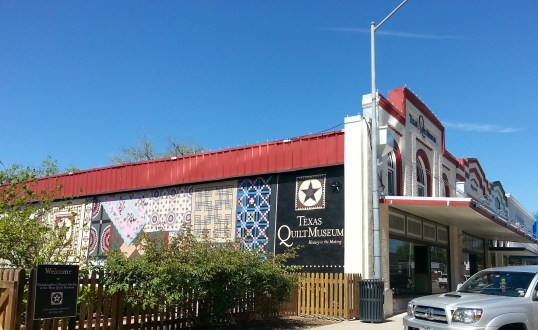
20170407_132055.jpgAfter lunch, a stroll around the square will bring you to the Texas Quilt Museum, a riot of color and pattern, usually with a special exhibit,  and staffed by friendly, well-informed volunteers. Their gift shop includes some great cards for sewers as well as wonderful textile crafts and some delectable antique quilts for sale.

The above quilts were part of a display from an International Quilt Exhibit – the leftward one is from Japan, the rightward from the US – I was fascinated by the complementary spiral motifs and colors from such disparate locations and cultures.

If you need some fresh air after the museum, Monument Hill/ Kreische Brewery State Historic Site is just a short drive out of town, and commands a spectacular view of the town of LaGrange and the entire Colorado River Valley.  The monument in question commemorates a squadron of LaGrange citizens who went off to fight the Mexicans during the Texas War for Independence, and were ambushed and either killed or imprisoned.

We missed the Texas History Museum which would have told us more about the ambush, but we did find a plaque honoring one of the town founders.  The plaque concluded its biography of the founder with “John Henry Moore died at he age of 80 on December 12, 1880…. The local newspaper carried a lengthy obituary extolling his many accomplishments and virtues. One week later a rebuttal was printed refuting these claims.”

Once in a while, you get to love Texas history.

Freeway Free in Texas: A GEM! Enchanted Rock State Natural Area

20170405_080617.jpgI thought I was accustomed to startling rock landscapes, having hiked to the top of Yosemite’s Half Dome, ridden a mule to the depths of Bryce Canyon, and driven dirt roads through Monument Valley.  But Enchanted Rock State Natural Area is in a separate class.  It features  a large pink granite dome which looks like something escaped from Yosemite, exfoliation and all, except it is the wrong color.  And except that, according to the geological information provided in the trail guides, most of this giant formation is buried under eons of silt deposits.  The summit is 1823 feet above sea level, offering wonderful 360 degree views of the Texas Hill Counry.  If it were fully exposed, it would cover an area as large as Manhattan, and be as high as Half Dome. 
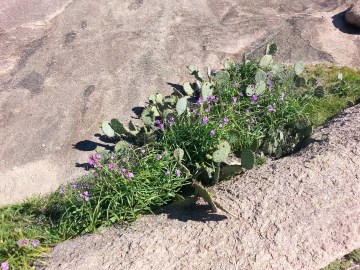
20170405_082659.jpg The  Summit Trail is an easy two/thirds of a mile from the principal parking lot, which also offers convenient rest rooms and picnic tables for befoore or after your hike.  The climb  is steep and without handholds.  Recommendation – Bring a walking stick with a rubber tip to act as a third leg to brace you against the slippery rock and the howling wind which on our visit was blowing across the top at about  30 mph.  Recommendation #2 – make sure your hat and your sunglasses, if you need them, are both secured with a cord. The wind nearly took my hat as I crested the summit, and my sunglasses went flying  as I was grabbing for said hat.  After I had secured them in a Velcro fastened pocket  and wrapped a scarf about my ears, the whistling of the wind bothered me much less! Recommendation #3: wear a scarf.

But oh, it was bracing to be at the top!

Freeway-Free in Texas: Fredericksburg a bit lacking in “authentic German soul”

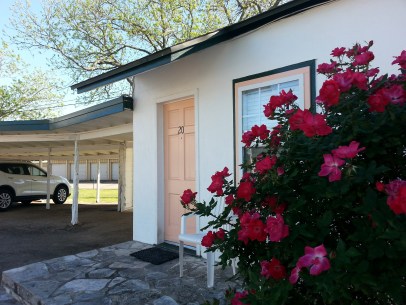
20170404_153027.jpgFredericksburg, founded in 1846 by German settlers, is said to have perpetuated not only the authentic German cuisine of the founders but also some of their “authentic German soul.”  (per VisitFredericksburgTX.com).  I have to say we pretty much struck out.  We got recommendations from the friendly host at our motel and headed hungrily into town after our drive from San Antonio.  The Old German Bakery and Restaurant, our first choice,  is closed on Tuesday, at Friedhelm’s Bavarian Inn we were greeted so rudely that we left, and we finally had a delightful meal with excellent service at the Auslander. 20170404_173818.jpg
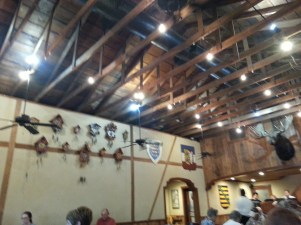
After dinner we meandered down the wooden sidewalks to check out the stores and crafts shops, but found most of the stores closed well before 9PM, except for the biergartens and souvenir shops.  There were some traces of Germanic architecture around, but they had a kind of faux-Hansel-and-Gretel look about them which felt more Disneyland than Bavaria.

With some relief we returned to our hotel, the Peach Tree Inn.  The contrast between La Contessa where we spent out two nights in San Antonio and the Peach Tree Inn in Fredericksburg, is dramatic. Instead of a two room suite with bar area and marble countered bathroom, we have one room  with two double beds, a microwave on top of the mini-fridge, and the TV on the wall.  But everything is clean and fresh, the amenities in the top drawer of the bureau are as needed. The “light continental breakfast is included, with hard boiled eggs, lots of different pastries, bread and bagels, apples and orange juice, good coffee,  And the $98/night charge included a very decent bottle of Australian pinot noir on our dresser as a welcome from the host. 20170404_153736.jpg

So we were not as charmed by Fredericksburg in general as we had hoped to be, but were beautifully rested from our evening at the Peach Tree Inn, and ready to explore the beautiful Texas Hill Country the next day. 

Coming up next: A secret gem – Enchanted Rock State Park


Freeway Free in Texas: San Antonio beyond the Alamo and the Riverwalk

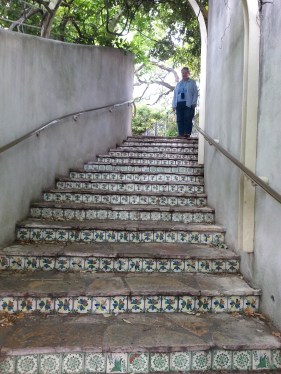
20170404_062510.jpgWe walked down the Riverwalk to La Villita, an  art area in a restored old section of San Antonio, replete with marvelous old tilework. Had a simple but ample breakfast with a server who was a cross between Jack Black and chirpy Ranger Tatum.

Next we drove to the Medina River Natural Area. We hiked mostly level trails along the river bank, with a few ups and downs between riparian and chaparral ecosystems.  I counted 21 varieties of wild flower plus four types of butterflies, and heard many bird songs. We were warned about some feral pigs in the area but saw none.


Lunch at Lai Wah’s Place, a modest Chinese restaurant in a strip mall thronged with locals, very good Cantonese-style food, old-fashioned fake paneling and suspended ceiling decorAFter , waitress moving at top speed at all times (hence the blurry photo), did not even have a chance to impress her with my Chinese.20170404_111118.jpg

 After lunch we continued our explorations to the  Denham Estate Park to see the beautiful Korean pavilion donated by San Antonio’s sister city Gwangju in Korea. ( I wonder what San Antonio sent in exchange?)  The pavilion is very lovely sitting over a pond on lovely grounds.  Unfortunately the  Denham home which is in the center of the park is loudly marked “no trespassing, no public restrooms.” A bit off putting!. 


Next on to the marvelous McNay Museum in northern San Antonio, in a  mansion which seems to have been blended from elements of the Ahwahnee Hotel in Yosemite and the old plaza in Santa Fe.. Lots of stenciled roof beams,  tiled stairways and benches, an interior patio, iron grill work…

…and some amazing art, ranging from medieval to Monet and Mary Cassat, plus some Southwestern ethnic stuff.  Outside in the sculpture garden another LOVE sculpture, as previously seen in Taipei, Tokyo, Albuquerque, and Philadelphia. And some Rodin. 

Blown away by all this exercise, culture, and art, we finally made it out of town, having skimmed a lot of the cream of San Antonio.

Freeway Free in Texas: The Missions of San Antonio

I had not been aware that the Alamo is only one of five San Antonio missions which together comprise a National Historic Park as well as a World Heritage Site.   W and I saw them all.

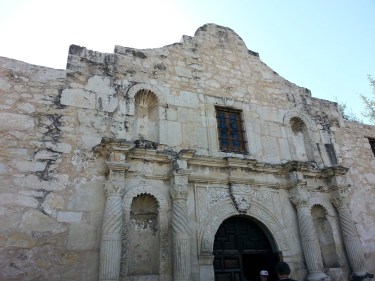
20170403_081959.jpgThe Alamo is not a large building, and until the Daughters of the Republic of Texas appealed to the state government, it was in danger of disappearing entirely under one or another wave of urban development which swept over San Antonio.  Now, of course, it is a cultural icon as well as a huge tourist attraction.   The State of Texas has taken over responsibility for funding its maintenance, with the DRT acting as custodians.


Since its time as a church, the Alamo has been an army barracks, a fort under bombardment, an army storehouse, and simply abandoned.  No wonder it is the least lovely of the five San Antonio missions.  It has no bell tower, no frescoes, no WPA restoration of dubious accuracy, no green lawns.  It does have some beautiful old live oak trees which were transplanted to the grounds, and a very well stocked gift shop, and mobs of tourists coming in waves from tour buses. We chose an audio tour so that we could try to go where the bus tours and field trippers were not, but were only partially successful.

 20170403_114756.jpg

The other missions make up in picturesque elegance what they lack in historical drama.  Conception has two towers a la Notre Dame de Paris.  San Jose has expansive grounds and a lovely window called “Rosita’s window” through which those Indians who were yet unbaptized could peek in and observe the religious ceremonies.  Here we were guided by the  incredibly perky Ranger Tatum who gave us a chirpy but very modern tour of the “Queen of the San Antonio missions” – exposing the inauthenticity of the WPA’s reconstructions, and the wrong-headed -ness of the priests’ aspirations regarding the natives.

San Juan has been spiffed up with whitewash and has an open belfry with the five bells arranged in tiers.  Estrada is the last and least restored, but its dilapidation has a raffish charm all its own.


The missions were opened as a way of establishing Spanish culture and faith in the New World;  the missionaries were at the same time agents of the King as well as of God.  The natives came to the missions as a last resort – they were being terrorized by tribes of Apaches who were invading south Texas in order to escape the even more martial Comanches, and they were dying of sicknesses brought by their early contacts with the Spanish.  The missionaries promised shelter from and defense against the Apaches, which they delivered in exchange for the natives’ abandoning their language, beliefs, and culture – even their names.  However the missionaries could not protect against the illnesses.  The priests believed that the natives were dying because of their sinful lives, not because of contagion, which was not then understood.  By the end of the mission era, 80% of the indigenous tribe members who had come to the mission for help were dead.

Lovely weather, and as we proceeded sown the Mission Trail the outer Missions were progressively emptier.  We walked a lot, mostly on paving stones and bricks and clinkers.  We felt we had earned a margarita at the end of the day at spangle-lit Mi Tierra, the doyenne of San Antonio’s Mexican restaurants. followed by a delicious platter of Monterrey Speciale, and a middling good flan to share at the end of the meal at the end of the Trail.


Post Navigation