Freeway-Free in Colorado: Boulder Beyond the Rocks

If you’ve heard of Boulder, CO at all, you probably know that it is one of the hippest college towns in the country, surrounded by beautiful mountain scenery, and with a tech-savvy population. (89% of households have broadband access, the highest rate in the country.)
But you might not know that Boulder also boasts an I.M.Pei-designed National Center for Atmospheric Research, that it is home to one of the original Chatauqua Institutes (established, oddly enough, by a group of Texans who felt that the weather in their home state was just too oppressive to host conferences), and that its Leanin’ Tree Museum of Western Art had one of the largest private collections of Western-themed art in the country [Note: Unfortunately, this Hidden Gem closed in August 2017, soon after my visit. And it is also the headquarters of the Celestial Seasonings tea company.
Boulder is a wonderfully walkable town, once you get there, and happily, you can get there without having to drive. If you fly into the Denver Airport, you can get to Boulder by bus for less than it would cost to pay the tolls on the E-470 tollway just outside the airport.
When you land, grab your baggage and head for the whale’s-tail shaped Westin Hotel at the east end of the lobby. Instead of going up the escalator to the Westin lobby, hang a U-turn at the ATMs and you will find yourself in the RTD Transportation Center. The SkyRide bus for Boulder costs $9 for a 70 minute ride to downtown Boulder, and leaves from Gate 8 at least once an hour beginning at 4:25 AM and ending at 12:55 AM. The bus will be full of UC – Boulder students no matter what time of day or night you get on, so be sure to purchase your ticket right away and stand in line for the next bus.
Once you are in Boulder, you can take advantage of the many whimsically-painted and whimsically – named (HOP, SKIP, JUMP, DASH, STAMPEDE…) Community Transportation buses to get just about anywhere in and around town.
Next: What to see when you get to Boulder


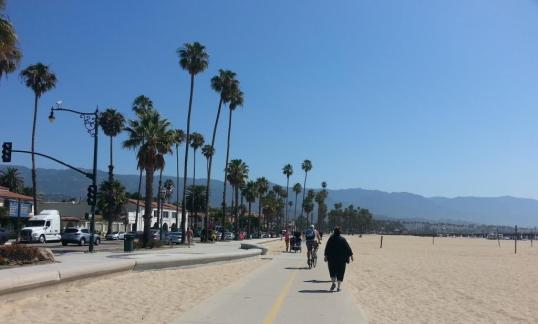
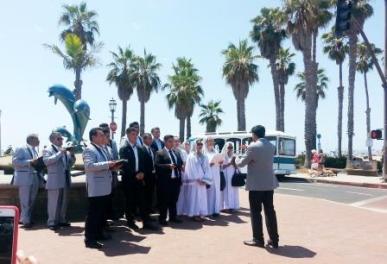
 We proposed at first to walk uptown, but W noticed signs for a shuttle going up and down State street every 1o minutes. The trolley was open air, crowded with tanned beachgoers and families, and at 25 cents for Seniors , 50 cents for youth, it was a bargain. Looking for historic Santa Barbara, we set down at the Paseo, but we were disappointed to find that it was merely a modern shopping center dressed up in red tile roofs and Adobe.



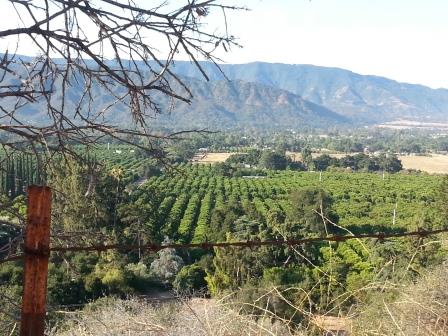
 After breakfast we headed out to Carol Vesecky’s organic orchard, where she cultivates about 40 different varieties of fruit. These included several varieties of mulberry, oranges, grapefruit, apples, figs, and several exotic south and Central American varieties that I did not recognize, though my companions who had spent time in South America greeted them like old friends. After picking some mulberries (and eating half of what we harvested as it was picked) we headed for the
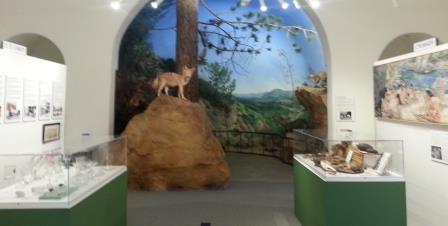
 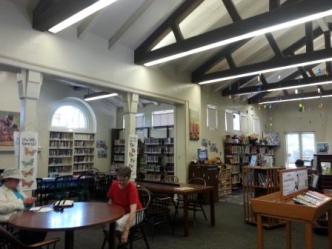 We checked in at the library, an old -style adobe and beam rambling building, then left W there, still writing, and continued to the Ojai Museum, located in a re-purposed church. My cousin, a long-time resident, had never visited before, and found out quite a few things about Ojai that after 27 years of residence she had never learned.
 Some might have been daunted at prescribing mission architecture when in fact Ojai had nothing resembling a mission. No problem. Libbey engineered the building of a mission-style Post Office, complete with a four-story bell tower which chimed each quarter hour. The false storefronts were replaced with cream-colored stucco and tile roofs; the wooden sidewalks were replaced with terra-cotta pavers and covered with arched arcades. Abracadabra! – Instant ambience!
 Allyson Johnson