Allyson Johnson

Pieces of my Mind

Archive for the tag “travel”

Tips for the Traveller in Nepal – Sanitation

There are lots of websites which include excellent checklists for trekkers in Nepal.  Here is oneHere is another. In these Tips for Travellers I will focus on items which I had not seen on checklists or will emphasize why some things are particularly useful, with a skew toward women’s concerns.

The first questions I am asked about my travels in Asia often  involve either the toilets or the water, so let’s get those basics out of the way.

Toilets:  (this is the right word to use when asking about “the facilities”.  The word “rest room” sounds too much like “restaurant” to a Nepali ear and will lead to frustration and confusion.)

Here’s the straight dope: Be prepared to squat. Throne-style toilets are not always available.  One of our fellow travelers anticipated this and did exercises in advance specifically to stretch her Achilles tendons. Balancing on the balls of your feet while hovering over the hole with nothing you would care to hold onto for support can be tricky.

The typical Nepali toilet room will look a lot like the picture.  There is often a deep window sill on which you can rest your pack or personal items;  there is a tap with running water used to fill the bucket and to sluice off the floor, hence the floor is often wet.  The bucket of water is for washing, and there is no toilet paper.  I never figured out once you have washed yourself off (using your left hand only) how you then gt yourself dry enough to pull your pants back up.  So I stuck with Western habits and accepted BYOTP as the norm.

To bring:

  1. Pop-up sanitary wipes – these come in packages and are much easier to handle in an Asian-style toilet than a roll of toilet paper. Packs of tissues are also good. Paper used as toilet paper does not go down the hole, but into a waste paper basket inside or just outside the W.C.
  2. Small plastic bags for trash – in case you need to go in the wild, or the basket is outside the W.C., and also to pack out Kleenex, trail mix wrappers, and other trail detritus.  You want to leave a clean footprint.
  3. A sink stopper. You will find a sink at each guest house, but for washing clothes, cleaning contact lenses, etc. you will need your own stopper.
  4. Panty liners.
  5. A portable clothes line,  clothespins, and biodegradable detergent.  You will have opportunities to hang up clothes at the guest houses, but you can’t expect clothespins, and evenings are breezy – you don’t want your backup panties blown 500 vertical feet down the valley.

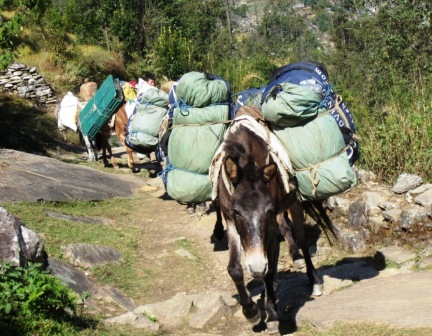
Water: No, you cannot drink the water from the tap in Nepal. Anywhere. Most hotels will offer bottled water in your room;  the more ecologically sensitive will provide a water station for filtered water to refill your bottles.  Recycling is very expensive in Nepal because everything has to be carried off the mountains to the nearest facility, which is probably in Kathmandu.  The carriers are either heavily laden pack mules, or equally heavily laden human porters.
To bring:

  1. Water filter/ UV SteriPen and iodine tablets or equivalent.  The water filter / Steripen will take care of 90% of the nasties you might find in the water but the other 10% are really nasty, so don’t forgo the iodine.  There are iodine equivalents which do not leave a taste in the water and do the same job.
  2. Two water bottles – one for drinking from and one for filtering into and  refilling from.  If you are using a water filter make sure your water bottles are compatible in size – you should be able to screw the filter  onto the water bottle securely.  You can find running water at most tea houses and it takes only a short time to filter a fresh quart.

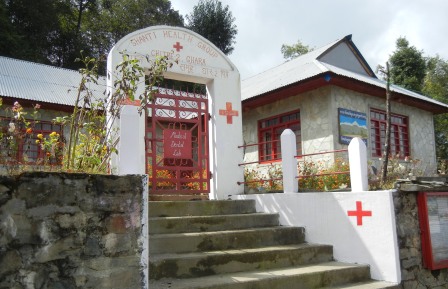
Medical treatment: although we occasionally passed medical clinics, usually funded by some foreign organization, we learned later that these clinics are staffed poorly, intermittently, or not at all.  Avialable anti-biotics and other medicines are often past their expiration date.  Evacuation to India or Bangkok is your best bet if you become seriously ill or injured, but this is very expensive.  Best to get your vaccinations up to date and avoid getting sick!
To bring in your own medical kit:

  1. Sunburn protection
  2. Antibacterial ointment
  3. Blister treatments ( Dr. Scholl’s Blister Protection/Prevention pads are very effective in keeping “hot spots” from developing into full-fledged blisters.  Most list-makers mention moleskin;  I had moleskin but never used it.)
  4. Aspirin – very effective in preventing altitude sickness
  5. Ibuprofen for muscle aches
  6. Bandaids
  7. Spare eyeglasses if you need them. Extra contact lens solution if you need it.
  8. Eye drops – your eyes can get very dry at high altitudes.
  9. Any medications which you are accustomed to having available as needed.

But enough of the scary stuff!  In my next post we will finally get on the trail!
Nepal – day 8 – Pokhara – Jumping off point for Annapurna treks

The ever-helpful 3Sisters Adventure Trekkers called just as we collapsed into our suite after our airport ordeal (see Day 7) –  alternate arrangements are made.  Since the weather is not expected to change tomorrow, we abandon hope of flying to Pokhara, the central starting point for trekking the Annapurnas east of Kathmandu.  They have arranged to pick up us at 6AM in their  jeep and take us to Pokhara.  It is an 8 hour ride over a road which is probably the best in Nepal outside of Kathmandu, since it supports the all-important tourist trade. (That doesn’t mean there weren’t some white-knuckle moments!).

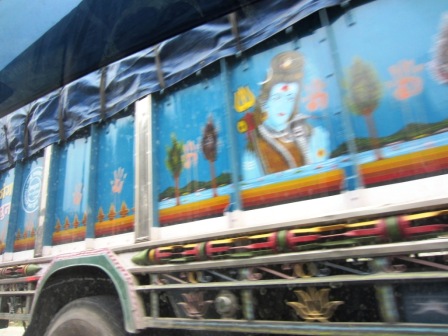
I’m not a big fan of SUV’s but in Nepal a large four-wheel-drive vehicle actually makes sense.  The road passes through  rural country and busy villages;  traffic alternately easy and harrowing.  The passing lorries are elaborately painted with pictures of gods, flowers, and strange beasts, set off with ornamental grille work also elaborately painted, and often sporting banners flying from the fenders.   These ornaments help take your mind off how very closely they pass on the narrow road clinging to the mountain side – art at work!

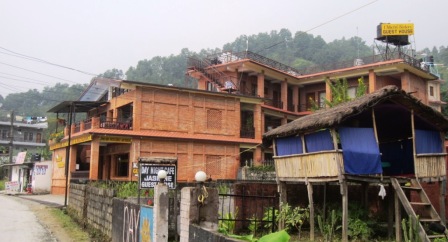
The  Chetri Sisters Guest House is friendly and comfy, though not as isolated as the pix on the website would have you think.   It was full of other trekkers, either families planning to trek together or other groups of women.

Although the 3 sisters started out as a service devoted to women trekkers on the well-established Annapurna circuit,  the slower pace, moderate burdens, and nightly accomodations have attracted families and other groups which include men – they have even added a couple of male tour guides to the staff (who also enjoy the benefit of the humane load limits imposed by 3 Sisters management).

Pokhara is a tourist town, with all the tourist ameniteis including souvenir shops, ATMs, and restaurants of every persuasion.  We ate lunch down by Fewa Lake along with several other women who will be traveling with us for the first two nights, shared a bit of a beer and chat.  Celebrated view of lake surrounded by snowy peaks invisible; instead we had a foggy Chinese-y landscape of gray lake and gray sky and darker gray foothills swimming out of the mist. (Can you spot the hills in this picture?)   We returned to a mandatory orientation meeting with our  guides-to-be, a presentation on Empowering Women of Nepal (3 sisters NGO), and a dinner of the Nepalese national dish, dal bhaat – rice, lentil soup,  curried  stew (sometimes this includes meat, sometimes not) and a pickled vegetable.  (Watch out for little pebbles in the lentil soup!)  We went to  bed to the sound of  rain pounding on the roof and gushing down the  gutters – hoping this augurs clear weather for tomorrow.

Kathmandu – Day 7 – the Kathmandu Domestic Air Terminal – and back

Kathmandu International Airport is modest, particularly in comparison with its glittering neighbor, Suvarnabhumi International Airport  in Bangkok.  It has a small traffic control tower, a simple customs process,  a short walk through the terminal to the taxi queue, a nicely landscaped divided entry highway which leads into town a reasonable distance away. It reminds me of the Oakland CA airport in the 60’s from which charter flights through to Europe through Iceland – competent and manageable.

So my arrival in Kathmandu through this gateway did not prepare me for my attempted departure through the Kathmandu DOMESTIC Airport, which was much more reminiscent  of  Oakland’s Greyhound bus terminal before anti-smoking ordinances were in effect, assuming that tule fogs had shut down all routes south and stranded five busloads of would-be travelers.

There is no such thing as curb-side check-in at the KDA – and if, like our group, you have several weeks worth of baggage, you would do well to tip your taxi driver or one of the unofficial airport porters to assist you to carry your bags.   You will need to pay an airport fee of about 200 Nepalese xxx and be able to show your receipt at the security gate.  You will be responsible yourself for getting your bags into the airport, labeled for your destination, and onto the conveyor belt at the security gate for X-raying. Then you will step through the security portal (Note that “Gents” go through a different portal than “Ladies”, in case you need to be patted down) and must then make sure your bags get into the proper pile to be loaded onto the airplane.

If there is fog, there will likely be several plane-loads of travellers waiting to embark.  Seating is limited and the benches appear also to have been handed down from a Central California bus terminal; their chrome armrests and cracked vinyl reek of authenticity, if not more.

If you are flying from Kathmandu to Pokhara-  the jumping off point for most treks on the Annapurna circuit – there are a few constraints.  The first and most important is that the Pokhara airport has no radar capability, so if the area is fogged in, it is not possible to land an airplane.  Also, it is not possible to land a plane after dark, as Pokhara electric service is limited.   Between October 15 and November 15 there is usually clear weather, so this is the peak season for trekking and for flying.  But if there is fog you will wait for it to lift – as we did.

Many of the waiting travellers will be smoking, as there is no such thing as smoking restriction in public areas in Nepal.  No, wait!  There IS a N0 Smoking sign in one area – and there are seats!  Uh oh!  it is the area next to the two public lavatories.  That’s why there are seats – the reek of the lavatories is perhaps less injurious to your health than the cigarette smoke, but it doesn’t make much difference, as there is nothing except the small sign preventing the smoke from the smoking section to invade the sacrosanct area.

There is a small snack bar offering candy, crackers, chips, soda, water, a limited selecton of souvenirs, and a very limited menu of hot sandwiches or rice bowls.  Since the flight to Pokhara will lasts less than an hour, you may forego these treats. Or if you find yourself waiting through lunchtime, as we did, you may give in.

I would like to be able to tell you about the boarding process, about the state of the Yeti Airlines plane we were to fly on, and about the Pokhara Airport, but unfortunately, you will have to learn about these from another, more fortunate traveler.  After SIX HOURS of waiting,  at 2:50 the nice young thing at the counter confided in DB ” We can’t fly after 4 PM because there are no lights at Pokhara, so the flight will be announced cancelled at 3.  Go quickly and get in line to re-book your flight and reclaim your luggage.”

So the three of us jumped into action – DB managed the baggage, I hit the Airport tax counter for a refund for the three of us, and DM stood in line to rebook.  DM also located the free phone and had a business card for our hotel, so we were able to secure our room again.

So now what?  We were  exhausted – 7 hours of airport noise and announcements and babble bracketed by unbelievable traffic and brown air, and no assurance that we would not have to go through it again the next day.  Stay tuned for Day 8!

******

Tip for travelers in Nepal – make sure to arm yourself with plenty of baksheesh  in the local currency before embarking – we needed an extra trip to the ATM after our experiences.

Nepal – in and around Kathmandu – Day 6

The holiday is over, and the people of Kathmandu have returned from their families and festivities to normal – and so has the pollution level in the city.   We steered through appalling traffic and dust and made our way outward and upward into the foothills.  The further away from the valley we got, the clearer the air, but the haze was still evident until we were well up the foothills.  It is hard to know how to fix this problem – like all cities in developing countries Kathmandu is a magnet for people looking for education, opportunity, excitement.

We headed for Dawainkali –  the temple dedicated to Kali, goddess of death and destruction.  “We are lucky you took a break day,” says Shaku, our guide.  “If we had come on Monday as planned, there would be little to see, but Tuesday is a day for sacrifices.”  We look at each other dubiously.

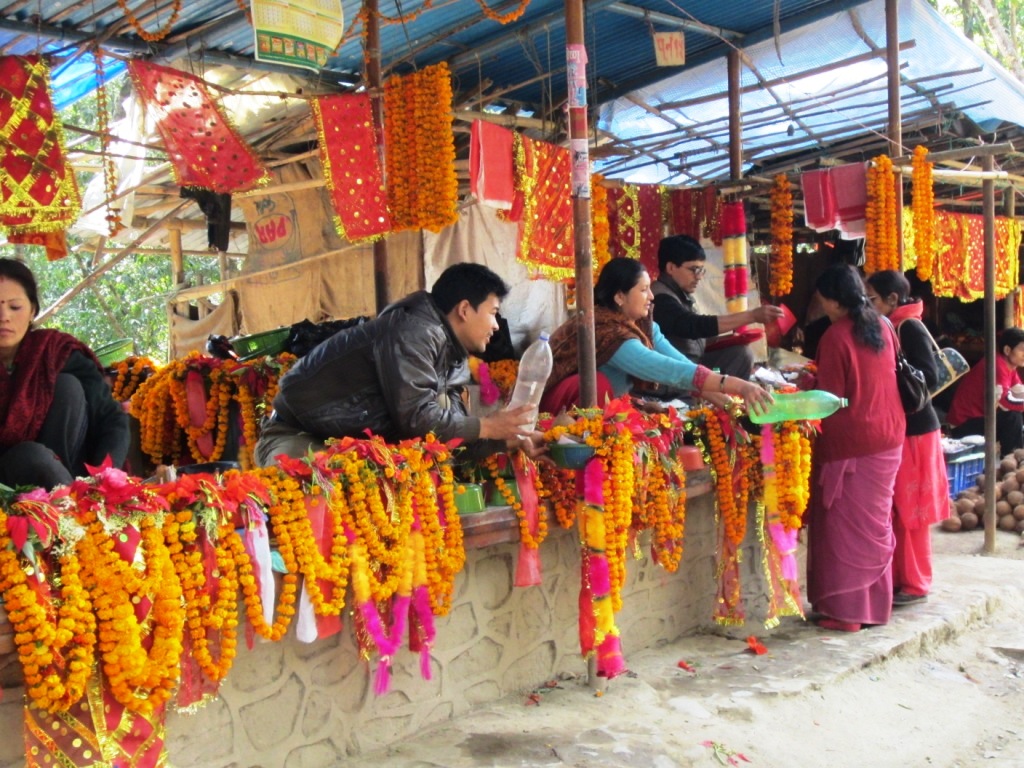
We arrive at the site, and walk up a cobbled street past blocks and blocks of people selling items for sacrifice, ranging from bouquets of roses and garlands of marigolds to chickens and baby goats. Not so many souvenir sellers – these stalls are for genuine Nepali worshippers, not just for tourist show.

At the site two long queues of people writhe around the shrine.  In addition, paths are set aside for non-Hindus and others excluded from the temple to observe the proceedings.  Shaku confided that she was very unhappy not to be able to participate, as she was  the wrong time of the month; women in menses cannot enter the temple.  However, she directs us to the best vantage point, and we are able to witness the decapitation of a goat as well as the axing of a number of chickens and coconuts.

Once the sacrifice is made, the blood is sprinkled on Kali’s image, and the devotee is free to reclaim the chicken, goat, or coconut.  Just outside the inner shrine is a shed where the animals are plucked, gutted, and dismembered for later barbequing.  The marble floor of the area was stippled with blood drippings and mud – the thought crosses my mind that if I slip and fall I will probably have to be air-lifted to Delhi for blood purification.
Next we climb up a steep hill of steps to a second, less blood-thirsty shrine overlooking the first, where the worship of Vishnu goes on inside  while at the same time at a corner of the plaza has been set up as  a small temporary Buddhist shrine , festooned with prayer flags, and a group of Buddhists are devoutly reciting scriptures under the tutelage of a white-garbed teacher.  A nice example of Nepali’s peaceful coexistence of religions. (Maybe it’s only the Muslims and Christians whose evangelical fervor makes trouble?)

On the way down we stop for tea and sai, a sort of Nepalese donut.  Since we eat with our guide, the entire set including a Coke came to 70NP (the going rate for a Coke alone in Thamel is 80NP). However, the Nepalese make no secret of their double standard in pricing;  all the museums and historic sites charge foreigners and tourists 3-5 times as much as ‘citizens of the SAARC” – which includes India, Cambodia, Thailand, Nepal, Bhutan, etc.  This seems fair for the historic sites, as the funds are used for maintenance and restoration, and even at restaurants the tourist rate is still very reasonable – we have not paid more than $6 / person for any dinner.

Next we visit a relatively new Buddhist stupa founded by Thai Airlines in memory of the crew members and passengers of a Thai Airways flight between Bangkok and Katmandu that crashed in 1992.  Golden buddhas, and a good view of smoggy Kathmandu below.

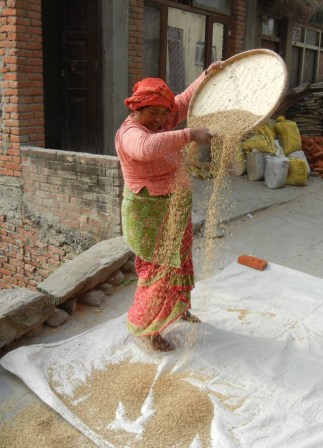
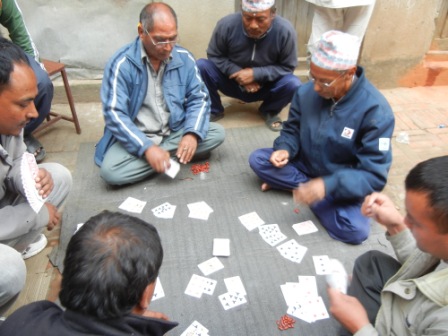
Our final stop is at a traditional Newari village, where  women in traditional costumes are threshing and winnowing rice using woven trays – tirelessly filling the trays and tossing the rice to the wind to allow the chaff to float away.  Where were the men?  Groups of them squat on street corners playing cards with dried beans for markers.  “It is a festival time for them,” explains Shaku – but evidently not for the women.

Back through the dust and pollution and traffic to our hotel – this time I use my neck scarf as a face mask and it was better.  We bid our escorts good by with generous tips (I am not the wife of an ex-tour guide for nothing.)

Our third friend has joined us, and we have been moved to the Holy Himalayan Hotel’s equivalent of a penthouse suite -two rooms, one with a king bed and bathroom with a tub, the other with twin beds, a balcony, and a small kitchen.   The cost is actually less per person.

For dinner we follow the recommendation of my sister’s colleague and hit  Fire and Ice Pizzeria.  Like other restaurants in Thamel it was founded by people who came to hike and stayed – the pizzas are as authentic as can be made with Nepalese ingredients, and the place is packed.

We sat at table with a charming young Belgian couple who had just completed much of the Annapurna circuit and had also gone to the Chitwan national wildlife park – another of the World heritage sites in Nepal where one can enjoy bathing with the elephants,  canoeing through the rain forest, spotting rhinos, and dodging crocodiles.  Maybe next time.

Note to travelers in Kathmandu:  If you want to get seated promptly at a restaurant, arrive at 6PM or shortly after – by 7PM the joint was jammed and jumping.

Second note to travellers in Kathmandu:  if you want to get your check in a hurry at a restaurant that is jammed and jumping, fugeddaboudit.

Third note: When you get the bill, be sure they return the credit card BEFORE you sign the chit.

Houston – Day 3 – Quirky Museums and a Museum event

Every city, I suppose, has its hidden gems – unusual museums that focus on some limited aspect of life and exceed your expectations because of the genuine love and enthusiasm for their subject.  This day we focused on two in Houston, plus some additional urban gems, all within biking distance of my Knowledgeable Friends’s central Houston digs.

First, the Museum of Printing History, a true gem. I expected a dusty little place with some etchings about Gutenberg and some old typewriters, maybe. Instead we found a bright new one-story building which included a working copy of Gutenberg’s first press, hand-crafted to match the original, on which the docent, with the aid of several amazed and delighted Cub Scouts on a field trip, printed a duplicate of a page from the Gutenberg Bible. Next, we proceeded to a replica of Benjamin Franklin’s printing press, on which the docent with similar aid, ran off a copy of the Declaration of Independence as originally printed in Philadelphia. Awesome!

In a separate gallery was a stop-you-in-your-tracks exhibition of poster prints, some for sale ($500-$700 ea) of posters designed and printed by the Swiss artist Hans Erni.

We had to breeze by a series of front pages of historic events ranging from the bombing of Fort Sumter through the sinking of the Titanic to the election of Obama – each one worth careful perusal to find out what ELSE was going on that day.

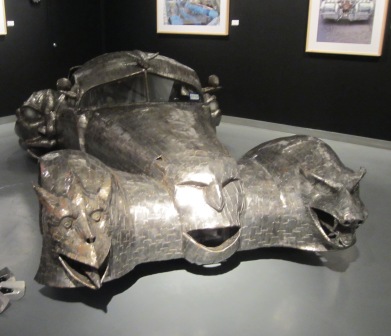
Next, the Art Car Museum. This was similar to the Kinectic Sculpture museum in Ferndale, but based on the annual Art Car parade in Houston. Since the vehicles did not have to dive off a 15-foot sand dune or be paddled across Humboldt Bay, they are not subject to the limitations of gravity or flotability. Amazingly silly. My favorite was the giant rabbit with sharks fangs about to devour a basket of little bunnies, chicks and lambs.

We biked over the freeway and picnicked elegantly on chicken-mango-yogurt salad on AkMak crackers in White Oak Park, a reclaimed railroad right-of-way with spectacular views of downtown Houston. Passing through central Houston on the way home, we stopped to rest at Discovery Green next to MinuteMaid Park and the Toyota Center (homes of baseball and basketball respectively) and discovered a Vietnamese Music Festival in progress. We saw a Vietnamese hip hop group in action, sharing our view space with  the Lion Dancers who had evidently performed earlier, their  t-shirts contrasting oddly with their lion-dance.

This evening, back to the Houston Fine Arts Museum for a gala premiere –  the first US showing of France’s  biggest movie blockbuster of the year in France . It is called The Intouchables, and will not be released in the US until this summer.  The Weinstein Group (which distributed The Artist in the US)  has already purchased the remake rights (maybe with Dustin Hoffaman and Eddie Murphy?) The audience was jammed with French speakers, the film was introduced by the French consul at Houston. Apparently this film has been seen by at leat one in 20 Frenchmen. (Variety hated it.)

So – everything from Cub Scouts to couture – a truly metropolitan day!

Post Navigation