Freeway Free in California: A Serene Escape from COVID-19 Stress
 I live in a COVID-19 hotspot – 43 cases and one death since the beginning of March – and public and private events are being cancelled left and right to prevent transmission. So what is one to do if you are healthy, not in one of the “vulnerable” groups, and needing some relief from the stress of it all? Maybe it’s time to visit a local museum.
The Asian Art Museum in San Francisco is one of my favorites. I visited this week and found plenty of parking in the Civic Center Garage ($12.00 for 5 hours), two featured exhibits of great interest, no crowds, and decent food at the museum restaurant. And if you are looking for stress relief, Asian art is all about serenity.
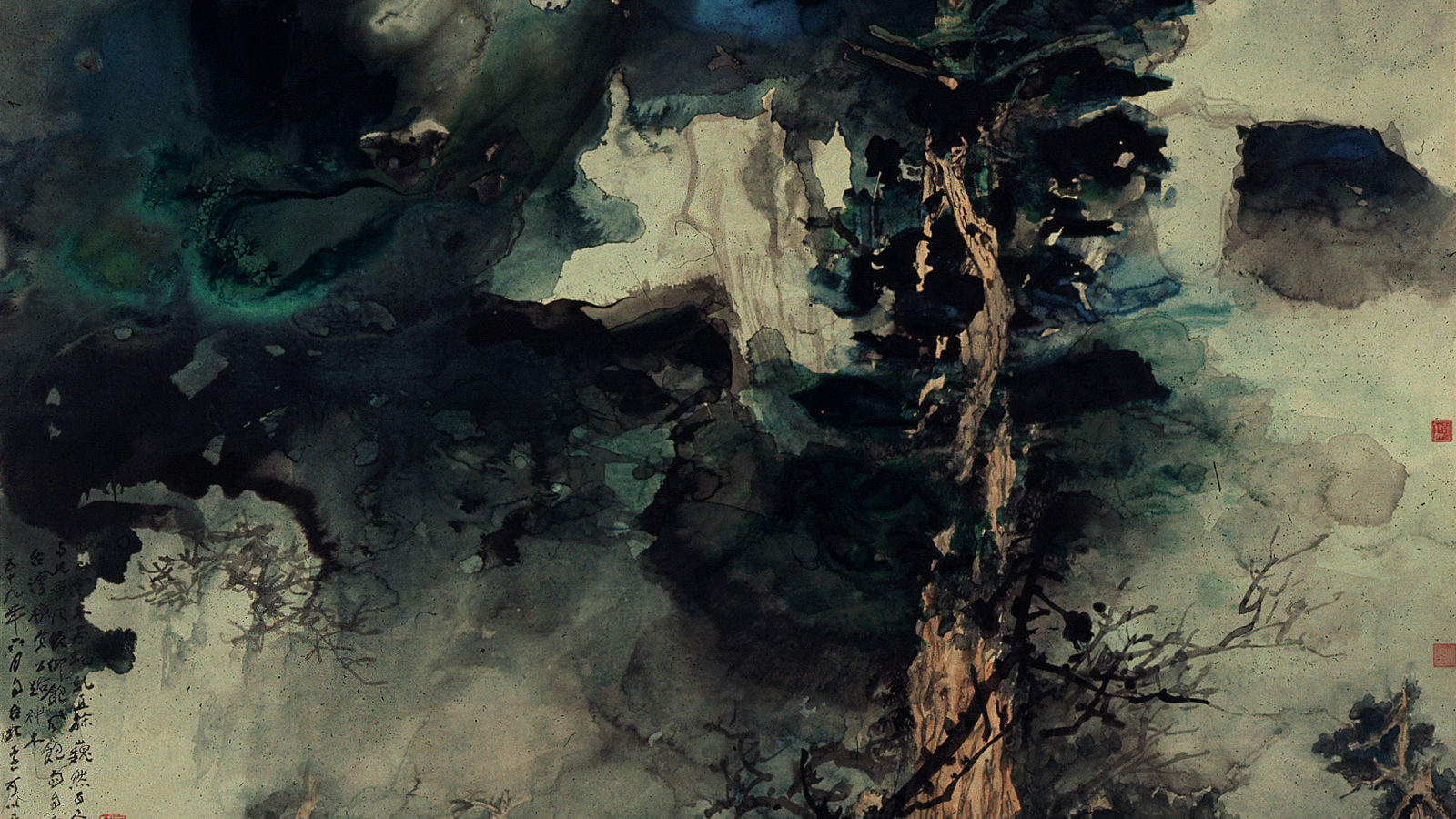
 The exhibit that drew me to the museum featured Zhang Da Qian (Chiang Dai-Chien in traditional transcription) who was the Pablo Picasso of 20th Century Chinese art. His work spans styles ranging from impeccable copies of venerated Chinese master artists of the past, to modern splash-ink impressions worthy of Jackson Pollock. He lived in mainland China, Brazil, Argentina, Taiwan, and California, and in each venue did his best to promote appreciation of Chinese art. One of the featured works in this exhibit is titled “Scholars on a wilderness path”, but the giant monolith in the background must be Half Dome.
Other paintings include a marvelous white gibbon, a black horse grazing in a blue-green pasture, a Tibetan dancer, several giant lotuses, and landscapes formed from giant splashes of ink enhanced with a few brush-strokes to define space, foliage, light, and dark.


After studying Zhang’s various works, a stroll through the adjacent Korean gallery offers a different range of experiences.


You can admire a glowing white “moon jar”, pristine on its wooden shelf, and discover an Asian precursor of the classic patchwork quilt, made from silken scraps.
Or perhaps you will spend some time in another featured exhibit, called “Awakening” which walks you through several centuries of Buddhist tradition, juxtaposing ceremonial vessels made from human skulls, many-armed monsters intricately carved and painted, and dainty gilded bronze sculptures celebrating sensual tenderness.


Or maybe some of the more modern pieces will appeal to you, like this sculpture by Liu Jianhua formed of letters and Chinese characters on view just outside the Korean section. 
The museum restaurant,Sunday at the Museum, features Asian style street food such as Vietnamese Pulled pork sandwiches, Japanese ramen noodles, and Chinese dumplings. You order at a counter and the food is brought piping hot to your table. Of course you could get better Chinese food in Chinatown, better ramen in Japantown, but the setting attractive and the service is fast and friendly.
If you have children tossed out of their school/daycare, the museum usually has some activities geared toward children set up either in an activity area or in the Shriram Learning Center on the first floor.
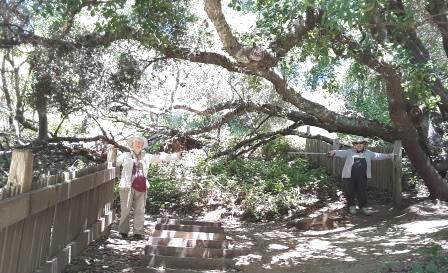 We fled the South Bay expecting a foggy few days on the Marin coast. To our surprise, the fog held off on our arrival, so we took advantage of the sunshine before we even checked into our lodgings. Our first stop was the Visitors Center at
  The Earthquake trail follows the natural escarpment where the San Andreas Fault skirts the edges of the California coastline before disappearing into the sea towards Alaska. It’s a shady stroll through pastureland and underneath gian twisted bay trees. Along the trail are interpretive placards explaining earthquake geology, plate tectonics, and the effect of the Fault on California geology. A line of blue posts marking the center line of the fault marches along the ridge above the trail. The high point of the walk is a point where two halves of a fence have been offset by almost 15 feet – the result of the ground movement in 1907, when action on the Fault caused the disastrous San Francisco Earthquake and Fire.


 It’s summer, and even in a “Mediterranean climate” the thermometer’s are nudging 90. Time to head for the coast, but not the boardwalk-bordered surf beaches of the southern California coastline. We are heading for the fog on the west coast of Marin County, the relatively empty corner of the Bay Area north west of the Golden Gate Bridge.
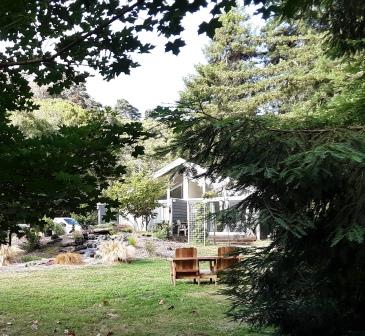 Feeling very happy with our first meal choice, we turned north up Highway 1 to our hideaway cottage in Inverness. The



 Cruising along the Inland Passage of Alaska reveals few “tourist traps.” The landscape is simply too big to allow any encroachment by man to seem significant against the surrounding mountains, glaciers, and ocean. Just standing on the upper deck of our small cruise boat allows us to take in vistas of ice, snow, forest, and water which make the occasional human settlement seem irrelevant. Still, we need to stretch our legs daily, and there are stops which allow us to focus our eyes on things less than 100 yards away.
 For Alaska’s centennial the wood carvers of Kare created the worlds largest totem pole, originally 168 feet high. Totem poles, however, are not designed as long-lived memorials; the top twelve feet with its watchward Raven fell victim to weather and wind and now lie in the grass next to the splintered and faded pole.
  The lead dancer is a black man adopted into the tribe on marriage with a Tlingit woman. He dances in a finely embroidered cape made for him by his mother-in-law as a memorial to his daughter, who was murdered while walking home from a dance the previous year by a boy from a rival clan. At the end of the dance the family of the murdered girl is presented with a ceremonial paddle marking her passage to the afterworld now that a year of mourning has passed.
 We ended up staying two nights at the


 As I walked back through the grove, I noticed that many of the boulders had small cairns built on top of them, perhaps related to the Jewish custom of putting a stone on the grave of a relative or friends when you visit. I stopped by an empty boulder and piled up a cairn – one for my college friend, one for two boys I had known well in high school, one for the son of my high school principal, one for another close friend who is, so far, as survivor. I had not thought of them for a long time. It felt good to think about them here.
 I am a big fan of public transit, taking the train regularly to Sacramento and San Francisco to visit family, taking BART to the Symphony or to museums in San Francisco, riding Light Rail and Muni in San Jose and San Francisco.


 Allyson Johnson