Freeway Free in Texas: The Other Side of Nowhere in the Back of Beyond – Day 2

I knew the second day at Big Bend Ranch State Park would be long and challenging. W insisted that she could do and I should see the hike from the Chilcothe trailhead to the Fresno Rim, overlooking the flat irons surrounding the collapsed magma dome Calle “El Solitario”. The length of the hike was 5 miles round trip, we had plenty of water, and the high was to be only 80 degrees.
We got off to a later start than we had wanted, finishing breakfast at 8:30, so despite aggressive driving on the long straight stretches of road with no traffic and an 80 mph speed limit posted, and later on the 27 miles of gravel road that leads into Big Bend Ranch State Park, we got to the trailhead at 11:30.


In many ways this was a rerun of Tuesday, only with a destination in mind. Beautiful blooming desert cactus: flame tipped ocotillo, barrel cactus with fiery orange, muted brown, or clear yellow blooms, and indeed a marvelous vista from the overlook, down hundreds of feet to the river twisting along the flat brown desert floor, and the remains of a mighty mountain moldering within the jagged circle of flat iron teeth. We picnicked leaning against a rock, hydrating and energizing with P&D grapefruit, grapes, and replenishing our salt with sardines and flaxseed crackers.
The trail across sandy washes and barren rock was marked by small piles of rocks, put together by earlier hikers with varying degrees of creativity. As we worked our way back through the desert, these small messages from earlier hikers seemed like silent little cheerleaders, beckoning us on.


There was not a speck of shade. W had the idea of dampening our bandanas and tying them around our necks, which helped a lot. (Hooray for stuff that is always in the backpack and seldom gets used!) By the time we sighted the truck again W was moving at maybe 60 steps at a time, then stopping to rest with her head and arms propped on her walking stick. I did not let myself think about what would happen if she fell over- maybe I could have driven the truck at least partway down the path, but getting her into it… Ah well, a bad thing that didn’t happen. She said “I knew I could do it if I just took it a little at a time.” We rewarded ourselves with a shared granola bar.
We had hiked at an average rate of one mile an hour.
Back at the Visitor’s Center, we found that the water supply was under repair due to a leaky pump, so we were directed to the bunkhouse, where we would have stayed if not for the geologists convention. The facility looked quite comfortable, each cubicle with two twin beds, a shelf and plenty of under-bed space for stashing things, and a curtain for privacy. And best of all, showers! I rinsed my feet under cold water and changed to sandals. Bliss!
=====
If you go (and it IS a marvelous vista!) take PLENTY of water, use PLENTY of sunscreen, and wear sun-proof hat, long sleeves, and long pants. Take your time and look around! We had completely missed these hoodoos on the way in.

 We had planned to leave at 7AM for
  With a sigh of relief, I spot a privy decorated with a cowboy mural down a little side road. The Visitors’ Center is 17 miles further on. The gravel road is bordered with ocotillo (long slender bare dead-looking sticks with flames of bright red flowers blooming at the tips) and Spanish bayonet (giant pompons of green narrow leaves cupping a torch of white and pinkish downward-facing blooms) and lots of bare earth where the cattle have grazed and platinum blonde grasses where they have not.

 After about an hour of jouncing over mostly-pretty-good gravel road, we get to the Visitor’s Center, a plain building with a minimal gift shop and a sign saying “Welcome to the Other Side of Nowhere.” The center also offers an up-to-date set of rest rooms with cool running water, and a friendly ranger who supplies us with trails and suggestions. We decide to eat our lunch at the lone picnic table under the lone bit of shade, and then head out on the Horse-Trap Trail that promises a view out over the central interior of the park, and possible encounters with local wildlife.


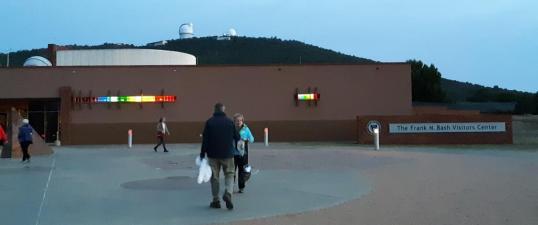 W had made arrangements for us to attend a Star Party at the McDonald’s Observatory 15 miles west of the Lodge. We knew reservations were required and had them, but did not realize that each party had over 200 invitees. I negotiated the twisty road in Moby Dick, our outsized 4×4 pickup, and parked in daylight, hoping to be able to find the truck later in the dark.
 We were early for the star-gazing, and browsed the Visitors’ Center and Gift Shop, as my spouse, a big fan of the Observatory’s Star Date broadcasts on PBS, had asked me to bring him something from MacDonalds. I managed to find some postcards and an affordable and portable book at the gift shop, and made it through the line at the cash register just as they were calling for the partygoers to come to the outside auditorium for the start of the star gazing.
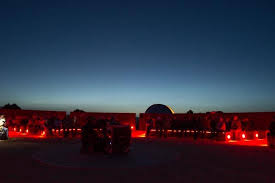 Whatever did we do before fleece! Cozy in fleece jacket and pants and three layers beneath, topped with hats and scarves, we sat on concrete benches as the star ranger pointed out details we had never seen before of Orion. The ranger drew a big laugh with his description of “the hunter, he has a sword, shield and these two bright stars mark his brawny shoulders, but like some other athletes, his head is this fuzzy thing…;” We were introduced to Leo, Taurus,
 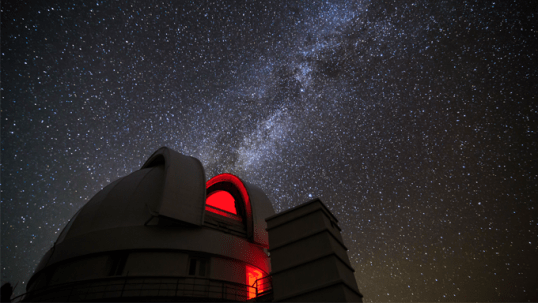 Then the host recommended we adjourn to the telescopes for viewing, as clouds were beginning to obscure the sky. There were three outdoor telescopes and two domes open, but even though some of the 200+ viewers had left the amphitheater early to get a head start, there were still long cold lines. We wished we had a fourth fleecy layer. We saw the Pleiades up close and two star clusters and then headed for the interior Sky Tour, which was rather redundant but at least it was indoors, warmish, and sitting. We bailed at 10:30, foregoing another classroom talk, and I drove prudently down the mountain. We crashed into bed at 11:15, piling on all the warm quilts we could find.
 If you are going to spend time in the desert, it’s best to know what you may be seeing, smelling, and getting stuck onto. The Chihuahua Desert Research Institute and Botanical Gardens, about 10 miles east of Ft. Davis, provide a convenient and comprehensive introduction.


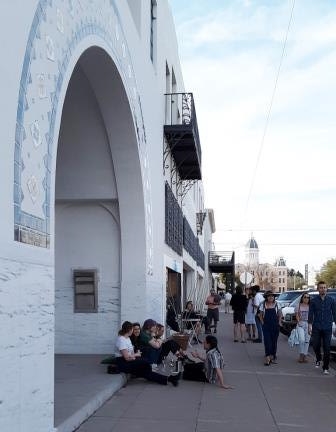
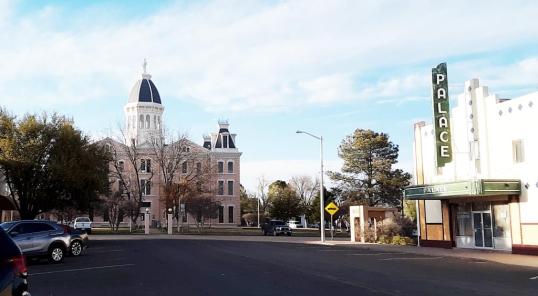 Marfa, in the Big Bend Country of Texas, is the home of the mysterious
  But the real mystery of Marfa is not the lights, but how a town of scarcely 3000 manages to maintain not just the grand old


 I confess: I did not come to Alaska to learn more about Tlingit culture or early Norwegian settlesments. I wanted to experience wilderness and wildness, before they disappear from the earth. When we sail up into Tracy Arm north of Hobart Bay, I feel like we were really there.


 Sitka is the launch point for many voyages up the inland passage. But don’t be in a hurry to leave. In addition to the


 As I walked back through the grove, I noticed that many of the boulders had small cairns built on top of them, perhaps related to the Jewish custom of putting a stone on the grave of a relative or friends when you visit. I stopped by an empty boulder and piled up a cairn – one for my college friend, one for two boys I had known well in high school, one for the son of my high school principal, one for another close friend who is, so far, as survivor. I had not thought of them for a long time. It felt good to think about them here.
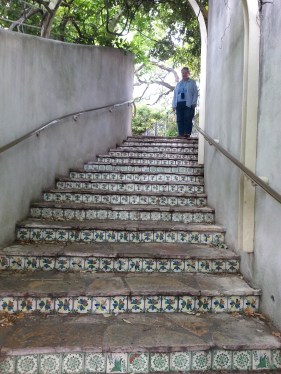 We walked down the Riverwalk to


 Allyson Johnson