Off to Cowlitz Falls County Park. This park is maintained on behalf of the public by the Lewis County Public Utilities District. There are actually no falls here, as the river has been dammed for hydroelectric power, and the only access to the river, the boat ramp, was destroyed in a flood and is being repaired. Aside from the misleading name, this is a lovely quiet place with lot of shade, lots of woodsy trails between sites and restrooms, a sunny meadow with a volleyball net, a horseshoe pit (equipment for both available from the ranger) and a playground.
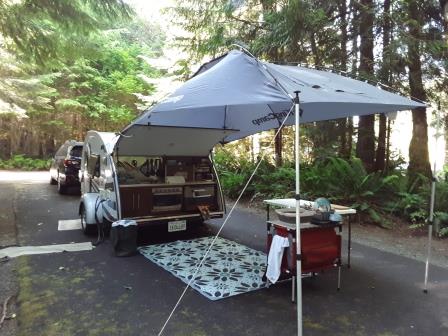
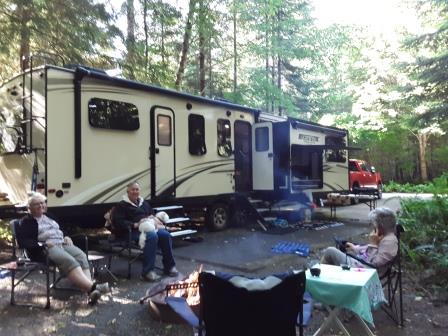
We set up in adjoining camp spaces, our tiny teardrop next to C&C’s Trailer Mahal. Instant conversation starters with folks strolling through the camp.
Then, just to make sure we meet everyone, we walk the dog, an adorable little white mop of a thing. Nothing like a cute dog to make instant friends along the trail.
The next morning we are just finishing a tremendous breakfast of eggs, bacon, toast (Thanks to C&C’s full kitchen) when our nephew P arrives with his wife T and five lively children.
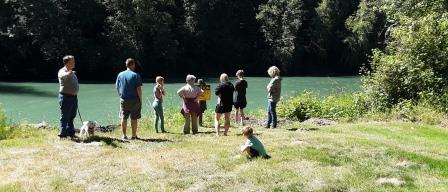
Fortunately Cowlitz [no]Falls has lots of distractions to offer. A walk to the river. Fallen trees to climb. Back at the camp, Grandma C has provided plenty of hot dogs, sodas, chips, and watermelon, while Auntie M has a box of trailer games. Five-year-old G is surprisingly deft at removing blocks from the Zenga tower!
I’d forgotten how exhausting family gatherings can be for us empty nesters. M and I tumble into our trailer while C&C are still admiring the moon over a last glass of wine.
After the heat of our second day, the cool of the next morning at Schroeder County Park finds me up early. I find a small hotel soap cake in my dop kit and take a shower, even washing my hair with the soap. Feels wonderful. M wakes, sees my wet hair, and follows my example. Breakfast again of strawberries, blueberries, granola, yogurt. We both feel great. What could be nicer, with the river sparkling, the air fresh, and the heat wave broken!
Locked, loaded, and leaving by 10 , we are proud of the improvement in our getaway time. We think we have an easy 3.5 hour drive up to our brother’s house straight up I-5 in Washington state, so we are open to a scenic detour. M calls friend in Corvallis to invite them to meet us in Corvallis’s central park for lunch – M is eager to show her old haunts, and the detour would be pretty. but the friends are on their way from Corvallis down to Winters along with another couple that M knows well, and are on I-5 headed the other way. We rendezvous at a Wendy’s in Eugene and the five friends are soon in full catchup mode, with lots of exclaiming, explaining, and suggesting. I feel like a hat rack, but it’s ok. I use the loo.
On our way again. We stop for lunch at another rest stop. We stop for gas and check the GPS. Hmmm. What was a 3.5 hour drive at 10 AM is now, at 2, after driving 2 hours all told, still a 3.5 hour drive. What had been a clear blue shot through Portland is now blood red.
It takes us two hours to get through Portland. We are delayed a bit by M’s fear of the electric connection coming loose again, so we pull off on Swan Island, home of rail yards, lovely homes, and lot of homeless encampments. Vagrancy and loitering used to be crimes, but certainly there should be a better alternative to jail time than these ugly shambles.
A homeless campsite on Swan Island’s Lindbergh’s Beach. (KATU)
Once we clear the Columbia it’s an easy half-hour to Kid Brother’s house. We get a warm welcome, a bedroom for each of us and a tour of the latest quilts, wall hangings, glitter dot pix, and other crafty things which KB’s wife has put together since our last visit. .the fully de-frosted salmon in our cooler provides the centerpiece for a fine meal, with side dishes from KBW’s well-stocked fridge, and wine from KB’s well-stocked cellar.
KB plans to retire in March of 2023, and he and WBW are planning some long long trips in their long long trailer. There are sights to see north of the border, relatives to visit in Idaho and Montana and Texas and California. When vagrancy comes packaged in a 30-foot trailer, it becomes a lot more glamourous.
My sister promised me two trips in her tiny teardrop trailer as Christmas/birthday presents. For our second expedition with her favorite toy, we decided to do a variation on an earlier trip, going north to visit our brother in Washington state, but on our way we also planned to visit old friends up and down I-5 and US-101.
We had planned to leave early in order to beat the heat on I-5, but domestic circumstances (which I resolve NOT to talk about in this series) delayed our departure until nearly 11:30AM. We had loaded the trailer’s refrigerator with a fresh-caught frozen salmon courtesy of M’s neighbor, a partially-pre-cooked hamburger casserole courtesy of my Personal Travel Agent, some gourmet cheese, assorted fruit, hummus, and enough wine to keep us merry as we camped our way up the valley.
M drives for the first two hours, straight up I-55 aiming at Mt. Shasta. We stop for lunch at a rest stop, where our little cocoon is dwarfed by the semis also taking their breaks in the lot marked for “Trailers and RVs”. The rest stop offers shade and a bit of a breeze, and duly fortified we proceed to our first camp spot, Railway Park Resort at Dunsmuir. We pull into the registration office past box cars and cabooses that have been re-purposed as lodge rooms for families, a gift shop, and a history museum. A Dining Car is now a restaurant. But we have our own traveling accomodation, and continue further up the road to our RV site in a different area.
It is HOT, but in the shade bearable. We see other campers returning from a swimming pool located back in the railroad car section, but it seems like too much trouble to change clothes and hike over to share a pool with a bunch of teenagers and tots. Instead, we explore and discover a creek near our site ideal for wading in. Oh bliss!
Returning with wet feet to our camp, we discover that the electrical connection to the trailer has come unplugged. We can’t know how long we have been driving without blinkers or brake lights, but long enough so that the salmon is completely thawed. We cross our fingers against botulism and hope for the best. Our first night meal is the partially pre-cooked casserole layered with noodles and cheese in a frying pan, super easy to fix, and we have some (warm) red wine to wash it down and some chocolate covered cranberries for dessert.
One dish dinner! Our camping standard.
M’s sleeping bag has a velcro-fastened interior lining, so we could pull off the warm layer and sleep under the lightweight sheet. Despite the heat of the day, the trailer cools fast with side windows and a ceiling vent open. We have no trouble falling asleep.
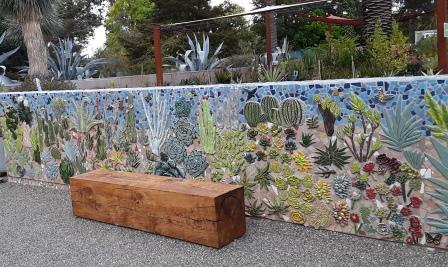
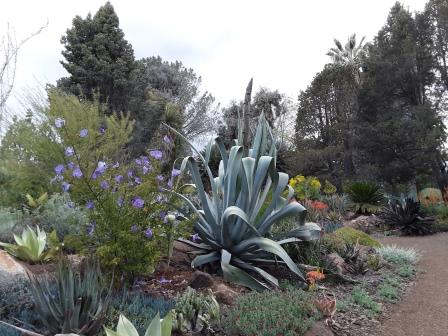
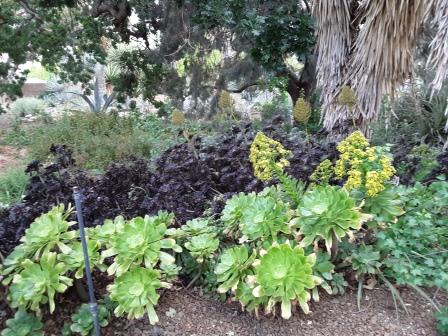
Ruth Bancroft’s legacy garden in Walnut Creek, California is a small plot of land full of wonders. Ruth Bancroft’s family had a farm in Walnut Creek; she was attracted to a rosette-shaped succulent, and this grew into a fascination with succulents, cacti, and numerous other drought – tolerant plants. The result is a fantasy garden of growing greenery, some of which looks as though it originated on another planet.
Despite years in the general area, and having heard about the Ruth Bancroft Garden, it took a family wedding to draw me there. Now I’m eager to go again with visiting friends.
It’s spring, folks! You’re going to see some gardens!
I spent Earth Day with friends, making a rather neglected park more beautiful by pulling weeds and trimming invasive plants. I hadn’t planned on doing anything to mark the day, but my friend Tao invited me to join her and her partner in a work project sponsored by the Chinese Historical and Cultural Project of San Jose.
The location was Iris Chang Park, shoehorned between a huge apartment block and culverted Coyote Creek. It was established to honor Iris Chang, the brilliant young author of “The Rape of Nanjing” and other histories of the Chinese experience, which opened to much community fanfare in November of 2020. But during the lockdown months care and maintenance fell behind, and the nettles and dandelions had grown almost as tall and profuse as the native grasses originally designed for the landscape.
The park offers a simple strolling path past a cenotaph telling about Iris Chang, a large circular sculpture evoking traditional Chinese artifacts, and several markers and low walls with quotes from Chang’s work. In April, irises planted by Chang’s parents were in bloom in several beds.
So we set to work. A couple of hours later, with a dozen people busy, we had accumulated quite a collection of refuse bags, and the park is ready for its closeup – a May 1 event to mark the anniversary of Chang’s death. Stop by if you are in the neighborhood!
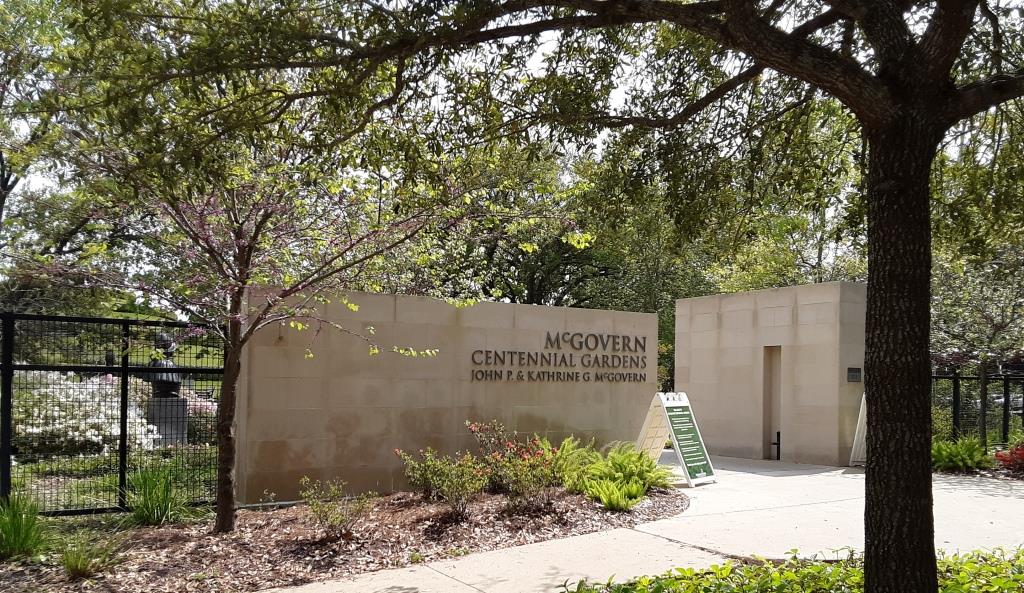
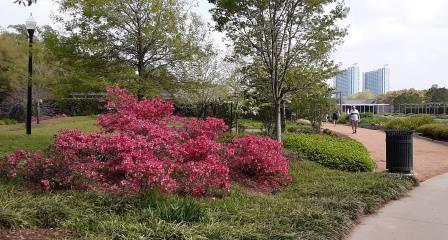
The time to visit the McGovern Centennial Gardens in Houston is definitely in April, when the magnificent azaleas are in bloom.
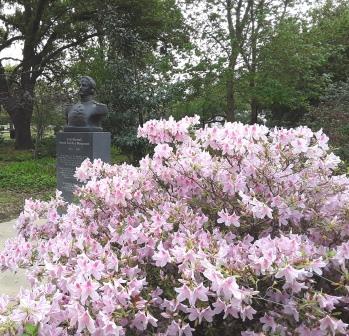
The entrance to the garden opens to a walkway lined on either side with bronze busts of notables, framed by (on my visit) luxuriant azaleas. It’s a bit difficult to figure out how the notables were picked. Texas historical figures such as explorer Cabeza de Vaca or Sam Houston are expected, but why the president of Chile? and why Robert Burns?
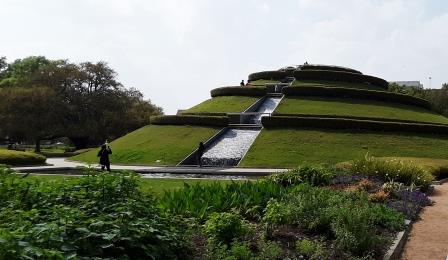
The centerpiece of the garden is a tumulus with a pathway spiraling upward to give you a view of the whole garden as well as the Houston skyline rising beyond. There is no marker to tell you who might be buried beneath this ceremonial mound, but it is precisely reminiscent of burial mounds in China, along the Mississippi, and in Britain.
The pathway is lined with shrubbery and ivy-covered walls. It seems to be a desirable habitat for lizards: I spotted six skittering away from me on my way up, in different shades of yellow, gold, and red. (California lizards are so dull and dirt-colored.) A fountain at the top of the tumulus sends water down a pebble -lined incline to a pond at the bottom; the pathway skips across the stream several times on narrow bridges. The effect is cooling, which is good, as there is no source of shade other than the ivy walls.
At the top of the tumulus are three benches inscribed somewhat cryptically: “In terms of one year, plant a seed. In terms of ten years, plant a tree. In terms of one hundred years, teach the people.” And, one could add, “In terms of one hour, have a seat!”
The rest of the Centennial Garden is still a work in progress. The beginning of a traditional rose garden is visible, but the bushes on my visit were neither labeled nor blooming. Eventually there will be benches shaded by blooming arbors, but not yet.
There is also a family garden, colorful during my visit with lush kale in many shaded of green, magenta, and yellow, and showcasing flowers, vegetables, and fruits which can be grown successfully in the Houston area.
I was charmed to find a Little Free Library conveniently positioned next to a picnic area in the Family Garden, offering books for children, but with a garden theme.
The Centennial Gardens are located within Hermann Park, also home of the Houston Zoo, a lake with paddle boats, and other family attractions. But the Gardens feel quite removed from the more commercial recreations also available in Hermann Park, and provice a lovely place for a quiet walk alone, or a walk-and-talk with friends.
I needed to stretch my legs after a full flight in coach to Houston, so my friend W obligingly scheduled a trip to the Houston Botanic Garden, sorta kinda on the way from Hobby Airport to central Houston. It was a drizzly afternoon, bracing after four hours in a mask, and we had windbreakers and an umbrella, so we strolled the deserted grounds of the garden quite comfortably. After all, in Houston the rain is warm.
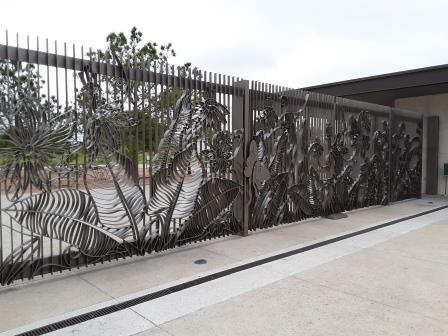
The entrance to the garden is austerely modern, but the fence by the gate gives a better idea of the kinds of richness behind the entry. The garden recreates a diversity of ecological settings, punctuated with fountains, raised beds, and a variety of eccentric artwork.
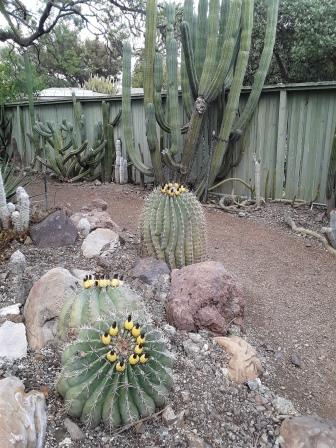
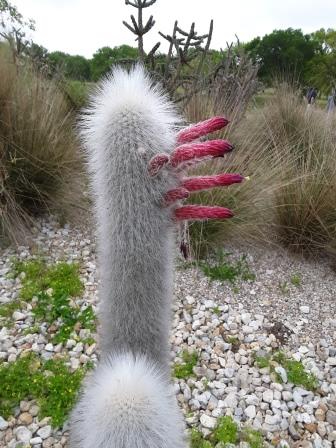
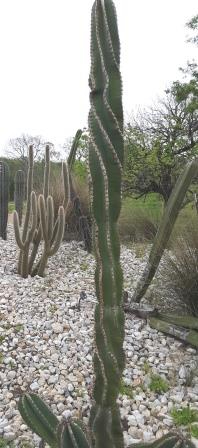
My favorite were the cacti, with all the eccentric shapes and shades they can show.
The major fountain would have been more striking in sunlight with water jets sparkling, I think. Under gray skies it had an effect recalling a set of tiled locker room showers. What do you think?
The raised beds in the culinary garden were beautiful, with richly colored kale and cabbage.
Definitely worth a detour when you are next in Houston! But don’t forget the umbrella!
My father used to say that we lived in Paradise, and in springtime in California, despite threats of drought, global warming, and wildfires, this is still true. I just got back from a week away (which I will write about later, never fear) and found that my garden is in full flush of bloom. So don’t expect travel tips or social commentary this week; it’s all about the pretty pictures.
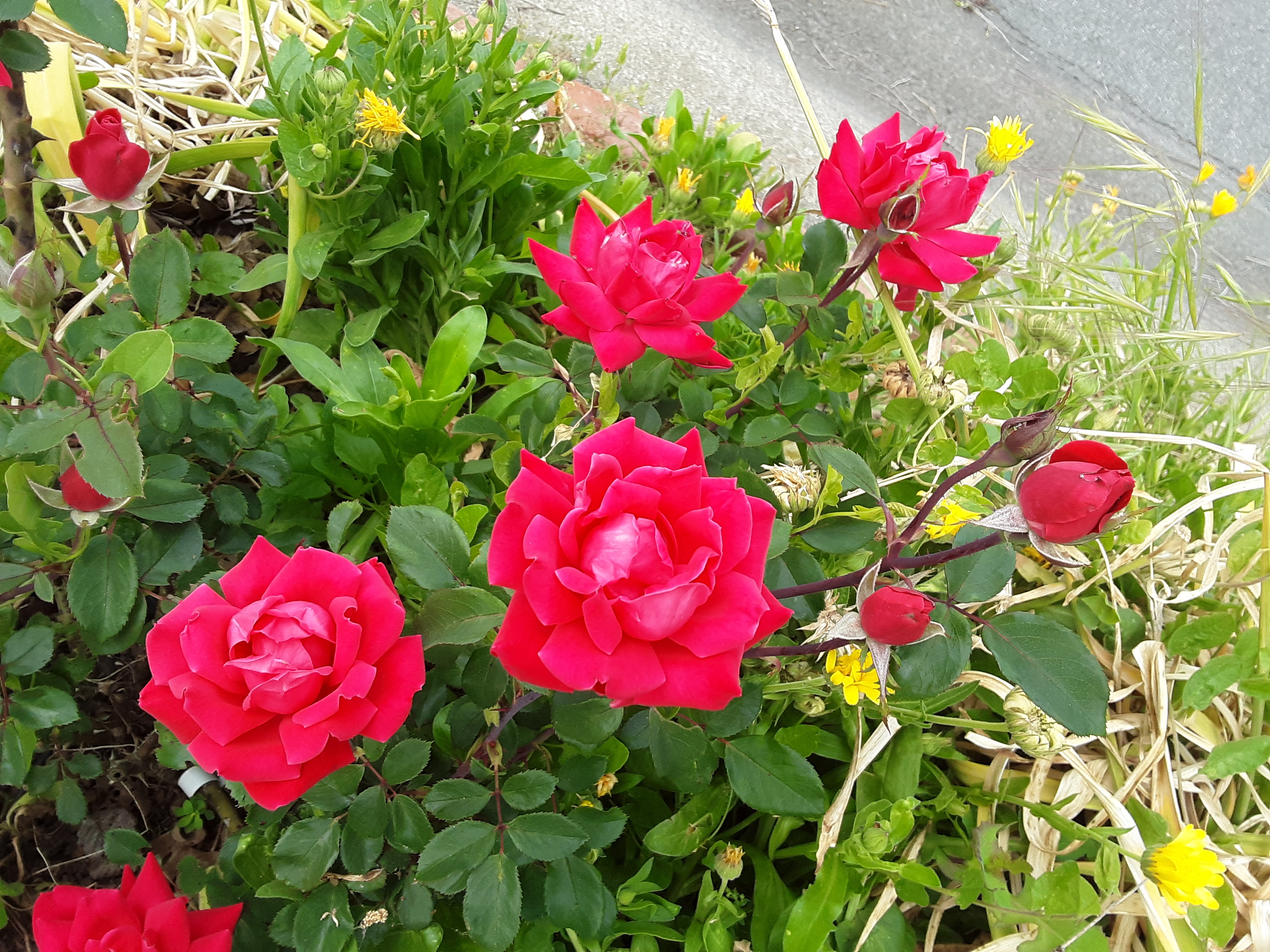
I ‘m not an assiduous gardener. There are weeds, and a lot of volunteer plants in places where they shouldn’t be. Fortunately, roses despite their beauty are very forgiving of neglect – so I have a lot of them.
I also have geraniums because they just grow, nasturtiums because they reseed themselves, and jasmine which invades from the neighbor’s yard and competes with the roses for fragrance and a basket of miniature petunias which I bought last year and has thrived on neglect.
And to top it off, my mother’s orchids, tucked away in remote corners of the yard for most of the year:
After hours in sterile cars, airports and airplanes, this was such a fantastic welcome I had to share!
Having nothing scheduled, we sleep until 6:30, when we both wake with the same need, scrambling for our camp shoes so we can hustle off to the nearby loo. If we were at home, we would have stayed upright, made coffee, and begun the day. But in camp, it seems still too dark to do anything serious, so M curls up for an additional doze, while I pull out my iPad to churn out another 1500 words of my latest imaginary adventure.
After a lovely camp breakfast of Raisin Bran, blueberries, raspberries and oranges, washed down with French pressed coffee, and milk, I do the washing up while M puts together a portable lunch in preparation for our hike to Buzzard’s Roost. We intend to leave by 10, but what with one thing and another it’s 11:15 by the time we set our feet on the path toward the Buzzard’s Roost trailhead.
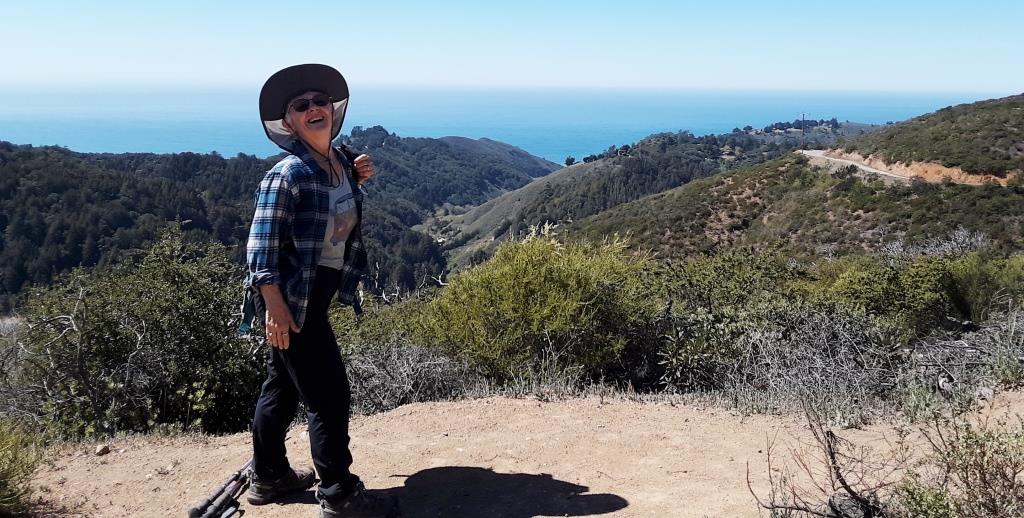
It’s a lovely walk under the Highway One overpass, up through stands of redwoods terribly scorched by the Basin Complex fire of 2008, but still bravely pushing out green shoots of new growth. Then we’re in ceanothus and scrub oak country, then manzanita, and finally barren red rock with a vantage point that looks over to Mount Manuel landward and to the brilliant blue Pacific to seaward. We spread our unneeded extra layers of shirts over the red dirt and set out a lavish lunch of hard-boiled eggs, carrots, hummus, crackers, string cheese, grapes, apples, and prunes – all finger food, no grease. We stay looking out to sea until our spines begin to protest against sitting unsupported on the hard ground, then round up the eggshells and cheese wrappers with other leftovers and set off on the return loop.
One of my perennial games on a hike is to count how many different kinds of wildflowers Ican spot. In Edgewood Park near where I live, I have counted as many as forty in the spring, due to the many different micro-biomes there. On this day at Big Sur we tally twenty one, including columbine, native iris, wild strawberry, dandelion, buttercup, trillium, and others of which I do not know the names. Counting varieties is a great way of forcing yourself to be on the lookout and to really notice what is around you.
Our plan after returning to our campsite had been to hop in the car, take care of a couple of small purchases at the general store down the road, and then to drive down to Pfeiffer Beach. But after our purchases M turns to me and asks “Do you mind if we don’t go to the beach? I just want to veg.”
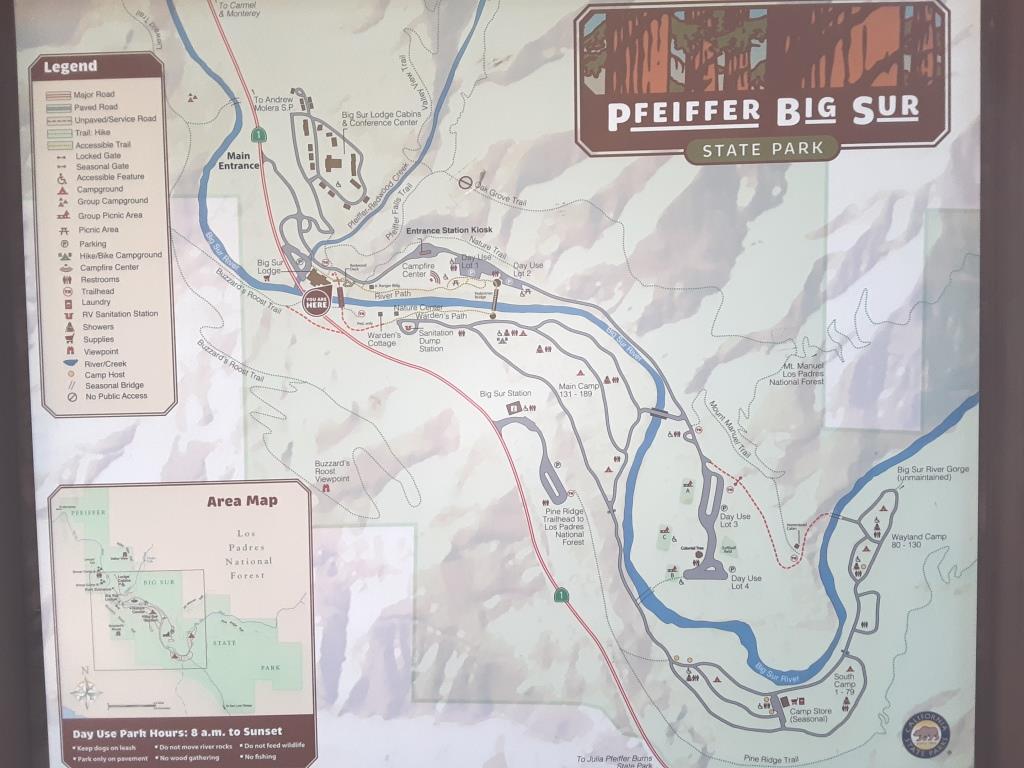
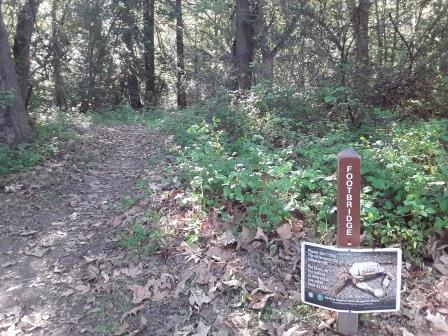
Instead we drive to the end of the road on the side of the river opposite our campground, just to see what is there. We watch a family playing softball on the weedy field for a while, and I want to check out the “seasonal footbridge” that the map shows opposite our campground (See the dotted line crossing the river at the end of Day Use Lot 4 on the above map?) M drops me off at the end of Parking lot 4 and drives away, while I follow the trail from the sign that says “Footbridge.”
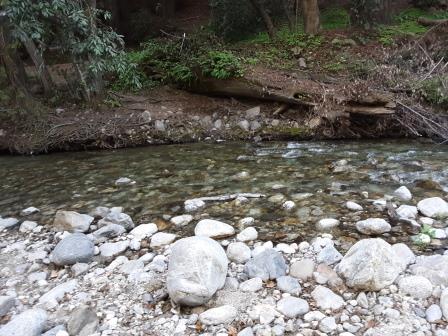
Guess what. No footbridge. Must not be the season yet. I debate wading across the shallowest portion of the Big Sur River as it ripples past where the bridge should have been. I’m wearing my water shoes, and my cargo pants with the roll up option, and the water looks shallow. On the other hand, the bottom of the river is paved with rounded stones of varied sizes which could be very unstable and slippery, the water is so clear that it’s hard to gauge how deep it really is, and getting up the steep bank on the opposite side looks chancy. So I opt for the half-mile walk around to the far bridge at the end of the campground. (It would have been shorter, but the most direct route was “authorized vehicles only,” and a ranger directed me in a friendly but definitive way to the trail around, not through.)
By the time I make it to our campsite, M has gotten worried and set out in search of me. By the time we reunite the sun is definitely over the yardarm. She lights the portable campfire, I run cold water from the camp faucet over my tired feet, and we settle to reading, phoning, and munching the last of the crackers and hummus.
Dinner is experimental but turns out well. A vegetable medley cooked in Frying Pan #1, sliced parboiled potatoes with onions sautéed in frying pan #2, and lamb chops sauteed in Frying Pan #1 after the veggie medley had been evacuated, along with a nice Pinot Noir, dessert of shortbread and chocolate squares, and some sisterly discussion ranging from “Do you think Mom resented me?” to “Have you smoked marijuana?” to “I have this genetic deformity. Do you have it too?”
And by 9PM we are snuggled in our teardrop cocoon once more.
Hiking boots still damp [See two posts ago] we decided ice skating would be the best option for an afternoon. . C started phoning. One place had a disconnected phone – probably not an option. We decided to check out the outdoor rink at Heavenly Village.
HV is a skier’s Disneyland. The gondolas leave from the middle of a pseudo alpine village with outdoor musicians, an ice-covered fountain, and various boutique shoppes and eateries. But the rink was dinky – smaller than the San Jose rink beneath the palms. so we tried Edgewood Lodge – sorry, not open to public. then the inside south Tahoe city Ice rink – reserved for hockey team practice and lessons except for Th-Sun. c thinks she might go on Friday when she is here alone – she brought her skates!
We were inspired, though, by the sign showing where those gondolas ended up – far up the mountain and on the other side of the ridge was the true Heavenly Valley. So we drove up the Kingman Grade (N-207) to HeavenlySki Resort. The gondola that goes up from the Village on US50 ends at a cluster of condos and cabins surrounding a take off point for several busy ski runs. This is literally another side of the Tahoe area, invisible from the Lake. We were hoping for some impressive lake views, but too many trees.
Nowhere to walk in the resort unless you were carrying skis over your shoulder on the way to one of the lifts, so we descended the Kingman Grade again, parked next to HWY 50, and took a walk along the South Tahoe bike way, then went down to the snow-covered beach and made our way back to our car. As we returned the sky turned blazing peach and pink and purple, celebrating our explorations. You can always count on Lake Tahoe to take your breath away, one way or another.
























 Allyson Johnson