Arturo Perez-Reverte has constructed a marvelous mystery which spans centuries. One mystery involves the restoration of a 15th century Flemish painting which depicts a chess game in progress. In the course of the restoration the cryptic inscription “Who killed/took the knight?” is revealed. Does the painting hold the clue to solving a 15th-century murder?
The second mystery develops as Julia, the young art restorer, tries to decipher the painting’s mystery and becomes involved in a series of murders which seem to be related to the painted chess game.
If you are interested in art history, or the miracle of modern art restoration, and have even a passing interest in the game of chess, you will be charmed by this novel. The setting, in Madrid, with some of the key incidents occurring in El Prado, enhances the action perfectly. The solution – without giving the story away, I will say that it is both outrageous and satisfying.
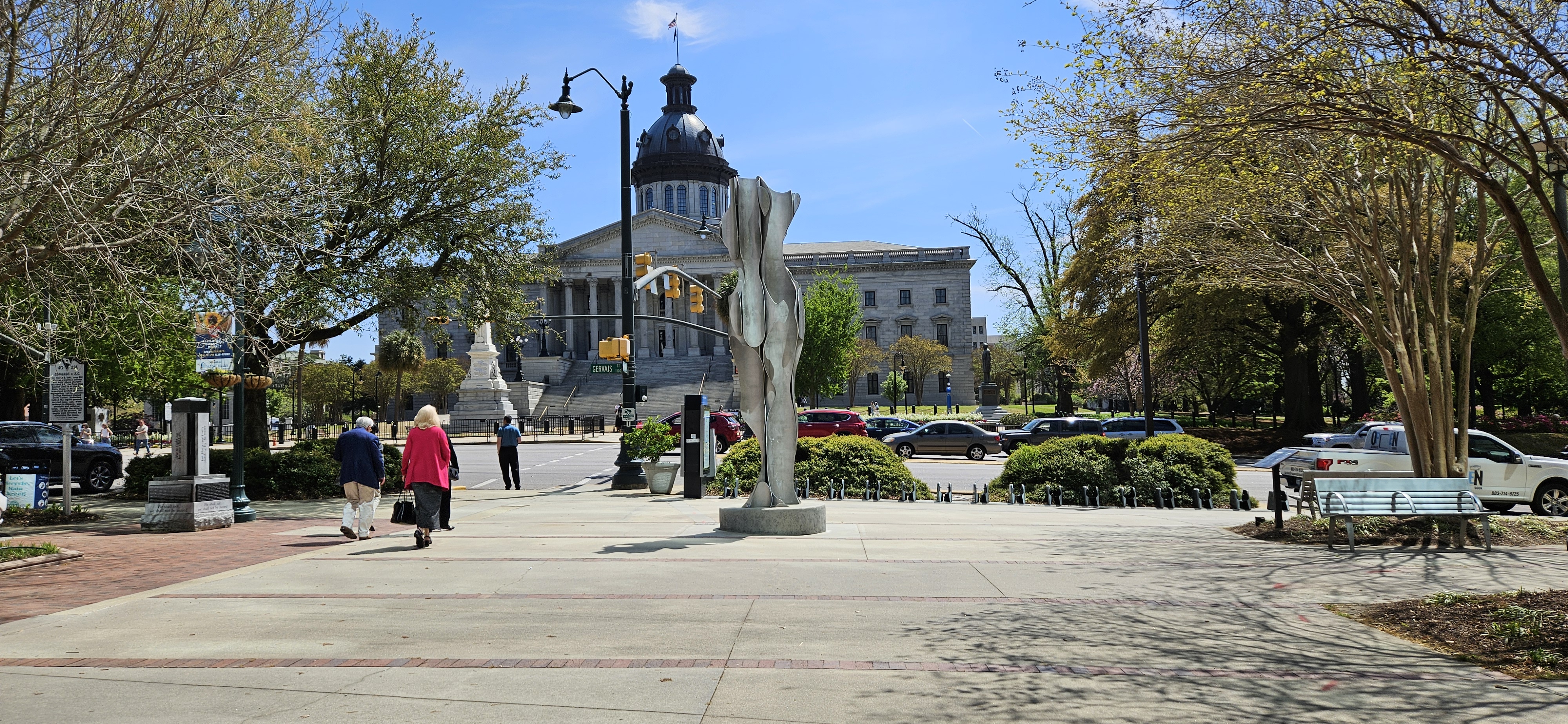
Columbia, South Carolina is a walkable state capital, and the area around the Capitol building has plenty of agreeable spots to walk to. The Capitol building itself is a peculiar architectural folly – a classic Greek/Roman base complete with grandiose steps and towering pillars, but topped incongruously with a weathered bronze cupola and dome which seem to have wandered over from some eccentric Victorian’s mansion. The Capitol grounds have the requisite number of monuments to the fallen heroes of various wars, interspersed with (in March at least) truly splendid beds of blooming azaleas, dogwood, and other gifts of nature.
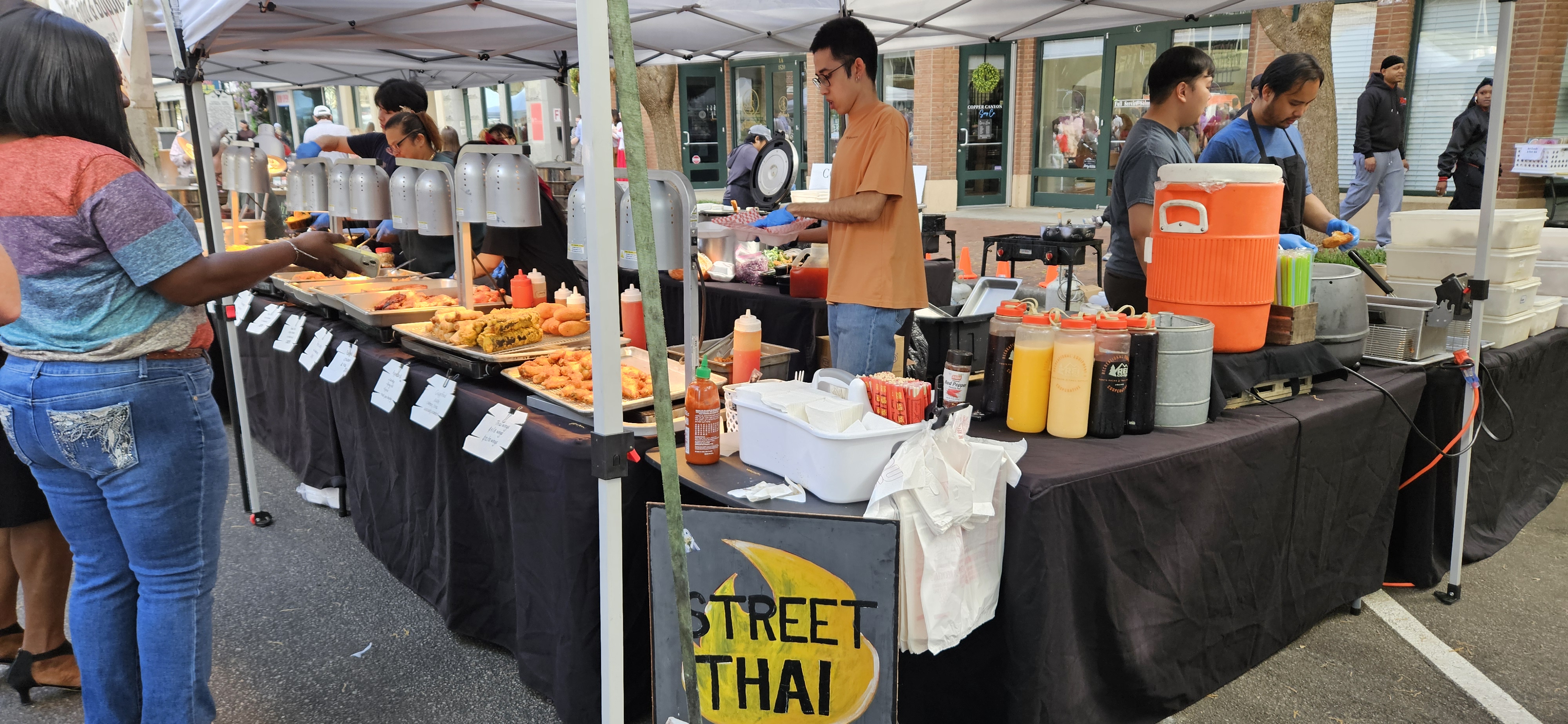
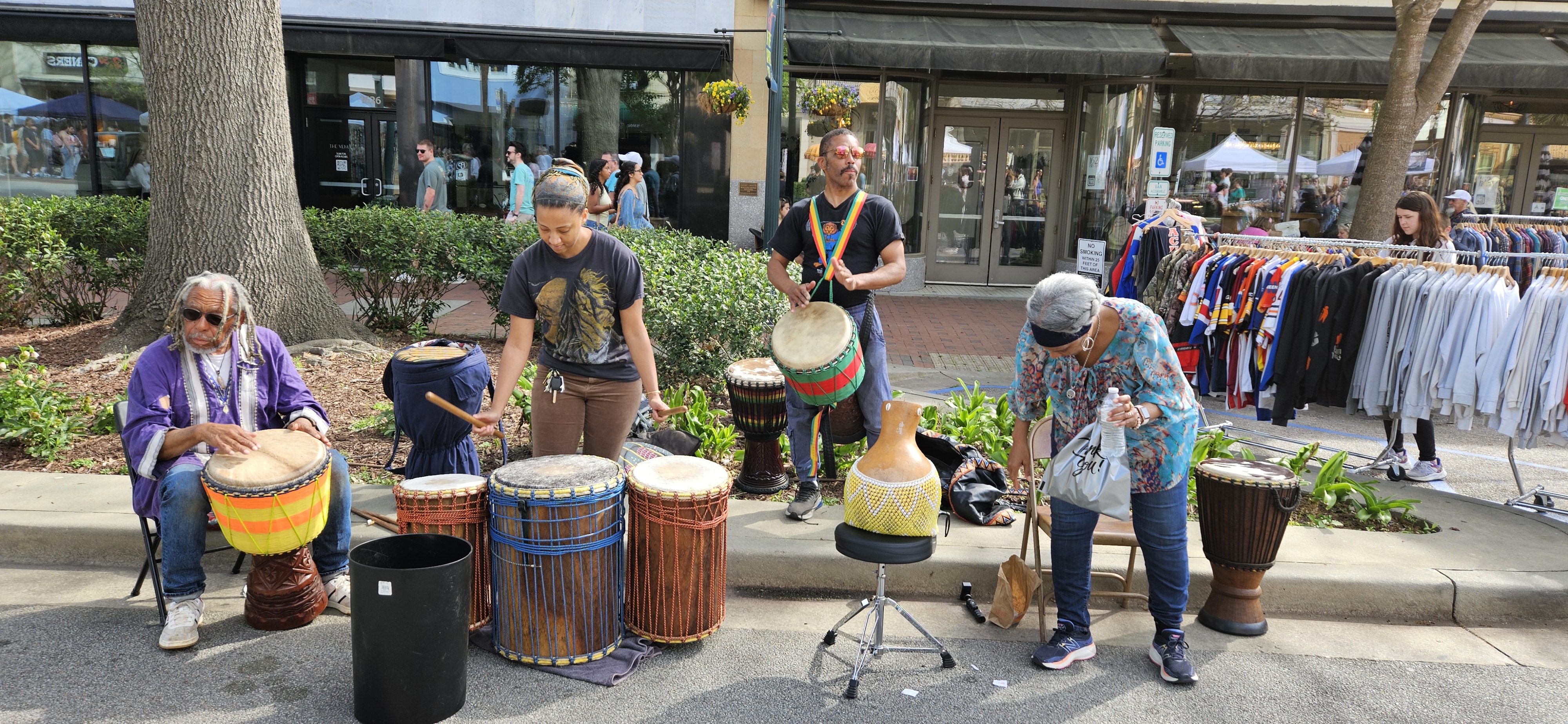
The main street of Columbia starts at the Capitol. Called, appropriately, Main Street, it is the core of activity every Saturday, when a craft/produce/food truck fair takes place from 9-2 year round. Folks line up for barbecue, for chicken with grits, and even just for coffee. If you are a fan of vintage clothing, kitchy art, and herbal cosmetics, you’ll have fun here. If not, you’ll still have fun watching the parade of people and pets that wander the street in search of that perfect vintage leather jacket, or the ideal potpourri.
And there’s the food…
And the street musicians…
And if you get tired of the crowd, you can always go to the art museum, only a block off Main Street…
Or to the Richmond Library, a truly amazing collection of books and nooks to read them in. only a couple of blocks in the other direction…
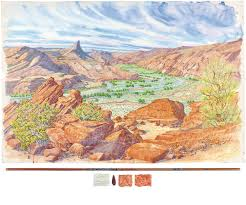
Tucked away in an industrial corner of Palo Alto, around the corner from an electronics recycling center and across the street from a geochemical testing laboratory, is the Foster Museum, a tiny jewel dedicated to showing the work of watercolorist Tony Foster.
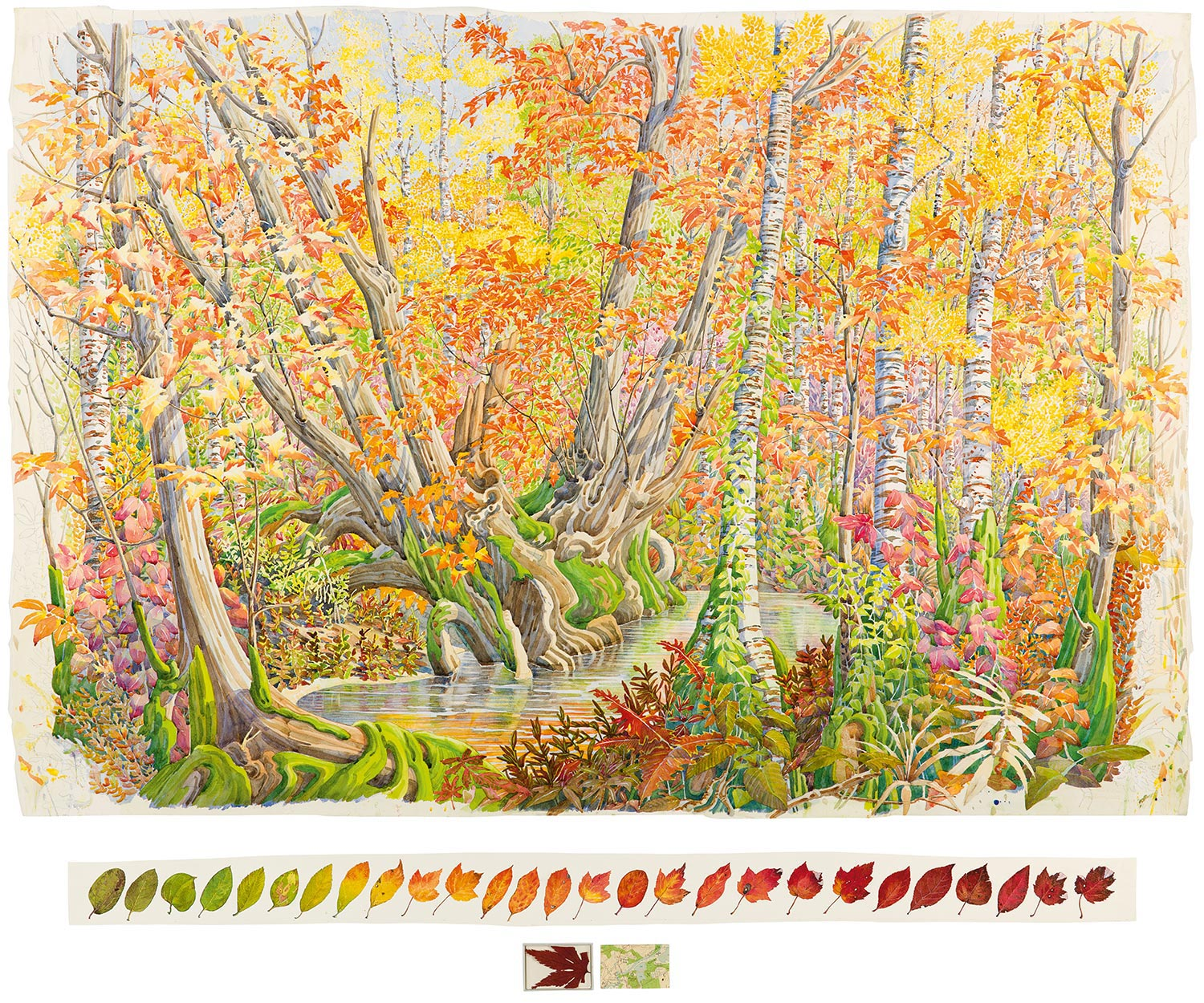
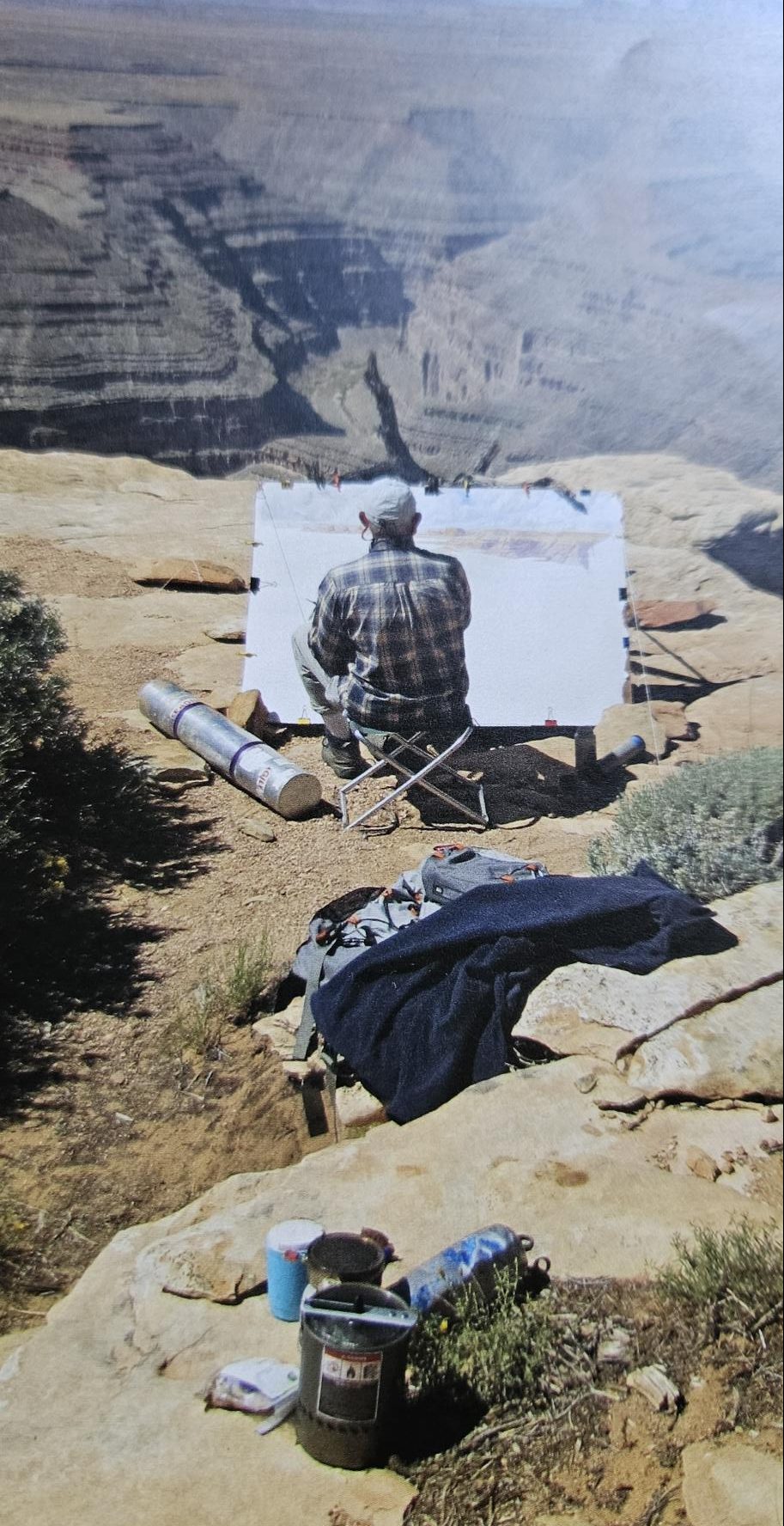
The museum is normally open by appointment only, but I happened to visit with a friend on a “Welcome to Walk In” day. Inside this ivy-covered block is a wonderland of watercolor murals, covering wall after wall with scenes of grandeur: the Grand Canyon, the Rockies, the volcanoes of Iceland, the rain forests of Borneo, the Himalayas, the High Sierras, the coral reefs of the Caymans. Amazingly, the paintings were done plein air rather than from photographs.
The paintings are specially framed with inclusion of leaves, pebbles, and other artifacts from the scene, and many of the paintings include handwritten notes by the artist in the margins of the painting. These artifacts and notes give an authenticity to the art which is terrifically engaging.
Foster writes of his struggles holding onto his palette and easel against howling winds in the Rockies, keeping his materials intact in desert dust storms and tropic rain, and even drawing with wax crayons underwater while wearing scuba gear near a coral reef.
The net effect is absorbing – I spent almost two hours perusing the amazing artistry and detail of Foster’s work, and only stopped because the museum was closing. If you are a fan of water color painting, or of outdoor adventure, this museum will satisfy in many ways.
Arles, of course, was one of the stops Vincent van Gogh made while searching for sanity and artistic fulfillment in Provence. After the dark murk of the Netherlands, the bright colors and warm weather seemed to galvanize his artistic expression, but unfortunately did little to stabilize his mercurial mood swings.
Arles was van Gogh’s home for eighteen months, and some of his best-known paintings were executed during that period. Modern Arles has seized on van Gogh’s posthumous popularity by providing posters marking the sites as above.
In Arles, van Gogh lived for a time with Paul Gauguin in the Yellow House which appears in several paintings. This house no longer exists. However, the hospital to which he was committed after he cut off his ear in an alcohol-enhanced rage still exists, its courtyard now filled with post cards, posters, t-shirts, and other memorabilia of the artist’s stay.
Just a block or so away is the cafe where van Gogh and Gauguin hung out. At the time, the cafe was painted a modest beige with brown trim, but that’s not the way van Gogh saw it or painted it. Surprise! the restaurant is now bright yellow with blue trim and yellow awnings, just as van Gogh saw it.
Outside the center of town is Alyscamp, a park centered on an avenue of trees leading to a Romanesque chapel. The trees cannot be painted to match van Gogh’s vision, but it is interesting to compare that vision with reality. in a mental hospital. The park is green and peaceful, with romantic ruins and vistas. The interior of the chapel includes a pool filling the lower lever -not clear whether this is intentional or an accident of age.
As van Gogh’s mental instability grew, Gauguin moved out, and van Gogh’s brother Theo enabled him to relocate to a mental hospital in St. Remy, which still exists. Reading the lists of treatments to which mental patients were subjected at this time is like reading of the Spanish Inquisition. The patients were confined in ice cold baths, bound, beaten, and burned, all with the idea of driving out the devils which had taken over their thoughts and actions.
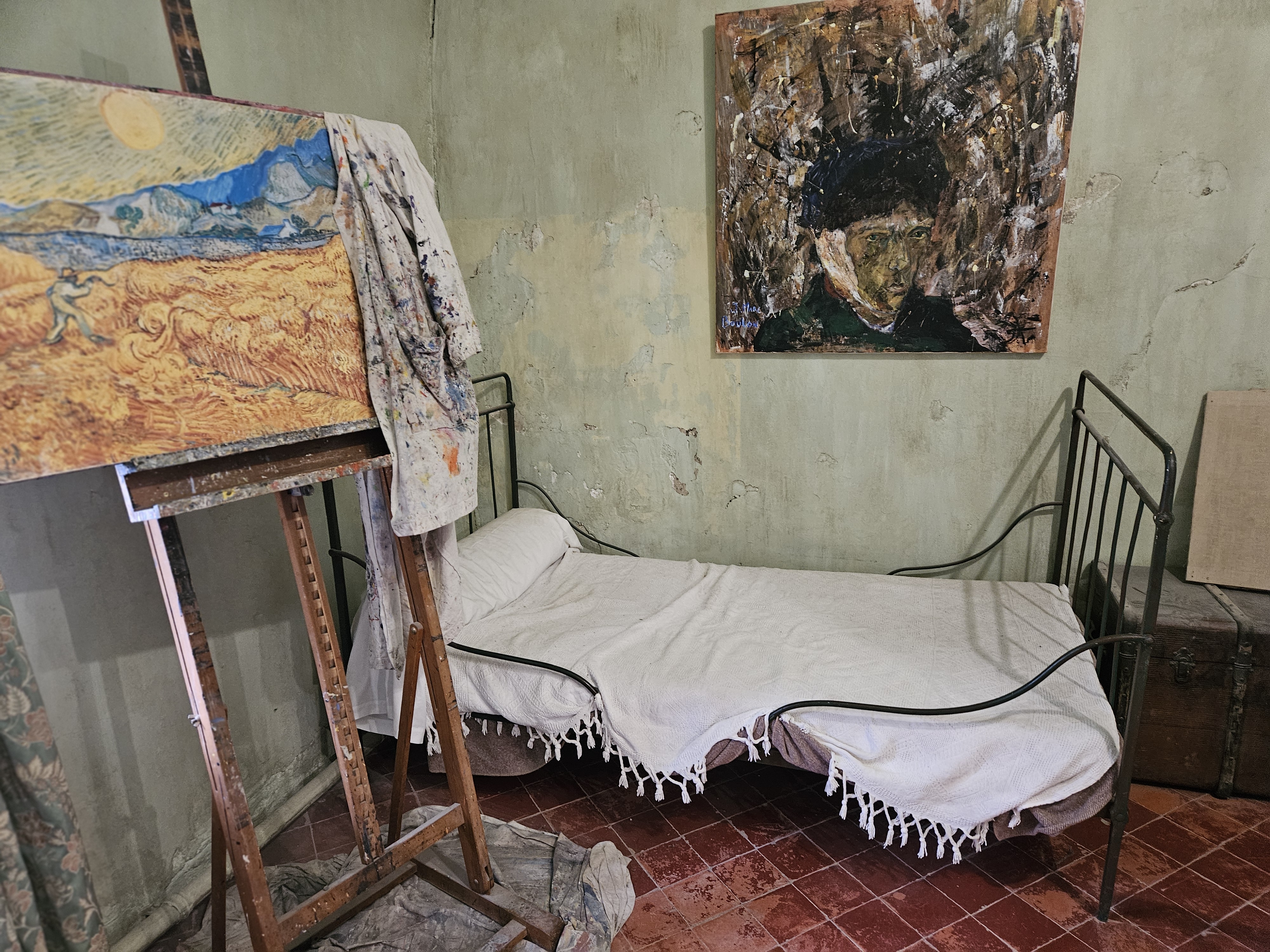
Part of the hospital is still used as an asylum, but one can still see van Gogh’s bedroom and the tubs used for the ice cold baths to reduce his choleric humors.
But outside, one can still see the orchard which inspired his painting, and iris are still blooming in the garden.
Later van Gogh was released from the hospital at St. Remy, and went to stay at Auvers, where he pained perhaps his best-known work “The Starry Night.” He died two days after suffering a gunshot wound. There is controversy about whether the wound was self-inflicted or whether it was the result of an accidental shooting by a group of teenagers who alternately patronized and teased van Gogh.
The leader of the group was the son of the local pharmacist, who owned the only gun in town. The son was prone to dress up in cowboy garb after seeing the Buffalo Bill Wild West show in Paris, and left town abruptly the evening that van Gogh appeared with his gunshot wound. Of course, this theory is not as attractive as the image of the tormented artist driven to suicide by a lack of appreciation, as Don McClain’s “Starry Starry Night” would have it.
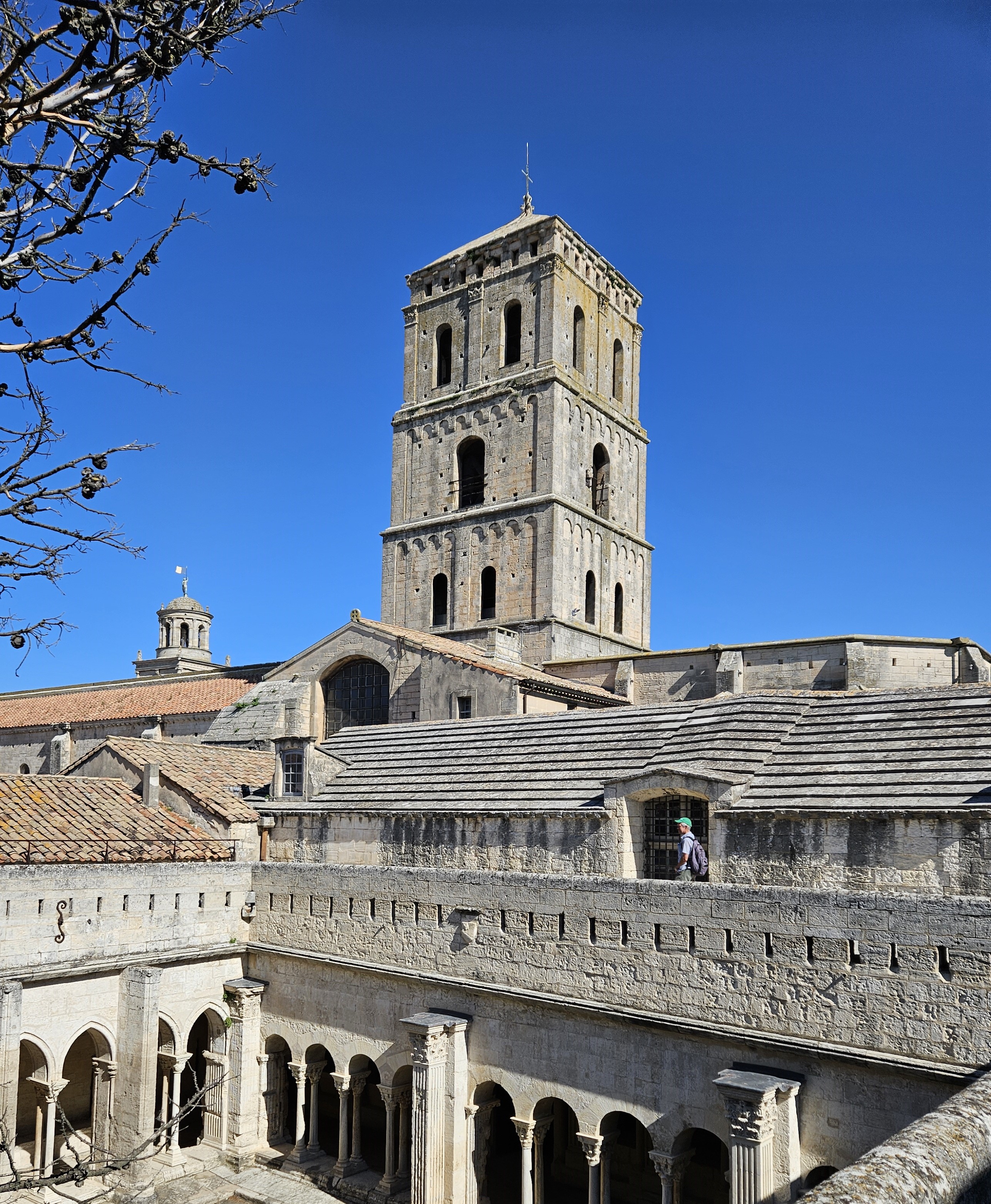
This was our “What shall we do while the rest of the group goes to Avignon?” Day. EJ and I met for breakfast (rather ordinary, but fortifying) downstairs, put on our walking shoes, and set off for the Tourist Information Office down the street. We picked up our Arles 365 Passes, allowing us into ten historical sites and museums, and started across the street directly to the Hotel de Ville (City hall) and the neighboring Cloitre de St. Trophime (St. Trophime’s Church And Cloister). This was our dose of Gothic/medieval Architecture – lots of biblical motifs, Christ in judgment with unhappy souls being led off in chains to the left, while the sanctified get their angel wings on the right, all over the Church door in graphic detail. Inside, lots of chapels with minor saints (St. Roch is my new favorite dressed in the garb of a Conquistadore, but evidently he lived in the time of the plague, and had one of those incredibly faithful dogs.)
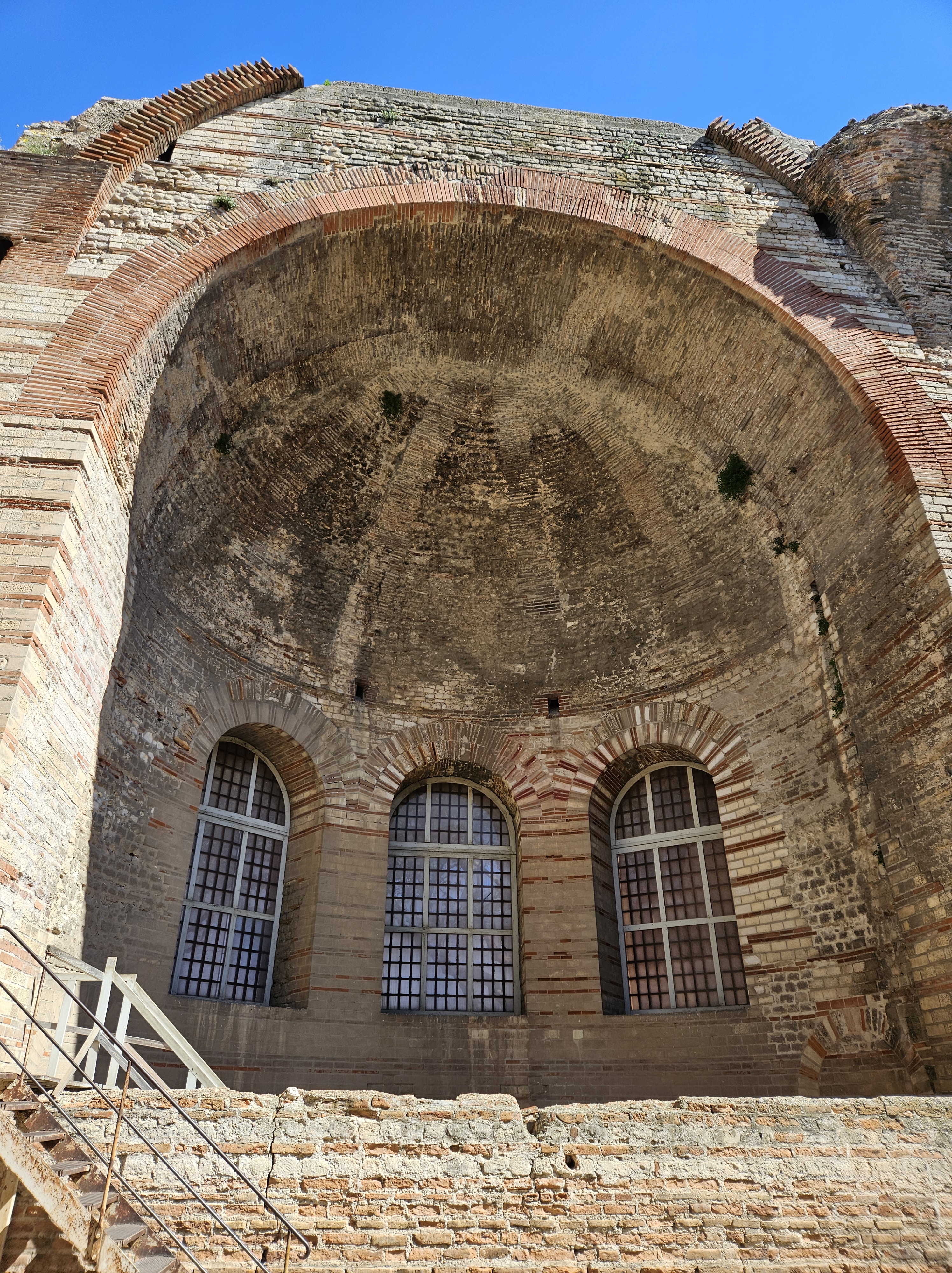
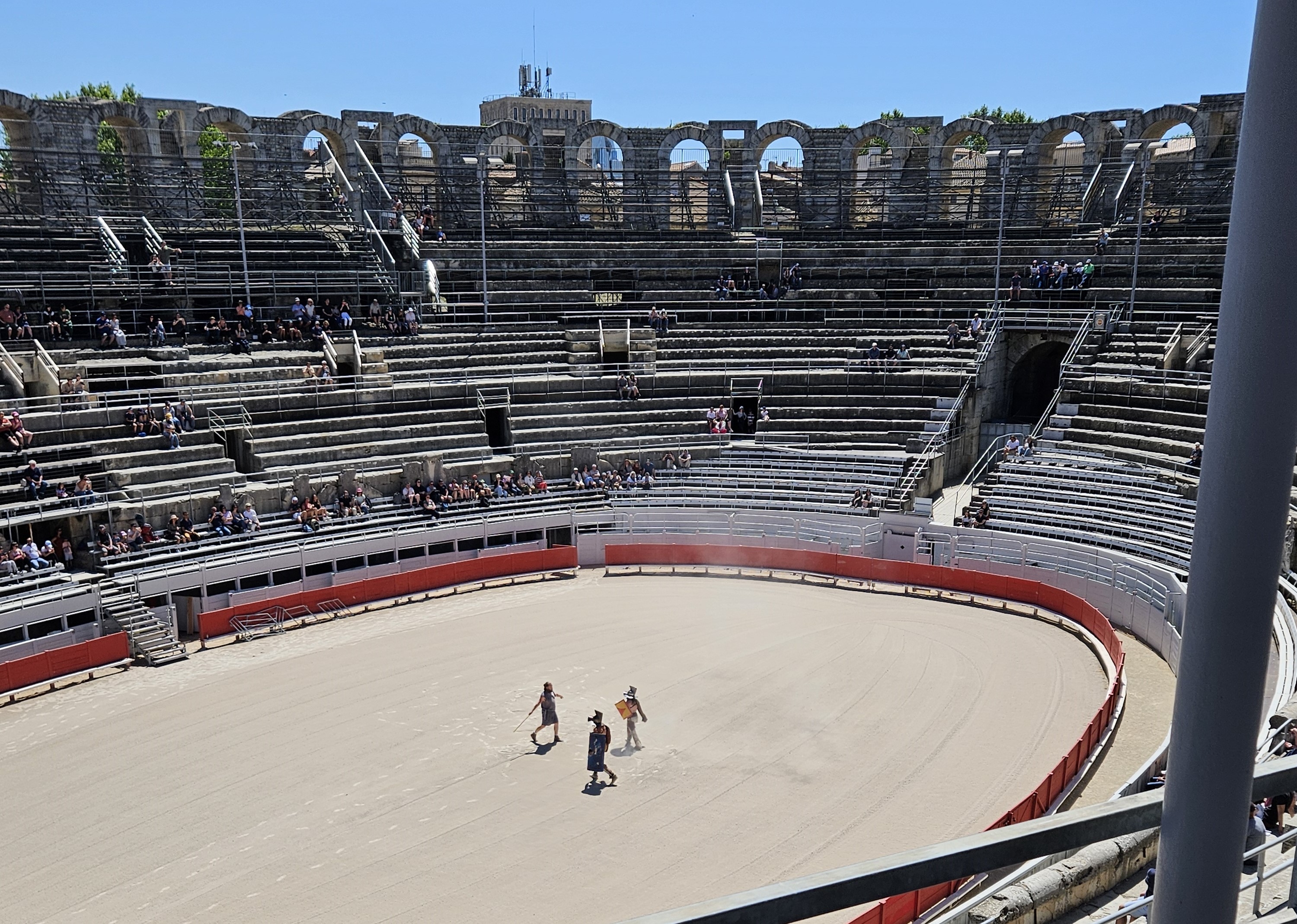
Then up to the riverside where we explored Constantine’s Baths (public steam room, exercise room, sun room, swimming pool – an incredible structure which, when first unearthed, was assumed to be a palace) Then through the adjacent Musee Reattu, an odd collection of 18th century and modern works (“The museum went to sleep during the world wars” explained the catalog), and down to the Arena, where we saw two gladiators battling rather cheesily.
Hungry and hot, we spotted the sign of Le Criquet, a restaurant that had been highly recommended by the Canadians EJ met the previous night, so we plopped down and were treated to delicious fresh shellfish over linguini or over potatoes (we had 2 different entrees) and a floating island pudding that relates to what they used to serve in our college dormitory as Italian gelato relates to a Fudgecicle. Fluffy, meringue, creamy pudding…. The picture can’t do it justice.
Almost dizzy from deliciousness, we decided to work off lunch by walking the length of George Clemenceau Blvd to the Musee d’Arles Antiques.
The museum’s modern bright-blue exterior belies the wealth of ancient artifacts contained within, including a cemetery’s worth of sculpted sarcophagi, murals re-constructed from villas excavated in the neighborhood, an ancient wooden boat retrieved from the Rhone river, its cargo of urns intact, and reconstructed, Greek statuary… and on and on. And, an extra plus after a day of sight-seeing – it’s air-conditioned.
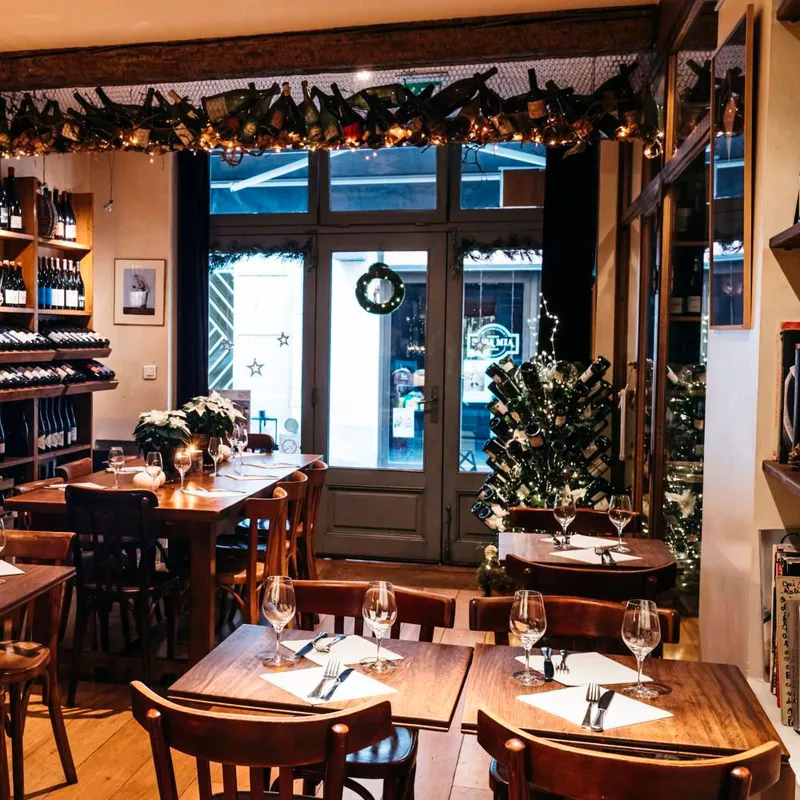
EJ has scheduled a birding expedition led by an expert local guide this evening and may miss dinner, which is why we splurged on lunch a bit. After a short rest back at the Hotel Constantin he leaves to rendezvous with his guide, while BB and I walk to meet the rest of the group at Le Gibolin, a Michelin -recommended restaurant within walking distance.
There we meet PS, former leader of our student group in France, whom I briefly dated afterward (he taught me to appreciate hot buttered rum), and SF, who traveled with me and two other students for three weeks crammed into a VW beetle – and still remained friends afterward! Rounding out our table was MV, who had been a high school student in Tours during our stay and whose family had informally adopted PS and me. I had not seen her for over 60 years – the other three I had seen briefly at reunions or visits. Would our camaraderie endure after all this time?
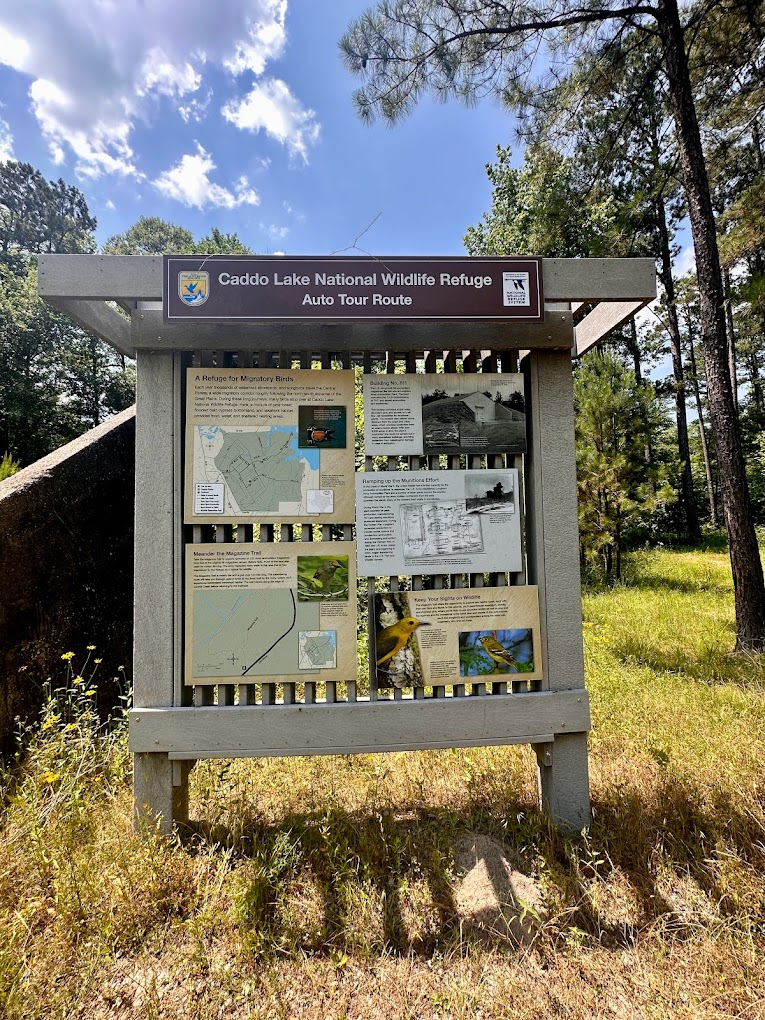
We had packed a picnic in advance of our canoeing adventure, and headed for the Park Store/Museum/HQ, where we inquired for the best place to take a picnic and look at the big Caddo Lake (the State Park only includes Saw Mill Pond, a quiet side area suitable for calm canoeing and fishing but not for broad vistas) The rangerette directed us to the Caddo Lake National Wildlife Refuge and Starr Ranch, a peninsula only 15 minutes way, as a place with a lake view and a picnic table.
The CLNWR is located on land which formerly housed the Livingston Ammunition plant, which was subsequently designated an EPA superfund site, and which is probably responsible for the bass and trout caught in Caddo Lake harboring unsafe levels of mercury and other toxic chemicals. At this time, however, the main toxicity seems to have been cleared, the former Guardhouse is now a nature center for RAMSAR Wetlands, and the expanse of flat roads, by-roads, dirt roads, and grassy lanes invites the birder, biker, and hiker.
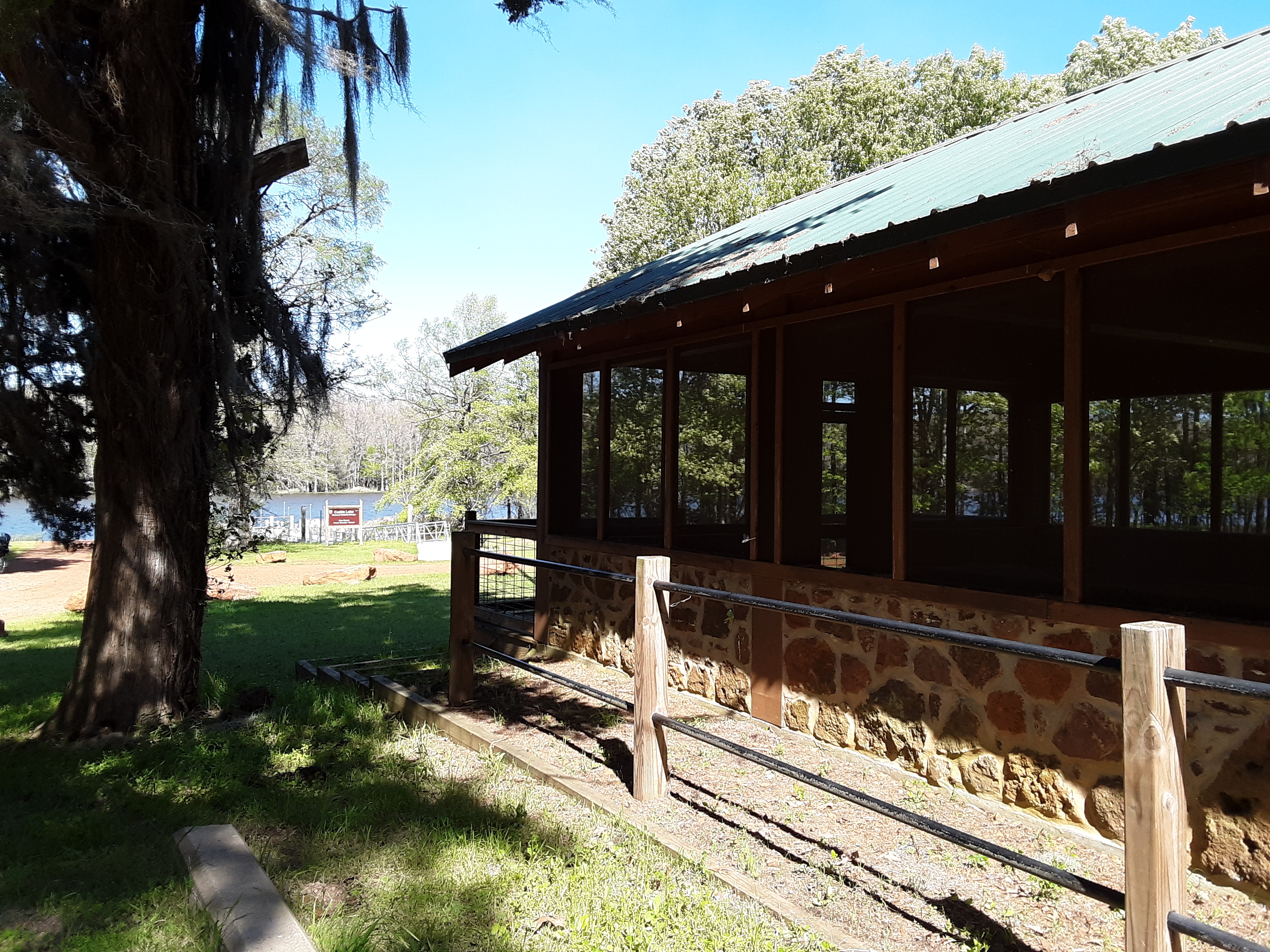
Starr Ranch turned out to be a peninsula with a wildlife viewing dock (looking brand new), one metal picnic table in full sun, a chemical toilet (looking pristine), and a pavilion (beamed ceiling, built-in pews on the side, picnic tables) looking quite new also except for a torn screen on the door, which hung open in the wind in a welcoming way.
No fees, no permits, no people except a couple of Harley riders who were consulting each other and their phones seriously but gave me a big smile – could have been drug dealers rendez-vous-ing but probably not), so we had our mackerel fillets, Boursin cheese, Wasa crackers and red Anjou pear looking out on the wind-white-capped lake. I almost felt guilty putting our mackerel/olive oil/pear core trash in that pristine trash bin in the privy.
After our lunch we stopped at the Visitor’s Center, housed in a couple of prefabs with an adjacent barbecue pavilion. It was completely deserted next to a parking lot designed for a host of tour buses – or maybe it was the former parade ground. We signed the guest book, browsed around, and saw not a soul either of staff or visitor. We could have made off with the stuffed bobcat and possum, but a sign warned that the site was “under surveillance”, and what would I do with a stuffed bobcat anyway?
When our boat docked at the small town of Kalama (population just under 3,000) I had a strange sense of deja vu. That three-story tile-roofed hotel facing the beach, with verandas wrapping around all three stories – hadn’t I seen it before?
It turned out I had – years earlier, on a honeymoon trip to Lahaina, and then again on an anniversary return trip to the same place. Nestled on the beach side of the railroad track which separates the town of Kalama from the marina, beach, and boat dock is a replica of the old Pioneer Inn in Lahaina, built from the same blueprints. This recreation is especially poignant as the original Pioneer Inn had been demolished less than two months earlier by the wildfire which destroyed most of historic Lahaina in August 2023.
The Oregon version has an extra level, and the palm trees are replaced by a trio of historic totem poles, but the exterior and interior are meticulously crafted to evoke the historic Pioneer Inn. Inside, the bar has a tiki theme, the walls are pine-paneled , a bark canoe hangs from the ceiling and the furniture is vintage.
But the Mcmenamins empire includes more than a single nostalgic lodge. At this establishment, instead of mai tais, the customer is offered beer from the Mcmenamins’ brewery and hard cider from the Mcmenamins- orchards. The brewery is conveniently located right across from the gift shop, so you can taste and buy onsite within a few steps.
Mcmenamins also owns a number of entertainment venues across the states of Washington and Oregon, and the pine-paneled walls are decorated with posters of noted concerts.
There is a claim, enshrined in oil paintings though not in photos, that Elvis Presley himself stayed, not at the Lodge, but nearby in Kalama on his way to film a movie in Seattle, and it is quite true that Marlon Brando was a frequent visitor to his son Christian’s home in Kalama. The oil painting of the two icons fishing together, however, is purely imaginary, as their visits were two decades apart.
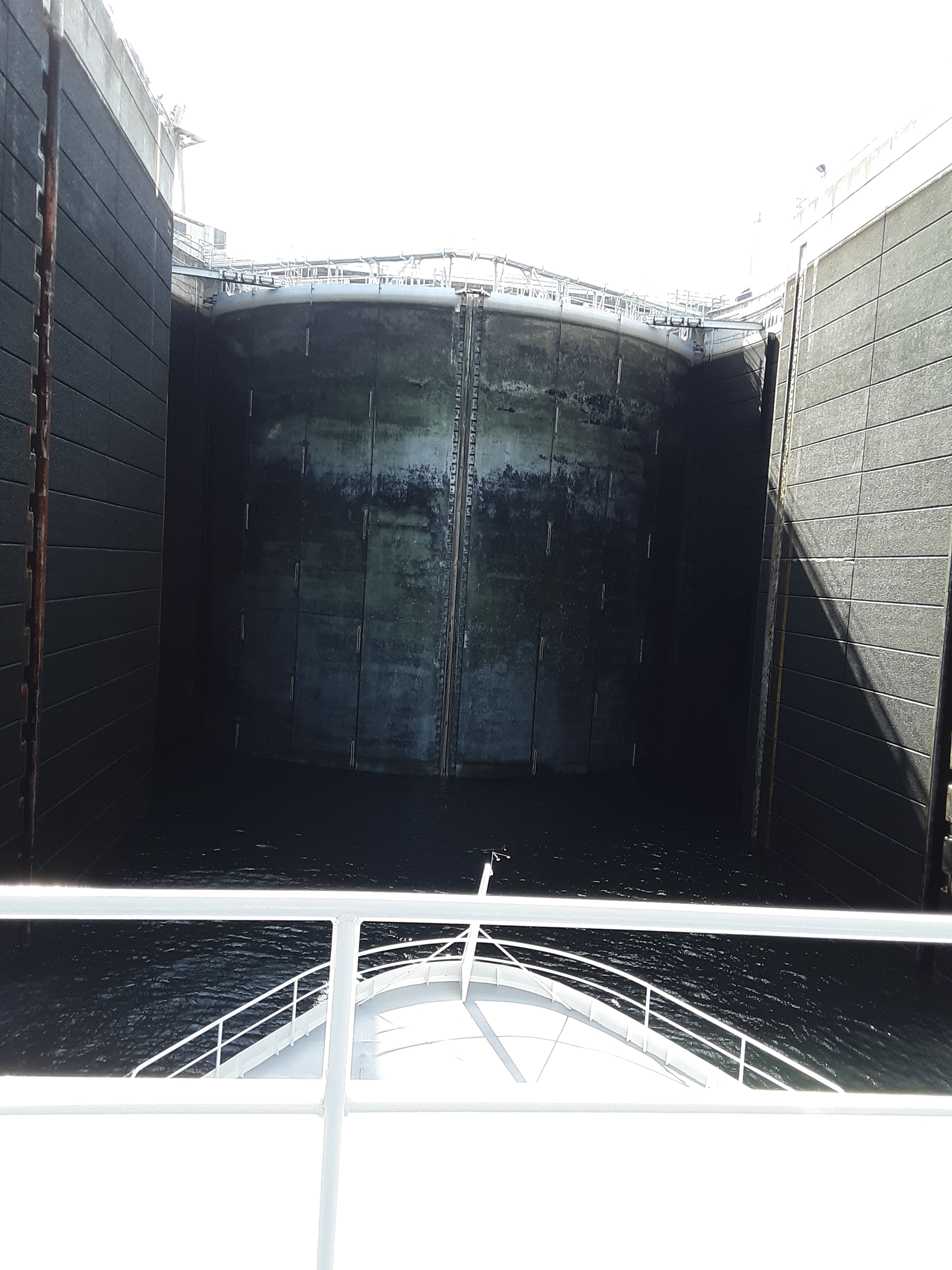
Our boat goes through our first lock – 80 feet or more down from one level of the Snake to the next. We move into the lock; a bridge is before us, an open space behind. Then a wall seems to rise from beneath the river behind us as the water level in the lock is let out and we begin to descend. The walls rise, only two feet from the boat on either side. The bridge before us is now far above, with a large and getting ever higher curving wall ahead. We descend and descend. The black wall behind us is holding back the river, though it appears there are leaks. The black wall ahead is now 80 feet high. On the side are dripping black concrete blocks a yard high piled up and up. Finally we stop descending. We wait. There is a loud shudder, and a crack appears in the wall ahead. Sunlight, and color, a view of hills and sparkling water. The crack opens wider – the feeling is like the scene in “The Wizard of Oz” where Dorothy steps out of the sepia-toned world of Kansas into a technicolor Oz. The engines throb and we move forward into the light and space.
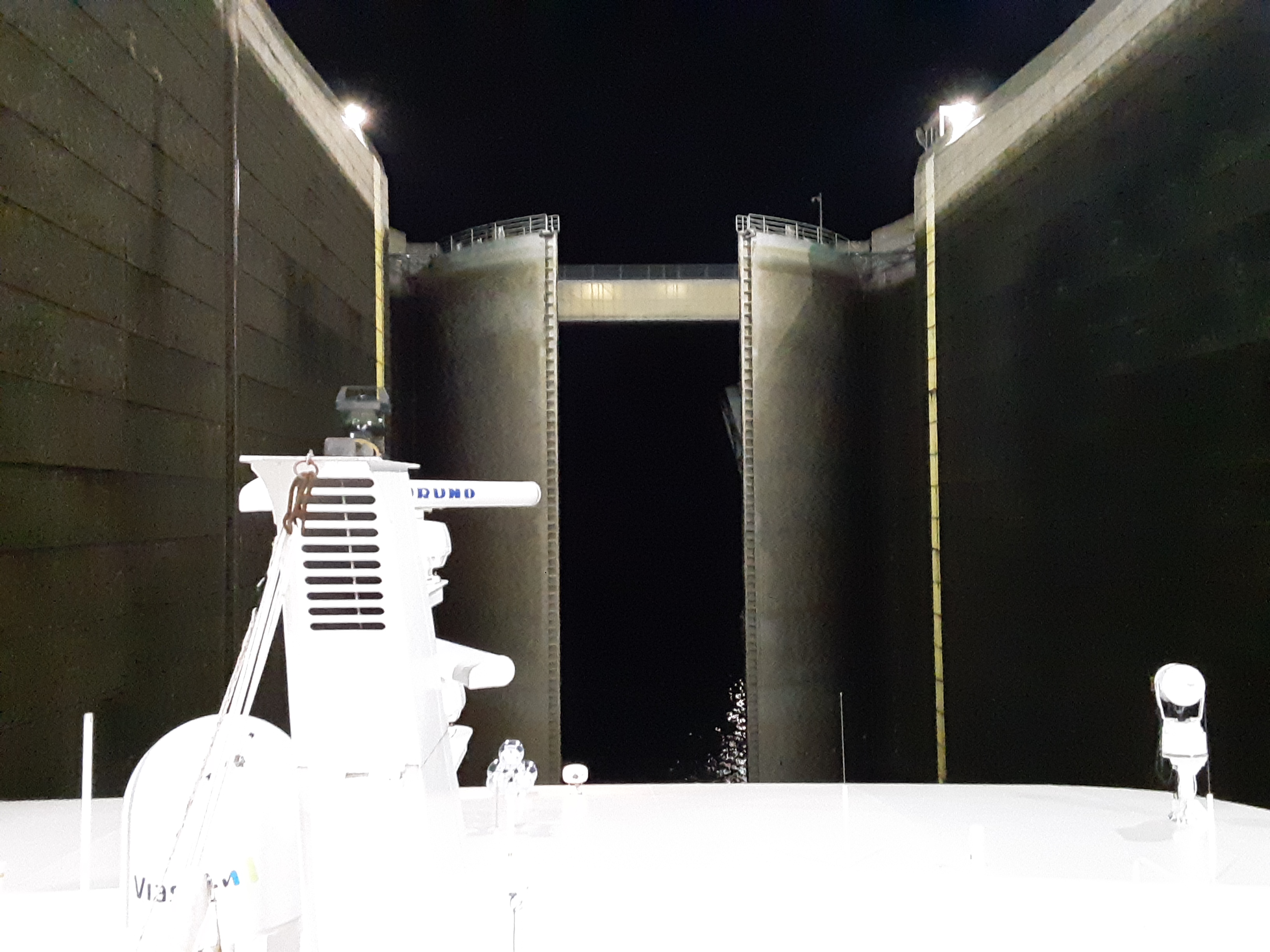
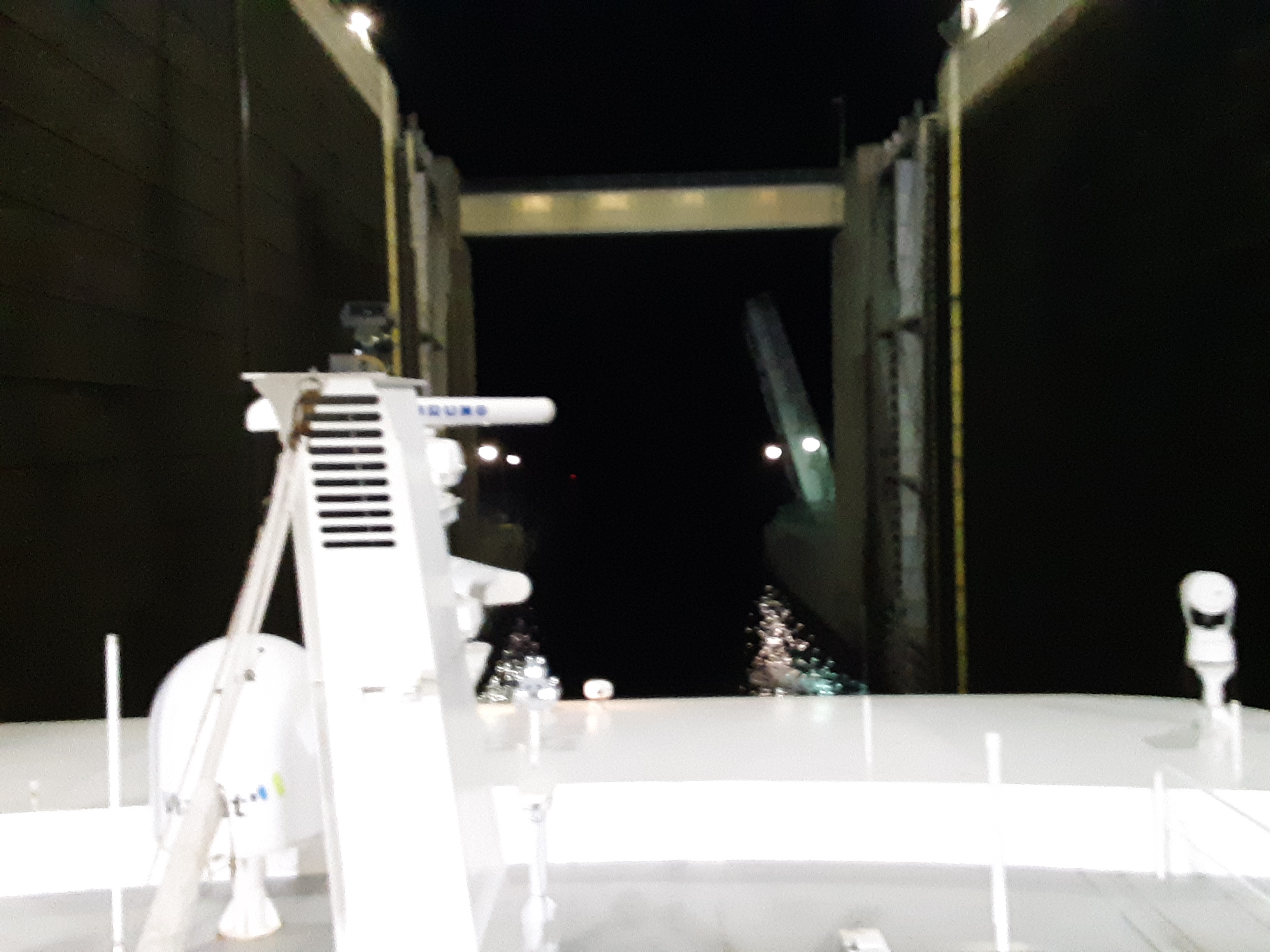
We go through a second lock at night – it is still magical. There is only black and white, the white boat, the black night, the gleaming gate, the sparkling water.
Later we explored off the boat at the Bonneville Dam, whose Visitor Center is a self-congratulatory celebration of the transformation of the wild rolling Columbia river into “a damn fine machine” for generating hydropower, in the words of an industry lobbyist.*
We saw another aspect of the locks and dams at the fish hatchery, where tiny salmon fry are nurtured until they are large enough to release downstream from the dams and make their way to the sea, and at the fish ladder, where returning salmon are given a chance to circumvent the dam in a series of cascades. These makeshift replacements of natural features are an attempt to appease the fishermen and native peoples whose lives depend on the salmon run. In another section of the hatchery, a bit off the self-guided tour, the sight of frustrated salmon leaping in vain against a current backed by a three-foot fence made me sad. In the hatchery these fish are artificially milked for their semen or eggs before dying, so the salmon fry can be created. The salmon would die anyway after spawning, but as they frantically jumped over and over against the impassable barrier, theyseemed to know they are supposed to get further to their spawning grounds than a hatchery.
===
*Quoted from Blaine Harden’s A River Lost; the Life and Death of the Columbia
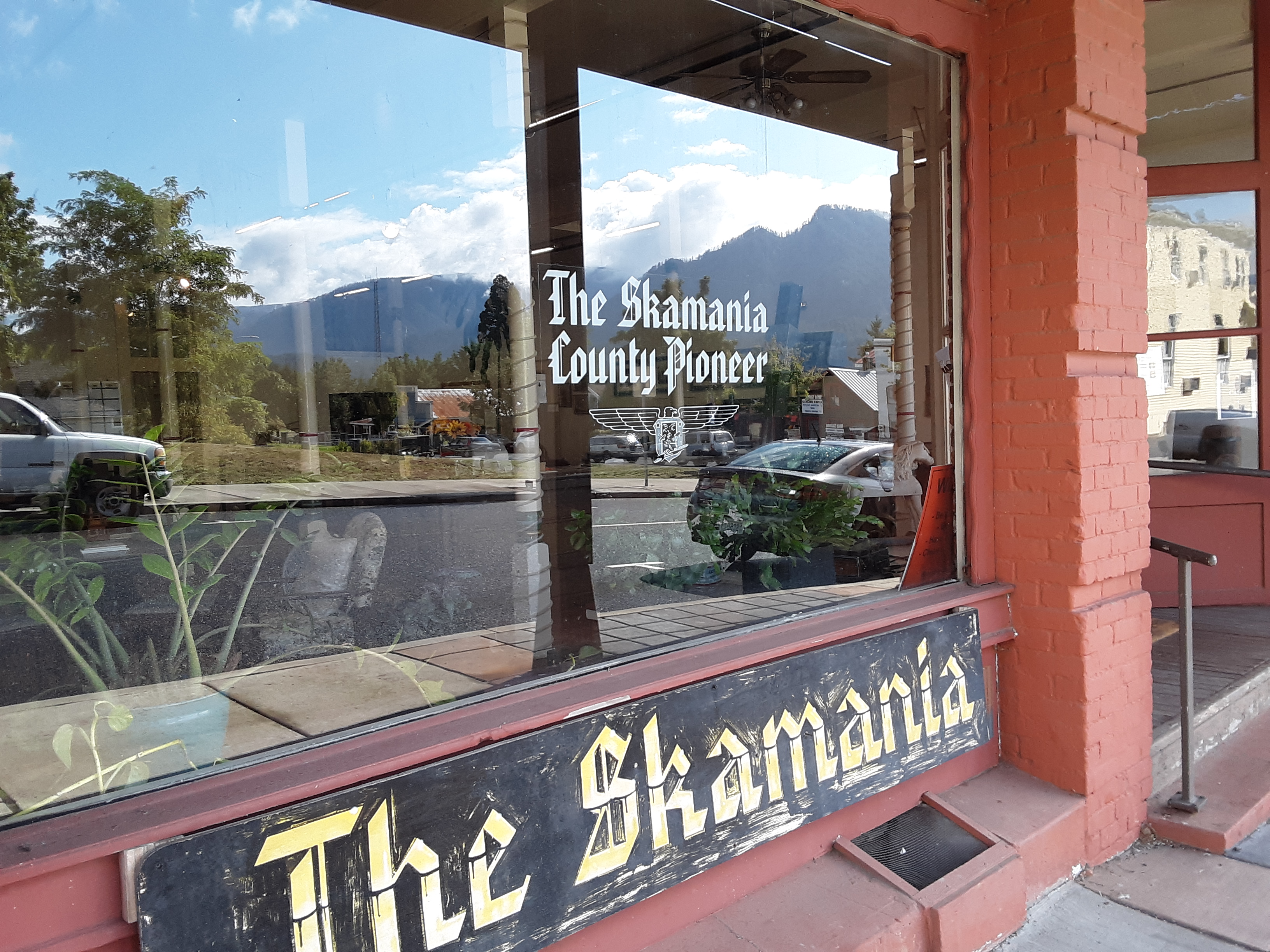
Stevenson Washington is a town of no more than 2000 people, with one main street that stretches from the Port of Skamania boat dock and park along the north bank of the Columbia River up three blocks to the brutally modern Skamania County Courthouse, with two cross streets, one of which is Washington State Route 14. But those three blocks are oddly charming, with shops that would be perfectly at home in an elegant Palo Alto shopping center. How do they survive?
Probably they survive because the boat dock is host several times a week during the summer months to American Cruise Line riverboats, which have picked Stevenson for a stopping point due to its convenient access to the Bonneville Dam, the Columbia Gorge Interpretive Center, and Multnomah Falls. In between excursions, the passengers are tempted to stroll off the boat, through the green and inviting park, and up the gentle hill to browse in North Bank Books, one of the prettiest and best curated bookstores I have ever seen, or examine goods in Out and About, a purveyor of beautifully tailored outdoor clothing, look for buried treasures at the Gorge Thrift Store, or taste a local craft beer at the Big River Grill, admire local art and crafts at Riverhouse III Gallery, or… but you should stop in Stevenson and see for yourself.
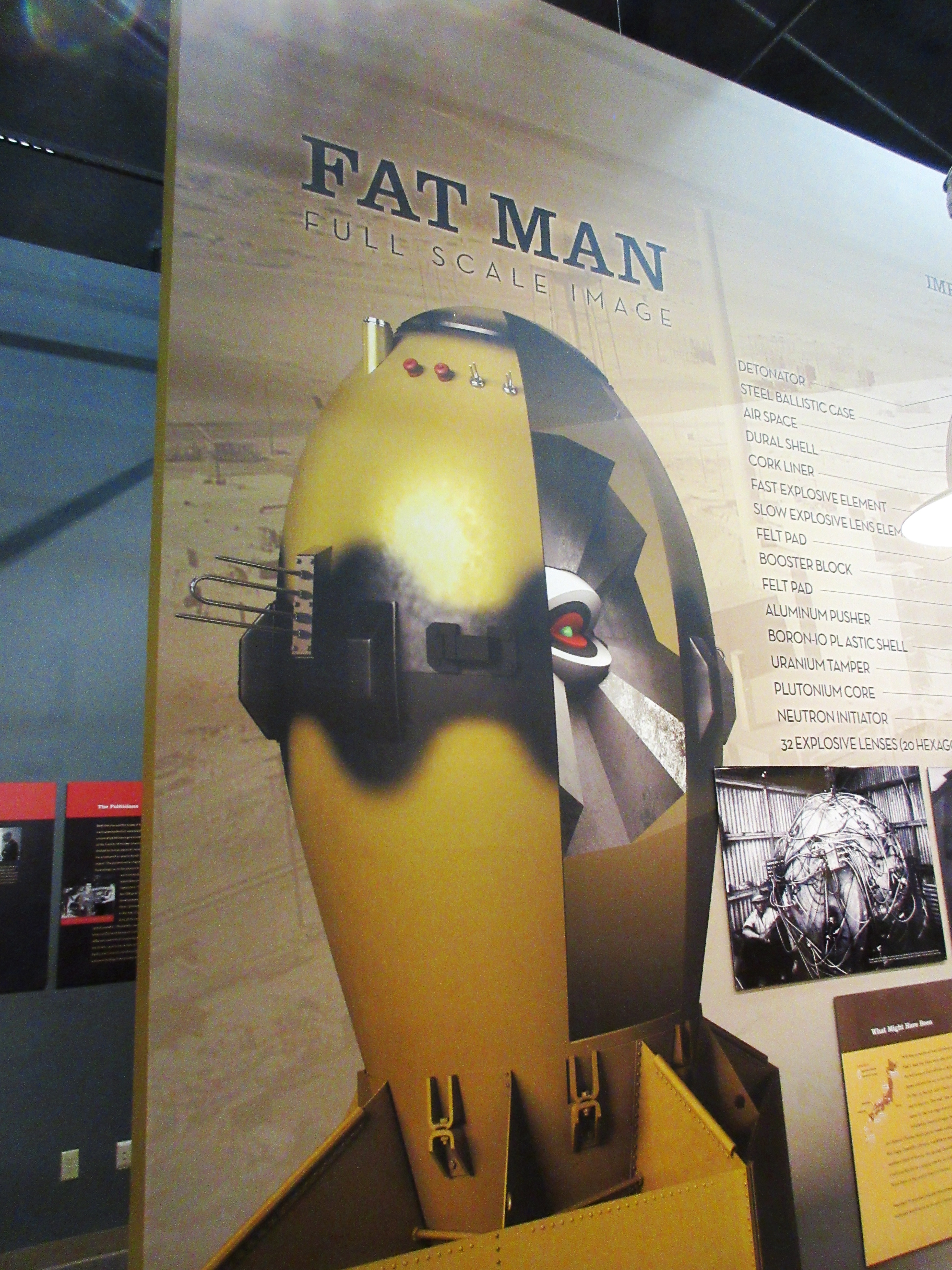
With all the discussion about “Oppenheimer” and his role in the development of the atomic bomb, one would have thought there were be more discussion of the other two locations which were key to his success. One was Oak Ridge in Tennessee, where uranium was refined for the first bomb, the other was Hanford, Washington, where plutonium for the second bomb was manufactured.
Like Los Alamos, Hanford was built in the most remote location possible, shrouded in secrecy, and filled with scientists who believed their labors would end World War II. At one point the town of Hanford was the fourth largest city in the state, with the largest General Post Office in the world (since addresses would have been Top Secret.) And as at Los Alamos, the scientists involved in the project worked with little apparent thought of the long-range effects of their labors.
The REACH museum outside of Hanford overlooks the longest undammed free-flowing reach of the Columbia River – hence its name. The country surrounding the museum is a sage and scrub desert, but it teems with wildlife including elk, antelope, an occasional bear, and all sorts of minor rodents, insects, and birds. Ironically, the reason for this virgin territory lies buried underground in unmarked sites and in leaking canisters – the radioactive waste left over from the plutonium project. No-one wants to drink water that may have overlain these poorly-conceived and poorly protected waste dumps.
The museum itself is a hybrid – half of it is devoted to the geology and wildlife associated with the Columbia River, the other half tells the story of Hanford, the plutonium project, and the community’s pride in its contribution to ending the war. Only one exhibit addresses the threat of radioactive contamination left behind, and that exhibit invites you to compare the amount of radioactivity in a vintage Fiestaware coffee cup to that in a sample of dirt from Hanford. (Surprise! the coffee cup’s red glaze has more!)
The US government has belatedly spent millions of dollars to remove or contain contamination around Hanford, and will need to spend millions more before it is safe to drink the ground water. But the town is still proud of its contribution to V-J day, still cherishes the government houses (Models A through F) thrown up almost overnight to accomodate the families, and wishes that “Barbenheimer” was”Barbanford”





















 Allyson Johnson