Allyson Johnson

Pieces of my Mind

Archive for the category “Memoir”

Read This Book (Los Altos Town Crier, Feb 3, 2016)

Imagine a dolphin swimming through the ocean depths, and suddenly becoming aware of the water’s being salty – something it had never noticed in the environment surrounding it every day – something it had taken as a universal fact. Then imagine that dolphin struggling with the concept of fresh water.
That would be something of the way I felt on reading Between the World and Me, Ta- Nehisi Coates’ award-winning exposition on what it is like to be “black” in America.51nX2wGTFXL._SX333_BO1,204,203,200_[1]
It had never quite gotten through to me, despite reading a fair number of books by African and Afro-American writers, that the concept of “race” which so permeates our society is almost a uniquely American idea. Other societies also make distinctions by skin color, preferring light-colored skin over dark-colored skin in their ideal of beauty, but only America makes the abrupt unilateral distinction between “black” and “white” which places a segment of our citizens irrevocably on one side of a chasm which the rest of the citizens do their best to ignore.


Coates refers to “those who believe they are white” to remind us that pink, peach, ivory, yellow, honey, or copper –colored skin is no more “white” than tan, chocolate, coffee, or ebony – colored skin is “black”. He tells us that racism is part of our American heritage, the dark side of the Constitution, Mt. Vernon, and Monticello. And he offers no suggestion of how to rid our society of this pervasive poison.
My parents grew up in Salt Lake City Utah. Until they were in their twenties and moved to the Bay Area, they had few ideas about race, as they had seen almost no African Americans in their lives thus far. Ironically, their innocence was a direct result of the Mormon Church’s deep-seated racism of the time, a doctrine which identified black skin as being “the mark of Cain” and excluded anyone with this taint from participation in Mormon society.
When my parents moved to East Texas, with two small children in tow, they entered a segregated society, complete with water fountains labeled “White” and “Colored”, separate waiting rooms for “Negroes” at the train and bus stations, segregated schools, and a shantytown. They did their best to keep us innocent, but racism was in the air. My parents almost never resorted to physical punishment, but I can remember my mother slapping my 5-year-old sister for hollering The N Word out the car window at a passerby. I knew what The N Word was about years before I had a clue about The F Word.
Decades later segregation is officially gone, and everyone drinks from the same water fountains. But Coates’ book opened my eyes to the constant and enduring presence of the idea of race in our American lives. Last month’s headlines about the lack of “black” actors and directors in the list of Oscar nominations could be understood only in American newspapers. The “Black Lives Matter” protests could only have caught fire in a society that accepts an artificial distinction between “black” and “white”.
If a dolphin discovers that the water he has been swimming in all his life is toxic, he has no choice – he has to keep swimming in it, even though it poisons him. Coates offers no easy fix” to our deep-seated beliefs about race . But perhaps as he makes us aware of the poison we breath in with every headline, we can somehow purify our toxic environment, thought by thought, word by word, deed by deed. Read this book.

History of a Plague (Los Altos Town Crier, Jan 6, 2016)

A quarter of a century ago, our world was threatened with a plague.  We reacted as humans do – first with ignorance (that’s an African thing), then denial (it’s just a few cases, and they’re all homosexuals, so I’m safe), blaming the victims (That gay lifestyle, what do you expect? If they would just straighten out…) and calls for social quarantine (Gay men should be required to wear a badge!) Mainstream America wanted to feel safe, because AIDS was fatal.  In 1990, if you contracted AIDS, there was no treatment, no cure.

At least three of my classmates died of AIDS.  Homosexuality was still mostly kept secret at this time. The obituaries tiptoed around the cause of death: “Complications of pneumonia”  “A long battle against disease”.  If there was no wife at the bedside, if a “long-time companion” was mentioned, one could guess.

And there were other casualties.  If you were unfortunate enough to need a blood transfusion  at this time, you were unknowingly at risk.  Blood donations were not screened for viruses, and the transfusion that saved your life one day could cause your death months or years later

Fast forward twenty-five years.  AIDS is still a tragic diagnosis, but not because there is no treatment. We now know the cause of the plague, we know how to prevent transmission, and we have medicines to treat it.  The tragedy is that people are still dying.

When the AIDS epidemic was first acknowledged, government decisions were made by the World Health Organization and by the US Center for Disease Control.  The epidemic, from being “just a blip on our radar” was now judged too widespread to make preventative measures effective.  The treatment was expensive.  The policy was announced:   There will be no funds for identifying HIV carriers, or for tracking the contacts of known carriers. HIV will only be treated when it has progressed to full-blown AIDS.  This shortsighted policy resulted in hundreds of thousands of undiagnosed, untreated HIV carriers infecting millions more people.

In the US,  private treatment funds have saved many thousands of HIV carriers ,  halting the progress of the disease,  and  preventing its transmission to others. But for many in the developing world, the cost of treatment is unmanageable. The plague goes on in Africa, where it wastes the bodies and lives of one and a half million victims yearly. 

The Los Altos Rotary AIDS Project, founded in 1989,  has adopted the strategy of the US military: Fight over there so we don’t have to fight over here.  Thousands of dollars have been funneled into Africa through the Save the Children Foundation to educate and treat pregnant women on how to prevent transmission of HIV to their children. There have been setbacks: Clinics established in Liberia were left un-staffed and empty when the Ebola scare dominated headlines; these clinics must be re-staffed and re-energized. But the work goes on.

If one of your New Year’s resolutions is to do something to make the world better,  a donation to the Los Altos Rotary Aids project would be a good place to start.   Contact [http://www.rotaryaidsproject.org/howyoucanhelp].

(My thanks to Dr. Art Amman for much of the information about the current state of AIDS worldwide.)


The Plight of the Trees

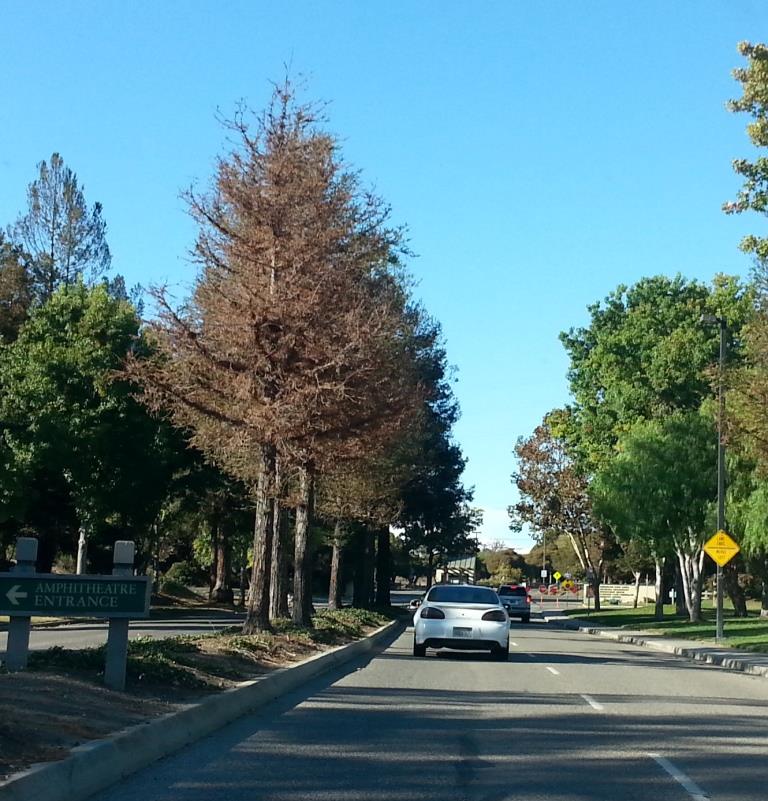
Dying redwoods in the median strip

Dying redwoods in the median strip

The combination of age and water conservation measures is taking its toll all around my neighborhood.  There are dead and dying trees on every street. Particularly sad are the landscape trees which were planted years ago when Los Altos was a new development, chosen for their rapid growth with no thought to their natural requirements, maintained for decades with irrigation, and now left to fend for themselves in an unnatural habitat.

Many of the redwood trees which tower along our major roads are slowly turning brown at the tips of their branches.  Growth rings on redwood trees show that they have survived drought periods as long as 200 years in duration, but not on the eastern side of the Coast Range.  Redwoods are adapted to get moisture from morning fog.  Deprived of their morning fog drink and  of  irrigation , they are struggling.

The Monterey pines are in even worse shape.   In native stands on the California central coast, a Monterey pine can live 100-150 years.  But “in captivity”, as a landscape tree, the life span shortens to as little as 20-30 years.  Monterey pines are adapted to live in crowded stands on thin soil underlain by bedrock.  As landscape trees, too much space, too much rich soil, and too much fertilizer all combine to put the Monterey pines in trouble..

Without sufficient water in the soil, the trees’ hydraulic system for transporting water to the limbs and leaf tips may fail, weakening the limbs and causing branches and trunks of well-established trees to split and fall.  My son’s car was totaled several months ago when a heavy branch split from the sycamore in his front yard.  Our flowering plum blocked our driveway when a third of its canopy fell.  Around my area old gnarled oaks and pepper trees have split down the middle. Seeing these trees go is like an old friend’s passing.  But when the branches fell from our plum tree we discovered a colony of wood boring grubs had ravaged the interior. It had to go. It felt like a mercy killing.

Gnarly almond hanging in there

Gnarly almond hanging in there

I felt differently about our almond tree.  One of a pair, its twin was sacrificed when my parents subdivided their lot so that we could build our house next door.  My father had worked tirelessly to protect the almonds from marauding squirrels, using his pellet gun to such great effect that for five years after his death the squirrels still avoided the area. The average life span of an almond tree is only twenty-five years and this one had struggled along for at least sixty.   Its bark had peeled off in large sections, leaving the bare wood to weather or rot where water collected in crevices, although it still bravely sported blossoms on its gnarled branches every spring.Almond - after

Finally, a few weeks ago, we ordered the almond tree and the plum tree cut down – too much of a hazard next to our driveway.  “This would make great firewood,” the arborist commented. “Don’t you want to keep the logs?”  But we converted our fireplace to gas years ago.  The logs were loaded into a truck for someone else’s hearth.

We planted a new little tree where the flowering plum had been.  It is a Chinese pistache, well known for its flaming fall foliage, recommended as a street tree by our city,  and reputedly very drought tolerant. It’s not going to bloom, but then it won’t be subject to fungus.  Despite drought conservation measures, we will be watering it every few days until the rains start.  Hurry up, El Nino!


Halloween Musings: Costumes

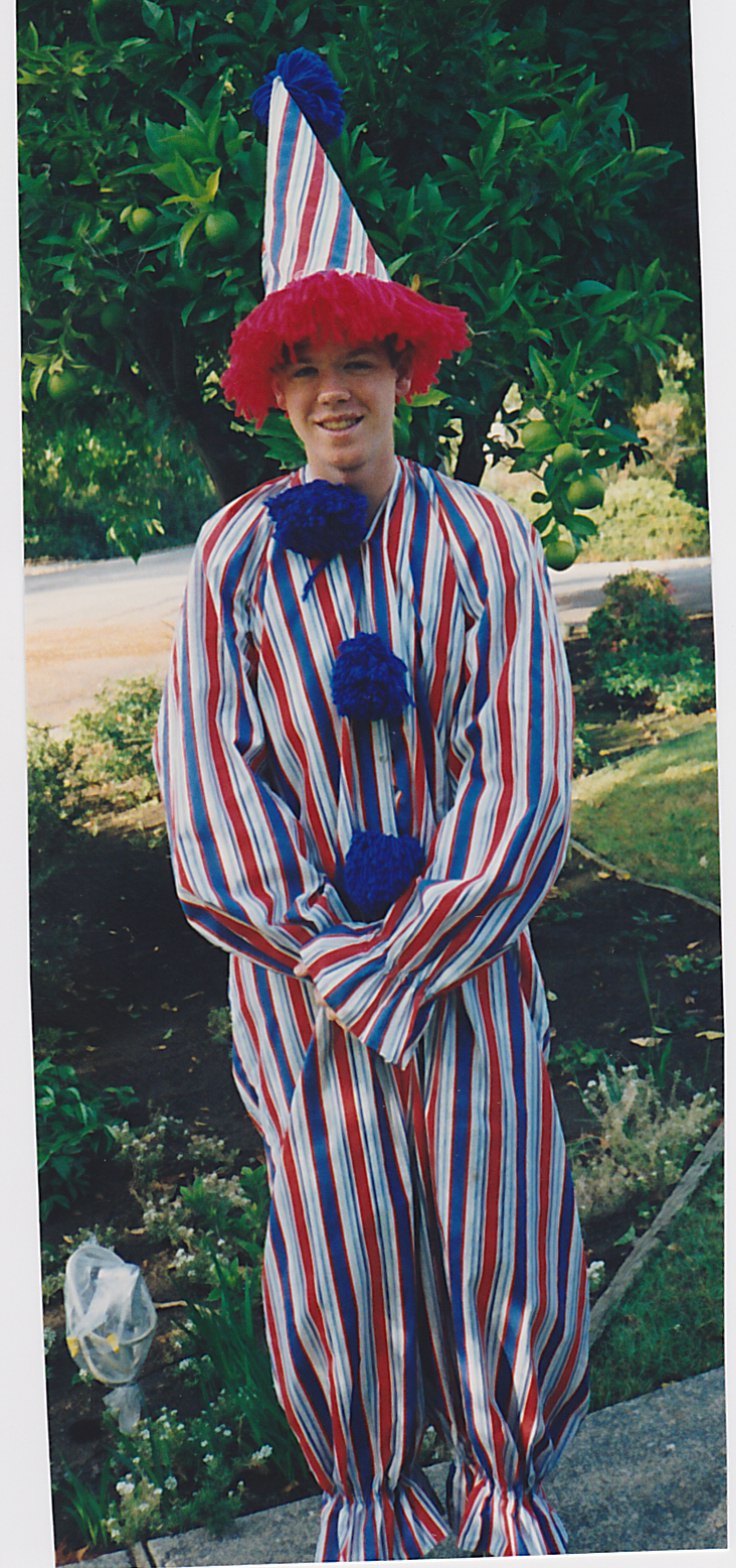
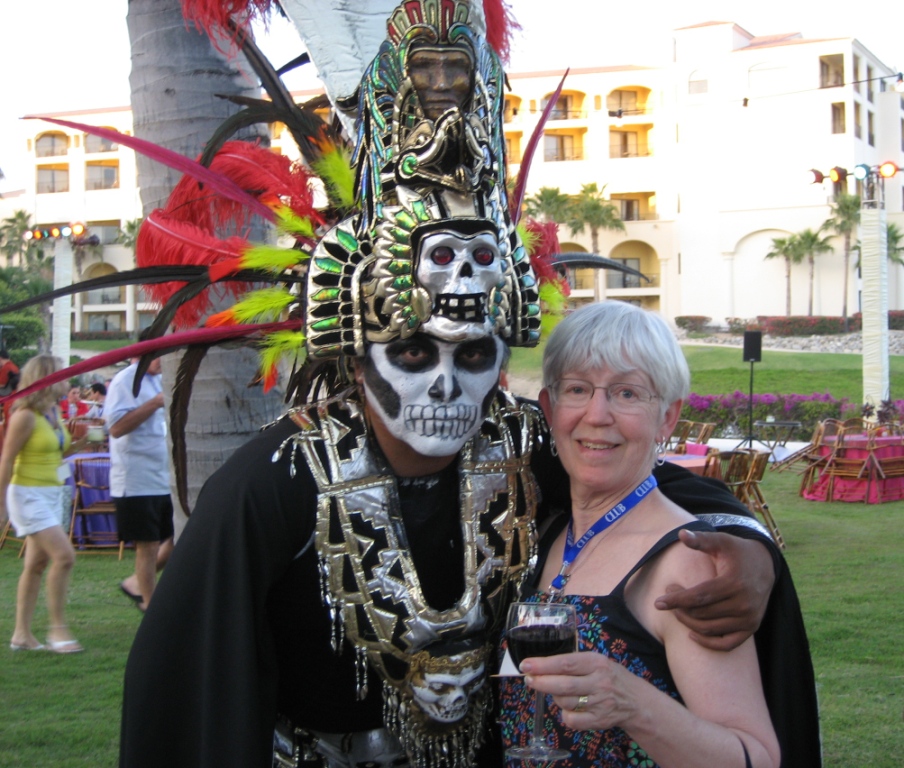
20151025_141531webHalloween, Day of the Dead, there’s something that makes us love costumes.  Maybe it’s the chance to express some aspect of our character that we normally keep hidden, maybe it’s a chance to go back to childhood where we were more free to imagine ourselves with alternate lives, when we might become almost anything.

Here is the same young man in  several different avatars –

Dan Oct1993

He can  be a clown —

Or a prince–Dan Oct1992

Or maybe experiment a little further – all the way to a different gender!

DragDancrop


No matter how you costume yourself, each imagination can bring you closer to the realest you.

And there is the romance of anonymity also – the classic question: who was that masked man? Whether you are behind the mask or in front of it, the romance of being unknown is only slightly more exciting than the romance of not knowing.

IMG_0490


So turn the kaleidoscope and come up with a new you for Halloween – maybe some part of the costume will stick!


Homecoming

Home 2008

Home – October 2008

Every year since we were first engaged, my husband and I have returned to his home town at least once.  Our visit a few weeks ago was the first time there was no family member to greet us and no family home to stay in.  Since my mother-in-law’s death last year and our final visit to her house to help clean out the accumulations of decades, the old home has been sold.  Instead of an upstairs bedroom with a shared bathroom in a home within walking distance from everything we might want to do and everyone we might want to see, we stayed in a tidy suite at a Wyndham just beyond the bypass that skirts the town.  We did a lot of driving instead of walking.

house2015

House October 2015

The young couple that had bought the old home invited us to come and see how they had updated it.  They had done wonders.  The narrow kitchen with its yellow formica counters and linoleum floor, where we had sat around the small table to dye eggs for many an Easter, was now a dining room and pantry.  The downstairs guest room, where I had slept chastely on visits to the home before our marriage, had been transformed into a master bathroom.  The dining room where three generations had gathered for Thankgiving and Christmas dinners was now a chef’s kitchen with gleaming stainless steel appliances and a granite island for informal eating. We ooh’ed and aah’ed and approved and told the new owner stories about how the house was built.  We had a fine time, but we won’t be going back.  It’s their home now.

We went for breakfast to Dunlap’s,  where we always had gone with my in-laws us because of the hearty portions and old-fashioned atmosphere.  We ordered eggs, wheat toast, home fries, coffee, and a fruit cup.  The eggs were perfectly fried.  The bread was only “wheat” in that it was a shade darker than “white”, but had none of the flavor or texture that we West Coast folks had come to expect.  The “home fries” were really hash browns, shredded, flavorless, and only browned in spots. The coffee was tasteless.  The fruit cup was dumped from a can of fruit cocktail.  We won’t be going back.

The next day for breakfast we tried Café St. Amand , a new French restaurant that advertised crepes and croissants.  I had a fresh-made crepe wrapped around fresh strawberries and blueberries and fresh whipped crème.  My husband had French toast made with brioche bread sprinkled with powdered sugar and cinnamon.  It all tasted great including the French roast coffee, and it actually cost less than Dunlaps. .  It wasn’t small-town home cooking. We loved it, and went there again the next morning.

For dinner we went to the historic Dobbin House restaurant where we had celebrated my mother-in-law’s 90th birthday. It had always been the best restaurant in town, despite the waitresses dressed in period costume and the pretentious menu  (e.g., describing the bread basket: A basket of afforted colonial breads paffed to your table fresh from our own bakery, served up with a galipot of butter.)

The food arrived: a plateful of salad, enough for a meal in itself.  Then the entrée – a large seriving of meat, heaps of vegetables, and a large baked potato with assorted trimmings to choose from.  I felt as though I was at an athlete’s training table. That’s not the way we eat anymore.

The next day we met a friend from the local college.  “You should try the new Gettysburg Baking Company,” he told us.  “They bake their own bread, even sourdough, and they have really good sandwiches.  It’s right on the square, where the Visitor’s Bureau used to be.  Too bad the new restaurant out at the Country Club is closed on Sunday. A guy from Philadelphia took over the clubhouse as a restaurant.  It’s really good – expensive, but they also serve tapas – small plates. You can make a meal of appetizers.”

We were amazed – a gourmet bakery and a tapas bar? Not the place my husband grew up in!

We did a lot of driving around the beautiful countryside.  The lawns were green, the trees were just beginning to turn red and golden.  We did some hiking on familiar paths.  But we returned to a hotel, and no one to share our adventures.

The town and house where you grow up are like molds that help form you into the person you become.  But there are reasons you can’t go home again.  You change. And so does the mold.


Car Spotting 2015 (Los Altos TOWN CRIER Sept 2, 2015)

Pagani1 When I was a kid, September was exciting, almost like Christmas, because that was when the Big Three automakers would reveal the new models for the upcoming year.

Previous to the announcement date, there would be mystery and skullduggery, as the new models were trailered to dealerships shrouded in black drapery to maintain suspense while car buffs and rival carmakers would do their best to sneak photos of the new cars before their debut dates.secret1

The Big Reveal came with fanfare and hoopla. The new cars sported chrome and optional vinyl roofs, fancy rocket-ship hood ornaments, candy colors and exotic attributes like “dynaflow,” “swept-wing” and “push-button drive.” Once the new models were officially available, I eagerly scanned the road, hoping to actually see one. The high point of my youthful car spotting was a Chevy Corvette, turquoise and white, which roared down the highway past us one day to my awe and wonder.corvette1

Then cars dulled down. The new models dribbled out over months rather than in a couple of September weeks. The exteriors reverted to one color, chrome was expensive and heavy, vinyl roofs proved not durable, swept-wing fins were hazardous to pedestrians when backing up and rocket-ship hood ornaments the same when going forward. Candy-colored paint contained lead and tended to go chalky on exposure to sun. My interest waned.

But recently the excitement has returned. One of the side effects of the Google/Apple/Facebook explosion is that there are a certain number of folks around our neighborhood who have more money than they know what to do with. And if you are an American male with lots of extra funds, inevitably some of that extra seems likely to be invested in The Car. Not just any car, but a Head-Turner, a Statement, Bling-on-Wheels. Spotting one of these exotic vehicles adds zing to the most ordinary auto outing.

The sporty Mustang has reappeared in bright primary colors; Corvette ditto. I have grown adept at identifying a Tesla, in its various models, a Bentley, a Maserati and a Ferrari. I have driven past the McLaren dealership on El Camino Real and peered in the windows, but I’ve never seen one on the road. showroomPA1

The prize of my car-spotting collection appeared one sunny Saturday afternoon driving home from the beach on sluggish Highway 17. I heard a roar behind me, and there it was. Black, low to the ground, with an Italian name, sexy curved fenders and strange aileron flaps that rose and fell as the car braked in traffic. Comparing this sports car to a Corvette would be like comparing Sophia Loren to Taylor Swift.

Because we were both inching along, it was not difficult to read the name on the rear. A quick thumbing of my smartphone revealed that I was looking at a Pagani Huayra, an Italian sports car with a 720-horsepower engine and a top speed of 231 mph. It is named after Wayra Tata, “God of the Winds” in the Inca Empire. It costs roughly $1.3 million.

I felt a little alarmed. If someone is going to be driving a $1.3 million car on public highways, shouldn’t he or she have outriders as are provided for trucks carrying oversize loads? “Caution: Hyper-expensive car ahead! Pass with care!” In the stop-and-go beach traffic, what if some unfortunate accountant or schoolteacher or retiree bumper-kissed this black bombshell? There goes the monthly mortgage payment!

My enthusiasm for car spotting has cooled a bit. Even if I do see a McLaren on the road, it will seem like a poor substitute for the God of the Winds.

The question I hope someone is able to answer for me: If you build a $1.3 million car, do you have to satisfy U.S. highway crash-testing requirements in order to drive it on the road? And who gets to pick up the pieces?

corvette2 Pagani3

My Solar Clothes Dryer (Los Altos TOWN CRIER, August 5, 2015

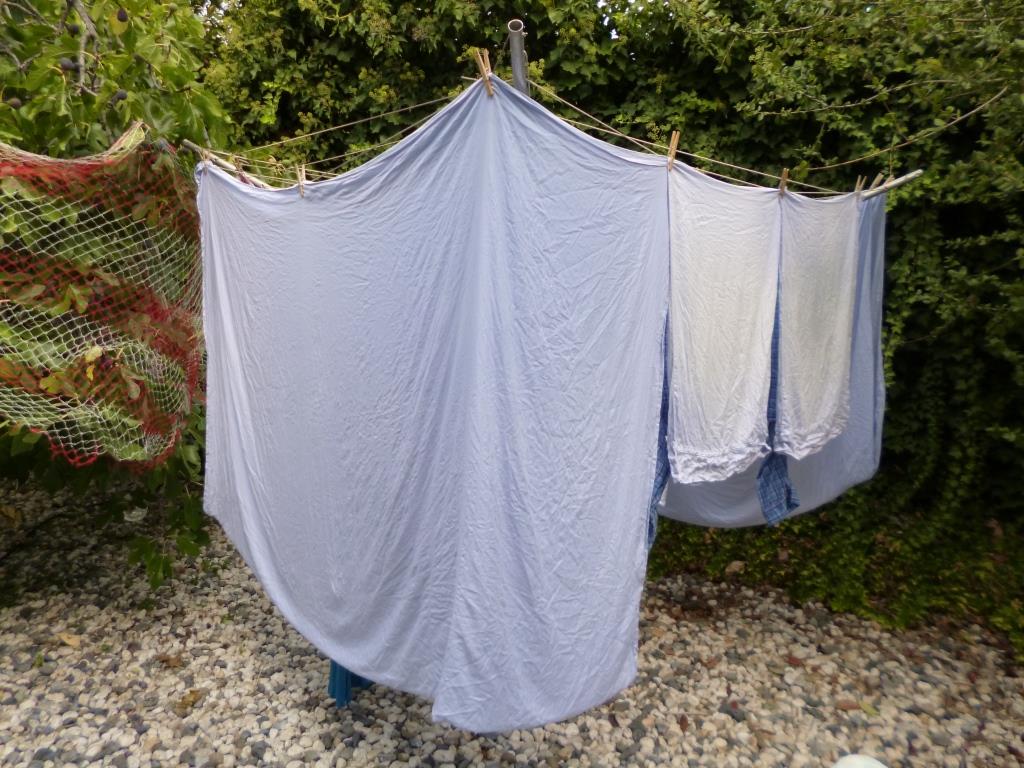
Solar clothes dryer

My cousin periodically sends me Internet nostalgia with comments along the lines of “Are you old enough to remember this?” One of her recent items struck me as newly useful in our energy-conservation-conscious times:

The Basic Rules for Clotheslines: (If you don’t even know what clotheslines are, a quick look on Google or Wikipedia will clarify.)

1. You had to hang the socks by the toes … not the top.

2. You hung pants by the bottom/cuffs … not the waistbands.

3. You had to wash the clothesline(s) before hanging any clothes – walk the entire length of each line with a damp cloth around the lines.

4. Wash day on a Monday! Never hang clothes on the weekend, or on Sunday, for heaven’s sake!

5. Hang the sheets and towels on the outside lines so that you could hide your “unmentionables” in the middle (perverts and busybodies, y’know!)

6. If you were efficient, you would line the clothes up so that each item did not need two clothespins, but shared one of the clothespins with the next washed item.

7. Clothes off of the line before dinnertime, neatly folded in the clothes basket, and ready to be ironed.

My cousin claims not to have used a clothesline since she first discovered dryers at the laundromat. For me, my clothesline is an integral part of my Saturday routine. It is very soothing to take the laundry outside and pin up or hang the clothes. It gets me outside, makes me bend and stretch, and saves at least one dryer cycle.

I don’t follow all of the rules above. Contrary to Rule 1, I always hang socks by the tops, paired with a single clothespin. I’d never heard of Rule 3 – I guess my mother assumed that the occasional rain would keep the line fairly clean. And for a working woman, Saturday, not Monday, is wash day.

Rule 2 has been made pretty obsolete with the advent of permanent press and spandex. When I was a child, my mother and I struggled on laundry day with pants stretchers that you put down the legs of trousers and expanded as much as you could so that the trousers – especially jeans – would dry with fewer wrinkles. Now all I have to do is hang the pants by the waistband with the fly zipped and they will dry flat.

Because I own a limited number of clothespins, I have to challenge myself to use as few pins as possible, as Rule 6 above suggests. (That’s about as much challenge as I can stand on a Saturday morning.) And I do hang sheets on the outside line, but only because that’s where they fit best on my umbrella-style clothesline. (See solar clothes dryer in privacy mode below.)

Permanent press and Kleenex have also put an end to the sprinkler bottle, used to dampen pillowcases, dishtowels and handkerchiefs so that they could be ironed more easily. My older brother made ours at Boy Scout camp – an RC Cola bottle painted green, with a decoupage flower on the side and a sprinkler top secured by a cork stopper. (I’m sure my brother will curl up and die now that I have revealed he is a decoupage maven.) Ironing now is only for the linen napkins if company is coming.

But despite some improvements in textile technology, I’m still enthusiastic about my small-ecological-footprint, resource-efficient, cost-effective, reusable, easily repaired combination low-impact aerobic exercise device/solar clothes dryer, available in retractable, parallel and umbrella versions from most online or offline housewares providers. Let me encourage you – take wash day back to the future! Solar dryer- privacy mode

The Death Knell of Suburbia (Los Altos Town Crier, July 1, 2015)

Photo by C Birnbaum

Photo by C Birnbaum


The orchards are gone. The single-story ranch house is seen as a waste of valuable land and air space. An eight-lane freeway thunders past the bridle paths in Los Altos Hills. But nothing has signaled the death of surburbia more definitely than the announcement last month that Sunset, the “Magazine of Western Living” is abandoning its spacious, rambling, garden-focused headquarters in Menlo Park and relocating to an urban shopping/restaurant hub in Oakland.

When my family moved to Los Altos in the late 50’s, we knew nothing about suburban life. My parents had been raised in a city, relocated to a smallish county seat in the mid-South, living in a succession of small homes. Then we found ourselves in Los Altos, on nearly an acre of land which included sixteen assorted fruit trees, three assorted nut trees, plus a grapevine and a mint patch, a separate outbuilding (part garage, part workshop, part toolshed) and a creek in the back.

Sunset, May 1993

Sunset, May 1993

Sunset became my parents’ bible. My father learned about composting, about roto-tilling, and about hulling walnuts and protecting almonds from squirrels, and about grilling steaks and salmon and trout on an outdoor grill. My mother learned how to dry apricots, can peaches, make plum jam, and put together a block party or a kid’s Christmas craft workshop. For years my parents saved every issue, just in case they needed a recipe for fig chutney or how-to instructions for making a picnic table or a lawn chair. I even appeared in a sidebar about making party banners, back before you could buy banners for every occasion in the hardware store.

Sunset August 1976 -That's me at upper right!

Sunset August 1976 -That’s me at upper right!

Of course, when I brought my young family back to Los Altos in the 80’s, we immediately subscribed to Sunset. I noticed a change. There were fewer articles about how to make things, and more articles about where to buy things. The recipes used more exotic ingredients like fenugreek and sumac and grapeseed oil, and less of the things you might grow in your own yard. A wine section had been added. The travel section listed more resort hotels and fewer family camping spots.

According to the announcement of Sunset’s move to Oakland (San Jose Mercury News, June 3, 2015) “the new headquarters… underscores the shift in western lifestyles in recent years…. Rooted for decades in suburbia and the suburban lifestyle…, the magazine now is following the trend of young tech workers, empty nesters and others who increasingly seek larger cities for their homes.” Per Sunset editor-in-chief Peggy Northrop “ we are joining the trend that our readers have started.”

Sunset July 2015 - pay to play!

Sunset July 2015 – pay to play!

I didn’t go to the last Sunset Celebration, the annual food/wine/garden/home décor party that has been hosted for decades at the Menlo Park headquarters. I didn’t want to say good-bye to the showcase gardens, which had been one of the places we always used to take out-of-state visitors to convince them that we really were living in Paradise. The property “is deemed to be a prime spot for development of first-class office buildings.”

I wonder if they will install a tombstone, or at least a memorial plaque: “Suburbia – born in the Valley of Heart’s Delight, 1950; died in Silicon Valley, 2015. And so goes the dream.

P1020825web

Sunset June 1976 – Campfire Cooking

Sunset July 2015 - Almond Torte with grilled figs

Sunset July 2015 – Almond Torte with grilled figs

Freeway Free in New Mexico: the Turquoise Trail

turq-pics_056-995x269New Mexico Highway 14 – the Turquoise Trail – parallels  I-25, the main road between Santa Fe and Albuquerque.  I-25 despite boasting  three lanes of (light) traffic each way is not  a freeway, as it alternates creatively decorated overpasses with intermittent cross traffic.  If you want to travel a beautiful bypass full of surprises, choose the Turquoise Trail.

The name is  a marketing ploy to attract tourists.  There are no opportunities to mine for turquoise, and not very many of the Indian arts and silversmithing shops that are so ubiquitous around Santa Fe’s main plaza. “Turquoise” is mainly the color of the overpasses feeding toward the Interstate 10-15 miles west.

What you will find is beautiful rolling open country dotted with sage, pinon pine, and juniper, punctuated by red rock escarpments stretching off into the purple distance where mountains lump up against the horizon.

The_band-565x292And there is amazing and amusing roadside art, first in dribs and drabs, e.g.  lifesize mustangs cut out of sheet metal and painted bright colors, interspersed with mustang-sized sheet metal origami cranes.  Then cresting into a tsunami of eccentricity in the  artist colony of Madrid (pronounced with the accent on the first syllable – rhymes with Hagrid) – a rather dilapidated settlement of old buildings, bright paint, tie-dye and macramé warped out of the 1960’s into a colder, blander 21st century.

We had a deadline to meet in Albuquerque, so we did not stop even to take pictures.  But one day I want to trek the Turquoise Trail again, and maybe spend some serious time lolly-gagging in a weathered rocking chair behind the wind chimes and macramé plant holders on one of those slightly skewed porches looking out at the passing parade.

Freeway Free in Santa Fe

IMG_0476doc

If you are in Santa Fe, stay at the La Fonda. Why not? It has all the historic charm of the Ahwahnee Hotel in Yosemite, or the El Tovar at the rim of the Grand Canyon. It is not located in a national park, so it went through some hard times before being lovingly restored to splendid 1920’s level grandeur. And it is MUCH more affordable than the Ahwahnee with all the wonderful hand-hewn timber, eccentric architecture (there are at least three different ways to get to any given room), interesting restaurant menus and wonderful service.P1020698web


IMG_0471webOnce you are there on the square, take a city tour. Why not? It will give you an overview of what you can walk to or drive to, some historical background, some pretty corny jokes, and an interesting group of fellow tourist to exchange home town data with. It’s a pleasantly slow ramp-up to the day, and you can hop on a trolley right outside the La Fonda. It will take you through the art scene street (see above), some excellent outdoor sculpture, and leave you with lots of ideas on how to spend your NEXT trip to Santa Fe. (Museum Hill?  A whole day we didn’t have to spend this time!)


Once you have finished your city tour, you will want lunch. There you are on the plaza/. Try the Famous Plaza Cafe – lots of history on the plaza, pressed tin ceiling, friendly and fast service, and killer fish tacos.P1020721web


Now it’s time for the museums. The New Mexico History Museum  is a GEM according to AAA’s road guide, and rightfully so. With admission you also get to explore the Palace of the Governors, one of the few surviving real adobe buildings in Santa Fe (the others are brick coated with stucco in imitation) and probably one of the few single-story palaces in the world.  And if you have read Willa Cather’s “Death Comes to the Archbishop” (and I hope you have, as a prep for your Santa Fe visit) you will find portraits of ALL the main characters hanging in the Museum or the Palace – instantly recognizable.


P1020741webOn your way back to La Fonda, be sure to explore inside the Cathedral of St. Francis of Assisi which faces the square. Again, if you have read “DCttAB” you cannot fail to be moved by the statue of the austere Archbishop Lamy who reformed and re-energized the New Mexico church mission, and by the little wooden Madonna, regally gowned by the devout needlewomen of the Santa Fe diocese, who is the core of Catholic tradition in the area, paraded around the square in her finery once eacy year.


You’ve walked a lot. Time to relax at the pool in the La Fonda central courtyard. It’s shielded from wind and sun and kept at a perfect temperature.P1020734web


Once you are dry and dressed, present yourself at the Bell Tower Bar at the very top of the LaFonda, with a 360 degree view of the square,the town, the mountains, and the clouds. Everyone up here is in a good mood – what nicer place could there be to strike up a conversation with the folks around the firepit or cocktail table?

And if you have not filled yourself up on appetizers at the Bell Tower, finish off your Santa Fe day at La Plazuela, the restaurant in the former courtyard (now roofed with a skylight) around the fountain at the center of La Fonda. There are other restaurants in town which boast Michelin stars, but none that can boast more atmosphere or history. I recommend the pork tamales.


The evening is up to you.

Post Navigation