Freeway Free in France: Following the Unsteady Footprints of van Gogh

Arles, of course, was one of the stops Vincent van Gogh made while searching for sanity and artistic fulfillment in Provence. After the dark murk of the Netherlands, the bright colors and warm weather seemed to galvanize his artistic expression, but unfortunately did little to stabilize his mercurial mood swings.
Arles was van Gogh’s home for eighteen months, and some of his best-known paintings were executed during that period. Modern Arles has seized on van Gogh’s posthumous popularity by providing posters marking the sites as above.
In Arles, van Gogh lived for a time with Paul Gauguin in the Yellow House which appears in several paintings. This house no longer exists. However, the hospital to which he was committed after he cut off his ear in an alcohol-enhanced rage still exists, its courtyard now filled with post cards, posters, t-shirts, and other memorabilia of the artist’s stay.
Just a block or so away is the cafe where van Gogh and Gauguin hung out. At the time, the cafe was painted a modest beige with brown trim, but that’s not the way van Gogh saw it or painted it. Surprise! the restaurant is now bright yellow with blue trim and yellow awnings, just as van Gogh saw it.
Outside the center of town is Alyscamp, a park centered on an avenue of trees leading to a Romanesque chapel. The trees cannot be painted to match van Gogh’s vision, but it is interesting to compare that vision with reality. in a mental hospital. The park is green and peaceful, with romantic ruins and vistas. The interior of the chapel includes a pool filling the lower lever -not clear whether this is intentional or an accident of age.

As van Gogh’s mental instability grew, Gauguin moved out, and van Gogh’s brother Theo enabled him to relocate to a mental hospital in St. Remy, which still exists. Reading the lists of treatments to which mental patients were subjected at this time is like reading of the Spanish Inquisition. The patients were confined in ice cold baths, bound, beaten, and burned, all with the idea of driving out the devils which had taken over their thoughts and actions.
Part of the hospital is still used as an asylum, but one can still see van Gogh’s bedroom and the tubs used for the ice cold baths to reduce his choleric humors.
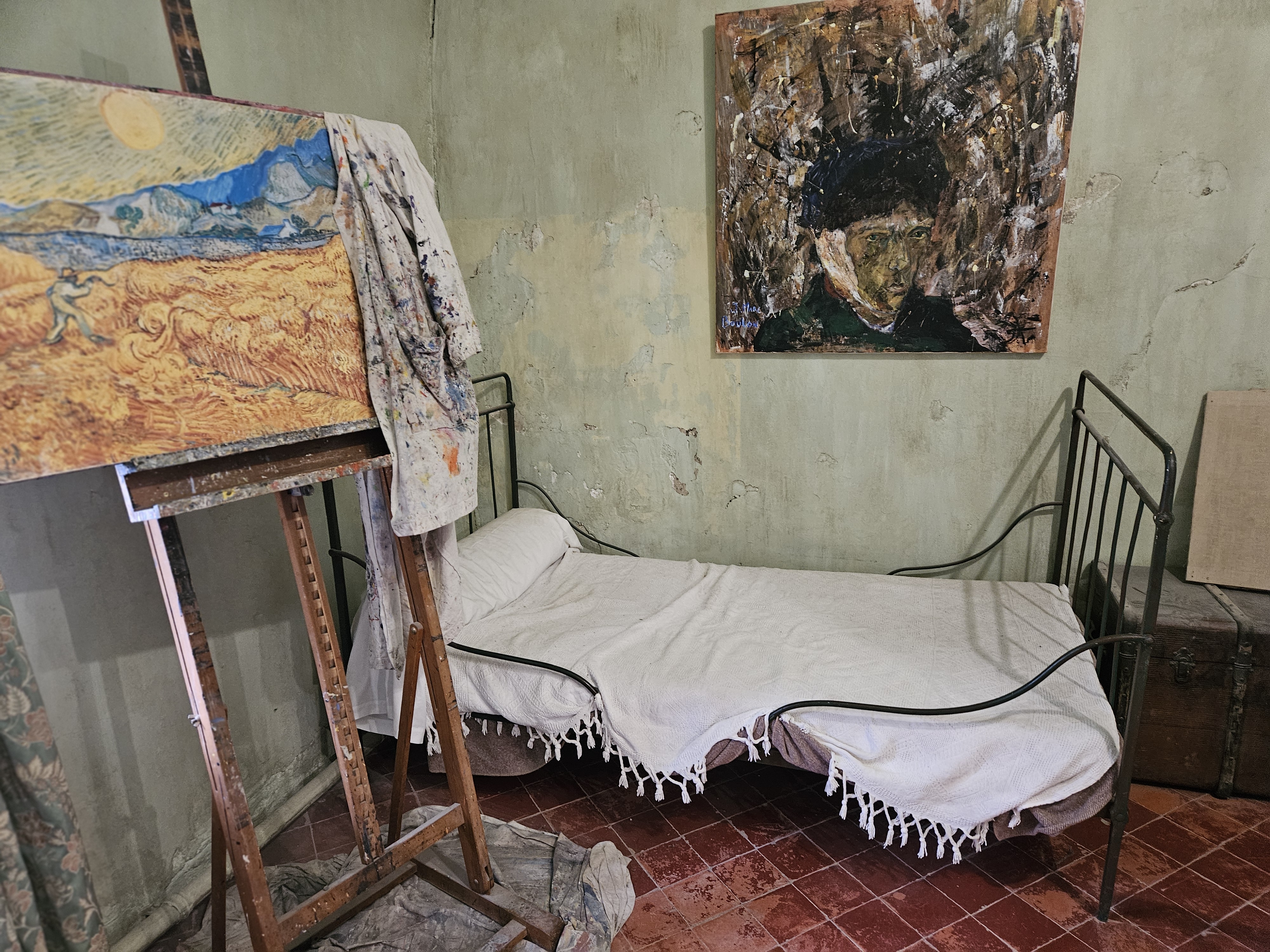

But outside, one can still see the orchard which inspired his painting, and iris are still blooming in the garden.

Later van Gogh was released from the hospital at St. Remy, and went to stay at Auvers, where he pained perhaps his best-known work “The Starry Night.” He died two days after suffering a gunshot wound. There is controversy about whether the wound was self-inflicted or whether it was the result of an accidental shooting by a group of teenagers who alternately patronized and teased van Gogh.
The leader of the group was the son of the local pharmacist, who owned the only gun in town. The son was prone to dress up in cowboy garb after seeing the Buffalo Bill Wild West show in Paris, and left town abruptly the evening that van Gogh appeared with his gunshot wound. Of course, this theory is not as attractive as the image of the tormented artist driven to suicide by a lack of appreciation, as Don McClain’s “Starry Starry Night” would have it.

 Allyson Johnson
Starry Night is a favorite painting of mine.
LikeLike
Very fine writing and photos, dear.
LikeLike