Freeway Free on the Mississippi: Tying up at Vickburg
 I had never paid much attention to the Siege of Vicksburg in my readings about the Civil War. Of course, the victory at Vicksburg made Ulysses Grant a hero and set him up for Appomattox later, but the other great Union victory at Gettysburg overshadows what was happening at almost the same time at the other end of the Mason – Dixon line. The Battle of Gettysburg lasted only four days, the territory of the battles is compact, and there is a clear turning point, dramatically titled “the High Water Mark of the Confederacy”.
In contrast, the Seige of Vicksburg lasted seven weeks. There were a number of small, inconclusive battles which took place miles from Vicksburg in April and May which led up to the Seige. Grant finally won his victory by cutting off supplies to the town and bombarding it from both river and land. The Vicksburg National Military Park, like the Gettysburg National Military Park, surrounds its eponymus town on three sides, but the actual battlefields are miles away. Like Gettysburg, the Vicksburg NMP has monuments scattered about commemorating different states’ contribution to the battle, but they are much less numerous and massive than those at Gettysburg, as if the city was simply too exhausted to raise many tributes to the fallen. We are, after all, in Mississippi, on the losing side of the war. The two Civil War re-enactors who talked to us at the Park seemed ruefully anachronistic, as they were both at least forty years older than the soldiers whose roles they were playing
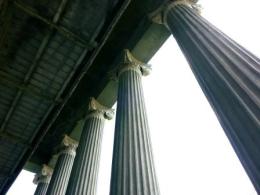 The Old Court House Museum in the center of town is small, intimate, and indomitably Southern. It includes battle flags from the Confederate Army, but few from the winning side. It includes donations of baby shoes and quilts and beaded purses from local ladies. It includes an un-abashed depiction of slavery which defends it as a humane and mutually beneficial relationship between master and slave. It includes an exhibit of china which is exactly like the set I inherited from my great-grandmother.


The walk down to the dock on a hot afternoon was a step back in time. As we left the historic district the sidewalks became more uneven, cracked, or non-existent. Black families sat on their front porches, lazily waving palm-leaf fans. Our tour boat waited for us on a nearly deserted quai, walled off from the town by a protective barrier which marked the height of historic floods. Vicksburg seems caught in a bubble of history, waiting for the past to come around again.


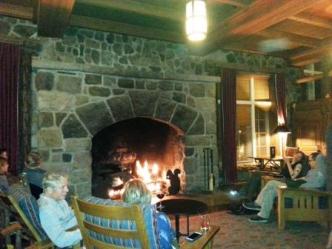 The Crater Lake Lodge is not the Ahwahnee, no yet El Tovar or the Old Faithful Inn, but has done its 1995 restoration/renovation best to revive the rustic resort ambience within the limits of a hotel located in one of the snowiest spots in the US, open only May through October if the weather permits. It does boast pillars and stairways made from Douglas fir trunks with the bark still on, and big stone fireplaces surrounded by the kind of chairs you can sink into.
 The next morning the smokiness has magically disappeared and the lake is the blue seen normally only on cheap postcards. We decide to take the

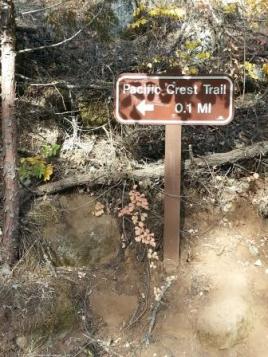 The falls and the lake are a popular stopover for hikers on the Pacific Crest Trail who need rest, refreshment, and re-provisioning. If you want to visit, the loop trail from the top to the bottom of the falls over a rainbow bridge gives a beautiful introduction to the area.


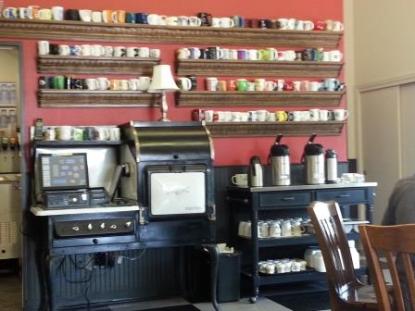 The
The 
 After lunch we walked off a calorie or two at the adjacent Library Park – an oasis of greenery and shade, complete with a bandstand and evident signs of a major festivity impending. The Library is an old Carnegie library building converted into a community center, while a newer, less picturesque but presumable more functional library has replaced it in the same park. Across the street from the park are a spiffy new police station and city hall. A new Lincoln waited at the stop sign as I crossed the street – there must be money in this town somewhere.


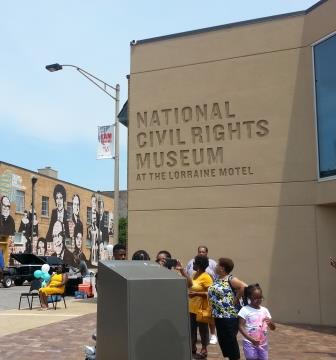 The National Civil Rights Museum is located in the former Lorraine Motel. At the time of Martin Luther King’s assassination, it was the only motel in Memphis which accommodated black guests. It documents the civil rights movement of the 1950’s and 60’s from Rosa Parks’ refusal to give up her seat on a bus up to MLK’s murder. I lived through these years. I was fascinated.


 Allyson Johnson