Allyson Johnson

Pieces of my Mind

Archive for the tag “women trekkers”

Freeway Free in Spain: One-Night Stand in Salamanca

Plaza Mayor - SalamanceMy niece Jen suggested that we should stop in Salamanca on our way to visit her in northern Spain, so we did, on the principle that a traveler should always take advantage of local recommendation when you can get them. Salamanca is famous for its beautiful Plaza Mayor, for its university, and for its cathedral, and justly so. You can read about those things in Lonely Planet and Fodor, just like I did.

In twenty-four hours, guide books in hand, we did there mostly what tourists do, saw what the guidebooks said we should see. For every other stopover we had established a home base and enjoyed day trips. Somehow, the home base gave me more of a feeling that I was getting to know an area, where the one-night-stopover felt like… a one-night–stand.

Salamanca- suburban desertOn entering the outskirts of Salamanca we saw the evidence of the disastrous Spanish housing bubble – acres of empty scraped land, streets laid out, with sidewalks and street lights intact, but no paving, set with lollipop trees all dead of neglect except for the hardy pine trees, no sign of construction activity. Gives new meaning to the term “desert”.

After settling into the Hostal Concejo looking out at the small Playa de Libertad, we set out to see Salamanca, maps in hand, cameras at the ready. We toured the famous plaza and dutifully took pictures of the much-defaced, often-replaced plaque of Franco among the other Spanish dignitaries honored on the Plaza in bas-relief.Franco and colleague

A better alternative: Down the hill along the Calle de San Pablo we found the convent de las Duenas.  Here in the cloister the carvings of demons and souls in torment are much more lively and evocative than the formal portraits of the Plaza. One wonders what the nuns made of some of the more explicit carvngs – they  would not seem to lend themselves to calm meditation and spiritual uplift. Adam unleashes demons

We strolled our way down to the old Roman Bridge across the Rio Tormes, admiring the golden carved façade and gilded carved interior of the Cathedral on the way. It felt a little ho-hum after the Roman remains of Merida and the Conquistadors’ gold we had seen flaunted in Trujillo. From the bridge we turned back to look at the city and spotted the amazing blue-stained-glass Art Deco façade of the Museo de Art Nouveau y Art Deco soaring above the river.

Museo Art Nouveau y Art DecoOf course we had to go look. Totally not Romanesque, Gothic, Classic, Baroque, or Ho-hum! Very strict rules against taking pictures inside, though, so you will have to take my word that the interior includes everything from Limoges and Lalique figurines to Kewpie dolls and scatological ashtrays, in a setting inspired by Gaudi and Louis Tiffany. A must-see (and a nice change of pace from all that Old Stuff.)

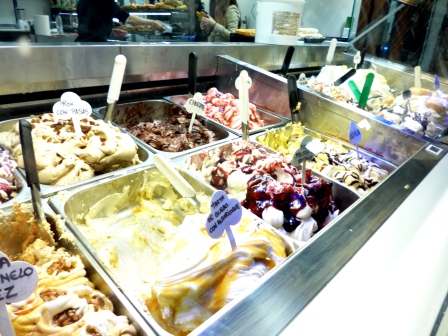
In Salamanca we had our first real culinary disappointment. The desk attendant at our hotel was not the comfortable matron of the afternoon – perhaps it was her son. We asked him for a recommendation to a local tapateria and he sent us to just the place a beardless youth would like: noisy, crowded,cheap ,bright, beery, and full of soccer fans. We fled, but try as we might we could not locate the kind of cheerful,friendly conversation-friendly place we had enjoyed in Caceras. We ended up in a near-by and near-empty joint with only a few middle aged soccer fans clustered at the bar. Too late we realized this dearth was a reflection of the fare and the service, but we were too hungry to look further . We drowned our disappointment in striacchiatti (chocolate chip gelato) and fresh berry yogurt from a shop on the way back to our plaza.Helado - Spanish comfort food
Freeway Free in Spain: Don’t Forget to Bring…

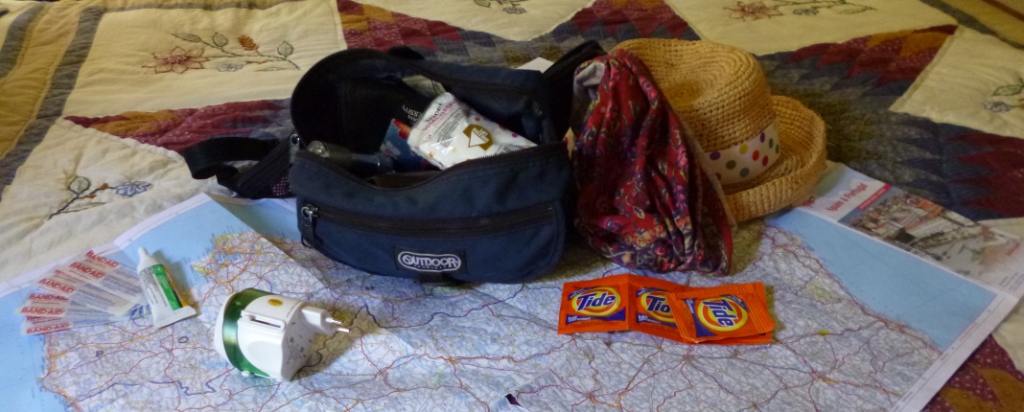
Thngs to bring

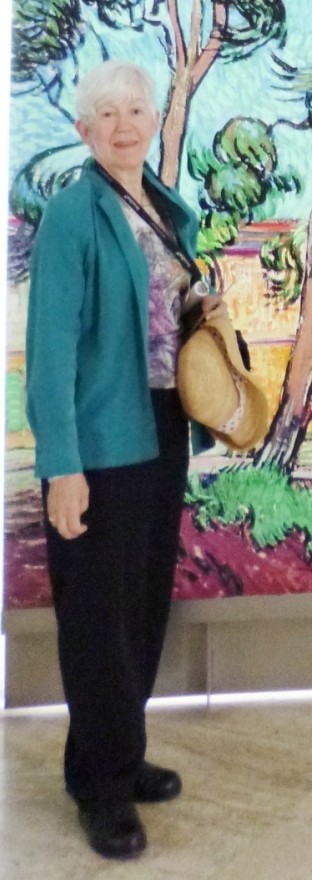
Note plain dark pants; sensible shoes, hat, shirt jacket are the same

Note plain dark pants; sensible shoes, hat, shirt jacket are the same

Note: raffia had, fanny pack as purse, bulging pockets of cargo pants

Note: raffia hat, fanny pack as purse, bulging pockets of cargo pants

I found my packing list for the Spanish trip today.  Reviewing, these are the things which jumped out as having been most useful:

A fanny pack. Mine is a dark color that can double as a purse or shoulder bag. It has lots of zippers, easy-access compartments, an adjustable strap with a sturdy clasp, and room for a water bottle.

A flashlight in the fanny pack –  in Spanish toilets  sometimes the light is on a timer and goes out unexpectedly, sometimes the switch is on the outside and a well-meaning user turns the lights off on exiting, sometimes there is no window and you need a flashlight to find the light switch.

Bandaids and anti-biotic – you hope you won’t need these, but in my case , both came in handy when I bumped the mirror in our Caceras hotel room and then caught it one-handed as it bounced. It only sliced a bit of the web between two fingers, and the Band-Aids and ointment eased both pain and anxiety.

A shirt jacket with a pocket on the front big enough to carry your camera – easy to get to, but out of sight, so you don’t scream “Tourist!” to every passerby. A dark color looks dressier in an urban setting, and is practical; a light color is more comfortable in heat.

Sensible shoes  The best are shoes that can pass for urban wear, but stay comfortable on a hiking trail or after a day trekking in museums. I swear by SAS Freetime, the classic worn by nurses in white and little old ladies in beige and me at countless trade shows and on myriad business trips in black or navy.

there are layers of long underware, a turtleneck, shirt, T-shirt, lightweight hoodie, and windbreaker rounding me out and keeping me smiling!

Six layers of clothing are rounding me out and keeping me smiling in the snow!

Cargo pants These are great for wear in rural areas where you are hiking, biking, or scrambling over cobblestones. The extra pockets can carry what you need and leave hands free.

Dark Casual Pants.  These should have deep pockets for your wallet, but  look like ordinary daywear for the urban areas where you don’t want to advertise that you are a  tourist.

Kleenex packs – you cannot count on finding tissues in the hotel, or toilet paper in those bathrooms.

Compact tablet computer.  I filled mine with free books and read them on the plane and bus trips.  W loaded hers  with tour books.  In both cases, we saved space by not carrying the actual books which are heavy and bulky. And of course don’t forget to bring the charger.

International Transformer/Adapter American plugs don’t work in Spain, and American power requirements can cause a hotel blackout in rural areas.  In a larger hotel in Madrid you can borrow an adapter from the concierge, but not in the smaller towns.

Laundry Soap packets (they work better than the hotel shampoo and don’t leave your clothes smelling of citrus or jasmine or whatever.)

Lots of Layers of clothing!!!. Maybe it’s climate change, maybe it’s not, but we went from 80 degrees. F. to 30 degrees F. in one day more than once.  I packed:

Bottoms: regular underwear, silk long-johns, and lined pants

Tops: regular underwear, silk long-johns, a knit turtleneck, a long-sleeved collared cotton shirt, a long-sleeved knit crew-neck shirt, a fitted knit hoodie, and a water-proof hooded wind-breaker. I never had to use all 7 top layers, but I came close.

Map Even if you have a GPS in the car, even if you have Google Maps on your  iPhone, a real paper map is invaluable for giving an understanding of distance and direction.  You can see how the distance you plan to travel today compares to the distance you traveled yesterday.  You can see whether a suggested side trip is a reasonable distance.  If the map is a good one, it will also give you an idea of the topography, and tell you the names of those distant mountains.  The one I brought was folded and re-folded until it was falling apart at the seams.

Scarves/Buff – neck warmers are key to sealing in whatever warmth your poor body can generate when you are caught in a cold drizzle or snow flurry.  A Buff can double as a hat or earmuffs.

Sun Hat.  If you are traveling with a friend, make your hats distinctive so you can find each other in a crowd.   W and I had nearly identical raffia hats, which we grew adept at spotting a la “Where’s Waldo?”

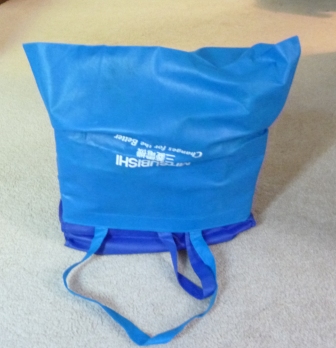
Step 1 - 2 can pack as flat as 1

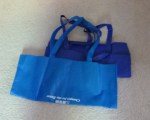
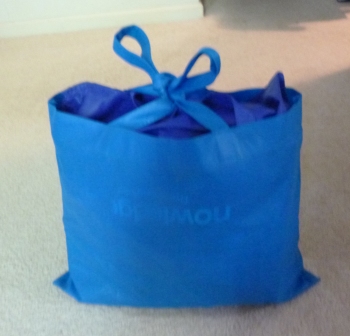
Collapsible Suitcase/Tote Bag Here’s a space-saving trick to provide extra carry power: Pack two large poly-fiber grocery bags (the kind you take to the market instead of getting paper or plastic).  They take up scarcely any space. One of these can serve as a handy carry-all for a day trip.  If you have purchased presents that overflow your suitcase for the return trip, you can pack the presents into one of the bags, put the second bag upside down over the first one, then invert the whole thing and you have a tidy package with handles which you can carry on as a personal item.

P1010392web P1010393web P1010394web

Freeway-Free in Trujillo – Local Bad Boys Make Good

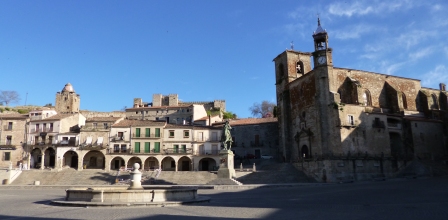
Plaza Mayor - TrujilloTrujillo in Extremadura is the hometown of Francisco Pizarro, the Conquistador who accompanied Balboa on his discovery of the Pacific Ocean, then overthrew the Inca monarchy, and was himself murdered by one of his own mutinous fellow- adventurers.  My fellow-traveller W learned most of this history from the Peruvian point of view, which substitutes “betrayed” for “overthrew”, “plunderer” for “adventurer” etc.  So I got a lot of colorful running commentary to accompany the information provided by the local tourist office.

Iglesia de Santa Maria - Ferdy and Izzy were hereFernando and his brothers were rapscallions to the core, and their fellow Trujillanos breathed sighs of relief when they shipped off to the New World in emulation of Cortez. Imagine their dismay when the black sheep returned with piles of Inca gold and an Incan princess under each arm. Most of the Pizarros  eventually died ingloriously in the New World, but not before bringing home a lot of plunder. Some of this was donated to the local church in the form of gold and silver reliquaries and altar pieces in an attempt to buy off the damnation they surely deserved.
Pizarro's PalacioThe survivor, Hernando, probably escaped death only because  during his volatile twenties and thirties he was already serving time in prison for murder.  On release he married his brother Fernando’s daughter by the Incan princess whose brother  Fernando had betrayed and burned at the stake.  The couple corralled the Pizarro fortune and spent it in the old home town on building a lavish public plaza and a huge mansion decorated with bas-reliefs of themselves. and their families . In your face, Trujillo!

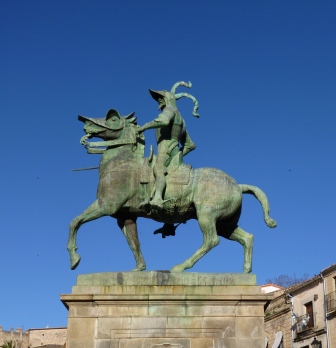
The  huge statue of Fernando Pizarro on horseback in the public plaza is actually an impostor.  The statue was originally commissioned by the Government of France as a statue of Hernando Cortez to be presented as a gift to the Government of Mexico.  The French were embarrassed to discover that Mexicans didn’t appreciate being conquered by Cortez and wanted no part of a statue honoring him.  Being both thrifty and resourceful, the French renamed the statue as Fernando Pizarro and sent it to Spain , where Pizarro is warmly remembered despite his wayward youth and unsavory exploits in the New World.Generic Conquistadore - AKA Pizarro of Trujillo

Trujillo’s  old Castillo, originally a Moorish fortification, is  positioned on the top of the  highest hill with its medieval walls either intact or restored.  We walked the entire battlement with some back-tracing and could see for miles across the country.  I understand why the Spanish from this region felt at home in their New World colonies – the green foothills with their rocky protrusions look quite similar to the Sierra foothills of California in spring, even to the serpentine color of the rocks.View from the Castillo - Trujillo

Trujillo is small and walkable and only a 45 minute bus ride from Caceres, so it makes for a perfect day trip with plenty of time for a siesta before venturing out for tapas in the evening.

Freeway Free in Spain: Livin’ the High Life in Caceras

Bride #3 and littlest guestCaceras Bride #2Saturday is the best day for  touring the medieval lchurches in Caceres. In addition to the wonders of the Old Town, you are likely to spot a bevy of up-to-date brides – always a great insight into the local culture.

The Old Town is very old indeed, with Hapsburg castles built on Castilian palaces built on Moorish forts built on Roman walls.  We wandered through maybe a quarter of the
Old Town, taking in the Visitor Center (highly recommended)  in a 14th century lookout tower outside  the wall and the Church of Santa Maria with its carved reredos and 14th century
Christo Negro.   This area was the home of Pizarro and Cortez (more on them later) and the church museum is full of silver and gold reliquaries and croziers made from New World gold and silver.

Caceras Bride #1At the Plaza San Jorge we spotted our first bride of the day, dressed in a very modern white gown – above the knee in front and trailing to the ground in back  –  posing on the step with her family including a tiny ring-bearer who was doing his version of  Gangnam Style   in the front row.

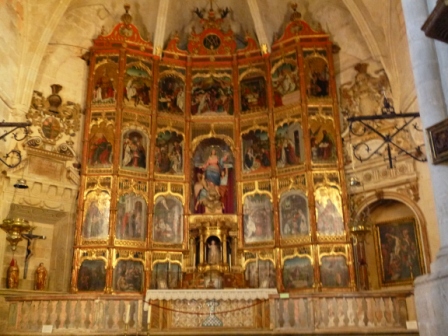
The cathedral of St. Francis Xavier  has a three story gilded reredos studded with saints.  In case there was not enough gilt on view, this particular weekend also featured  a special exhibition of icons from around the world.  In this setting all that glitters is not gold, but might well be ruby, emerald, or mother-of-pearl.Altarpiece, Church of San Francisco Xavier

After being dazzled, we  squeezed our way up a two-story wrought iron spiral staircase (not for the vertiginous!) and then up the spiral stone steps of the two towers, from which one could peer across to say hello to storks guarding their nests at eye level.    A beautiful day  allowed us to look across the green valley to the peaks of the Greda range still well-covered with snow.Stork at home

Second church, second bride (see above leftf).  At the Plaza San Mateo we found a VERY upscale wedding, with the female guests wearing Jimmy Choos and fascinators a la Kate and William’s wedding, and the male guests wearing silk ties which coordinated with their wives’/girlfriends’ dresses.  When the bride and groom emerged the air was full of red and white rice-paper hearts which were carried everywhere and up by the wind.

Taxis whisked the most important guests to the reception, while the other female guests tottered off over the cobblestones in their 5 inch heels. Some had to be assisted on both sides to keep from falling, just like the Chinese ladies of old with their bound feet.  To each her own torture.These shoes ain't made for walkin'

We hit the Cultural Center (also recommended)  and the Artisan Coop (interesting local art, but pricey!)  and headed for our hotel in  time to catch the 3rd bride exiting from the church of San Juan just outside the old city –  more fascinators, more silk gowns.  I felt way under-dressed in my well-traveled raffia hat and cargo pants, but that didn’t stop my snapping pictures of the elegant display.  And no one preening in their finery seemed to object to becoming part of my travel story – no Mafia dons in Spain?

Freeway Free in Merida: Ramblin’ round the Roman Ruins

Roman theatre in MericaIf you OD on medieval ruins in Caceras, you have options.  How about Roman ruins instead?  Merida, another World Heritage Site, is only an hour’s train ride away.

Wow!  Those Romans were some engineers!  Stuff they built 2000 years ago is still being used  in Merida, such as a magical open air theatre where we happened upon a kind of rock n roll High School Musical version of “The Rape of Europa” (That giant white caterpillar with black antennae is supposed to be Jupiter as a white bull).

Temple of Diana - Merida

The Temple of Diana has a 15th Century villa built INSIDE.

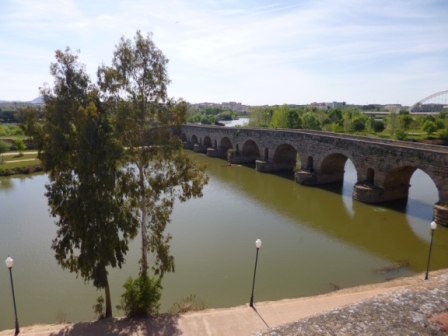
Roman bridge - Merida

A graceful bridge across the Guardiana River is used now by pedestrians and bicycles as part of an extensive trail network.

Arc of Trajan - Merida

Cars still rumble under Trajan’s Arch.

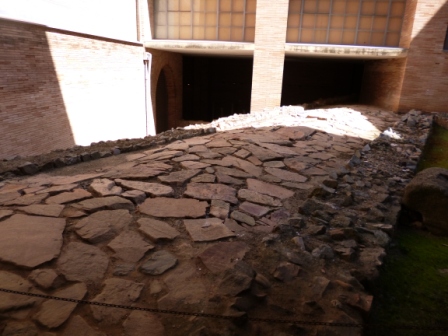
Roman road leads to ongoing archaeology

In many places the original Roman roads form the substrata for current city streets.

I

Museo National de Arte Romano

And there is a great museum next to the theatre and amphitheater which makes sense of it all.

Freeway Free in Spain: Every Day a Festival

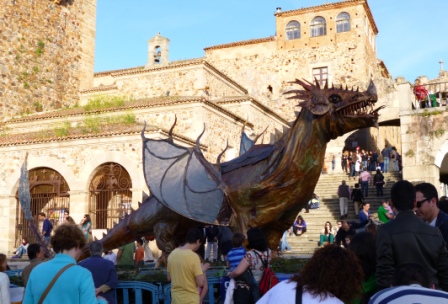
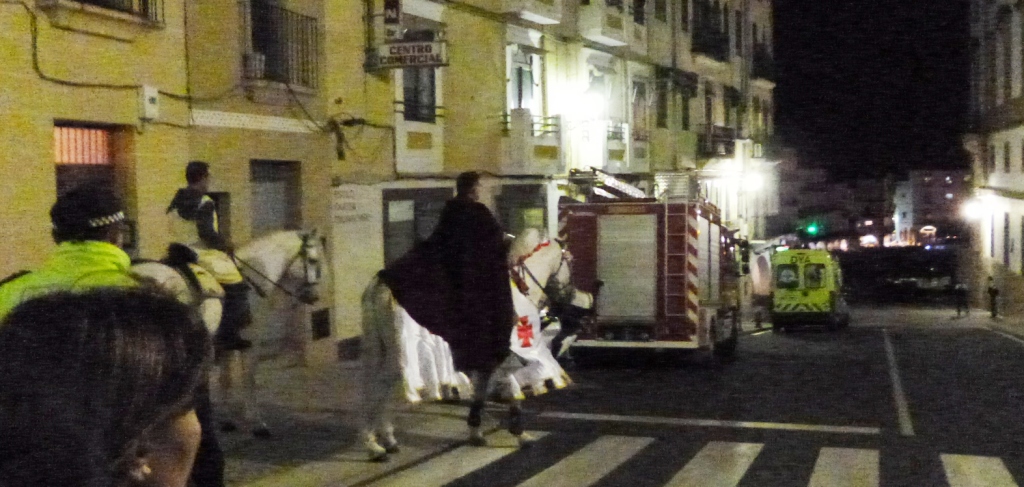
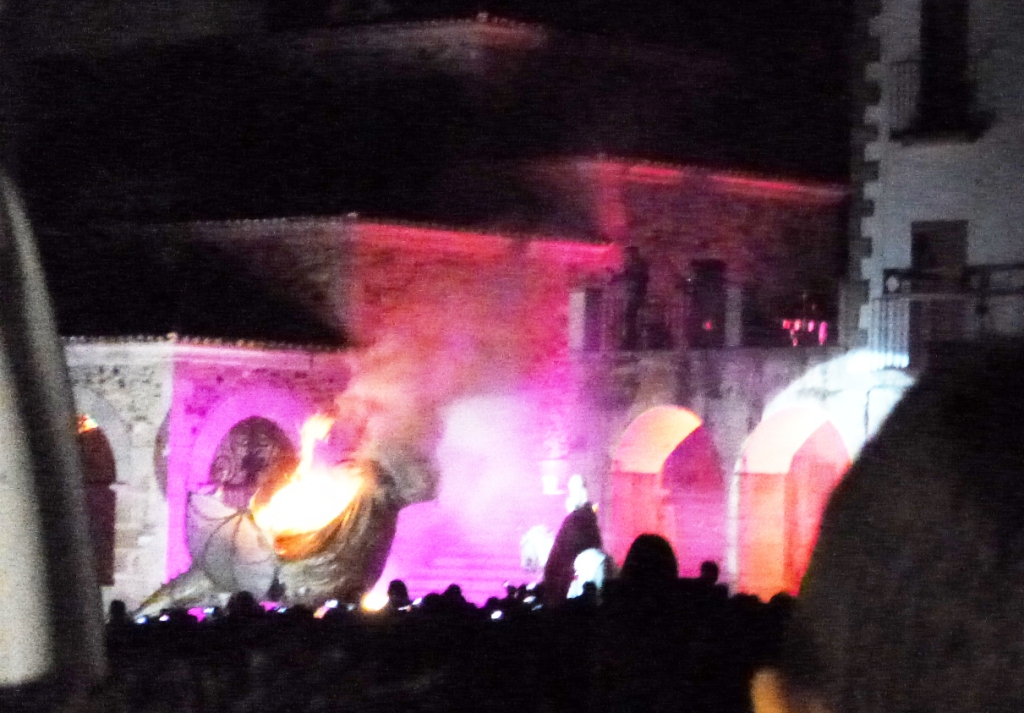
CacerasDragon2013We happened to be in Caceras on St. George’s day. Great Britain’s favorite dragon-slayer is also the patron saint of Caceras, so, being Spain, a festival is called for. This one involves the making and parading of a large paper-mache dragon through the streets, accompanied by an army of costumed Moors (the dragon’s evil henchmen), their ladies in various ideas of harem dress, and a princess destined to be sacrificed. This group is pursued by a squadron of Christian knights sporting white tunics and red crusader crosses, followed by the hero, St. George, on his white horse ( a highly trained Andalusian paso, striking camera-friendly poses all down the street). When the parade reaches the Plaza Major, St. George defeats the Moorish leader in a swordfight, then plunges a blazing torch into the dragon’s heart. The dragon bursts into flames, and the princess, St. George, and his horse watch its demise from the battlements of the Old City, as ear-splitting fireworks and rockets illuminate the Plaza.

St George in waitingYou can google “Caceres dragon” and get a pretty good idea of the festivities – videos from this year may be posted soon but don’t bother to look for me. We are way back under the arcades opposite the guys juggling torches.

The dragon-burning was fun. W and I were mostly surrounded by tall people and people with kids on their shoulders, but we did get a good view of St. George as he waited in the wings on his white horse behind the fire engines (can’t be too careful around a fire-breathing dragon!), and during the subsequent sections the main action was projected on the castle walls so all could see. After the dragon was lit and St. George and his horse had taken their bows everyone headed for the exits at once. We stopped for a helado once we were free of the crowd and ambled back to the hotel alternately looking upward at the  fireworks visible between the buildings on the narrow streets and looking downward at our ice cream.Festival's fiery endCan you spot St. George on his white horse gloating from the balcony?

Freeway-Free in Spain: Around and About in Extremadura

Carpets of wildflowers - Extremadure springAs an American, I thought the whole North/South thing was a side – effect of our 150-year-old civil war, but it seems to be a global prejudice.  Whether it’s a Tuscan speaking of Sicily, or a Parisian of Provence, or a New Yorker speaking of anywhere south of the Mason-Dixon line, the general thread is “Oh, those southerners!  They live at such a slow pace!  They are lazy!  And their accents – you can barely understand them!” This also is what the Spaniards of Castile y Leon or Catalonia say about Extremadura, maybe one of the most fascinating places you have never heard of.

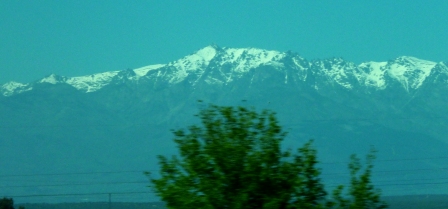
“Extremadura” simply means “beyond the Madura River”.  It takes in the broad plains and mountain ridges between Madrid and the Portuguese border. The province is ringed by mountains, so during the Peninsular Wars Wellington’s troops swung north, leaving the medieval fortress walls of Caceras and Trujillo and the  Roman ruins of Merida unscathed. If you dream of going back in time, in Extremadura you can almost pick your century.Sierra de Gredos

The bus ride from Madrid  to Caceras, the center of Extremadura, takes a little over four hours with one half-hour and one five-minute stop.  After an unusually wet spring  it was a lovely ride, with the snowcapped peaks of the Sierra de Gredos rising above the rolling green plains of La Mancha, – only missing some windmills to tilt at.  As we moved into Extremadura the landscape looked more and more like spring in California’s Sierra foothills  – pools of blue flowers that weren’t lupine, shrubs covered with big white flowers that weren’t matilja poppies, recognizable Scotch broom and mustard and unrecognizable pink and lavender flowers, all  painting the slopes beautiful.

Hotel Don CarlosOur home base for the week is the Hotel Don Carlos, just off the Plaza Mayor (Main Square) and steps from the medieval Old City which earned Caceras its World Heritage Site designation.  Our first two nights were spent in a spacious room with a luxurious bath,  facing the narrow cobbled pedestrians-only street, with a cute balcony and view down the twisting lane to the restaurant on the corner.  The first night we slept as befits travelers who have been on the road for twenty hours.  The second night we slept as befits those whose open window is just down the street from a bar patronized by soccer fans who are cheering, drinking, and arguing raucously until at least 4AM.  We asked for a change, which happened seamlessly while we were out sight-seeing.  The following nights were spent in a smaller room facing the inside courtyard, with no balcony or bidet but lots of blessed quiet.

Note to travelers in Spain:  The American work schedule has not penetrated past the Pyrenees.  Spaniards snack at 8 AM, take a two hour lunch break 12-2PM, work til 7PM, hang out on the Plaza until at least 9PM, maybe think about dinner after 9PM, and after dinner hang out some more.  Don’t even think about looking for dinner before 9PM.

On our first evening we walked through the neighboring church plaza spotting storks nesting on the church steeple, swallow chicks chirping in the nests built in cracks in the church facade, swallows swooping and dodging after gnats to feed to the chirping chicks, and lots of folks of various sizes, shapes, and colors strolling, sipping, socializing in the empty open walking and sitting spaces.

Regional cheese - CacerasThe helpful desk clerk had recommended a tapas bar just beyond the church plaza.  Not being accustomed to Spanish hours, we were the first customers.  We  asked for three of the four featured tapas and got enough food to feed four people comfortably, including the best anchovies either of us had ever eaten or imagined, assorted wonderful local cured pork, and a local soft cheese whose deliciousness defies description.   A walk around the Plaza Major shook down enough space within to make room for   a tiny cup of exotically flavored gelato after the post-tapas stroll.
It was 10PM and the Plaza was just getting going, but the lure of a warm shower and a soft bed has us postponing our adjustment to Spanish time for one more day.

Next: Medieval Meandering in Caceras

Freeway-Free in Spain: Castles in Caceras

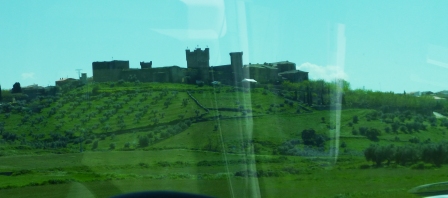
Castle in Spain - through the bus window“I long for the day/ I can get underway/ and look for those castles in Spain…”

Faraway Places – Margaret Whiting hit song of 1948

Castles in Spain – My childhood friend  W mentioned that she was planning to make a trip to the area in Spain from which emigrated some of the families she had known during her Peace Corps service in Peru. She thought maybe she would stay an extra week in Madrid to see the art museums.  Naturally, I invited myself to come along.

My contribution to the trip was a further extension of a third week to accommodate a visit to my niece J who lives with her Spanish husband and two children in a smallish town in northern Spain. We planned to travel mostly by bus and train, except for the visit to the smallish town, where we would need to rent a car – something I had never done in all my foreign travel.The bus to Badajoz (with a stop at Caceras)

Smart thing I did:  Hang my plane tickets and passport in an easy access pouch around my neck, so they were visibly THERE at all times and easy to get to even though I was using carry-on luggage.

Dumb thing I did: Omit the last-minute-before-you-leave-the-house check for all necessary documents. Thus I failed to notice that my wallet-on-a-string had snagged itself on a towel bar in the kitchen as I zoomed past and had been pulled out of my fanny pack. Panic in the car on the way to the airport.  Go home? Risk missing the plane? Decision to rely on W for credit and ATM for a few days, assuming Capable Husband could find and FEDEX the missing wallet.

Smart thing we did: Book our first full week staying in one hotel central to Extremedura, so we could settle in – and the wallet could catch up with me (which it did, a day earlier than I had thought possible. Blessings on CH and FEDEX!)

Eighteen hours after leaving my house, via car, plane, subway, bus, and taxi, W and I arrived in Caceras, equipped with two Kindles, an iPad, a MacBook, and a cheap cell phone purchased at the bus station for making calls to my niece.  We were to become very attached to this phone.

Travel Trivia: Caceras, with its intact medieval Old City, was the second World Heritage Site created in Europe.

Sierra Gredos range, from the bus

You-tube Video: All-women trekking in Nepal with Three Sisters (and me!)

Check it out!  Here is the link on You-Tube:

http://www.youtube.com/watch?v=EjdHc-Boigs

Trekking in Nepal – Day 11 – Jomsom to Pokhara

This morning the weather in both Jomsom and Pokhara has turned overcast, foggy, and damp,  so no planes are flying.   The town is swarming with folks who wanted to fly and are now seeking wheels.   We fall back on Alternative Transport to cover the ~ 90 miles.  Flying would take less than 60 minutes. Alternative Transport? In Nepal that means

Stage 1 – Jomsom to Ghaza    –  Bina, our guide,  manages to secure a jeep – one of the standard white made-in-India models, with blue tarp duct-taped over the space where the rear window used to be, clear packaging tape overlying the spider-web of cracks in the windshield, and a roll of duct tape for emergencies hung on the gearshift lever.  The Nepalese standard usage is a minimum of 14 people plus baggage.  Happily, our resourceful guide hired the jeep for the seven of us, paying for the extra phantom 7 people at the Nepalese rate – 140 NR/person, or an extravagant $12.50 extra.  We got puzzled and disappointed looks all up the road from folk who wanted to flag down the jeep and fill the empty spaces.
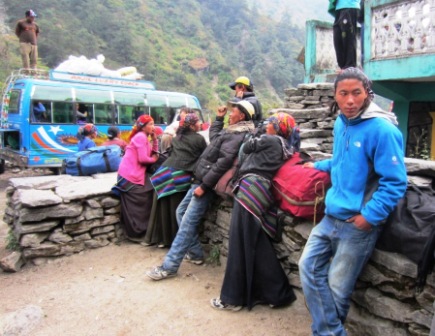
We departed at about 8 AM.  Just out of town we stop to top off the gas tank.  No gas pump – just a five-gallon plastic jug full of gasoline and a siphon.  It’s primitive but it works.

About 5 Km into the journey, we make an unscheduled stop: the driver hops out and greets an elderly woman carrying a plastic bag full of garlic.  He examines the garlic, shakes his head, discards some of the more dubious roots, then slings the bag into the back of the jeep on top of our packs.

Another 5 KM – a very unusual sound comes from underneath the floor of the jeep, and the engine stops.   Within 5 minutes there are two buses headed the other way which have been forced to stop, their two drivers are standing around our jeep offering advice to our driver, who is underneath the jeep with a monkey wrench.  After about 15 minutes he emerges, wipes his hands on the grubby towel he had been lying on, and we proceed with cheering from our group.

Another 5 KM – The driver stops again and a young woman runs up to the jeep.  He brings  out the garlic, and gets a big smile from the happy homemaker.

Stage 2 – We arrive at Ghansa about noon.  The driver refuses to drive any further, as the bridge has washed out at the Rutche falls and there is no turnaround.  So we resume our packs and hike for two hours, plus a lunch stop just after making our way over the washed -out bridge, until we get to Tithze (?) where we hope to hire another jeep.  The walk is actually very pleasant – cool, bypassing the road, and it feels good after the hard seats and bouncy suspension of the jeep. But yet to come was

Stage 3 – at Tithze, no jeep is available – all have been booked by folks who walked faster than we did.  Bina books us on the next available bus, which was third in line to leave – again, the earlier buses had already filled with an eclectic collection of Tibetan refugee women in their colorful woven aprons, young Nepalese men in blue jeans, and a swarm of trekkers from Germany, France, Australia, the US, and many other points, in various stages of grunginess and grumpiness.

Bina got us onto the bus as early as possible before its 3PM departure to make sure everyone had a seat – that was fine, until the additional folks started filling in the cracks.  DM and DB and two Nepalese and two Frenchmen sat in the area in front of the partition that was designed to separate the driver from the passengers;  I was packed into my seat unable to move my legs as they were wedged in between the spare tire, four back packs, and a violin case, plus assorted legs of fellow passengers.  Fortunately, I had made an offering to Ganesha, the god of travellers, at the temple in Mulktinath, so we survived the trip, although DB had to exchange seats with Bina since she couldn’t stop herself from shrieking at every upcoming hairpin turn.  We thought that the bus was crammed full, but that didn’t stop additional passengers from hopping aboard through the always-open side door – we accumulated three in the course of the ride, all of whom ended up sitting on the packs on top of the spare tire next to me.

The trip was eerily like living the previous week in reverse, as if the tape of my life were being rewound. We went through all the small towns – “Ah, there’s the Dutch Bakery in Tubuche where we had that great carrot soup and brown bread!” “Look, there’s where you lost your hat!” We plunged down the gravel track traveling from barren scrub brush to pine forest to cherries in bloom to apple orchards laden with fruit to banana trees.

Three hours later, we made it to Bema, and

Stage 4 – the SUV from 3 Sisters arrived to carry us the rest of the way – three more hours in the dark and rain (of course it would rain!) on roads not much better than the “drivable gravel roads” we had been on.  We keep ourselves awake and alert by trading songs with the Nepalese guides: DB, DM and I harmonize on “You Are My Sunshine”, and the girls in the back respond with a Nepalese folk tune that involves a considerable amount of finger-snapping and tongue-clicking.  We come back with a round of “White Coral Bells.” We get through our entire repertoire of 1960’s Girl Scout Camp songs before finally in the last hour we hit blacktop!

At 10PM we reached the 3 sisters guest house, where they insisted on serving us  our Farewell Dinner – dal bhat, of course.  Then we thankfully hit the cozy beds. Tomorrow we will enjoy hot showers and full-size towels, then DM and I will hit the road back to Kathmandu.  Next stop – Thailand! 

Post Navigation