Susie Boyt’s 200-page novelette takes on the story of a mother hoping against hope to bring her daughter back from drug addiction, while at the same time raising the granddaughter abandoned by the addicted mother and her lover. Sounds like a downer. But somehow it is not. Ruth, the narrator for most of the story, explores all the ups and downs of a love which is patient, is kind, that alters not when alteration finds. She doesn’t give up, despite the well-meant urgings of her friends to “move on.” And she works hard also to prevent her love for Lily, her granddaughter, from being possessive, or from seeing Lily as some kind of earned compensation for the sorrows Eleanor, the daughter, brought down.
Bernard Cornwell is a master at recreating a past society, whether it’s life on the battlefield of the Napoleonic Wars, an immersion in the Saxon society of Arthurian England, or in this case, the pinnacles and pitfalls of the evolving theatre in the time of Elizabeth I. The protagonist is Richard Shakespeare, the younger brother of William, who escapes from a brutal apprenticeship and runs to London in hopes of joining his brother’s theatre group, the Lord Chamberlain’s Men. But William’s welcome is chilly, and Richard must pay a steep price to learn the skills he needs to be a player on his brother’s stage. Did Richard Shakespeare actually exist? Yes, there was such a sibling, ten years younger than William, but the historical record is mute as far as his life is concerned, leaving Cornwell an open field to imagine. The plot is a little thin, involving the rivalry between the Lord Chamberlain’s Men and the struggle to find new plays to please the populace. The world is so real, though, that I could feel the drip of rain down the back of Richard’s neck, hear the pounding of the carpenters working on stage sets as Richard is trying to rehearse, and see the flickering lights of dozens of candles used to light the stage. Cornwell assumes that the reader is pretty familiar with at least two of William’s plays, A Midsummer Night’s Dream and Romeo and Juliet. If you’ve gotten that far in studying Elizabethan drama, you’re ready to plunge in to Richard Shakespeare’s world.
I wish I could have liked this better. I really enjoyed Kate Atkinson’s “life after life” and the early Jackson Brodie novels, and thought I had found a writer whose works were beautifully written, satisfying, and prolific.
Well, two out of three.
Judith Anderson, the protagonist of “Transcription, is a young woman drafted into a clerical position in Britain’s M15 spy corps during WWII, and then is “promoted” to being a transcriber of secretly recorded meetings between an M15 agent posing as a German spy and fascist sympathizers. These recordings short-circuit the passing of useful information about military installations and preparations to the Nazis, so they are theoretically a useful contribution to the war effort. But for the most part, the meetings are composed of long stretches of puerile conversation half-heard over the noise of traffic, paper rustling, a barking dog.
But “things are seldom what they seem”, as Gilbert and Sullivan are quoted by Judith’s boss. The book descends into a tangle of “coincidental” encounters, possible betrayals, shifting identities, pseudonyms, and a couple of quite unpleasant deaths.
Atkinson artsifies the plot by shifting the time back and forth. We see Judith in 1981, the victim of an apparent hit-and-run accident. Then we are in 1950, where Judith spies a former colleague from M15, who denies knowing her. And then we are in 1940, at the beginning of the war, and Judith is being reassigned to her transcription duties. We jump back between the war years and the post-war years several times. It’s a way to build suspense – we know that something horrible happened and want to find out what- but it’s not a way to build sympathy for Judith.
So I ended up admiring the technique, but not caring very much whether that hit-and-run was really an accident. Reading the reviews, I see the book is “laced with wit”. I wonder if I have an insufficient sense of humor? or maybe I sympathized a bit too much after all with Judith, preventing me from laughing at her predicaments.
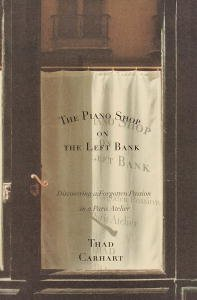
The Piano Shop on the Left Bank If a book cover has the words “Bookshop” or “Paris” or anything evoking those memes, I’m liable to pick it up. If it has “Piano”, that’s almost as magnetic. This memoir of living in Paris and finding access to the neighborhood hidden behind the courtyard doors is charming, full of information about French life and culture, and about the history, development, mechanisms, and lore surrounding the pianoforte.
A perfect bedside book, as it alternates between personal experience and historical reflection in alternating chapters.



 Allyson Johnson