Allyson Johnson

Pieces of my Mind

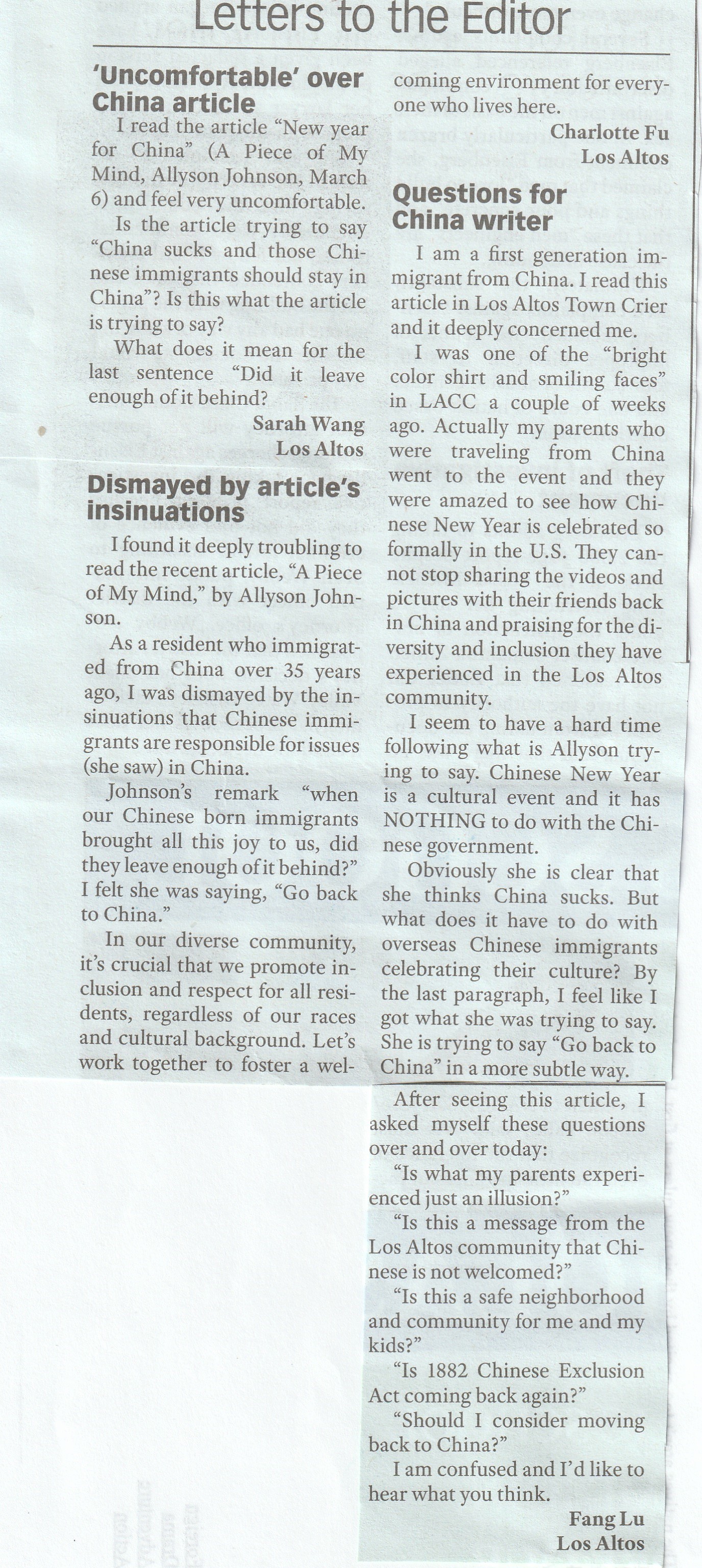
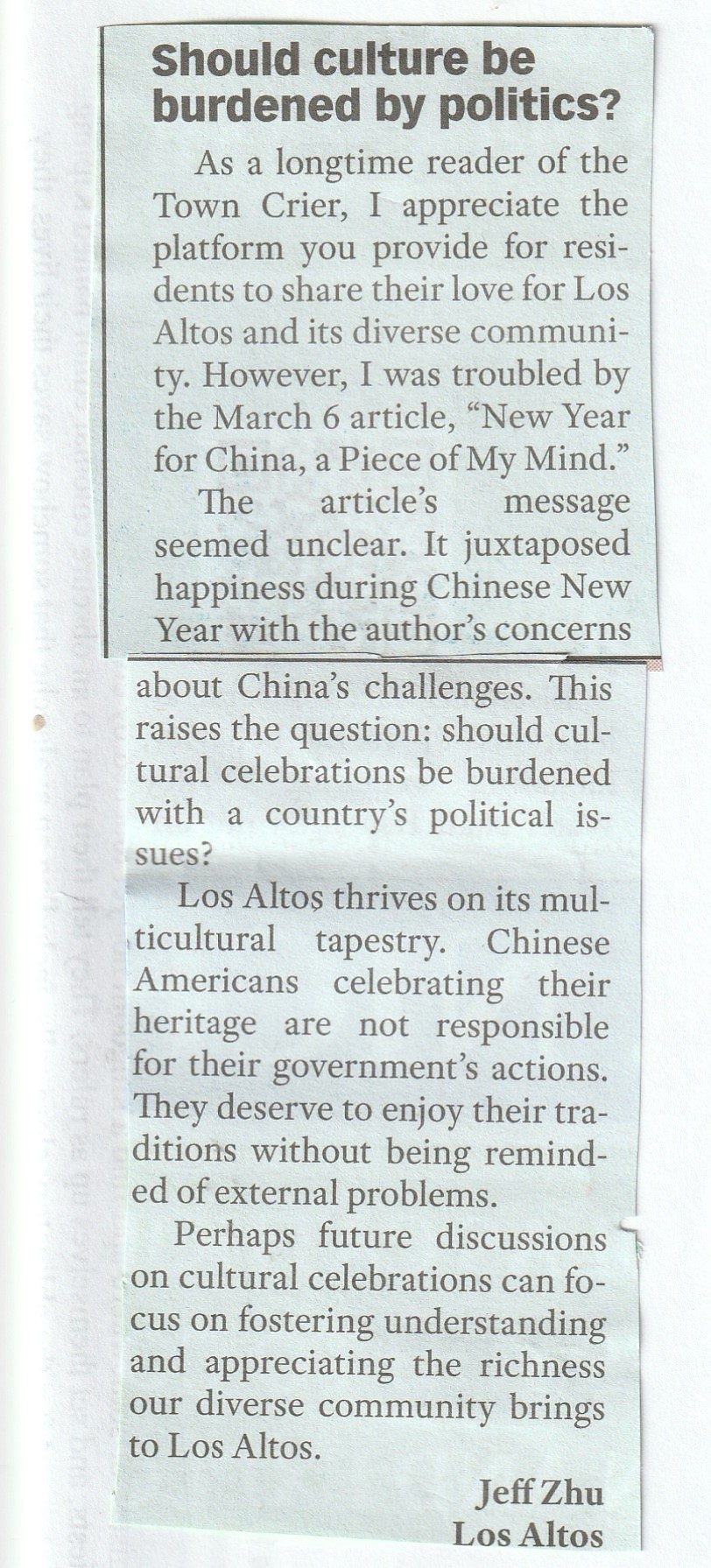
A Piece of My Mind: New Year for China (Los Altos Town Crier March 6, 2024

Last weekend I happened by the local community center and saw a queue of parents and children waiting outside, many wearing bright red shirts, ribbons, or hats.  Other families were walking away, many with children waving brightly colored pinwheels or carrying red and gold balloon creations and bright red swag bags.  Of course, it was the community celebration of the Chinese Lunar New Year, the Year of the Dragon.

I was reminded of my trip to Hong Kong at the turn of the 21st century. Hong Kong celebrated the Year of the Golden Dragon with fireworks, lanterns, and no apparent fear of the impending handover of the colony from British to Chinese jurisdiction.  

In those years I visited China several times for business and for pleasure. Deng Xiao Ping had opened the Bamboo Curtain in 1979, and twenty years later the Chinese tourist industry was booming, with Americans and other foreigners eager to walk on the Great Wall, stand face to face with the Terra Cotta Warriors in Xian, and shop on Shanghai’s Bund.  

Foreign investors  also lined up to enter the untapped market of Chinese consumers.  Jiang Zemin, General Secretary of the Communist Party as well as President of China during these years, promised that “the Chinese people will firmly and unswervingly follow the path of reform and opening up.” Lia Mingkang, a prominent financier of the time, foretold that “as economic freedoms expand, we are inevitably securing more social freedom and the ability to exchange the information and ideas we need to grow.”

Twenty years later, I have to wonder what went wrong. 

Tourism in China was completely shut down during the Covid-19 pandemic. Only in January of 2023, after nearly three years of closed borders, did China cancel all COVID-19 quarantine requirements and reopen the country for international travel. But visitors complain of the high degree of surveillance which prevails not only for tourists, but for ordinary citizens. 

The U.S. Department of State currently warns travelers to “reconsider travel” to mainland China “due to the arbitrary enforcement of local laws, including in relation to exit bans, and the risk of wrongful detentions.” The State Department classifies Hong Kong under a lesser warning, telling Americans to “avoid demonstrations”, “exercise caution in the vicinity of large gatherings or protests”, and “keep a low profile.”

Foreign direct investment into China shrank for the first time in over a decade in 2023, as Western governments discouraged reliance on Chinese-based supply chains. President Xi Jinping’s increasing focus on national security has also left many foreign companies uncertain about where they might step over the line of the law. Chinese entrepreneurs who have become too successful, particularly in social media, have had their businesses shuttered, their property confiscated, and even been jailed on suspicion of subversion. Foreign companies complain that their trade secrets have been copied by Chinese competitors.

Add to this reports of Chinese industrial pollution, oppression of cultural minorities, economic deflation, collapse of the housing market, population implosion, and the on-going threat to Taiwan. and  that golden time at the turn of the century seems like a fantasy.  Then I think of the bright colors and smiling faces at the LACC last weekend and I wonder – when our Chinese-born immigrants brought all this joy to us, did they leave enough behind?

Graffitti – Gritty, Ubiquitous, Affirming

The railroad tracks from the Coliseum to Jack London Square – everywhere the trash and debris of homelessness… rusted out cars, plywood shanties, abandoned chairs, strollers, buckets, tires, tarps…. But everywhere also the triumphant gaiety of graffiti – a rainbow of indecipherable words adorning every available concrete surface – amazingly no pornographic or obscene drawings or postings, only an occasional sad face, Raiders logo, anime girl in a sarong, a smiling blue tiger.   Some of the artists have mastered techniques that I have failed to grasp in art classes – shading, three-D effects. Odd that these artists don’t express more anger and frustration.  Every tag, every angular or curvilinear phrase (some out in the water on pipes, some twenty feet high) expressing “I am here!”

Some businesses have given in to the graffiti and put up their own murals using the curvilinear or anime style – these seem to be respected.  It is very bad form to paint over another artist’s work. And now at Jack London Suare the graffiti disappears amid the apartments and banners and “public artwork” of the respectable and established world.

Per Wikipedia,Graffiti (plural; singular graffiti or graffito, the latter rarely used except in archeology) is art that is written, painted or drawn on a wall or other surface, usually without permission and within public view.  Graffiti ranges from simple written words to elaborate wall paintings, and has existed since ancient times, with examples dating back to ancient Egyptancient Greece, and the Roman Empire.. Modern graffiti, focused on tagging, probably began on New York City subway cars and spread like a living cloak flung across railway cars, freeway overpasses, and abandoned buildings. When I first visited Japan in 1997 I remember my colleague remarking on the lack of graffiti . When I last visited in 2011 graffiti was everywhere. In some eyes, graffiti are acts of vandalism. In others, they are works of art.

We leave the Square, with its up-market businesses including a Ben and Jerry’s ice cream, a BevMo, a Cost Plus World Market… and then abruptly we are into the Port area and the graffiti erupts again. Dingier here, as though the artists lacked the energy to walk this far from warmth and people.  A huge recycling center.  Stacks of shipping containers, A row of black oil tankers, oddly un-graffitied, unlike the box cars and flat cars on the next track over. Is it hard to make the paint stick on the curved surfaces? The cattle cars and box cars are painted as high as a man can reach. Of course – why paint a lowly concrete barrier when one can send one’s aspirations across the country?

A Piece of My Mind: When Los Altos was Wet and Wild (Los Altos Town Crier, Feb. 7,2024)

When I was a girl in East Texas, I took swim lessons in the public pool from a Red Cross instructor.  I was a good floater and treader of water, due to my persistent baby fat, but flailed desperately to swim across the pool just once in order to earn my Beginner badge. There were plenty of other flailers in the pool, though. Swimming was just something you did to cool off in the summer.

Then we moved to Los Altos, which at that time was a fairly new middle-class suburb.  The lots were no larger than what I had known in East Texas, the houses no more spacious, but there was one key difference.  Of our six closest neighbors, four had swimming pools.  

On my first day at school, I marveled at the tanned students with hair tinged green from chlorine.  New friends casually mentioned how they dove into their pool each morning before breakfast and did a few laps just to wake up.  The school had a swimming pool.  And swimming was a regular part of gym class.

In Texas, football had been the sport which determined who was Campus King.  In Los Altos, it was swimming.  I had not known that swimming could be a competitive event.  I had never heard of water polo.  But here was LIFE magazine coming to campus to do a feature about our student body President, Steve Clark, who for a brief time was known as “the world’s fastest swimmer” due to his record-breaking 100-meter freestyle times.  The president of the LAHS California Scholarship Federation was also the goalie on the US Olympic water polo team. The LAHS swim team under coach Nort Thornton broke 13 national records out of 20.  Thornton went on to coach Cal to two National Championships and is in the International Swimming Hall of Fame.

This all came back to me as I read of the abrupt closure in January of the George Haines International Swim Center in Santa Clara.  The ISC opened during the golden age of Bay Area swimming. Though Los Altos High School ceased its prominence in the swim world when Thornton left for Foothill College and then Cal, the school continued to produce Olympians who swam at the ISC. Steve Clark trained there under George Haines for the 1964 Oympics, and won a gold medal.  I was most recently at the ISC for a benefit for the US Olympic synchronized swimming team, which won a bronze medal in Greece in 2004,captained by LAHS alumna Lauren McFall.  

There are still plenty of swimming pools in my neighborhood, but not as many children.  I see plenty of students walking or biking to and from the campus with unusually colored hair, but none with that tell-tale chlorine green.  A quick scan of Town Crier articles about high school sports turns up dozens of articles on football, soccer, basketball, and volleyball, but nothing about swimming or water polo. Does the demise of the ISC in Santa Clara reflect a general sag in swimming as a path to glory?  Or are there are still students at LAHS who dive into a backyard pool every morning to wake up? I hope that tradition lives on, even if the ISC does not. 

Freeway Free in Washington – A Ghost of Lost Hawaii

When our boat docked at the small town of Kalama (population just under 3,000) I had a strange sense of deja vu. That three-story tile-roofed hotel facing the beach, with verandas wrapping around all three stories – hadn’t I seen it before?

It turned out I had – years earlier, on a honeymoon trip to Lahaina, and then again on an anniversary return trip to the same place. Nestled on the beach side of the railroad track which separates the town of Kalama from the marina, beach, and boat dock is a replica of the old Pioneer Inn in Lahaina, built from the same blueprints. This recreation is especially poignant as the original Pioneer Inn had been demolished less than two months earlier by the wildfire which destroyed most of historic Lahaina in August 2023.

The Oregon version has an extra level, and the palm trees are replaced by a trio of historic totem poles, but the exterior and interior are meticulously crafted to evoke the historic Pioneer Inn. Inside, the bar has a tiki theme, the walls are pine-paneled , a bark canoe hangs from the ceiling and the furniture is vintage.

But the Mcmenamins empire includes more than a single nostalgic lodge. At this establishment, instead of mai tais, the customer is offered beer from the Mcmenamins’ brewery and hard cider from the Mcmenamins- orchards. The brewery is conveniently located right across from the gift shop, so you can taste and buy onsite within a few steps.

Mcmenamins also owns a number of entertainment venues across the states of Washington and Oregon, and the pine-paneled walls are decorated with posters of noted concerts.

There is a claim, enshrined in oil paintings though not in photos, that Elvis Presley himself stayed, not at the Lodge, but nearby in Kalama on his way to film a movie in Seattle, and it is quite true that Marlon Brando was a frequent visitor to his son Christian’s home in Kalama. The oil painting of the two icons fishing together, however, is purely imaginary, as their visits were two decades apart.

A Piece of My Mind: The Dinosaur in my Den

I gained a few pounds on my recent vacation, so I opened the cabinet underneath our TV monitor, found  my VCR tape of “Jane Fonda’s Low Impact Workout” and thrust it into my VCR. (I have a DVD player, but the golden age of video workouts was the VCR age, and I have kept my machine and my video tapes through the era of DVDs and the era of streaming.  I know, I might as well say I keep a brontosaurus as a pet.) Thirty-five minutes of constant motion later I finished the last steps of the cooldown, hit STOP on the VCR, and then EJECT. 

The tape cartridge came halfway out, then stopped.  I pulled.  Clearly the tape had not released properly; I could feel it give.  I tried to push the tape cartridge back into the machine. No go – there was a barrier.  Slowly and carefully I worked the tape cartridge out of the machine.  A loop of tape, wrinkled and sagging, but unbroken, dangled from the cartridge.  I managed to work the tape back inside where it belonged, crossed fingers, and put the cartridge back into the machine.   It worked – a bit blurry, but this time it ejected with no problem.  Whew! 

Two days later, still angry with my scale, I found “Kathy Smith’s Instant Workout” and plopped that cartridge into the VCR. At first the tape was streaky and jittery, but then it cleared up. Forty minutes of toning and low impact aerobics later I hit STOP, then EJECT. 

Again, the tape cartridge came halfway out, then stopped.  I pulled.  Again the tape had not released properly; I could feel it give.  Slowly and carefully I worked the tape cartridge out of the machine.  This time, the dangling tape was broken.  No more “Instant Workout.” 

In anticipation of the worst, I inventoried my VCR collection: Several favorite Jane Fonda workouts (which I used to have to hide from my Viet vet brother), several Kathy Smith workouts (longer and more strenuous than Jane’s), several little-used yoga tapes from my yoga period (I was more flexible then),a couple of old movies, some souvenir video tapes from the Lick Observatory, from the National Park Conservancy, from a cruise that we ended up not taking, the stirring“16 Days of Glory”  from the 1984 Los Angeles Olympics,– all forgettable or replaceable.  

But then there are the recordings. The tape of coverage of 9-11 as it happened, which we replay every September lest we forget.  My son’s extra credit project from high school.  My son’s appearance on local TV as a burrito expert. A performance put on by our church of “Amahl and the Night Visitors” in which my husband had a singing role. The funeral of an old family friend. My parents on vacation with friends from their childhood. These could not be replaced or updated via Amazon. 

The next day I decided I would say goodbye to each tape by playing it one last time, resigned to its breaking on ejection.  I danced through Jane Fonda’s “Lean Routine”, rewound and ejected with no problems!  Maybe the dinosaur has a few more ages to live through after all!  But an attempt that evening  to watch a travel video failed – lots of snags, black screens, interruptions.  Not dead yet, but in its death throes, I decided. There are services which, for a ruinous charge, will transfer my irreplaceable memories to DVD.  I will have replaced my brontosaurus with a wooly mammoth, but my memories may last until the next Ice Age. 

Freeway Free on the Snake River: Locked In, Locked Out

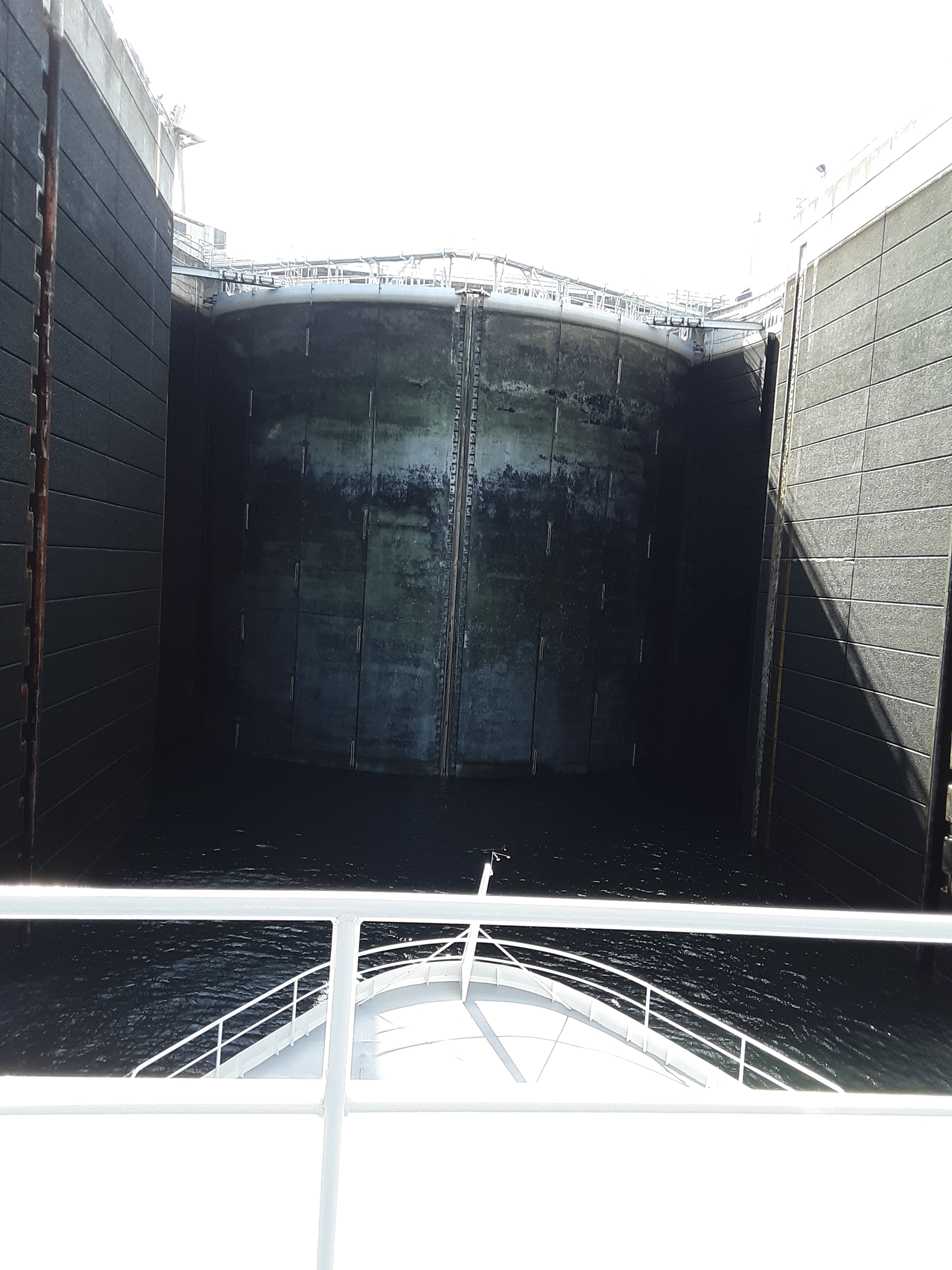
Our boat goes through our first lock – 80 feet or more down from one level of the Snake to the next. We move into the lock; a bridge is before us, an open space behind.  Then a wall seems to rise from beneath the river behind us as the water level in the lock is let out and we begin to descend.  The walls rise, only two feet from the boat on either side.  The bridge before us is now far above, with a large and getting ever higher curving wall ahead. We descend and descend.  The black wall behind us is holding back the river, though it appears there are leaks. The black wall ahead is now 80 feet high.  On the side are dripping black concrete blocks a yard high piled up and up.  Finally we stop descending.  We wait.  There is a loud shudder, and a crack appears in the wall ahead.  Sunlight, and color, a view of hills and sparkling water. The crack opens wider – the feeling is like the scene in “The Wizard of Oz” where Dorothy steps out of the sepia-toned world of Kansas into a technicolor Oz. The engines throb and we move forward into the light and space. 

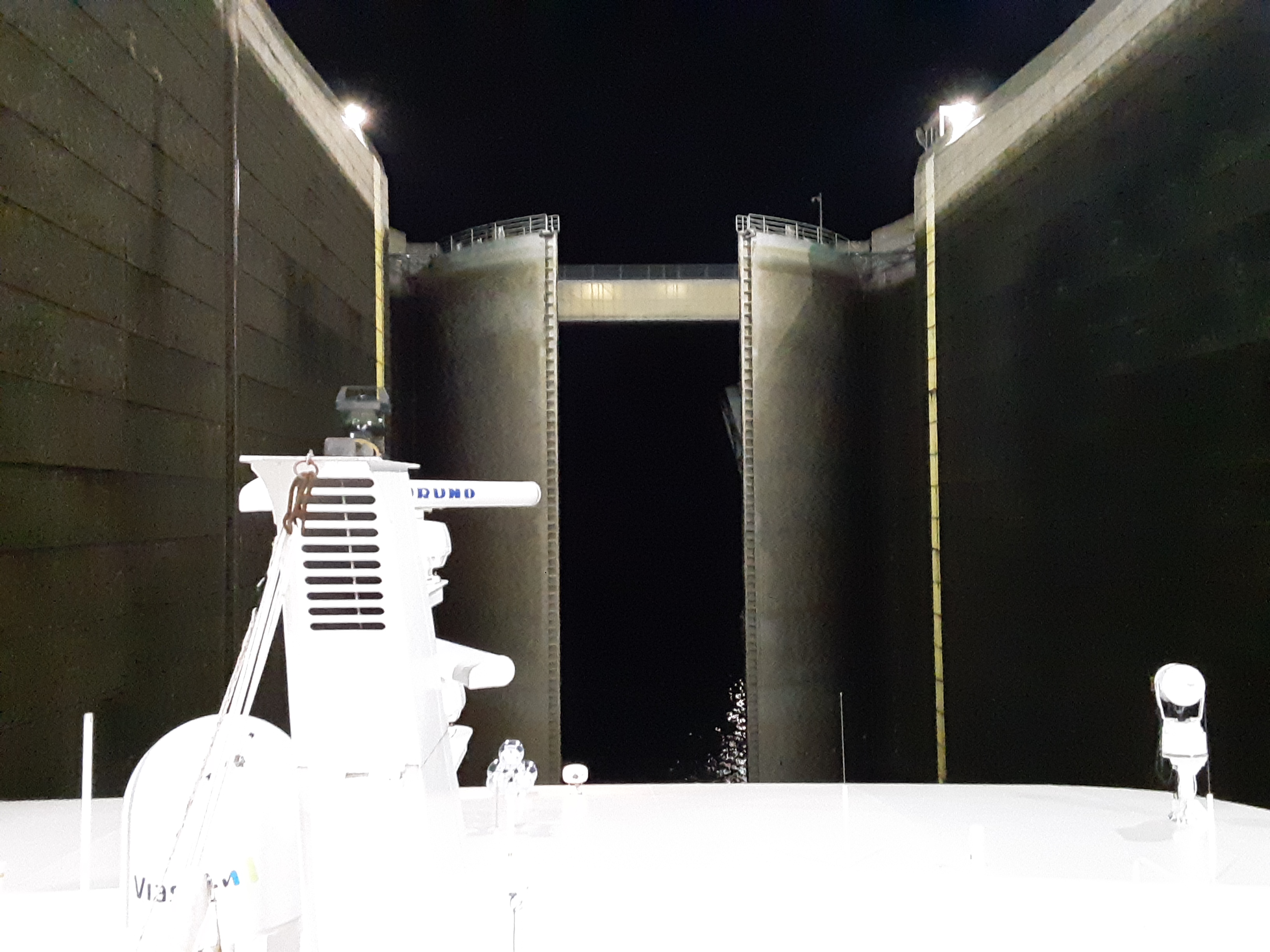
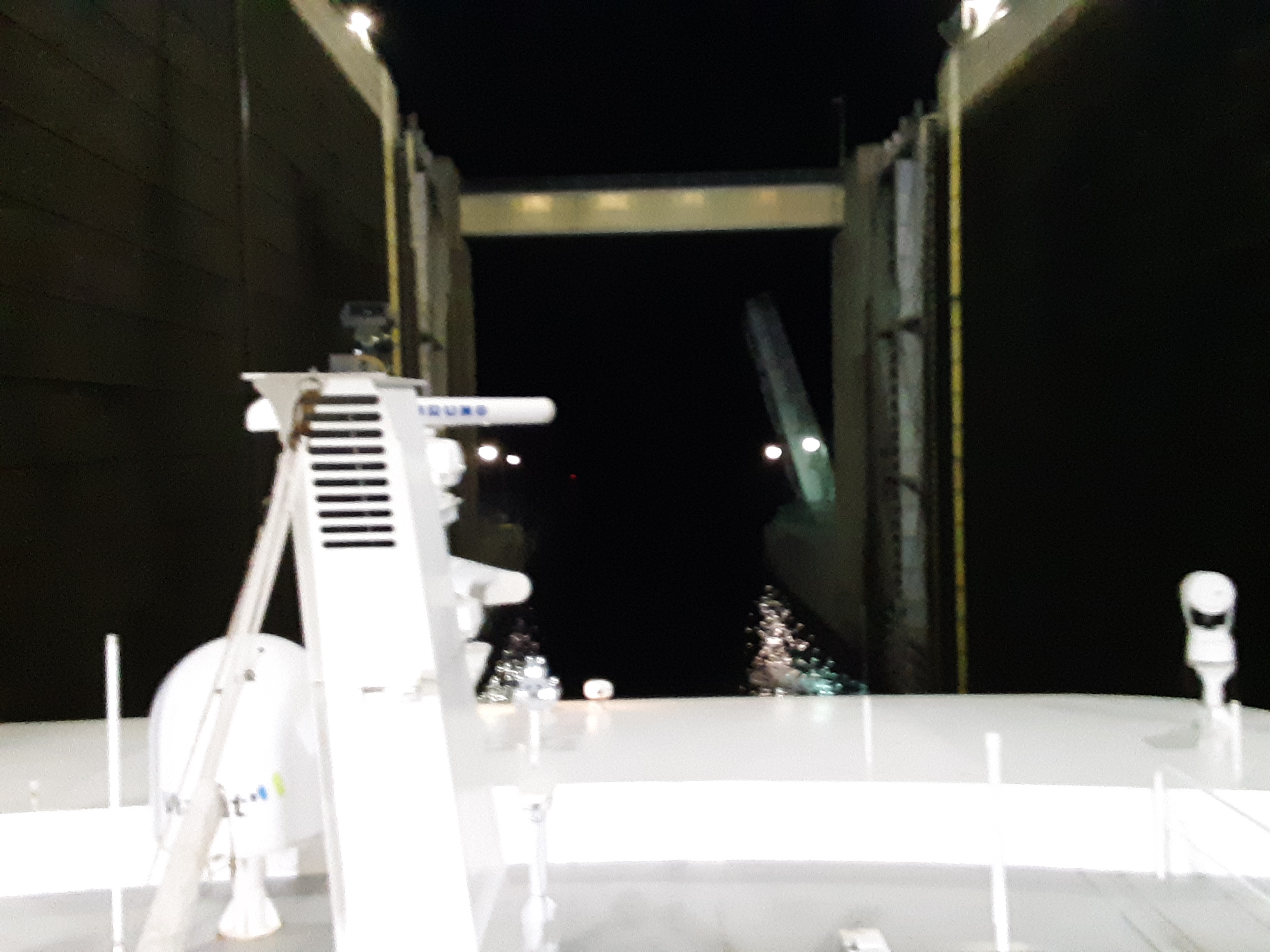
We go through a second lock at night – it is still magical. There is only black and white, the white boat, the black night, the gleaming gate, the sparkling water.

Later we explored off the boat at the Bonneville Dam, whose Visitor Center is a self-congratulatory celebration of the transformation of the wild rolling Columbia river into “a damn fine machine” for generating hydropower, in the words of an industry lobbyist.*

We saw another aspect of the locks and dams at the fish hatchery, where tiny salmon fry are nurtured until they are large enough to release downstream from the dams and make their way to the sea, and at the fish ladder, where returning salmon are given a chance to circumvent the dam in a series of cascades. These makeshift replacements of natural features are an attempt to appease the fishermen and native peoples whose lives depend on the salmon run. In another section of the hatchery, a bit off the self-guided tour, the sight of frustrated salmon leaping in vain against a current backed by a three-foot fence made me sad. In the hatchery these fish are artificially milked for their semen or eggs before dying, so the salmon fry can be created. The salmon would die anyway after spawning, but as they frantically jumped over and over against the impassable barrier, theyseemed to know they are supposed to get further to their spawning grounds than a hatchery.

===

*Quoted from Blaine Harden’s A River Lost; the Life and Death of the Columbia

Freeway Free in Washington: Eating Wild in Spokane

D and I were at the Hilton Garden Inn in Spokane, about to embark the next day on a cruise down the Snake and Columbia Rivers. The Garden Inn is a functional airport hotel, made charming by exceptionally pleasant, smiling staff. But dinner at the hotel looked like a bleak proposition; a bunch of folks were playing cards in the lounge, and the dining area was over-brightly lit and uninviting.

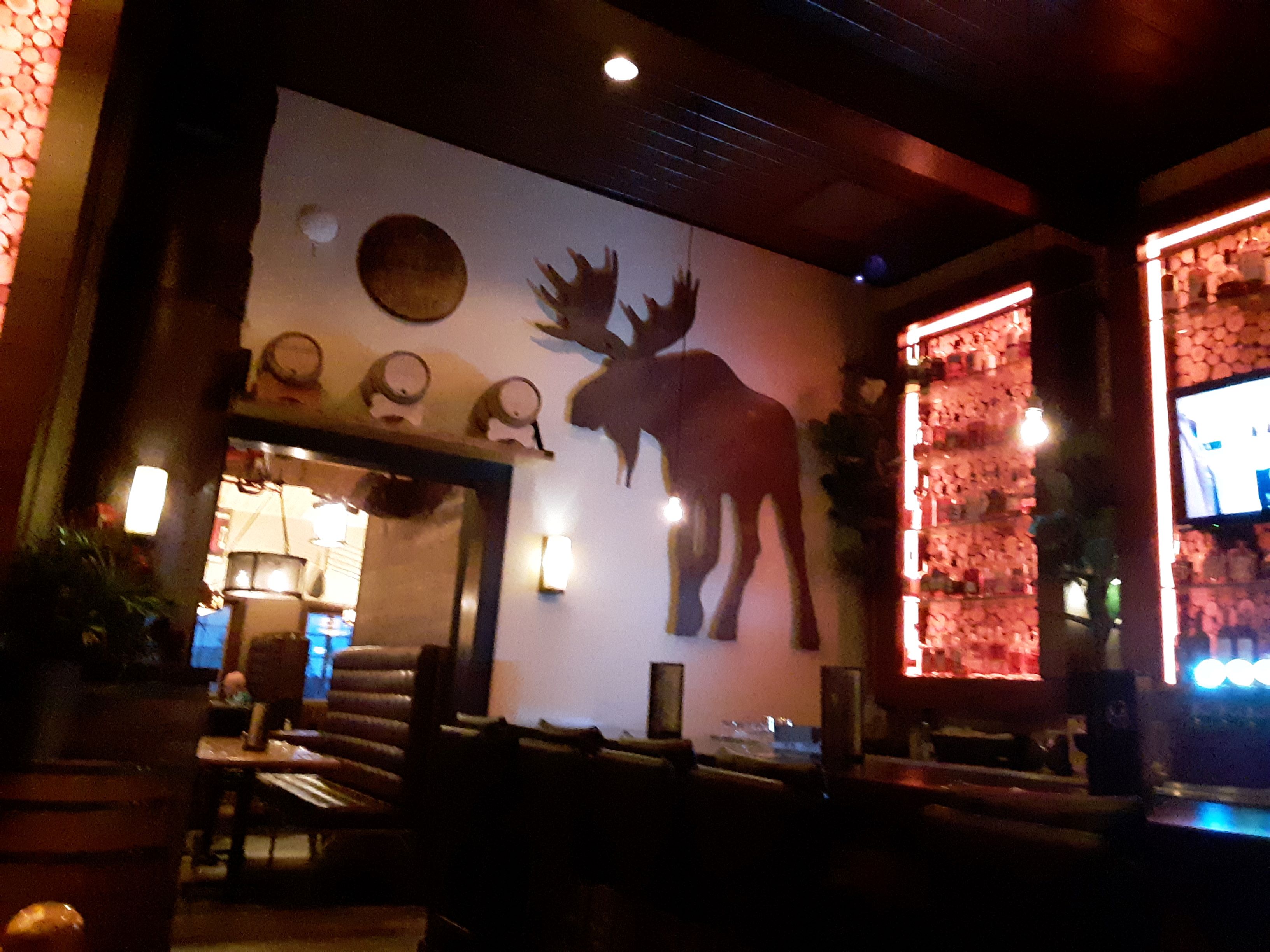
So we walked across the parking lot to the Rusty Moose, which, turned out to be very welcoming, despite being decorated with a lot of staring animal heads and other effigies. Though wild game burgers were the featured attractions, Destiny (our smiling server) served us a delicious dinner of seared halibut (D) and Idaho trout (me) with a yummy rice pilaf and baby asparagus on the side. We splurged on a bottle of the house Sauvignon Blanc from WA state, and a berry cobbler shared for desert (served with ice cream AND whipped cream on top – Washingtonians don’t stint!)

Maybe not a destination restaurant, but certainly a worthy haven en route to wherever!

Freeway Free in Washington: Surprising Stevenson

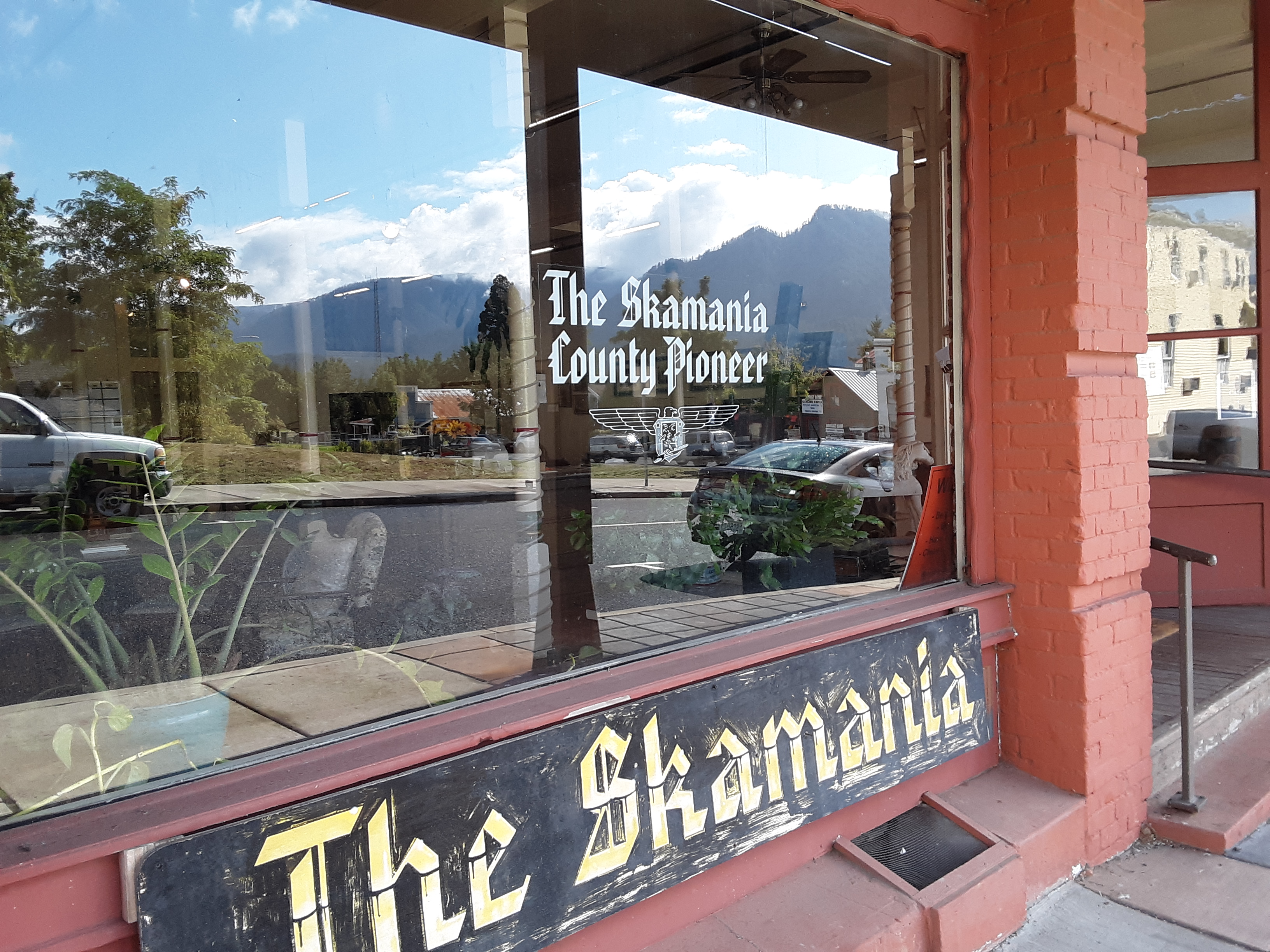
Stevenson Washington is a town of no more than 2000 people, with one main street that stretches from the Port of Skamania boat dock and park along the north bank of the Columbia River up three blocks to the brutally modern Skamania County Courthouse, with two cross streets, one of which is Washington State Route 14. But those three blocks are oddly charming, with shops that would be perfectly at home in an elegant Palo Alto shopping center. How do they survive?

Probably they survive because the boat dock is host several times a week during the summer months to American Cruise Line riverboats, which have picked Stevenson for a stopping point due to its convenient access to the Bonneville Dam, the Columbia Gorge Interpretive Center, and Multnomah Falls. In between excursions, the passengers are tempted to stroll off the boat, through the green and inviting park, and up the gentle hill to browse in North Bank Books, one of the prettiest and best curated bookstores I have ever seen, or examine goods in Out and About, a purveyor of beautifully tailored outdoor clothing, look for buried treasures at the Gorge Thrift Store, or taste a local craft beer at the Big River Grill, admire local art and crafts at Riverhouse III Gallery, or… but you should stop in Stevenson and see for yourself.

Freeway Free in Washington: The REACH Museum celebrates unspoiled nature and toxic science

With all the discussion about “Oppenheimer” and his role in the development of the atomic bomb, one would have thought there were be more discussion of the other two locations which were key to his success. One was Oak Ridge in Tennessee, where uranium was refined for the first bomb, the other was Hanford, Washington, where plutonium for the second bomb was manufactured.

Like Los Alamos, Hanford was built in the most remote location possible, shrouded in secrecy, and filled with scientists who believed their labors would end World War II. At one point the town of Hanford was the fourth largest city in the state, with the largest General Post Office in the world (since addresses would have been Top Secret.) And as at Los Alamos, the scientists involved in the project worked with little apparent thought of the long-range effects of their labors.

The REACH museum outside of Hanford overlooks the longest undammed free-flowing reach of the Columbia River – hence its name. The country surrounding the museum is a sage and scrub desert, but it teems with wildlife including elk, antelope, an occasional bear, and all sorts of minor rodents, insects, and birds. Ironically, the reason for this virgin territory lies buried underground in unmarked sites and in leaking canisters – the radioactive waste left over from the plutonium project. No-one wants to drink water that may have overlain these poorly-conceived and poorly protected waste dumps.

The museum itself is a hybrid – half of it is devoted to the geology and wildlife associated with the Columbia River, the other half tells the story of Hanford, the plutonium project, and the community’s pride in its contribution to ending the war. Only one exhibit addresses the threat of radioactive contamination left behind, and that exhibit invites you to compare the amount of radioactivity in a vintage Fiestaware coffee cup to that in a sample of dirt from Hanford. (Surprise! the coffee cup’s red glaze has more!)

The US government has belatedly spent millions of dollars to remove or contain contamination around Hanford, and will need to spend millions more before it is safe to drink the ground water. But the town is still proud of its contribution to V-J day, still cherishes the government houses (Models A through F) thrown up almost overnight to accomodate the families, and wishes that “Barbenheimer” was”Barbanford”

A Piece of my Mind: “Barbenheimer” Bites

Two blockbuster movies provided conversation and impromptu personality tests this past summer. “Barbie” presented a world full of parties and pastels, with non-stop smiles, smashing costumes, almost all women slim and successful, and men relegated to the status of accessories.  “Oppenheimer” presented a wartime world of dark suits and uniforms,  almost all men brilliant and competent, and women relegated to the status of loyal housewives or untrustworthy temptresses.  Reactions to the two movies contrasted as strongly as the movies themselves.  

At a block party, I sat between two women and asked the innocent question: “Have you seen the ‘Barbie’ movie?” 

The older woman with curly ash blonde hair on my right smiled broadly.  “I saw it with some friends.  We did the whole pink thing.  I laughed all the way through it.” 

The face of the younger Asian woman on my left twisted into a grimace. “Did you really?  Some of it was funny, but that part about how hard it is to be a professional woman – I’ve been through all that.  I’ve heard it all: ‘We need someone with more gravitas’ (Euphemism for ‘You look too young’).  “You’re too aggressive/not aggressive enough (‘We don’t see  a woman in this position.’). ‘We don’t feel you’d be a good fit.’ (‘You’re too Asian’).  ‘We want someone who can grow with the company.’ (You’re too old.’) When the movie got to that section, I was crying. “  

“Oppenheimer” also elicited very different reactions:  “Oppenheimer wasn’t the greatest scientist, but he was an organizational genius.”  “Oppenheimer was a martyr,  a scientific genius sacrificed to the red-baiting right after some harmless flirtation with communism in the 30’s.” “Oppenheimer  was so focused on solving the puzzle of how to construct an atomic bomb that he didn’t consider the human consequences. He left all of us in later generations to live under the constant threat of nuclear devastation.  He had blinders on.”  

When the men of “Barbie” stage a brief revolt, the women become arm candy and servants, but by the end of the movie the matriarchy is restored, together with the pastels, the sunshine, and the smiles.  This world has all the substance and nutriment of Necco wafers and spun sugar. 

The women of “Oppenheimer are seen only as frazzled housewives and overburdened secretaries, while the men wrestle with problems of domestic politics, national security, and the ongoing world war.   Those of us who remember the “Duck and cover” drills of the Cold War decades have to wonder – would they have gotten better results with a bit less testosterone? 

Can we strike a balance? Not a matriarchal world with the colors and substance of cotton candy, and not a patriarchal world of dark suits and uniforms and the threat of annihilation, but some blend of the strengths of each?  


Post Navigation