Allyson Johnson

Pieces of my Mind

A Piece of My Mind: Hallowed Ground?

Louisiana Monument

A Millennial friend of mine, touring the Gettysburg battlefield, asked “Why are there all these memorials glorifying people who fought for such a terrible cause?”  It was a question I had never considered despite many visits to the battlefield. 

Yes, Gettysburg is a historical site. Yes, the statues and memorials mark where generals actually stood and watched the battle, where particular battalions fought, and what contribution they made to the course of the battle.  Some of the Confederate monuments, such as the one designed by Gutzon Borglum, the sculptor of Mr. Rushmore, have artistic merit in themselves. But some are cringe-worthy.

The scripture on the Mississippi monument, for example:

            On this ground our brave sires fought for their righteous cause; In glory they sleep who give to it their lives

Who can read this today without gritting their teeth?
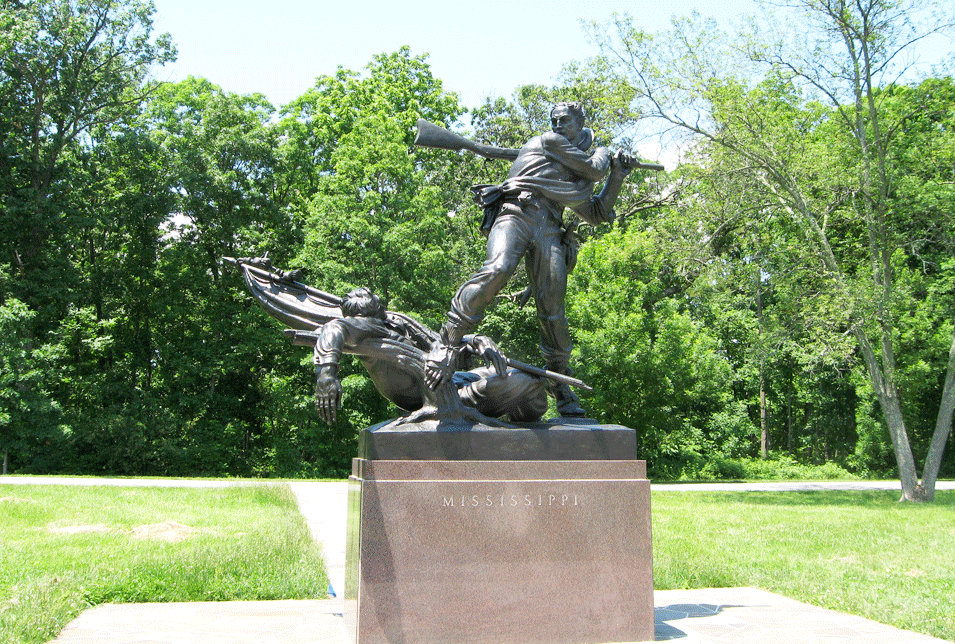
Mississippi monument

“I read that most of these Confederate monuments were put up in the 30’s at the height of the Jim Crow era, funded by the Daughters of the Confederacy,” my Millennial continued.  “What kind of euphemistic name is that?  If they called themselves “Daughters of Slaveholders”, would they have been allowed to put up monuments in a national park?  Does Germany put up battlefield monuments funded by Daughters of Nazis?”

My Millenial friend went on to wonder “Why is the monument to General Lee the largest on the battlefield?  He was supposed to have been such a great strategist, yet he sent his army to attack a stronger force in a fortified position uphill.  I’m told the professors at West Point use Lee at Gettysburg as a textbook example of what not to do strategically.

“Why does he get a giant statue when he basically did what Tennyson condemned in “Charge of the Light Brigade,” sending his forces into withering artillery fire in the Valley of Death?  Only there were a lot more than six hundred who died for his hubris. And Longsteeet – the only general who had the guts to stand up to Lee and tell him the charge was a bad idea – he only gets a 1/4 life- size statue hidden away from the street in a thicket.”
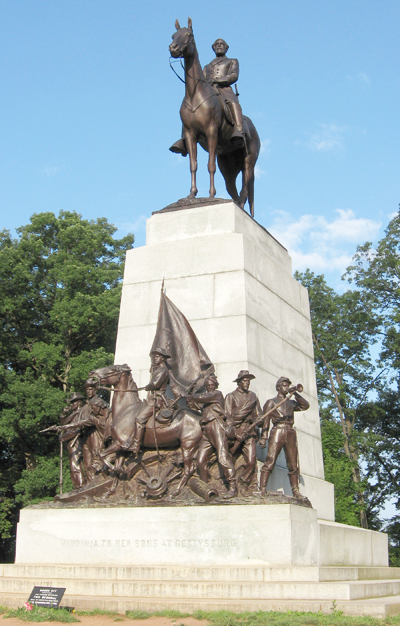
Virginia Monument

I tried to answer.  “Lee was supposed to be the best general in the Army at the time.  He was offered the leadership of the Union Army and agonized over turning it down. His uncle signed the Declaration of Independence. He symbolized the agony of having to decide between Country and State loyalties.”

“Yes, I know he graduated at the top of his class from West Point,” countered my Millennial. “But what did he learn, except to believe his own hype? He betrayed the oath he took at West Point when he defected to the Secessionists.   Yes, he was descended from Revolutionary War aristocracy.  But he was a still a slave holder, and defended slavery.

My millennial friend went on to ask “Why set aside all this land to commemorate warfare and dying?  The National Military Cemetery and the monument to Lincoln’s Gettysburg Address up on Cemetery Ridge say everything one would want to say about the men and boys who died to eliminate slavery in the US and to keep the country together.  The cemetery is what Lincoln called “hallowed ground”, not the battlefield.   These Matthew Brady photos of dead soldiers at Devil’s Den, and the informative signs about the Bloody Angle and the Slaughter Pen –  it’s like a theme park for carnage.”
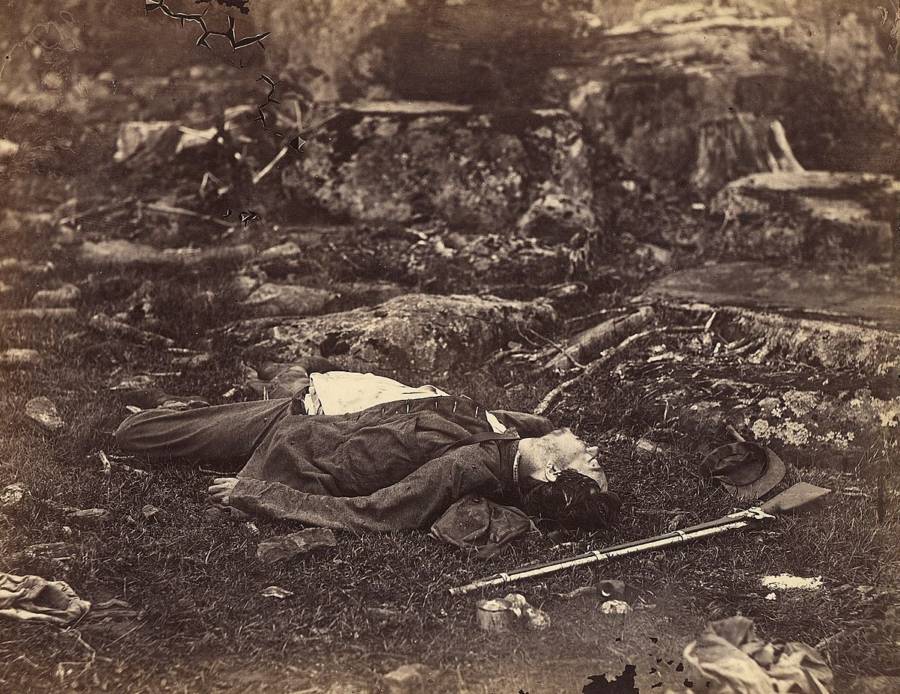
Confederate sharp shooter at Devil’s Den

We continued along Confederate Avenue, then drove across the valley to the sites of the Union lines from Little Round Top down to Cemetery Ridge.  I was trying to think of a good counter to my Millennial friend.  I’m still working on it.

A Piece of My Mind: The Oreo Epidemic

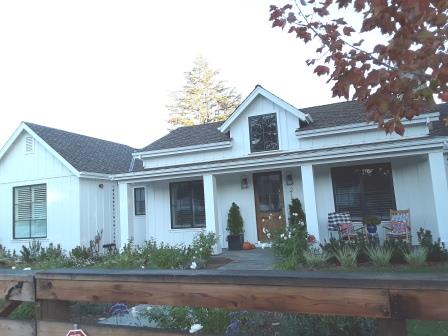
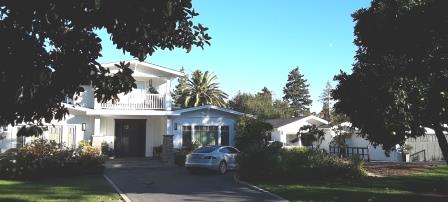
You’ve seen them, popping up like mushrooms all over our community.  My husband and I call them “Oreo houses”.  They are typically new construction, often built on spec, with  the “For Sale” sign going up as soon as the lollipop trees are in the ground.  They are painted stark white, almost always with matte black trim, the color scheme of an Oreo cookie.  

Often the Oreo house will have board and batten siding, so that the shadows of the battens relieve the starkness of the white.  The roof is usually gray metal.  Sometimes the Oreo house will have touches of natural wood – maybe the garage door and the front door.  Sometimes a facing of gray rock adds additional texture.   

When I first spotted an Oreo house, maybe back at the beginning of the pandemic, I thought it a strange color scheme.  Don’t they know that stark white will show every speck of dirt?  And every trail of rust or moss from a downspout?  And that the white paint will yellow in the sun? The black trim was such a harsh contrast.  And the black front door – so unwelcoming.  I shrugged mentally and thought “Each to his own taste. No more unusual than the lavender house with pink trim up on Los Altos Avenue, or the purple house with the stainless steel door on El Monte.”   

But then I saw another one.  And another. Now almost every residential street in town has at least one Oreo house. Furthermore, the decor seems to be contagious. Traditional ranch houses from the 50’s suddenly have their used brick painted over in stark white, with matte black shutters and window trim.  Even the handsome 1920’s Prairie School home with its outbuildings taking up a double lot down from the high school has, between one of my trips to downtown and another, been painted stark white. 

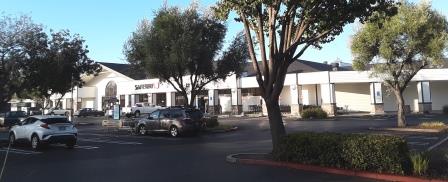
 The venerable historic train station (now a restaurant) has changed its adobe /redwood color scheme colors to Oreo. And at the south end of town, the contagion has swept across an entire shopping center. 

As many of our children are being forced to emigrate to more affordable housing in Texas and Idaho, are these ghostly white houses an omen of our future as a ghost town? 

There is hope.  An otherwise completely Oreo house on one of our main streets sports a bright blue roof instead of the common gray or black. If I could only spot one with a red door….  

What I Did on my Summer Vacation

I stood in line (masked, but not distanced).

I rode in a bus (masked, but not distanced).

I flew in a plane (masked, and with a vacant middle seat).

I ate inside at a restaurant (not masked, but distanced).

I served myself food in a cafeteria (with a disposable glove, masked).

I ate meals in a dining hall with people who were supposed to be vaccinated, but no proof was required. (not masked, not distanced, lots of open windows).

I went to an outdoor live music performance (not masked, distanced).

I went to an indoor theatrical performance (singing from the stage, not masked, not distanced, no windows) that lasted two hours.

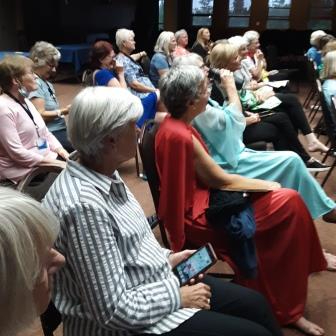
I attended several lectures, and emceed a variety skit night (not masked, not distanced, lot of open windows, everyone had provided proof of vaccination) each lasting at least an hour.

I had a COVID-19 test when I got home.

Negative – I got away with it.

Risk

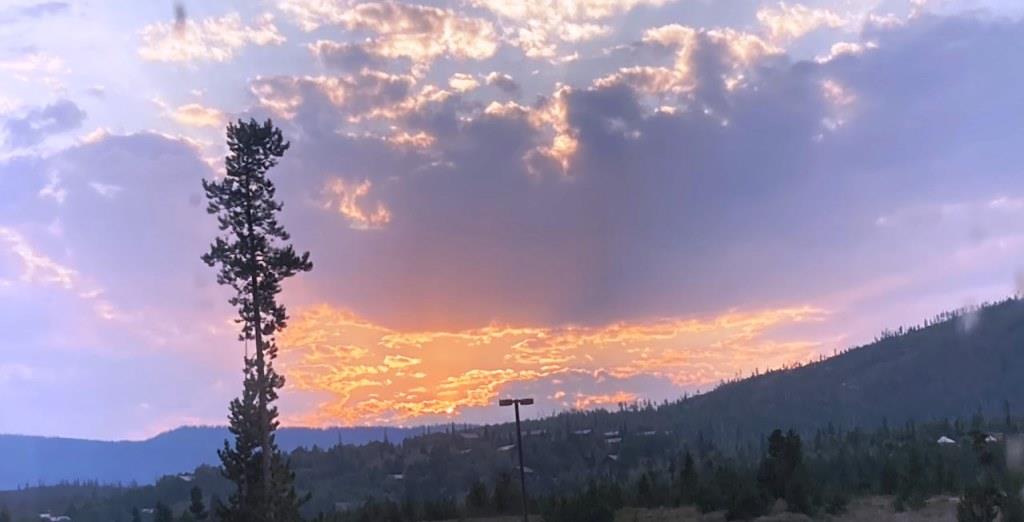
My friend called me, her voice tinged with panic.  “Do you think we should do this, with the Delta variant and all?”  We were planning to fly together to a women’s fitness camp on the western slope of the Rockies that we both had attended several times in past years.   

I reassured my friend.  “We are all responsible adults.  The people are all women we’ve known for years now.  We’ll be outside most of the time.”   

“Ok, I just needed to hear that.”  We continued with our plan that she would drive to my house the night before our trip, meeting me and my sister, and the three of us would be driven to the airport early the next morning by my Personal Travel Consultant, AKA husband. 

It happened that my son came down for an overnight visit the evening before the other women arrived, and he stayed working from our upstairs “office” for the day until joining us for happy hour and dinner the eve of our departure. 

“You’re going to be sharing eating space with a bunch of people you don’t know?  And just taking their word that they’ve been vaccinated?”  My son was so upset that he jumped to his feet and had to walk up and down on the street outside for several minutes to settle down.  He and his family had been to a party a couple of weeks earlier where “everyone was supposed to have been vaccinated, but the hostess called us the next day to let us know that a guy who left just ten or fifteen minutes after we arrived had just reported testing positive for COVID-19. So we were all exposed.”  His faith in folks’ “word of honor” is badly shaken. 

But I need to go.  I need to look at something different out the window, preferably something more than 30 feet away.  I need to hear some different voices.  I need to vary my diet from the familiar favorite offerings of my Personal Chef (AKA husband.) I need to stop reading about chaos in Afghanistan, earthquakes in Haiti, flooding in Tennessee, overwhelmed hospitals in Florida, hurricanes in Louisiana, wildfires in the Sierras, and attempts to overthrow the governments in Washington DC and California.  

When he returned to our back patio, I tried to reassure my son in the same way I had reassured my friend.  He listened, and then smiled with resignation. 

“Mom, I have just one thing to say to you,” he said.  “Make wise choices.” 

Something Different: a Physics lesson on race-car driving (Guest post)

“What?” you say? Am I in the right blog? Yes you are – it’s all about the connections!

My grandson, Chance Reilly Johnson conceived, execute, and edited this one-minute video as an entry in a national contest. (Challenge: Concoct a 1-minute video illustrating something counter-intuitive in physics. He chose “steer right to turn left” – you know about this if you saw the movie “Cars”!

The top 100 entries with the most views will be considered for a Major Award. Chance is up against grownups and influencers with loads of web followers. Click away! and you might even find this useful if you ever happen to be speeding around a tight curve.

Free Freeway into San Francisco

A friend invited me to visit for a few days at her time share in San Francisco, so of course I accepted with alacrity the opportunity to look at different walls and a different neighborhood. The time share was located at the Worldmark by Wyndham, right in the middle of Dashiell Hammett country, around the corner from where [Spoiler Alert!] Brigid O’Shaunessy killed Miles Archer in “The Maltese Falcon” (the movie scenes showing Humphrey Bogart striding past the hotel play in an unending loop in the lobby).

Getting into San Francisco was unexpectedly easy. I can’t get used to the lack of traffic on a summer afternoon going into the City (and maybe I’d better not get used to it – how long can it last?) I breezed up the scenic 280, cut over at the airport connector, scarcely touched the brakes on the Bayshore, cut over on 280 again past the ball parks, took one left at 3rd, a second left at Bush, and I was beckoned into the Sutter-Stockton garage directly across from the hotel. Wow!

Note to out-of-towners: Even the municipal parking garages in San Francisco will seem outrageously expensive to you coming from anywhere else but maybe New York and Washington DC. Best to come into the city by train or BART or shuttle and rely on the excellent (even during COVID-19 conditions) public transit system. If you have to come by car, plan your activities so that you can leave the car in the garage one day, using public transit to get around, and go all the places the buses don’t go on the same day without re-entering the garage until you are done. Every in and out costs $4, while a full day maxes at $44.

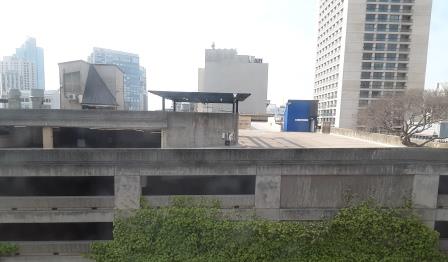
View of Sutter/Stockton Garage top floors – empty even in tourist season!

Freeway Free in San Francisco: Hangin’ out in the ‘Hood

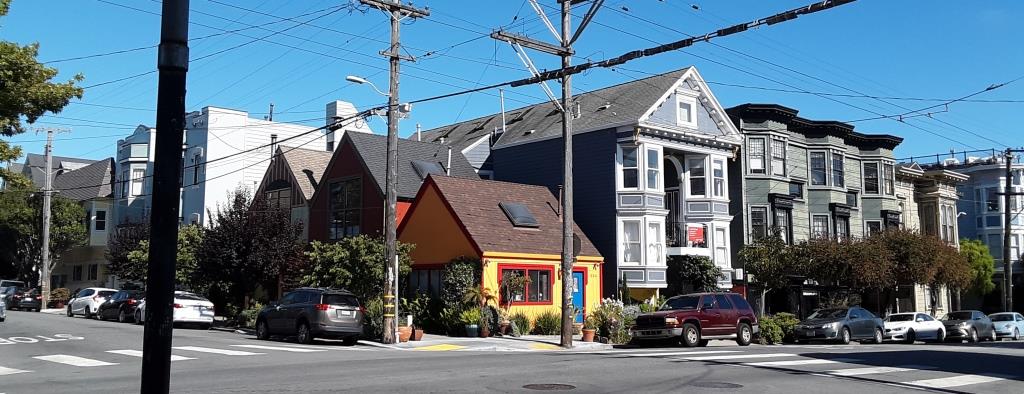
San Francisco is a city of neighborhoods. Each has its distinctive personality, though they do evolve slowly. The Tenderloin has retained its seedy Character ever since the days of Dashiell Hammett, even though it is tightly sandwiched in between upscale Union Square and the culture-heavy Civic Center. Sea Cliff and Pacific Heights are posh, the Richmond and Sunset districts are full of fog and families, while South of Market (SOMA) is still heavily ethnic and blue-collar.

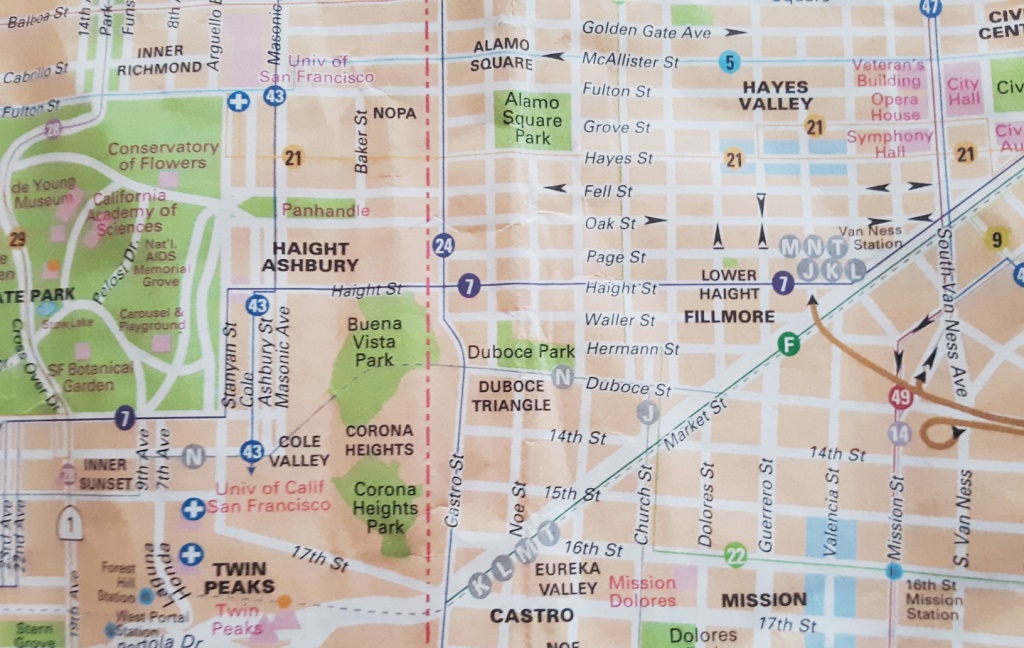
W and I were invited for dinner in the Dubose Triangle. This is a quiet neighborhood of Victorians which have been cut up into apartments and condos, tucked between the flamboyant Castro District and trendy Cole Valley. We met our host at Dubose Park, just next to the runner where the N-Judah dives underground below Twin Peaks before surfacing in the Sunset District near the beach. The lower section of Dubose Park is dedicated to dogs , with all varieties of mutt and breed frolicking on green and well-kept lawn. The upper section requires leashing so that toddlers can learn to crawl on the grass and families can picnic.

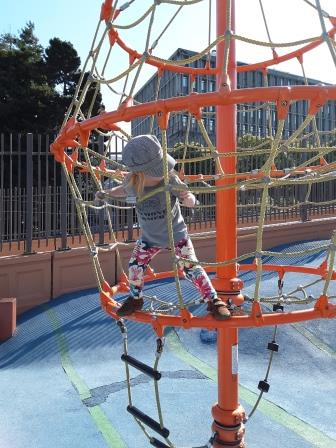
We met our host next to the fenced=in play structure, where he and his neighbors were chatting about good places to camp with children, plans for their next getaway, and the difficulties of finding contractors to do minor remodeling and repairs.

When our hostess arrived after her work-from-home meeting, we pulled the pre-schooler away from her posse and ambled back down to the house. On the way my host was greeted over and over by passers by. “I’ve lived in this neighborhood for fifteen years,” he shrugged. “i know a lot of people.”

Who says urban life is cold?

A Piece of My Mind: Groundhog Day? Groundhog Decade?

It’s become a cliché to compare living in the year of COVID-19 lockdown to the movie Groundhog Day, in which Bill Murray’s character is doomed to relive the same day over and over until he gets it right.  I’ve certainly had that feeling, as Laundry Day seems to come around faster and faster, and the only difference from week to week is what color sheets I put on the bed.  

But hey!  We’re getting through it, right?  I’ve been waiting for the New Normal for a while now, with the anticipation of looking forward, rather than looking back at How Things Used to Be.  But this week I had an unsettling discovery which challenges that anticipation.  

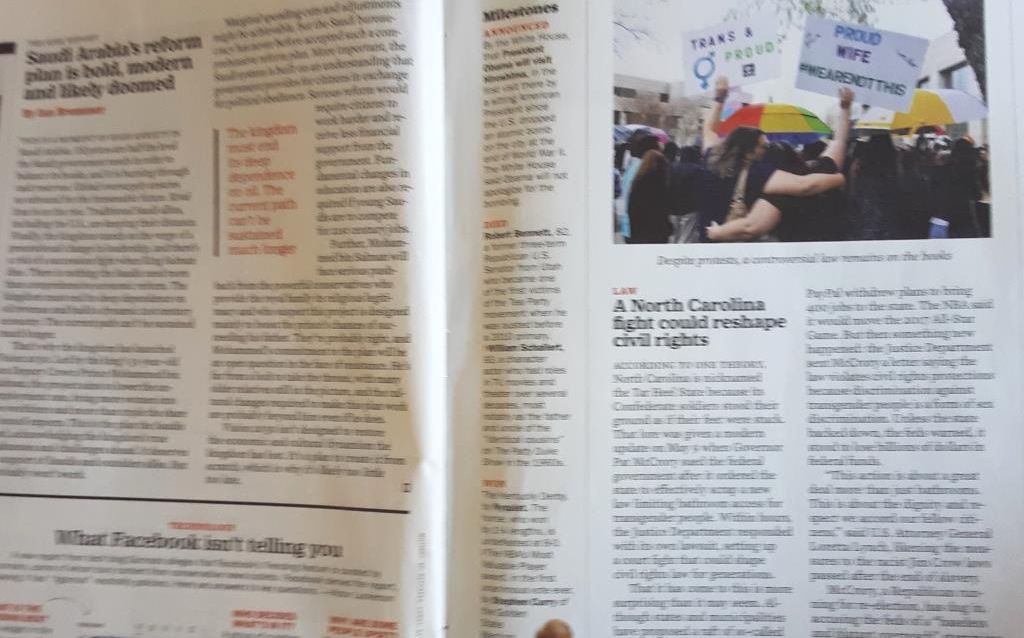
Like many people, I keep a stack of unread magazines in the bathroom which I am going to get around to reading sooner or later. During lockdown, I made a lot of progress.  This week, near the bottom of the unread magazine pile I found an issue of Time from summer, five years ago.   

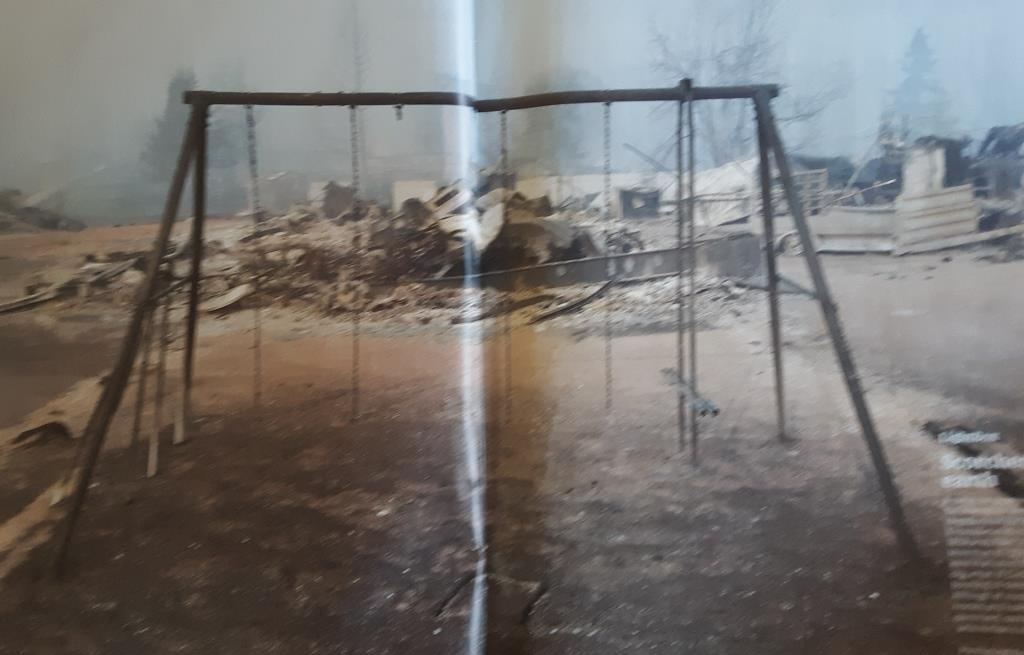
There was a two-page photo spread showing a scorched playground swing among the smoky ruins of a school, one of at least 2400 homes and businesses in a community destroyed by a wildfire. 

A lead article talked about how to achieve equity and inclusion for black students at colleges and universities, using the line “Black Students Matter”.  

Another article featured edible cutlery as a way to keep plastic waste out of landfills. 

An op-ed article discussed how to help your children interact with and understand artificial intelligence. 

A second op-ed article worried about how the aging of the Baby Boomers would impact our society, especially if they are siloed in retirement communities and lose engagement with their communities. 

The lead articles discussed the need to reform our tax system in order to narrow the wealth gap and the lack of political will to address our crumbling transportation systems.  The entertainment section featured an article on the retreat of movie and television drama into endless fantasies where magic and superpowers prevail over reality.  

In short, if you changed a few political names, updated the titles of the books, movies, and TV shows, and overlooked the lack of mention of pandemics, there was almost nothing in the magazine that couldn’t have been written this week.  I have the horrible suspicion that once I am out of lockdown, the New Normal could just be 2016 over and over again, until we get it right.  

There are still a few magazines in my pile, even older than the copy of Time from 2016. I’m going to wait a bit before I look at them, though.  If we are stuck in a Groundhog Decade, I don’t think I want to know. 

Freeway Free in Texas: Take Me Home From the Ball Game

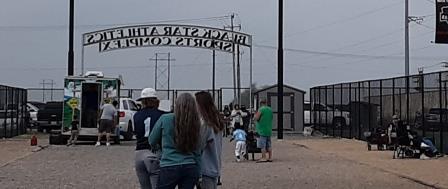
          It’s 6:30 am and we are off to Kyle (touted by Wikipedia as the fastest-growing town in Texas, which also makes it a strong candidate for the ugliest – lots of big box stores and pop-up housing.) My nephew’s team, the Texas Gunners, will be playing the Triple Play in the Battle of the Basement. (Winners get to sleep in. Losers play at 8:30, and the team meets for warm-ups an hour earlier) The Gunners have beaten Triple Play in two previous games but we must not be overconfident.

          We arrive at the ball park.  My nephew and brother stride off toward the dugout with the duffel bag full of gear.  My sister-in-law and I note the rain spangling against the windshield and decide to huddle in the SUV for a few minutes longer.

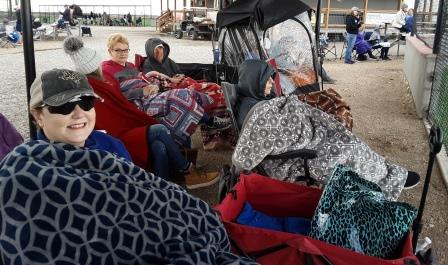
          Twenty minutes pass.  The rain is still spatting against the windows, but we unfurl ourselves from the SUV, add a couple of layers of warmth from the back seat stash, and make our way to the bleachers, happily sheltered under a tin roof. The other parents are cuddled in sleeping bags, or afghans, or double layers of fleece. One family has brought a tent, which is pitched under the tin room for added protection.

          First inning.  The wind picks up. And up. The sky grows darker. And darker.  My nephew distinguishes himself as pitcher during the first inning, and the second.  Rain continues. Wind increases.  25 mph, says the weather app on my smartphone.  It is now the third inning, and my nephew’s  pitches are getting wilder.

          “Will the game be called on account of rain?” I ask my brother through chattering teeth.

          “Nah.  Only if there’s lightning. If there’s lightning they have to stop and wait for a half hour since the last thunder clap.”

          As if on cue, there is a bright flash of lightning. A long roll of thunder.  The umpires blow their whistles.  The teams retreat to their respective dugouts. The parents shiver beneath their blankets.  The kids seem immune to cold, not even donning their team sweatshirts as they wait out the interval.

          A half hour passes.  No more thunder. The teams resume the field.

          Bad news:  My nephew’s team loses again. They are eliminated from the tournament

          Good news: They don’t have to play again.  We can go home and get warm.

Dawn On the Freeway

Photo by Jason Freis

The gaudy neon carnival of a predawn freeway. Gas Stations pass like brutalist modern sculptures standing out in the blackness . I’m in Texas but could be anywhere, as the comfortably familiar logos flash by. Lowes, Motel 6. Panera bread. IKEA. Harley Davidson. Suddenly we are in a city. Skyscrapers dimly lit, offices weekend-empty. Then a tangle of concrete arches, and we are back in Logoland. Toyota, Acura, Jeep, it must be an AutoMall. Jack-in-the-box, the golden M. Apartment blocks huddled\ darkly together, Public Storage conveniently adjacent (why do people accumulate so much stuff that they have to rent auxiliary storage? They can’t all have inherited their parents’ dining room furniture!).

The sun is struggling to rise through thick clouds. The striped roof of a KFC emerges from the gloom, lit by Verizon, Chick-fil-a, T.G.I. Friday. No people visible anywhere except for other drivers staring fixedly forward as we pass them in the fast lane. More three and four story apartment blocks, more widely spaced. And then we are out of the suburbs and the space opens out to a horizon brought close by the clouds, and an expanse of scrub brush and winter-dried grasses. And just as suddenly into another suburb, Shell, Starbucks Burger King 7-eleven. More public Storage. Auto maintenance and repair. Huddled 2-story apartments. A parking lot full of cherry pickers and backhoes. Dawn is here. The neon lights are shutting off. Open space again briefly, then another suburb. We exit the freeway and stop at a red light. We have arrived at Somewhere. Walmart. Walgreens. Goodwill. Just like home.

Post Navigation