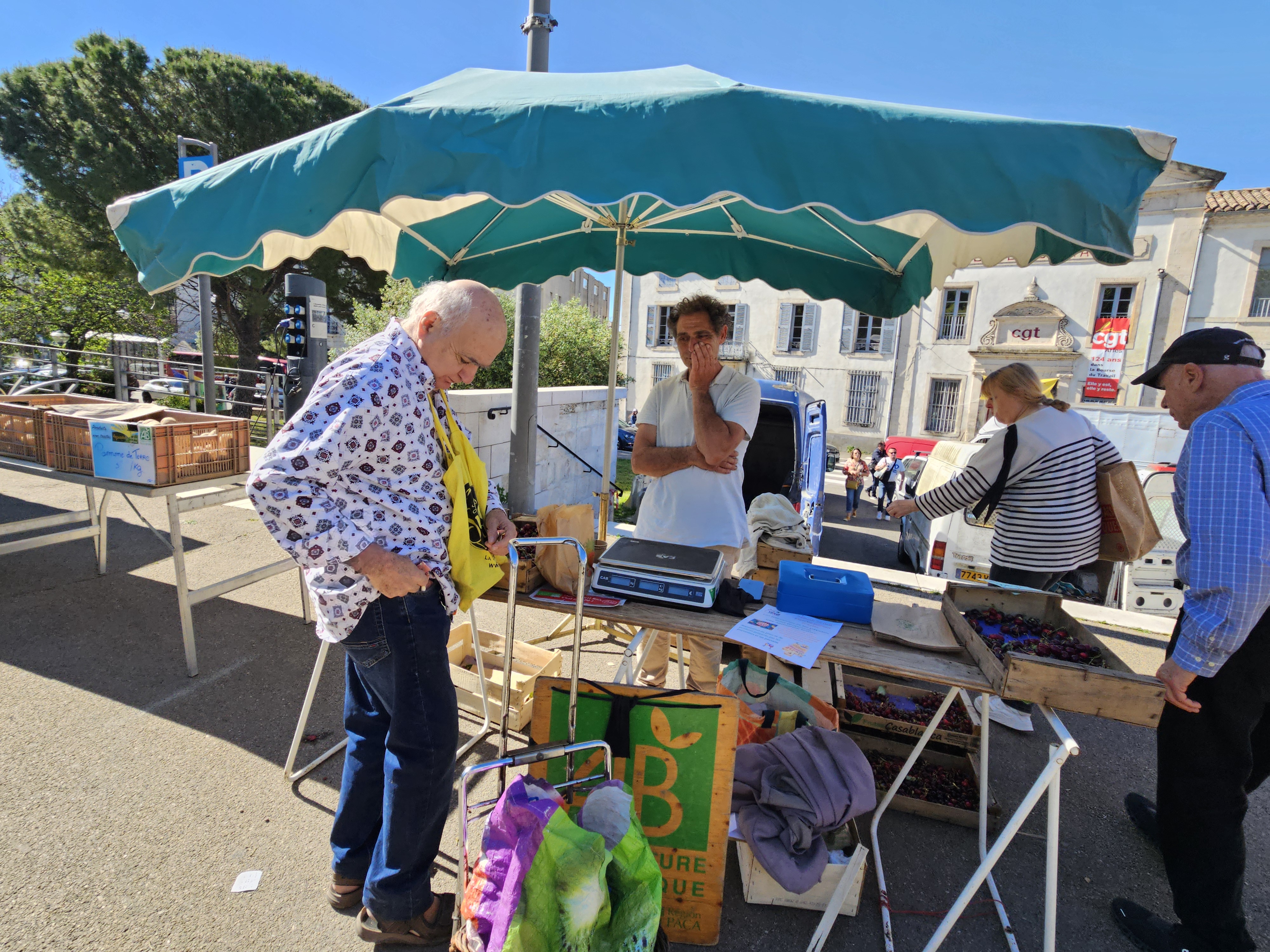
EJ suggested that a Provencale cooking class would be fun, and two of us took up the suggestion. EJ, SF and I meet Erick Vendel at his home, and proceed with him and his assistant Sylvia to the vast Saturday market along George Clemenceau Blvd in central Arles. I heroically walk past the racks of 5 euro dresses and 7 euro hats but allow myself tastes of wonderful cheese, olive bread, salami,and other bits while odors of paella, falafel, and various exotic spices waft past, while Erick chooses supplies from his favorite vendors
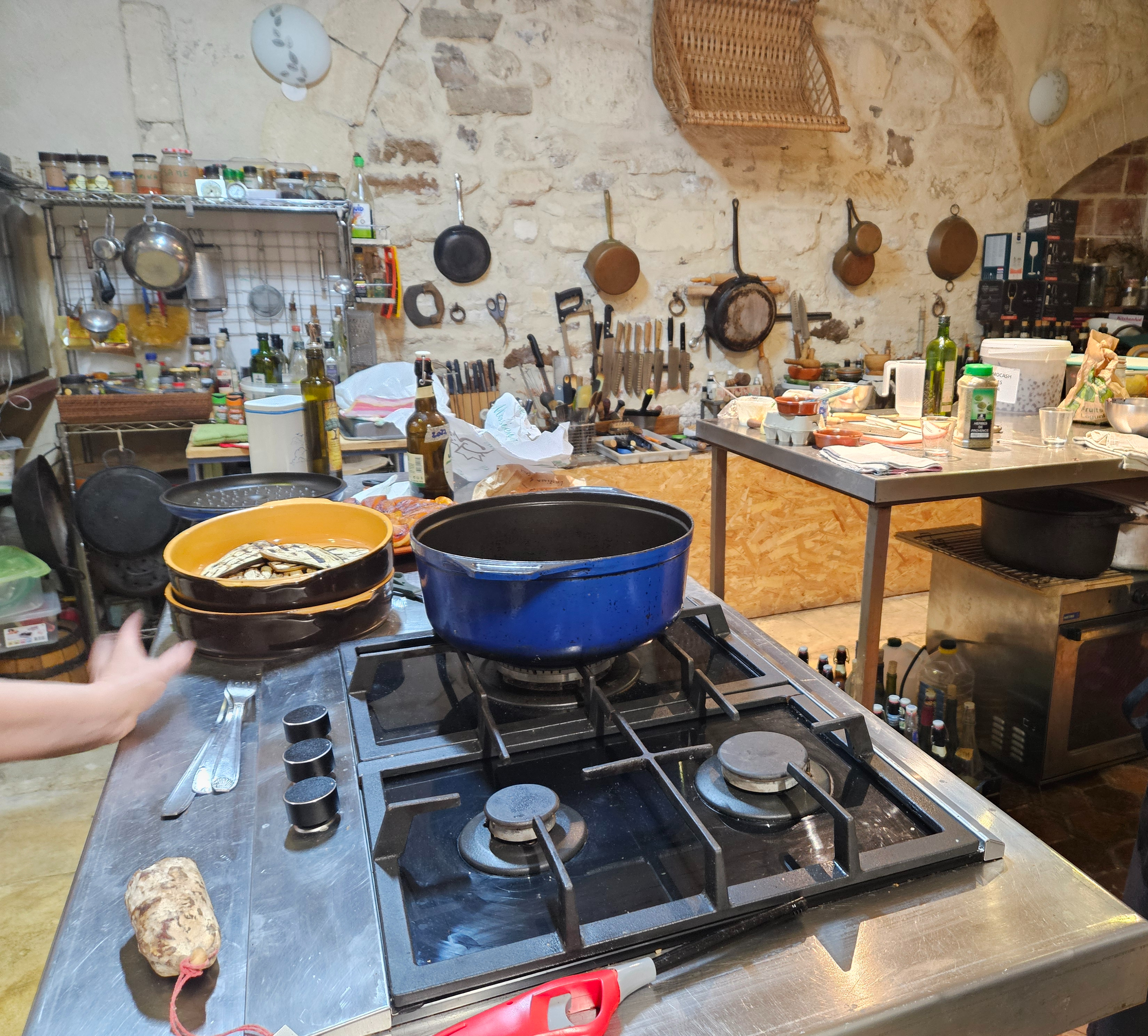
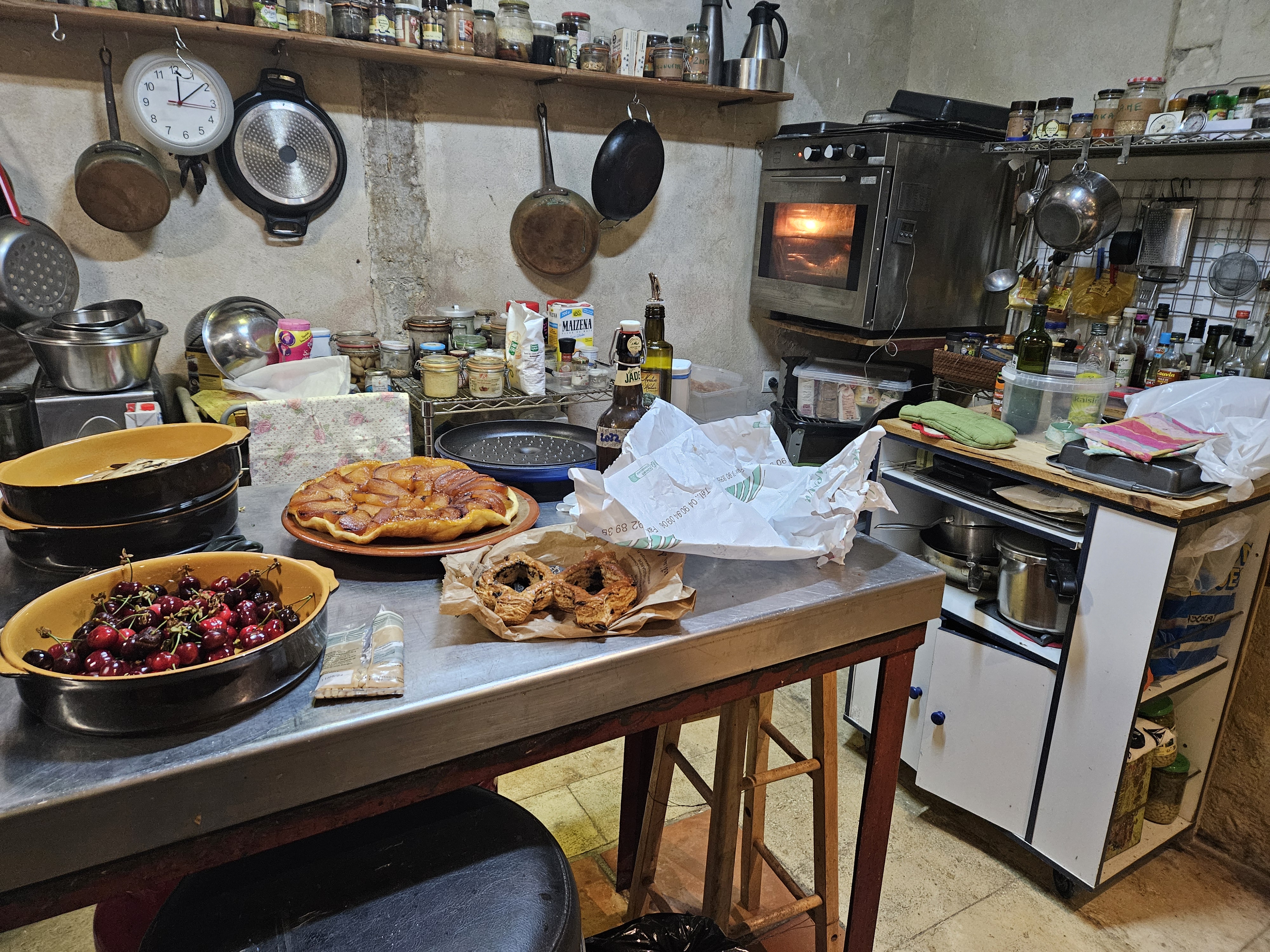
Once back at the well-supplied cooking kitchen, we learn how to make Mille feiulles de legumes (there’s a trick to grating the garlic) pintade aux olives, (Chef Erick gallantly chopped off the head and feet of the pintade [guinea fowl] for us), torte aux blettes (be sure to wring out the chard), riz au gingembre and tarte tatin (amazingly easy and dramatic upside-down apple pie dessert!)
Everything in the oven or on the rack! Triumphant sous-chefs take a moment.
Then we sit down and eat it all, together with wine and digestif, which makes conversation lively in English and French. Then, clutching our recipes, we totter back to our hotels for what will probably be naptime.
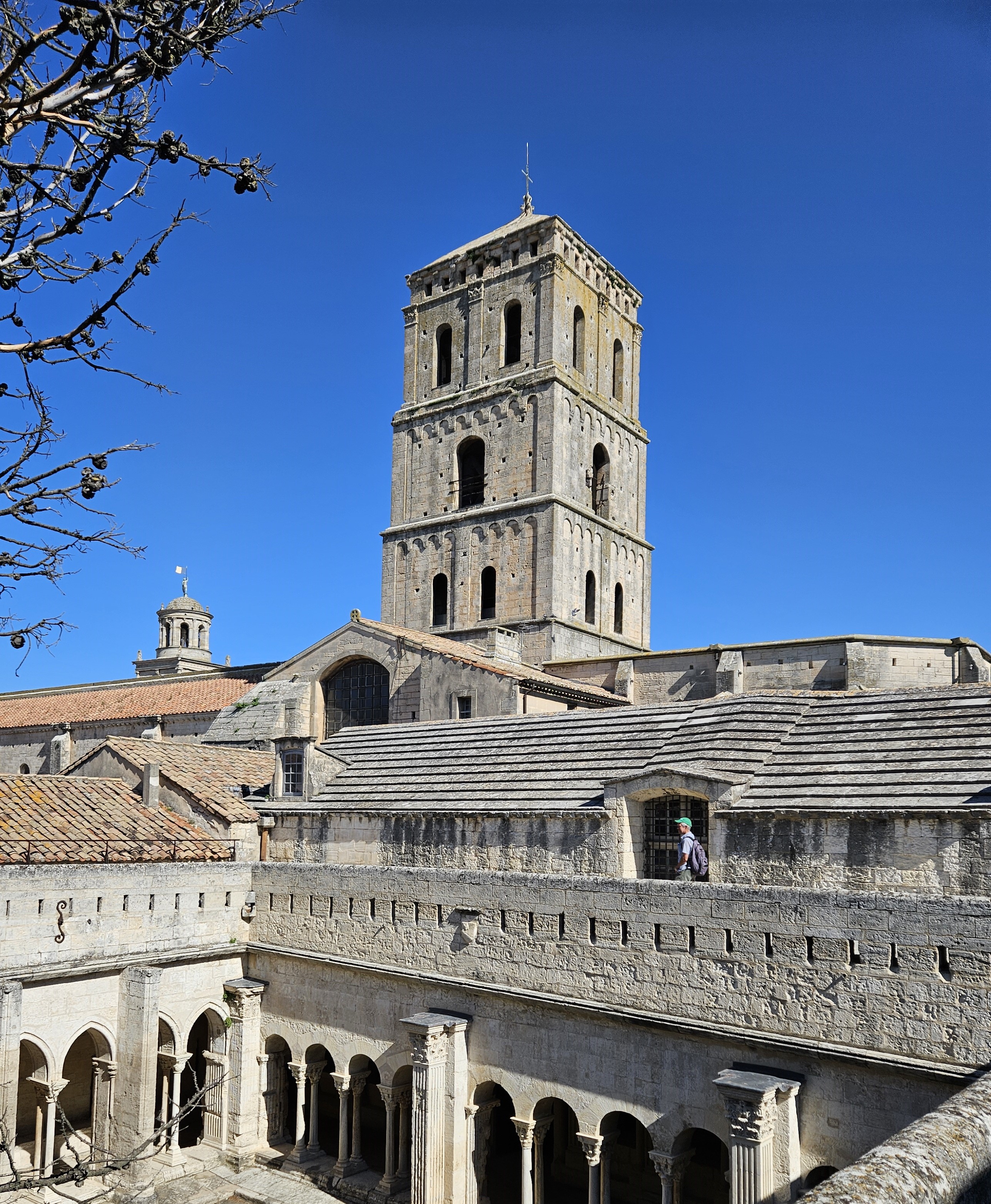
This was our “What shall we do while the rest of the group goes to Avignon?” Day. EJ and I met for breakfast (rather ordinary, but fortifying) downstairs, put on our walking shoes, and set off for the Tourist Information Office down the street. We picked up our Arles 365 Passes, allowing us into ten historical sites and museums, and started across the street directly to the Hotel de Ville (City hall) and the neighboring Cloitre de St. Trophime (St. Trophime’s Church And Cloister). This was our dose of Gothic/medieval Architecture – lots of biblical motifs, Christ in judgment with unhappy souls being led off in chains to the left, while the sanctified get their angel wings on the right, all over the Church door in graphic detail. Inside, lots of chapels with minor saints (St. Roch is my new favorite dressed in the garb of a Conquistadore, but evidently he lived in the time of the plague, and had one of those incredibly faithful dogs.)
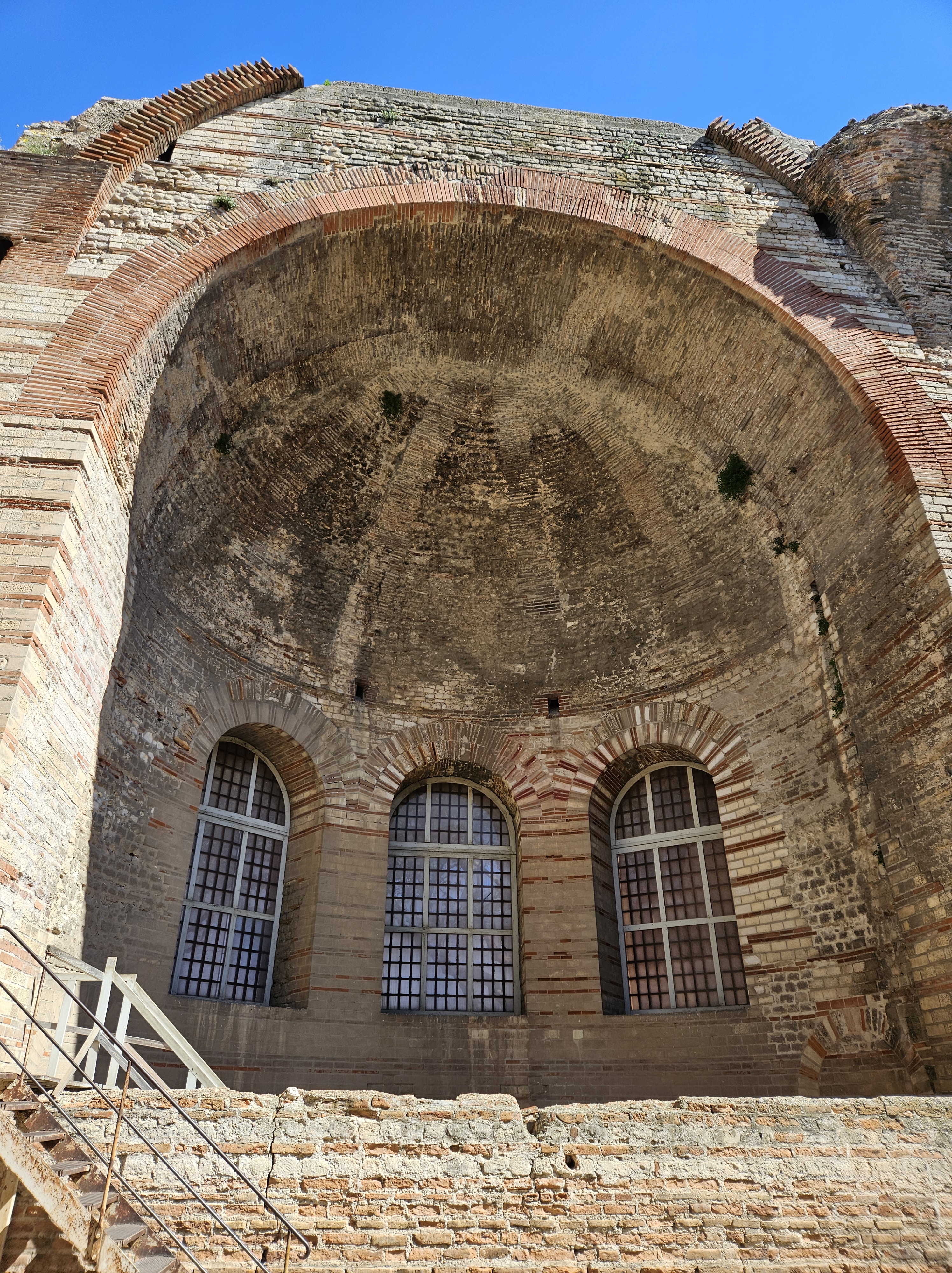
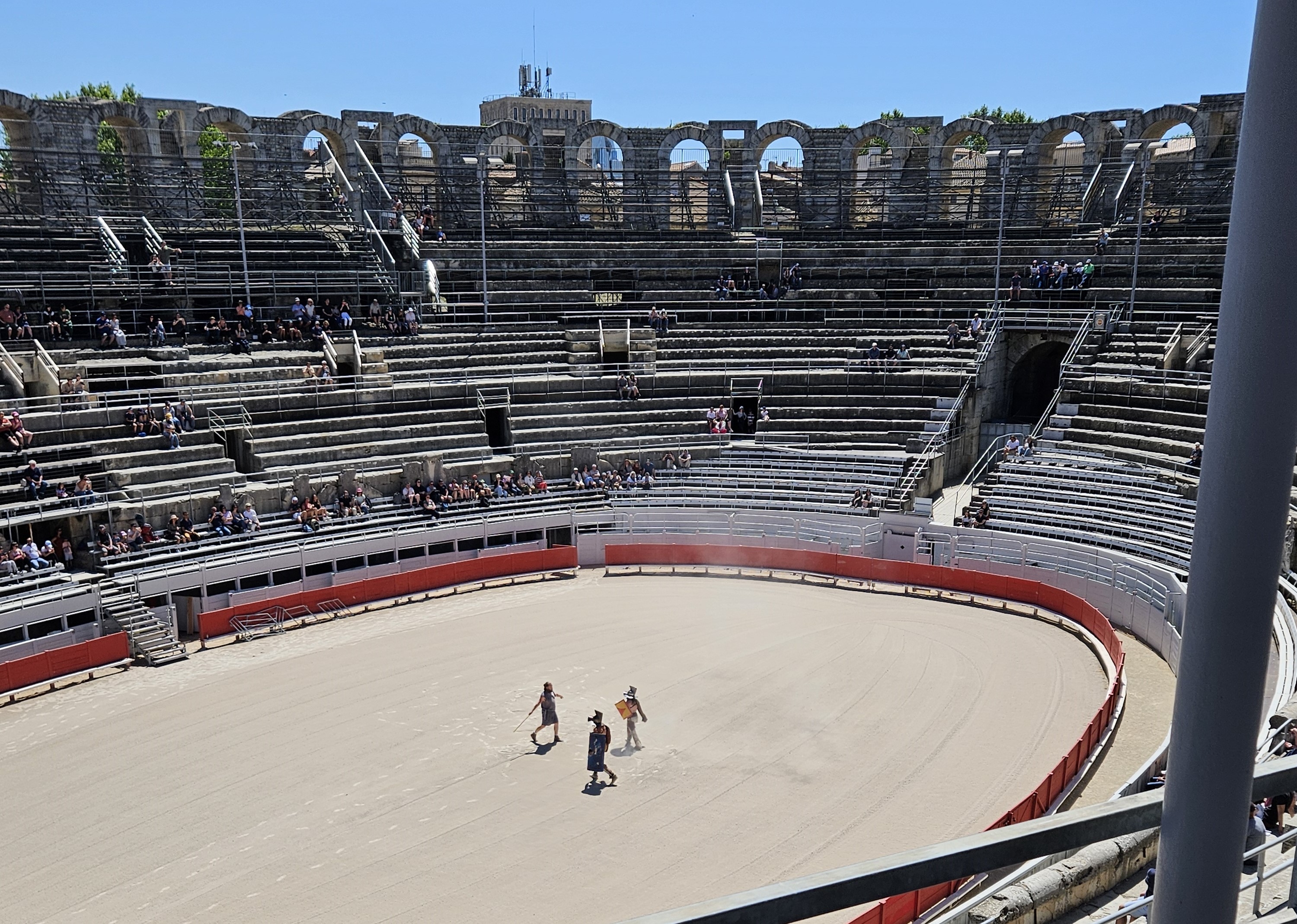
Then up to the riverside where we explored Constantine’s Baths (public steam room, exercise room, sun room, swimming pool – an incredible structure which, when first unearthed, was assumed to be a palace) Then through the adjacent Musee Reattu, an odd collection of 18th century and modern works (“The museum went to sleep during the world wars” explained the catalog), and down to the Arena, where we saw two gladiators battling rather cheesily.
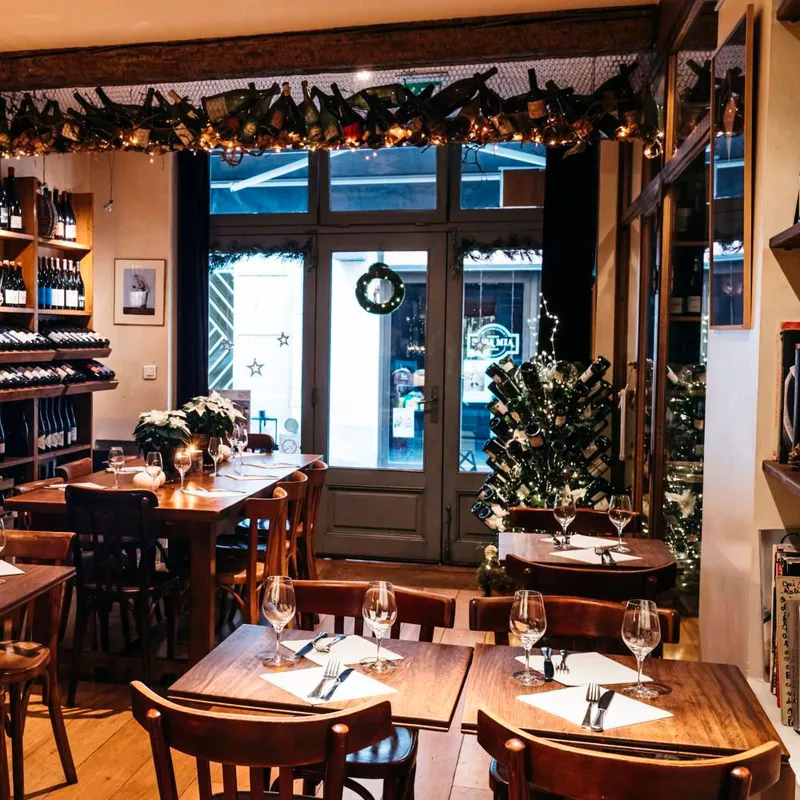
Hungry and hot, we spotted the sign of Le Criquet, a restaurant that had been highly recommended by the Canadians EJ met the previous night, so we plopped down and were treated to delicious fresh shellfish over linguini or over potatoes (we had 2 different entrees) and a floating island pudding that relates to what they used to serve in our college dormitory as Italian gelato relates to a Fudgecicle. Fluffy, meringue, creamy pudding…. The picture can’t do it justice.
Almost dizzy from deliciousness, we decided to work off lunch by walking the length of George Clemenceau Blvd to the Musee d’Arles Antiques.
The museum’s modern bright-blue exterior belies the wealth of ancient artifacts contained within, including a cemetery’s worth of sculpted sarcophagi, murals re-constructed from villas excavated in the neighborhood, an ancient wooden boat retrieved from the Rhone river, its cargo of urns intact, and reconstructed, Greek statuary… and on and on. And, an extra plus after a day of sight-seeing – it’s air-conditioned.
EJ has scheduled a birding expedition led by an expert local guide this evening and may miss dinner, which is why we splurged on lunch a bit. After a short rest back at the Hotel Constantin he leaves to rendezvous with his guide, while BB and I walk to meet the rest of the group at Le Gibolin, a Michelin -recommended restaurant within walking distance.
There we meet PS, former leader of our student group in France, whom I briefly dated afterward (he taught me to appreciate hot buttered rum), and SF, who traveled with me and two other students for three weeks crammed into a VW beetle – and still remained friends afterward! Rounding out our table was MV, who had been a high school student in Tours during our stay and whose family had informally adopted PS and me. I had not seen her for over 60 years – the other three I had seen briefly at reunions or visits. Would our camaraderie endure after all this time?
For some people, seeing a total solar eclipse is a bucket list item. For me, it was a lucky accident: I always visit my brother D in Texas in late March or early April, and he happens to live in Georgetown, right in the path of the totality of April 8th. I asked him way back last August if I could stay an extra day for the eclipse and he agreed; then my son and his family asked the same favor a few weeks later, so we end up with a mini-reunion.
D belongs to a golf club, and the club makes an occasion of Eclipse Day, with access offered to the driving range for an unobstructed view. Since the celestial event is scheduled for about 1:30 PM Texas time, the club also sets up an outdoor grill serving hamburgers and hot dogs, with soft drinks on tap and Milky Way bars for dessert. (Cute!)
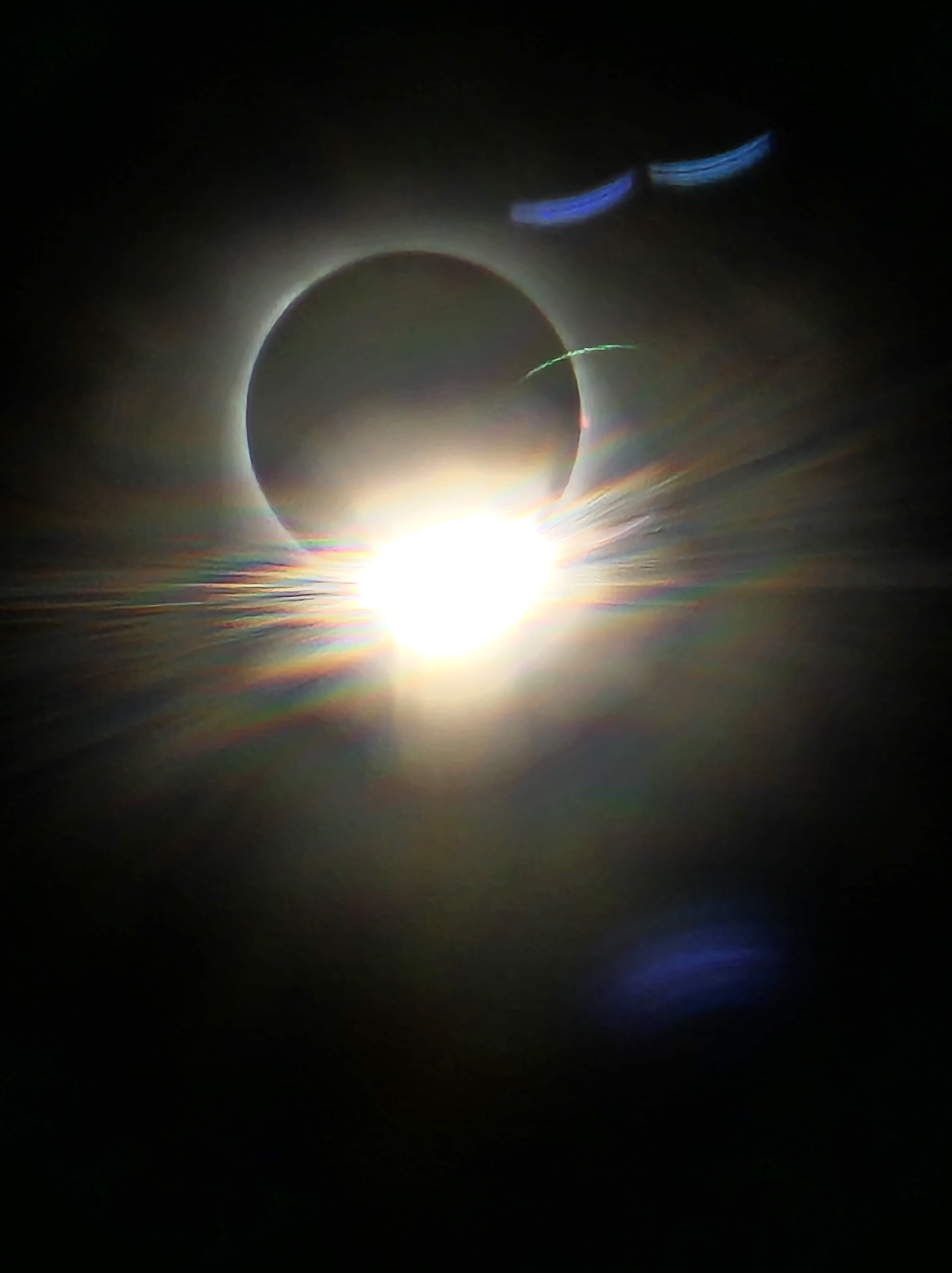
The eclipse – peekaboo clouds, and then just before totality, they part perfectly to frame the diamond ring, then almost evaporate completely as the aurora flares out and a few red coals glow on the rim of the moon – solar flares, I am told later. The audience spontaneously applauds – good show, God! Amazing that if the moon were just a bit smaller, or the sun just a bit closer, the effect would not occur. Is this Creation at work for us or just lucky coincidence?
When my previous post “New Year for China” was published in the LATC, I hoped to get a letter or two of appreciation for my positive write-up of the the local celebration of the Chinese Lunar New Year and for my regrets about the deterioration of relations between China and the US over the past 20 years.
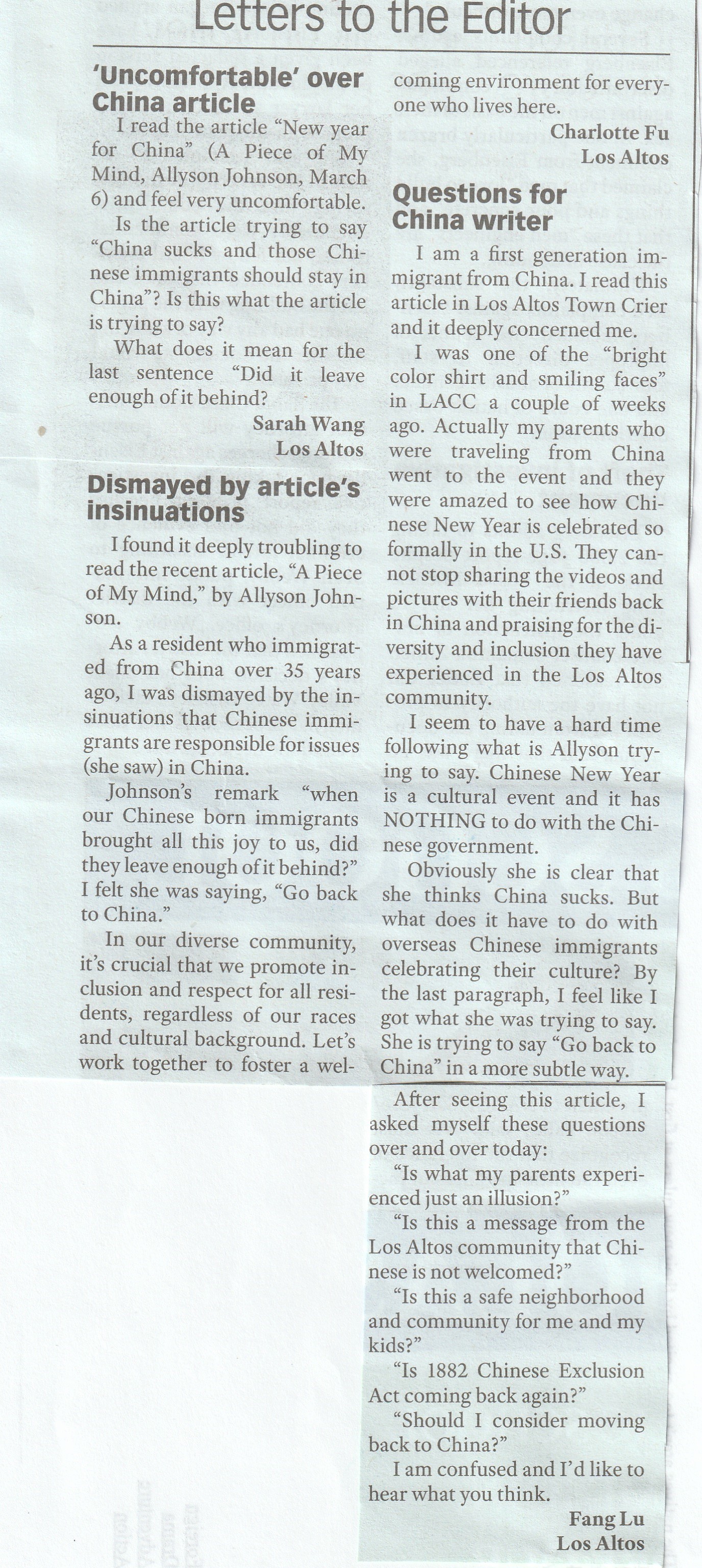
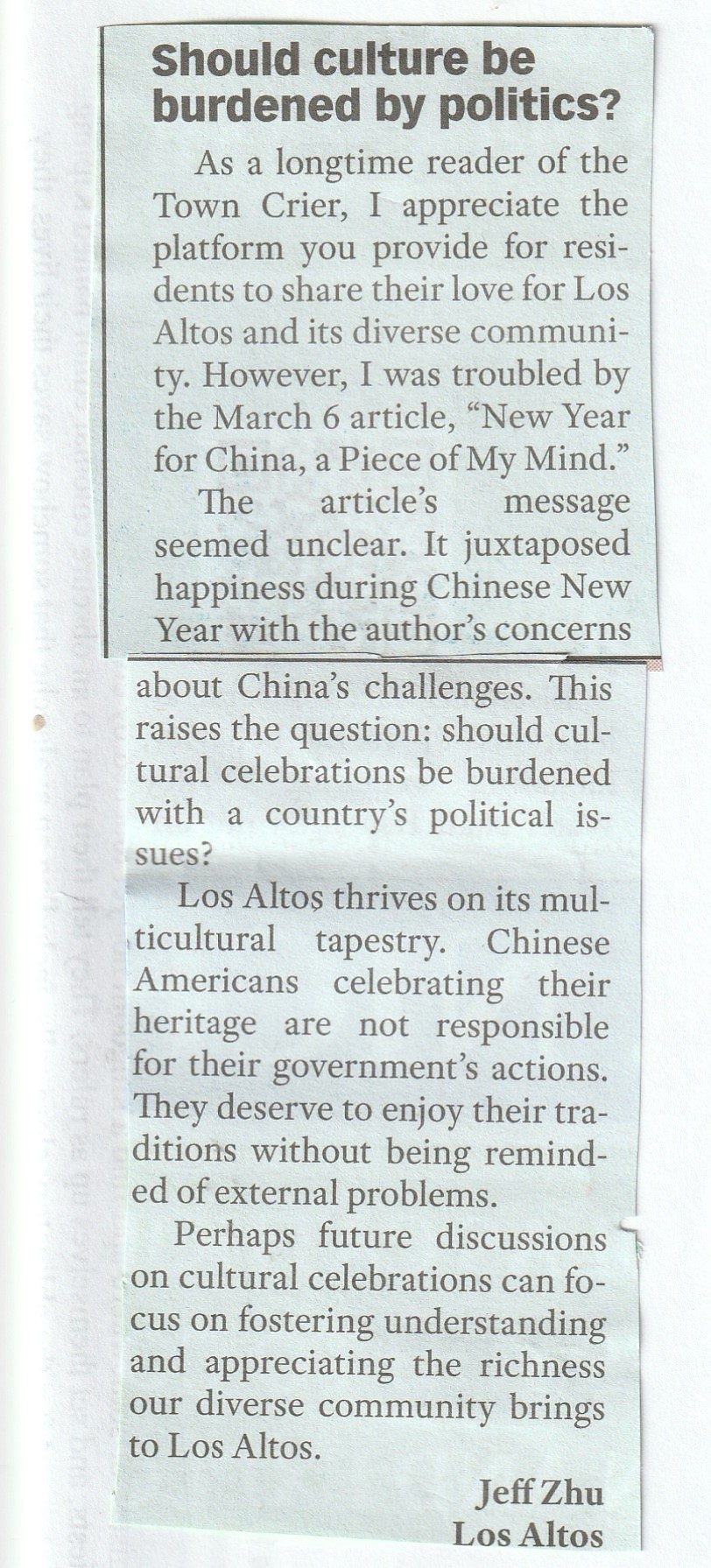
Here are the letters that came in.
And here was my published response :
Was my original writing really that muddled? Perhaps some readers had earlier bad experiences of Sinophobia, which made them sensitive to possible slights, implications, and innuendoes.
My granddaughter, as a toddler, was knocked over by an unleashed dog, and has been afraid of dogs ever since. Not unreasonable. But, I hope, overcomeable. No one should have to live on the alert for danger.
When I was a girl in East Texas, I took swim lessons in the public pool from a Red Cross instructor. I was a good floater and treader of water, due to my persistent baby fat, but flailed desperately to swim across the pool just once in order to earn my Beginner badge. There were plenty of other flailers in the pool, though. Swimming was just something you did to cool off in the summer.
Then we moved to Los Altos, which at that time was a fairly new middle-class suburb. The lots were no larger than what I had known in East Texas, the houses no more spacious, but there was one key difference. Of our six closest neighbors, four had swimming pools.
On my first day at school, I marveled at the tanned students with hair tinged green from chlorine. New friends casually mentioned how they dove into their pool each morning before breakfast and did a few laps just to wake up. The school had a swimming pool. And swimming was a regular part of gym class.
In Texas, football had been the sport which determined who was Campus King. In Los Altos, it was swimming. I had not known that swimming could be a competitive event. I had never heard of water polo. But here was LIFE magazine coming to campus to do a feature about our student body President, Steve Clark, who for a brief time was known as “the world’s fastest swimmer” due to his record-breaking 100-meter freestyle times. The president of the LAHS California Scholarship Federation was also the goalie on the US Olympic water polo team. The LAHS swim team under coach Nort Thornton broke 13 national records out of 20. Thornton went on to coach Cal to two National Championships and is in the International Swimming Hall of Fame.
This all came back to me as I read of the abrupt closure in January of the George Haines International Swim Center in Santa Clara. The ISC opened during the golden age of Bay Area swimming. Though Los Altos High School ceased its prominence in the swim world when Thornton left for Foothill College and then Cal, the school continued to produce Olympians who swam at the ISC. Steve Clark trained there under George Haines for the 1964 Oympics, and won a gold medal. I was most recently at the ISC for a benefit for the US Olympic synchronized swimming team, which won a bronze medal in Greece in 2004,captained by LAHS alumna Lauren McFall.
There are still plenty of swimming pools in my neighborhood, but not as many children. I see plenty of students walking or biking to and from the campus with unusually colored hair, but none with that tell-tale chlorine green. A quick scan of Town Crier articles about high school sports turns up dozens of articles on football, soccer, basketball, and volleyball, but nothing about swimming or water polo. Does the demise of the ISC in Santa Clara reflect a general sag in swimming as a path to glory? Or are there are still students at LAHS who dive into a backyard pool every morning to wake up? I hope that tradition lives on, even if the ISC does not.
I gained a few pounds on my recent vacation, so I opened the cabinet underneath our TV monitor, found my VCR tape of “Jane Fonda’s Low Impact Workout” and thrust it into my VCR. (I have a DVD player, but the golden age of video workouts was the VCR age, and I have kept my machine and my video tapes through the era of DVDs and the era of streaming. I know, I might as well say I keep a brontosaurus as a pet.) Thirty-five minutes of constant motion later I finished the last steps of the cooldown, hit STOP on the VCR, and then EJECT.
The tape cartridge came halfway out, then stopped. I pulled. Clearly the tape had not released properly; I could feel it give. I tried to push the tape cartridge back into the machine. No go – there was a barrier. Slowly and carefully I worked the tape cartridge out of the machine. A loop of tape, wrinkled and sagging, but unbroken, dangled from the cartridge. I managed to work the tape back inside where it belonged, crossed fingers, and put the cartridge back into the machine. It worked – a bit blurry, but this time it ejected with no problem. Whew!
Two days later, still angry with my scale, I found “Kathy Smith’s Instant Workout” and plopped that cartridge into the VCR. At first the tape was streaky and jittery, but then it cleared up. Forty minutes of toning and low impact aerobics later I hit STOP, then EJECT.
Again, the tape cartridge came halfway out, then stopped. I pulled. Again the tape had not released properly; I could feel it give. Slowly and carefully I worked the tape cartridge out of the machine. This time, the dangling tape was broken. No more “Instant Workout.”
In anticipation of the worst, I inventoried my VCR collection: Several favorite Jane Fonda workouts (which I used to have to hide from my Viet vet brother), several Kathy Smith workouts (longer and more strenuous than Jane’s), several little-used yoga tapes from my yoga period (I was more flexible then),a couple of old movies, some souvenir video tapes from the Lick Observatory, from the National Park Conservancy, from a cruise that we ended up not taking, the stirring“16 Days of Glory” from the 1984 Los Angeles Olympics,– all forgettable or replaceable.
But then there are the recordings. The tape of coverage of 9-11 as it happened, which we replay every September lest we forget. My son’s extra credit project from high school. My son’s appearance on local TV as a burrito expert. A performance put on by our church of “Amahl and the Night Visitors” in which my husband had a singing role. The funeral of an old family friend. My parents on vacation with friends from their childhood. These could not be replaced or updated via Amazon.
The next day I decided I would say goodbye to each tape by playing it one last time, resigned to its breaking on ejection. I danced through Jane Fonda’s “Lean Routine”, rewound and ejected with no problems! Maybe the dinosaur has a few more ages to live through after all! But an attempt that evening to watch a travel video failed – lots of snags, black screens, interruptions. Not dead yet, but in its death throes, I decided. There are services which, for a ruinous charge, will transfer my irreplaceable memories to DVD. I will have replaced my brontosaurus with a wooly mammoth, but my memories may last until the next Ice Age.
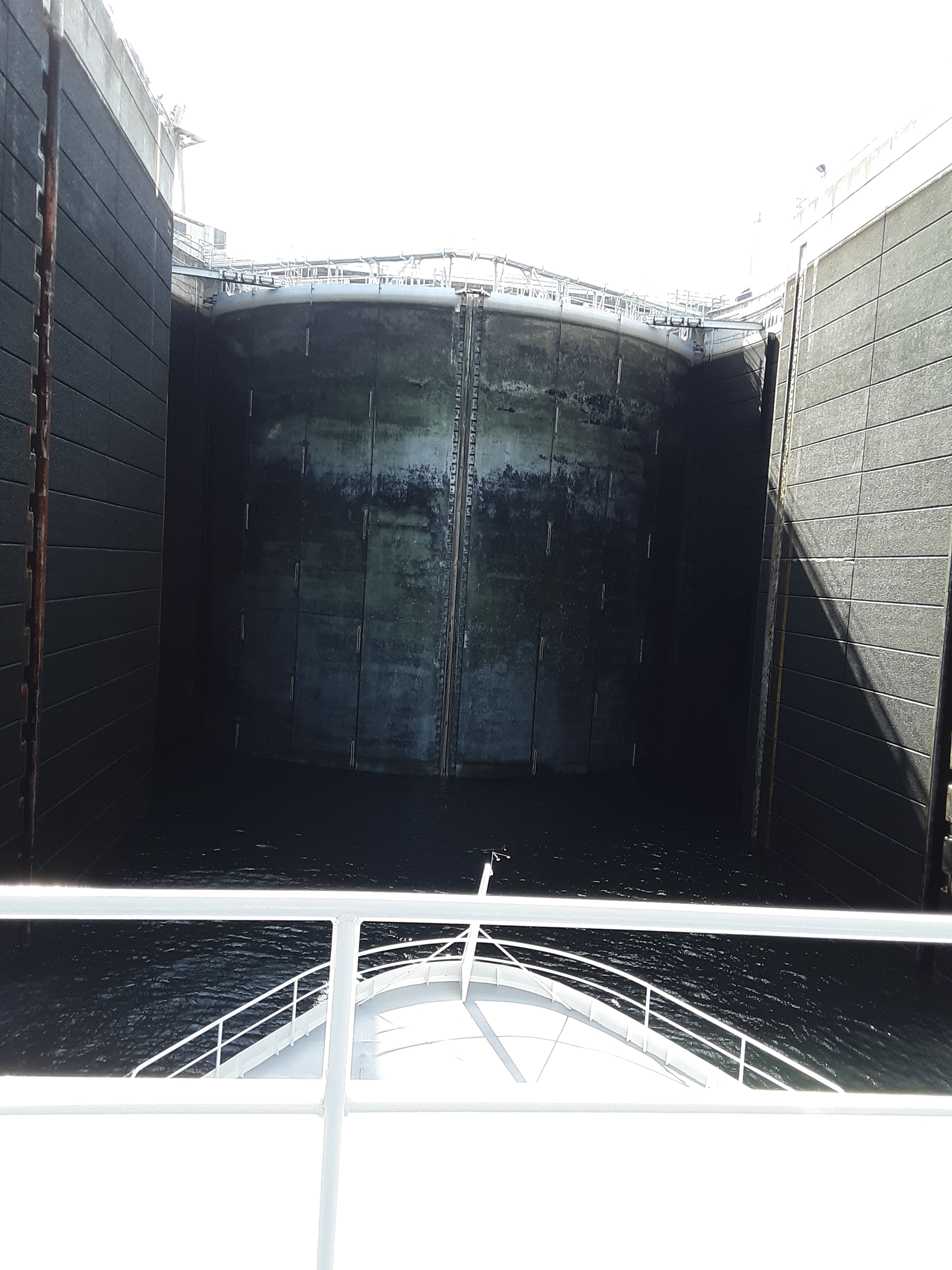
Our boat goes through our first lock – 80 feet or more down from one level of the Snake to the next. We move into the lock; a bridge is before us, an open space behind. Then a wall seems to rise from beneath the river behind us as the water level in the lock is let out and we begin to descend. The walls rise, only two feet from the boat on either side. The bridge before us is now far above, with a large and getting ever higher curving wall ahead. We descend and descend. The black wall behind us is holding back the river, though it appears there are leaks. The black wall ahead is now 80 feet high. On the side are dripping black concrete blocks a yard high piled up and up. Finally we stop descending. We wait. There is a loud shudder, and a crack appears in the wall ahead. Sunlight, and color, a view of hills and sparkling water. The crack opens wider – the feeling is like the scene in “The Wizard of Oz” where Dorothy steps out of the sepia-toned world of Kansas into a technicolor Oz. The engines throb and we move forward into the light and space.
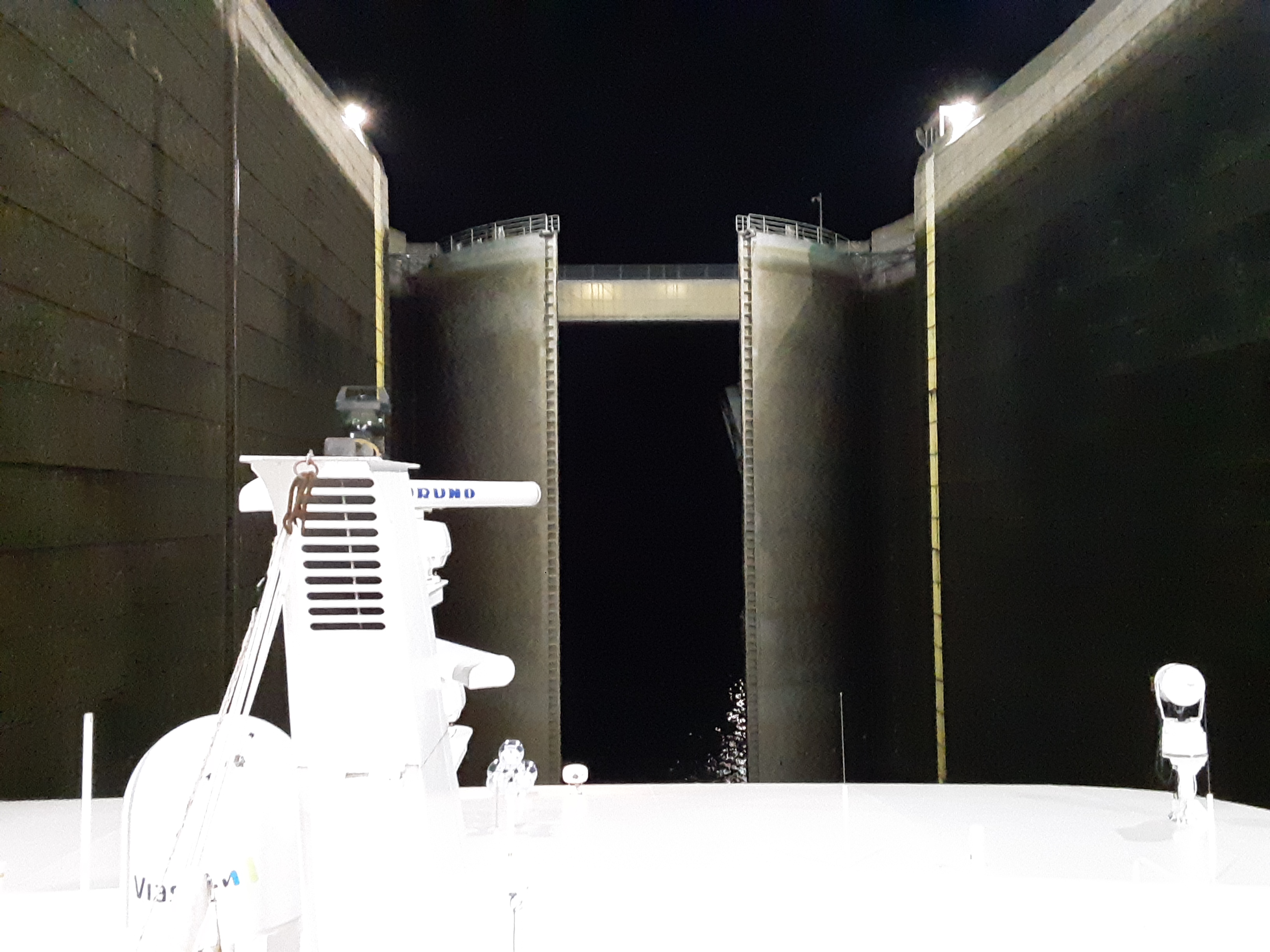
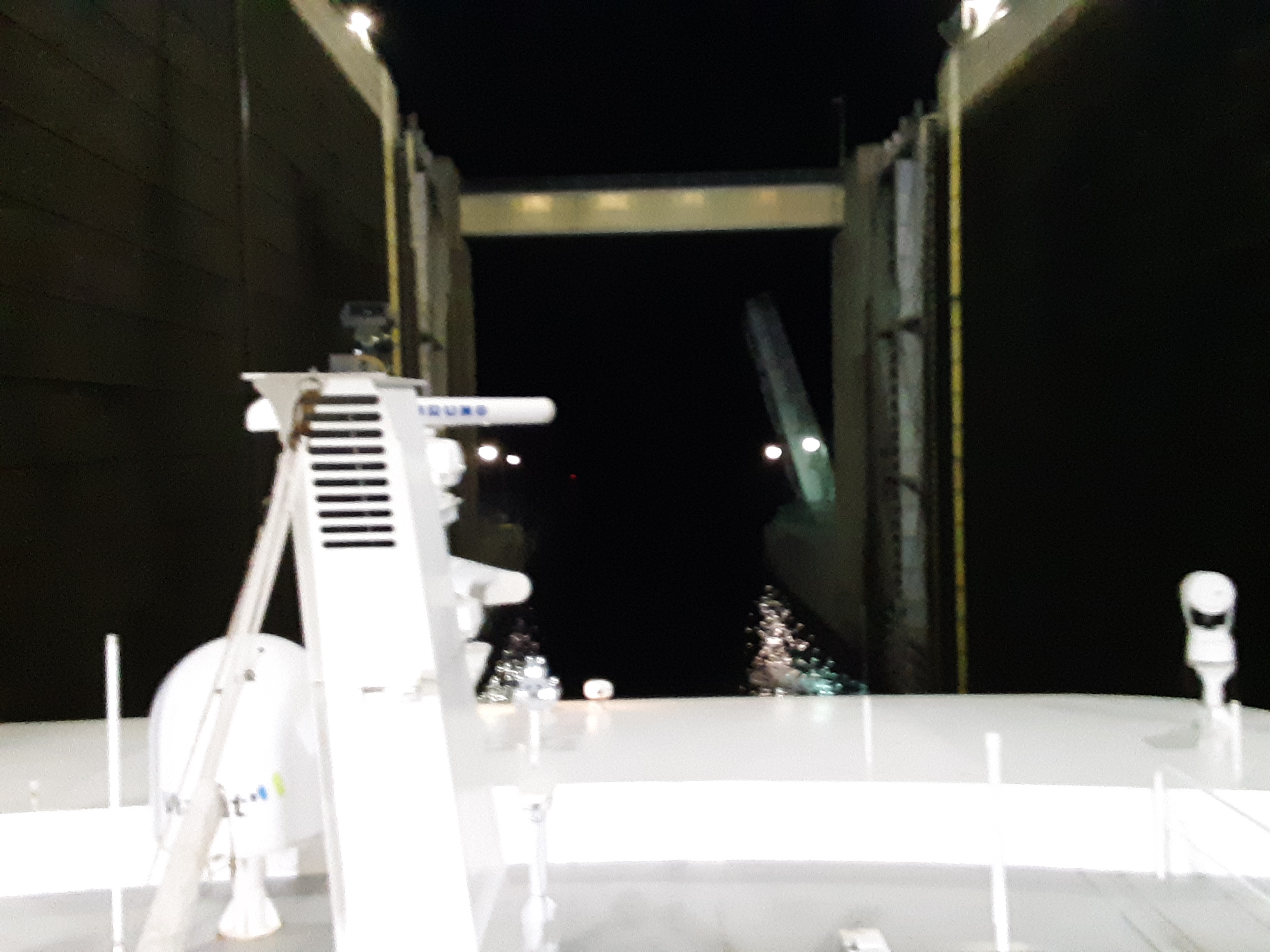
We go through a second lock at night – it is still magical. There is only black and white, the white boat, the black night, the gleaming gate, the sparkling water.
Later we explored off the boat at the Bonneville Dam, whose Visitor Center is a self-congratulatory celebration of the transformation of the wild rolling Columbia river into “a damn fine machine” for generating hydropower, in the words of an industry lobbyist.*
We saw another aspect of the locks and dams at the fish hatchery, where tiny salmon fry are nurtured until they are large enough to release downstream from the dams and make their way to the sea, and at the fish ladder, where returning salmon are given a chance to circumvent the dam in a series of cascades. These makeshift replacements of natural features are an attempt to appease the fishermen and native peoples whose lives depend on the salmon run. In another section of the hatchery, a bit off the self-guided tour, the sight of frustrated salmon leaping in vain against a current backed by a three-foot fence made me sad. In the hatchery these fish are artificially milked for their semen or eggs before dying, so the salmon fry can be created. The salmon would die anyway after spawning, but as they frantically jumped over and over against the impassable barrier, theyseemed to know they are supposed to get further to their spawning grounds than a hatchery.
===
*Quoted from Blaine Harden’s A River Lost; the Life and Death of the Columbia
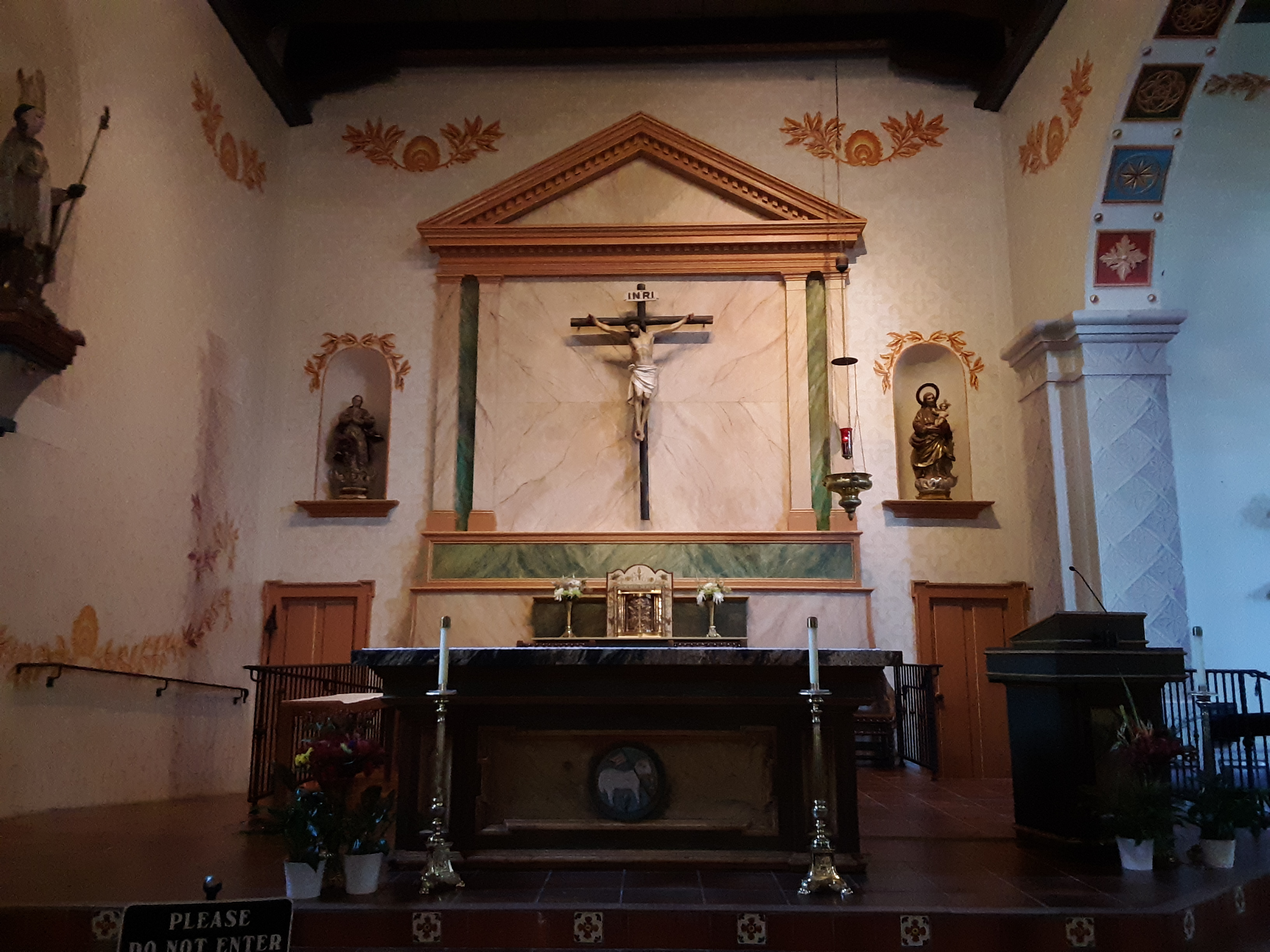
This morning we went to downtown San Luis Obispo, magically stripped of its food stalls, produce, and acrobats from last night’s farmer’s market, and checked out the mission – lovely, quiet, full of apologetic acknowledgement of the mistreatment of Indigenous People’s. We left W, who had seen plenty of missions, outside on a bench by the creek, and returned to find her having befriended Adrian, a very well-spoken and tidy vagrant who welcomed us all to SLO.
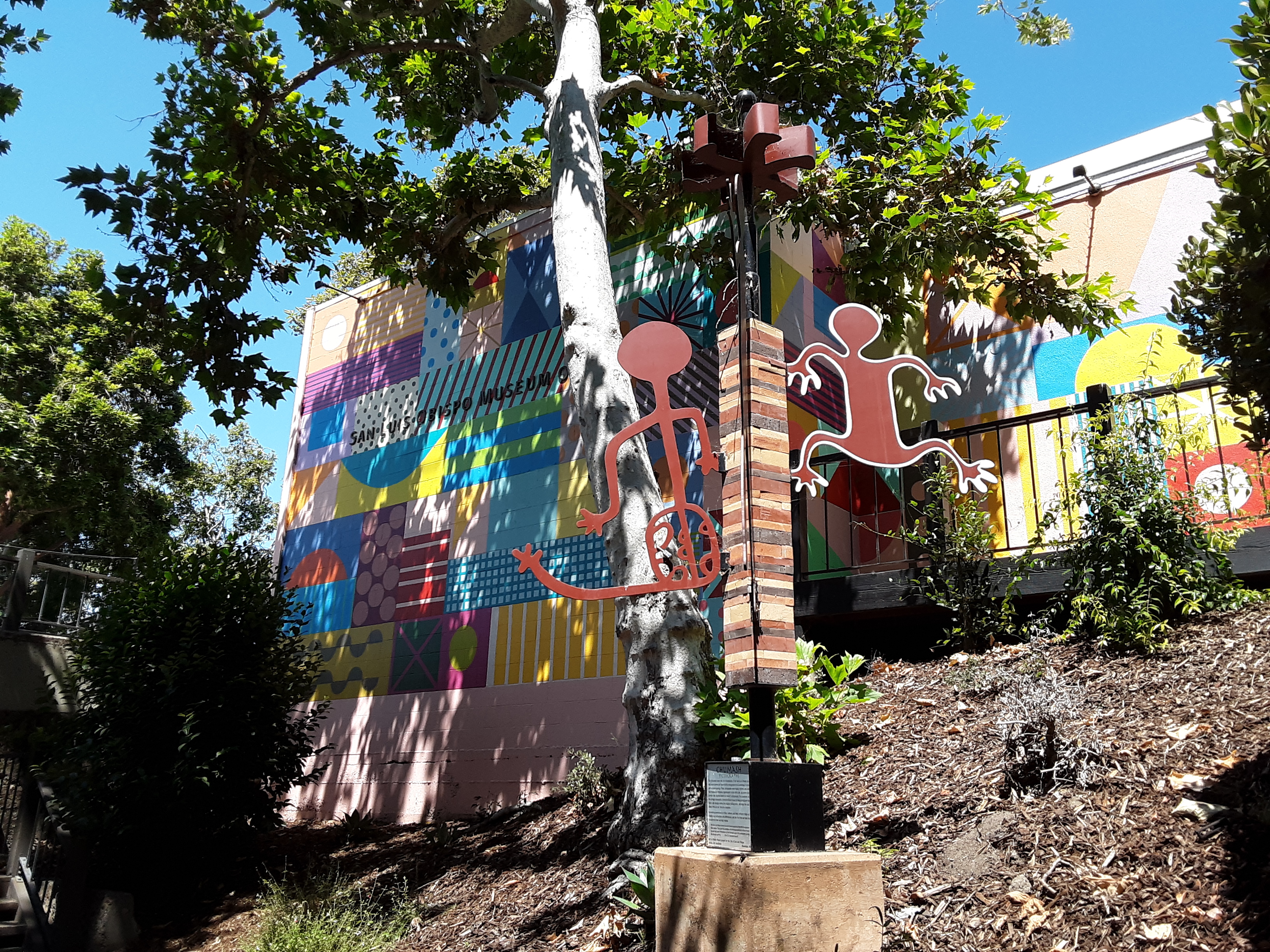
We wandered along thecreek to the SLO Art museum, a very small but attractive venue with three local artists exhibiting (loved Anila Agha’s India-inspired lanterns), plus a colorful abstract mural which wrapped completely around the outside of the museum.
On our way back to the car we couldn’t pass up the old Carnegie Library, now the home of the SLO History Museum. The exhibits and the docent who talked about them were unexpectedly fascinating – I had to go out for extra time on our (very expensive) parking meter. The docent was a Viet Nam vet who knew a lot about the Dust Bowl and the Japanese internment, and is doing research on WR Hearst. He explained and enhanced a lot about the old photos which were displayed, and recommended The Habit for a light hamburger lunch just a block away.
The Habit is a fast food place a cut or several above McDonalds – I had a fancy burger with mushrooms and garlic aioli and tempura string beans instead of fries for about $12 including tax. The most unusual aspect is the ordering, all done at touch-screen kiosks at the front of the store, with a buzz to your cell phone when your order is ready.
When we left the mission in the morning, we had seen people setting up already for the free Friday concert in the Plaza in the evening. (People were already reserving their spaces at 11AM). We thought about attending, but decided instead to reserve a riverside table at Novo just down San Luis Obispo Creek from the mission and the Plaza.
Our dinner at Novo was a triumph – all participants raised a toast to D for having suggested and reserved the place. We were outside next to the creek, but far enough down the creek and across so that the noise of “The Molly Ringwald Experience” rock band going in in the Plaza was just incidental background noise.
We feasted on four appetizer plates: calamari with 2 kinds of sauce, roasted Brussels sprouts, warm Chèvre (goat cheese) with olives and sourdough toast, and minced chicken in lettuce cups. We finished off with a shared chocolate decadence fudge thing, all deliciously accompanied by a generous pour of the house Merlot.
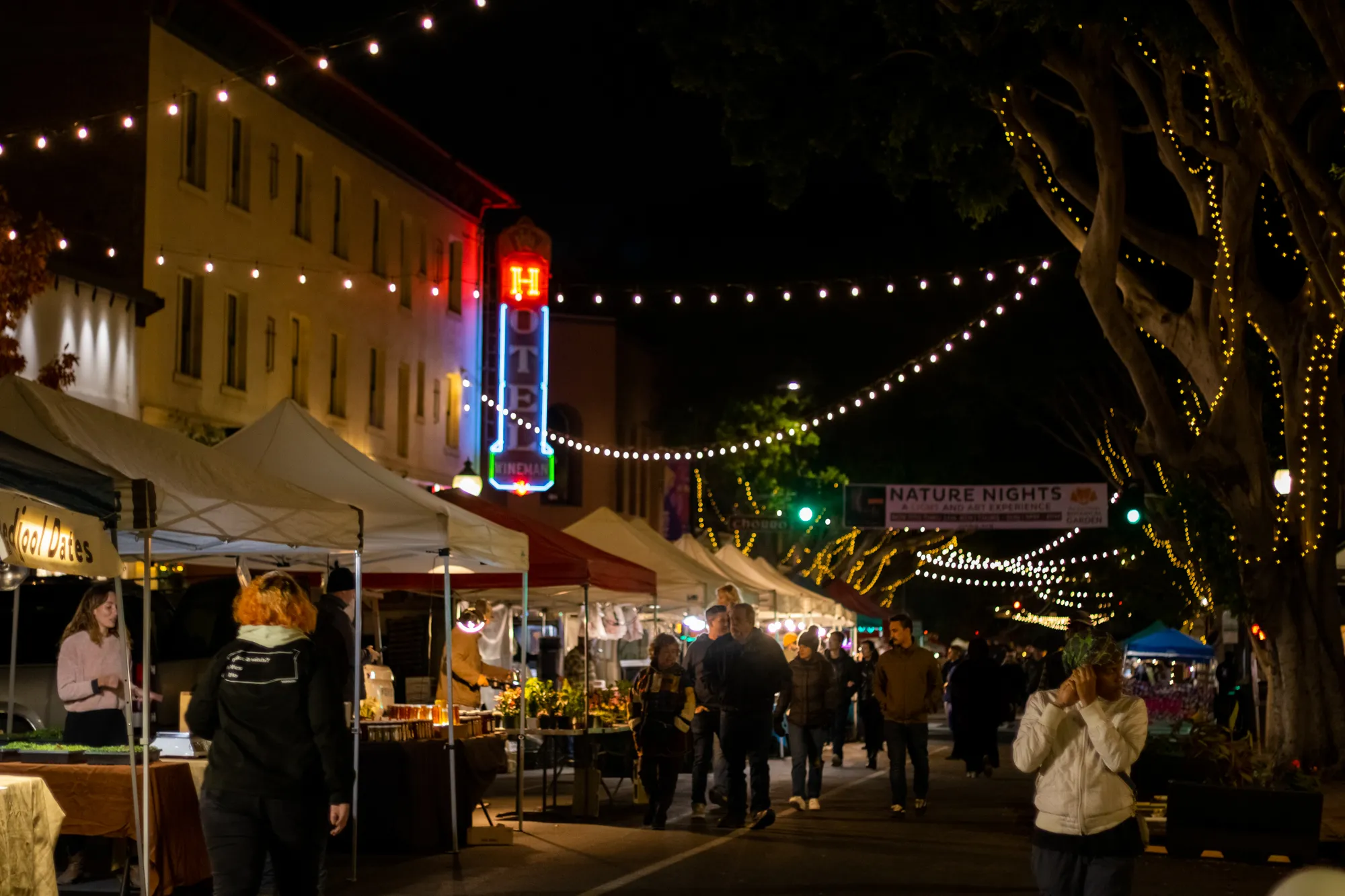
The San Luis Obispo “Farmers market” is justly famous, but not for farming. I put the quotes because the actual produce-vending section occupies maybe two blocks, while the food stalls, real estate booths, craft booths, and beer dispensers made up at least five. You might also see a balloon guy with balloons that light up in rainbow colors, an acrobat who climbs a pole held steady by four volunteers and does gymnastics thirty feet up in the air, a group of rock performers who alternate on instrument playing and K-pop style dancing, or a dancing dread-locked saxaphonist.
The market is held every Thursday evening beginning at 6PM on SLO’s main street, Higueroa Street, which is decked in lights and lanterns and shut down to all but foot traffic. In summer, long-lasting daylight allows you to appreciate the beauty of the produce and see the performers more clearly, but there is something magical about lantern-light and sparkly garlands which will lure you to spend more time after dark.
The food-stall section offers a huge variety of walk-away food, as many of the local restaurants set up food stands and offer sample platters of their standard menu items. W and I shared a couple of platters of Indian food from the Shalimar restaurant, with mango lassi as drink/dessert, while C wolfed her way through a plate of large juicy beef BBQ ribs. Roasted corn on the cob, churros, tacos, gyros, hummus. BBQ chicken, varieties of satay,, ramen, and chowmein, ice cream, crepes, and many other exotic, vegan, and other choices were available.
W sat and people-watched (lots of summery swirly dresses, bare midriffs, ripped jeans… SLO is a college town, after all) while Cindy and I explored up and down the blocks. Market closed down at 9 and so did we, making it back to our hotel by 9:30 and everyone well-fed and snug in bed by 10.
One word of warning: Parking in downtown SLO is expensive ($4/hour) and hard to come by on Market Night. I let W and C off a block from Higueroa and drove five blocks in the other direction before I found a parking place (at least it was beyond the range of the parking meters). Make sure to take note of where you park, and have a phone with a flashlight for your return, as the street lights of SLO are also few and far between once you are off the main drag.
The San Jose Mercury-News had a featured op-ed on the opinion page about “the unprecedented economic costs of COVID-19.” The article cited an estimate from “our team of economists, public policy researchers, and other experts” of over $14 trillion lost due primarily to workplace absences and lost sales. But authors Jakub Hlavka and Adam Rose noted that “we didn’t estimate a vast array of indirect costs, such as … mental health effects on the population and the learning loss experienced by students.”
Already, graphs and charts show economies bouncing back, workers returning to unused offices, or the offices being repurposed. What can’t be measured, as Hlavka and Rose admitted, is the collateral damage to families and communities, and what can’t be predicted is the length of time required to truly heal.
I know a young woman who was a junior in college when COVID hit. Lockdown forced her into an unrelenting intimacy with her roommates which ended in hard feelings and frayed friendships. No internships or jobs materialized in the long locked-down summer. To save money in her senior year, since all classes were being held remotely, she lived with her father and stepmother. Again, the stress of too much proximity led to an argument, an explosion, things said that were hard to forgive, and now the daughter has been estranged from that part of her family for over two years.
I know a young man who was a high school senior taking advanced classes. Lockdown in the spring quarter of his senior year meant none of the traditional rites of passage happened: no Senior Sneak Day, no Senior Prom, no Yearbook signing, no Grad Night. He decided to take a gap year rather than spend his freshman year (and tuition) on Zoom classes. He did not make good use of the gap year, and when he started at an excellent private college he was out of the habit of attending to class schedules, dorm rules, and course requirements. He has narrowly avoided expulsion, and after turning over and spoiling a number of new leafs, hopes to start again this fall in a local public university.
Younger children, also, have been affected in hard-to-measure ways. A pre-kindergartener I know was outgoing and self-confident about meeting new people, but during lockdown she saw almost no-one except her parents. An extended trip before starting kindergarten didn’t provide much more opportunity for interaction with strangers without her parents beside her. Now in kindergarten, she is doing well in classes, but any disruption to her normal after-school and bedtime rituals may bring on a meltdown. She has never been put to bed by anyone but Mommy or Daddy that she can remember, and she’s not ready to start now.
Multiply these examples by hundreds and thousands. Then try to measure the disappointment, pain and anxiety that has been caused by COVID-19’s social disruption. How many tears add up to a dollar?
=====
My debut novel, Fox Spirit, is published in twice – weekly episodes on ajmccready.wordpress.com. It’s not too late to catch up! – here’s the link to the first episode: February | 2023 | Chinese Puzzle Box (wordpress.com)