What I’ve Been Reading: Triple Trouble/ The Hate U Give
Triple Trouble/The Hate U Give
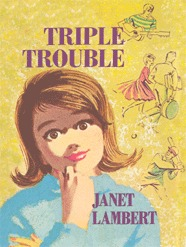
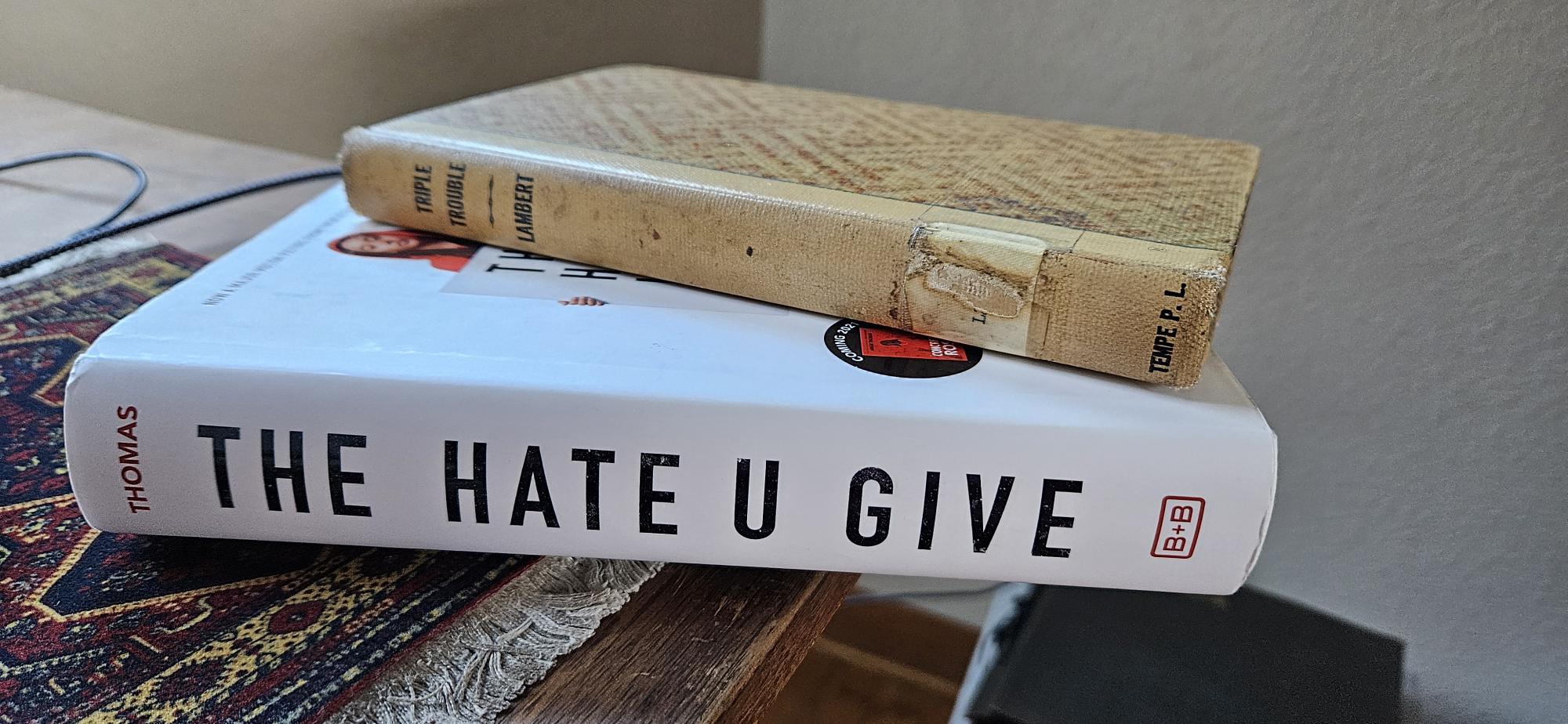
My eyes lit on a battered discarded library book in one of the neighborhood Little Free Libraries. “Triple Trouble – Lambert” in black capitals on the spine. Could it be? Yes it was – written by Janet Lambert, the queen of Young Adult fiction in the 50’s, and part of a series that somehow I had never read. (Ah, the publication date was 1965 – I had grown out of the Teenage section of the library by then.) I took the book home, and settled down into a time warp.
Cinda Hollister, the seventeen year old protagonist of “Triple Trouble” lives in a house with a library and a Persian rug and hardwood floors and columns on the front porch and a balcony and a broad slope of lawn and a basement with a rec room. Her oldest brother is at Princeton, the second is into sports at a the University of Michigan and coaches Little League, and she also has a fourteen-year-old “terror” of a little brother and a quiet little sister. The house isn’t air-conditioned, but they can cool off at the club pool. They have a cottage at the shore but rent it out for part of the summer.
So what is the Triple Trouble? Will the oldest brother drop out of Princeton to marry his girlfriend? Will the second brother drop out of college to accept a contract with a pro baseball team? Will Cinda be taken in by the artsy poet who fascinates her or will she stick with her white-bread suburban high school boyfriend? At the end, Cinda says ““You know, [Mom], this has been quite a summer…. But you weathered it in fine style. And because you stood by and kept your good sense of values, we all did.”
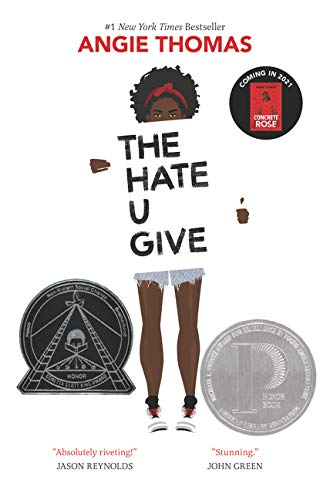
By chance, at home I had just begun to read a different Young Adult book, “The Hate U Give” by Angie Thomas, published in 2017. Starr Carter, the 16-year-old protagonist, lives in a black neighborhood of Los Angeles with her father, an ex-con who runs a grocery store, her mother, a nurse, and off-and-on her half-brother, who stays with his father when the man his mother lives with gets violent. The language is graphic, and the action is violent.
Starr has already seen her childhood friend Natasha killed in a drive-by shooting, and early on in “The Hate U Give” she is the passenger in a car which is pulled over by a white policeman who with little provocation shoots the driver, Starr’s close friend) in the back. The rest of the book deals with Starr’s wrestling with her nightmares, the media, the legal system, and the different demands of her friends and family.
Lambert writes of a world that could pass as a MAGA fantasy, while Thomas writes of a reality nearly as dystopian as “the Hunger Games.” Oddly, though, they both end in the same place – the importance of family, community, and values.
I grew up in a suburban bubble not very different from the one in “Triple Trouble” and felt very much at home in Janet Lambert’s world. I’m sorry that today’s Young Adult readers face a much grittier reality than I had to, but glad that the fundamentals underlying what they are reading about seem to endure.
























 Allyson Johnson