Artificial Intelligence – a Cosmic Joke?
The media is full of information and speculation about AI – Artificial Intelligence. Will it supplant human intelligence? Will robots become sentient? Will humans become obsolete, or at best slaves to their robot superiors?
Most of this speculation is poppycock, fueled by a misnomer. AI as we see it in operation does not involve intelligence at all. AI is a form of search technology that, in response to a request, can search through gazillions of online data points, accumulate the ones which seem relevant, and serve them up either as an undigested mass of trivial and not-so trivial information or a digested mass of pablum which reflects only the most common points made about the subject.
At best, AI is a tool which can facilitate research by searching online texts, posts, and scanned media for keywords. But it cannot judge which of the texts, posts or other media are most relevant to the question. It cannot judge whether a given text is fact or fantasy. For that you need a human interpreter.
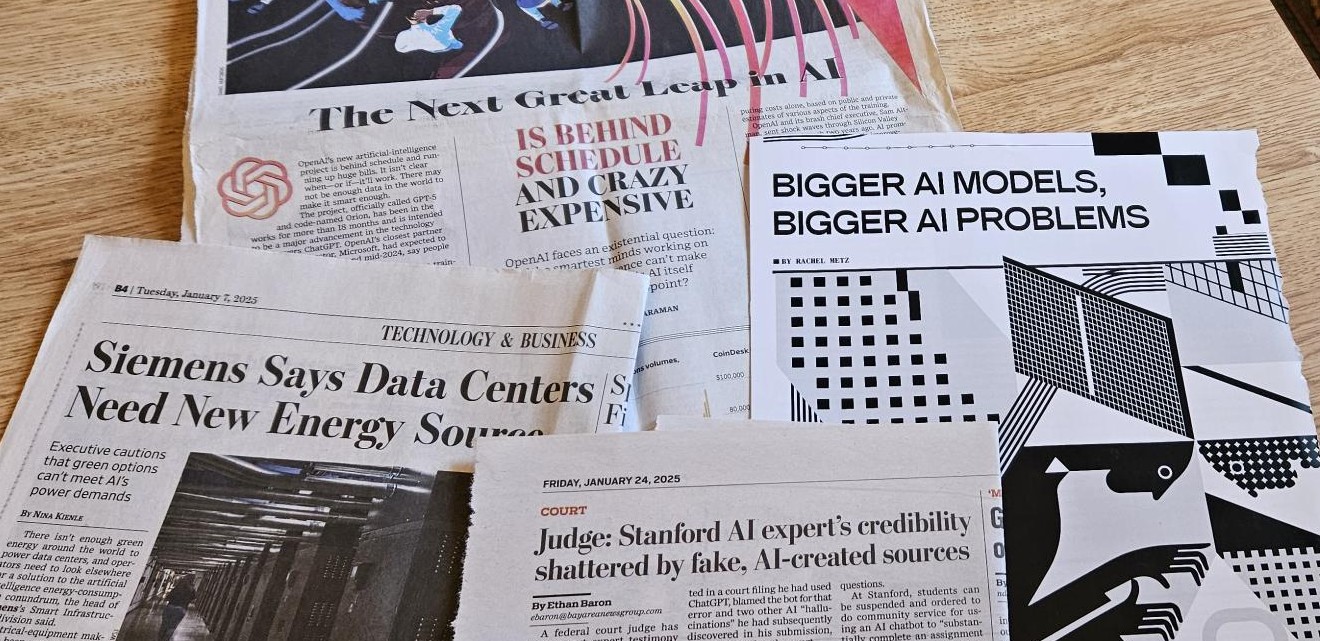
“Generative” AI can take the results of its research and, based on its scans of human writings, deliver it in the form of an essay or article. But in aping human writing, it may slide over gaps in its story by inventing plausible-sounding text to fill in the gap. Even AI experts can be taken in, as was Stanford professor Jeff Hancock, who was called as an expert witness in a case involving AI-generated “deep fake” photos. Hancock used OpenAI’s ChatGPT to find and summarize articles on how AI can generate misinformation, and failed to notice that the software had inserted non-existent sources in spots where Hancock had noted “needs citation” in his request. [San Jose Mercury News, Dec 4 2024] His testimony was thrown out.
I’ve begun to see generative AI’s pre-digested paragraphs popping up in unwelcome places. Google search now often delivers an AI-generated paragraph in answer to such questions as “How often should I water my orchids?” and Microsoft’s CoPilot offers to summarize my incoming emails. But these paragraphs have no flavor or nuance, no detail or backup or discussion of possible exceptions.
Google has realized that the more web content is generated by AI rather than humans, the less reliable and interesting that content is going to be. Further, the more people rely on these AI-generated summaries, the less they will scroll down to the sponsored links which generate Google’s revenue. Melissa Schilling, professor of management at New York University’s Stern School of Business, has said “AI is to search what e-commerce was to Walmart.”
If the degradation of the Internet were the only adverse side effect of AI’s rise, we would have enough to worry about. But AI is not just an attention-getting device. It is a terribly hungry and expensive device. According to Deepa Seetharaman writing in the Wall Street Journal [Dec 21, 2024, p. B1],” a six-month training run for a new AI product can cost around half a billion dollars in computing costs alone.” The data centers which provide the computing power that AI needs to run require hefty amounts of energy, water for cooling, and land to build on. Already some cities such as Atlanta are pushing back against the takeover of greenspace in its suburbs by proliferating data centers. [WSJ Dec 28, 2024]
Our civilization is already struggling with climate change. We are trying desperately to cut back on the use of fossil fuels. We urge water conservation to stop the desertification of open land due to the deterioration of underground aquifers and diversion of surface water for agriculture and industry. But the energy requirements of the expanding AI industry will gobble up all the gains we have made in this area and demand still more energy to fuel its growth. Already the energy requirements of AI are equal to the energy used by the Netherlands. [CITE?]
Is AI a kind of cosmic joke? Just at the time when we need most to conserve water and energy, the Universe dangles this glittering toy in front of our innovation-hungry eyes. Humanity has a poor record of resisting temptation. Will we be able to resist this time?


 Allyson Johnson